
Two days after we called Slovenia the last real question on Polymarket’s Eurovision 2027 board, the market answered it. Read on 8 October 2026, Slovenia has fallen from 45% to 23.5% — the biggest two-day move the board has produced since Iceland’s collapse. Italy, which we told you to ignore at 81%, has rebounded to 94.05%. And the one genuine piece of 2027 news in that window, Czechia’s withdrawal, has no contract on this board at all.

18+ | New customers only | T&Cs apply | Please gamble responsibly
Illustration: an arena with most of its seats unlit. Generated image — no act, venue or person depicted.
Key takeaways
- Slovenia −21.5 points in 48 hours, from a coin flip to a two-in-nine shot, with nothing published by RTVSLO.
- Italy +12.8 points on about $26 of new volume. We flagged its 81% as noise rather than information on 6 October; it has now round-tripped almost all the way back.
- Iceland is drifting the other way — 12% to 20.5% — as the gap between a board recommendation and a management decision stays open.
- Ireland is now the shortest contract on the board at 3.3%, below Spain.
- Czechia withdrew on 6 October and the board cannot express it. There is no Czechia contract, so the week’s only confirmed withdrawal is untradeable.
- The real deadline is 7 December, the EBU’s extended application cut-off, and it is the only scheduled event that can settle most of these contracts.
What’s on this page
The 48-hour move table · Slovenia, and what it is pricing · Italy: we said noise, and it was noise · Iceland drifting back · The news the board cannot trade · Where the money actually is · Reading fourteen independent contracts · 7 December
The 48-hour move table
Both columns are our own reads of Polymarket’s public Gamma API: 6 October at 03:46 UTC and 8 October at 04:51 UTC. Nothing here is a bookmaker price and there is no overround to strip out — on Polymarket a price reads directly as a probability.
| Country | 6 Oct | 8 Oct | Move | Volume added |
|---|---|---|---|---|
| Italy | 81.25% | 94.05% | +12.80 | ~$26 |
| Iceland | 12.00% | 20.50% | +8.50 | $0 |
| Kazakhstan | 8.00% | 12.90% | +4.90 | ~$20 |
| Belgium | 76.50% | 79.50% | +3.00 | ~$443 |
| Israel | 94.15% | 94.60% | +0.45 | $0 |
| Netherlands | 94.80% | 95.25% | +0.45 | $0 |
| Austria | 92.95% | 93.40% | +0.45 | $0 |
| Moldova | 90.50% | 90.50% | 0.00 | $0 |
| Canada | 96.40% | 96.30% | −0.10 | ~$1 |
| Spain | 6.90% | 6.65% | −0.25 | ~$359 |
| Germany | 95.50% | 95.20% | −0.30 | $0 |
| North Macedonia | 79.75% | 79.15% | −0.60 | ~$435 |
| Ireland | 7.45% | 3.30% | −4.15 | ~$20 |
| Slovenia | 45.00% | 23.50% | −21.50 | ~$140 |
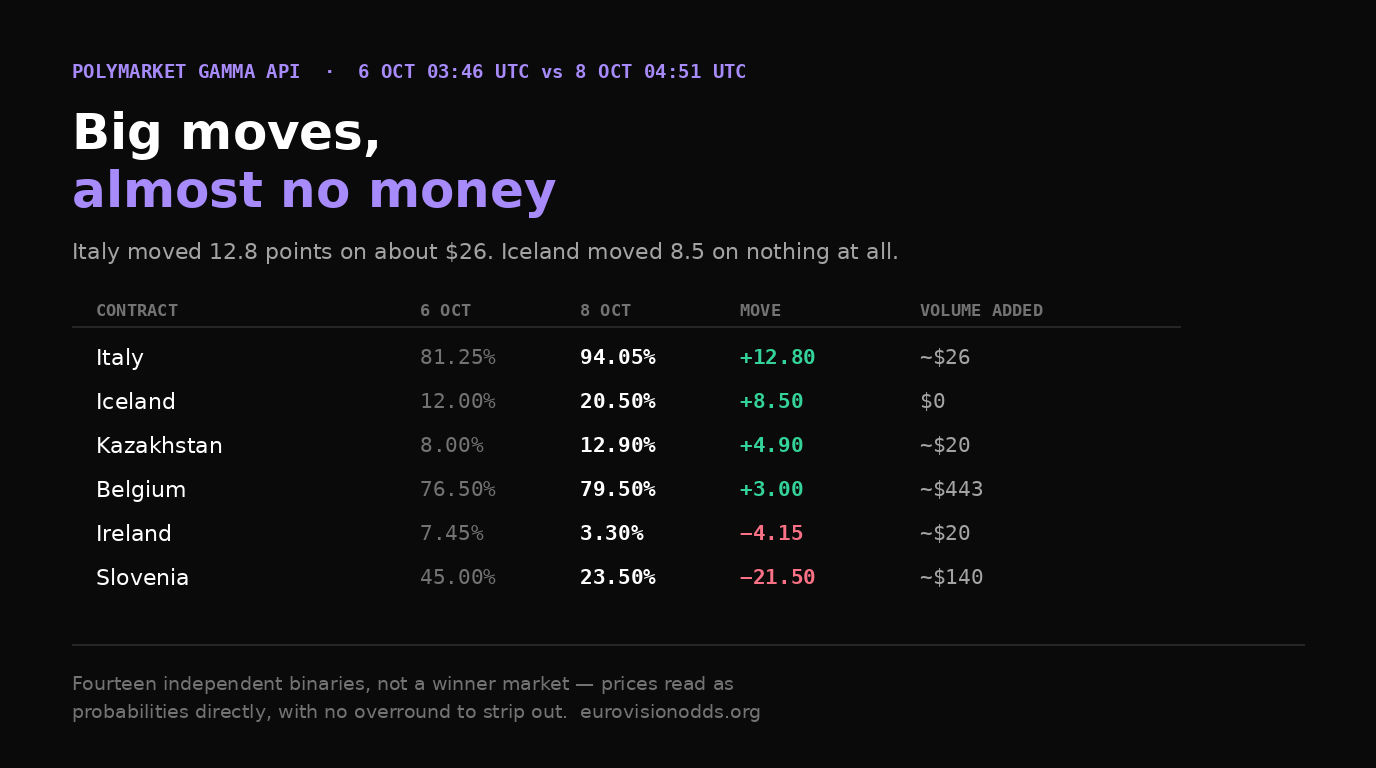
Read the last column before the third. Italy moved nearly thirteen points on roughly $26 of trading, and Iceland moved eight and a half points on nothing at all — its lifetime volume is identical to Monday’s. Those are not repricings in any meaningful sense; they are what a quote does when a book this thin is nudged.
Slovenia, and what it is pricing
On 6 October we wrote that Slovenia at 45% was “the only contract on this board where the market is admitting it does not know”. It is no longer admitting that. At 23.5% the market is now saying RTVSLO stays out of Burgas, and it got there on about $140 of fresh volume against a $2,334 book.
What it is not pricing is a public decision, because there has not been one. RTVSLO has published nothing since our last read. So this is either someone trading ahead of information the rest of us do not have, or it is the same thin-book drift that moved Italy, pointed downhill. Given the volume involved, the second explanation needs less belief than the first.
There is a structural reason to be cautious about short Slovenia prices specifically, and it is the resolution rule we set out in the board’s full write-up: these contracts settle on the first official EBU participant list, and later withdrawals do not change the outcome. A broadcaster that is wavering rather than formally out tends to appear on that first list. Slovenia is the clearest wavering case on the board, which argues its fair value sits above a flat “will they compete” read, not below it.
Italy: we said noise, and it was noise
This is the part where we mark our own homework, because the call was testable and it has been tested.
On 6 October Italy sat at 81.25%, down from 97% in August, and we could find no 2027-specific news behind the slide. What we wrote was: “Italy has $710 of lifetime volume against $1,111 of standing liquidity — more money sitting in the order book than has ever traded through it. A contract like that moves 16 points when one participant decides to take a position… We would treat Italy’s 81% as noise until something confirms it.”
Forty-eight hours later it is at 94.05%, having added about $26 of volume. Nothing was published by RAI in between. The 16-point slide was noise, and so is most of the 12.8-point recovery — the contract has simply drifted back toward where the fundamentals always had it, which is a Big Five broadcaster that publicly backed Israel’s participation and confirmed its own entry.
The general lesson is the one worth keeping: on a board where individual books hold between $41 and $8,175, the volume column is more informative than the price column. A double-digit move on two-figure volume tells you about the order book, not about a broadcaster.
Iceland drifting back
Iceland has gone 12% to 20.5% with zero new volume, which means the quote moved without a trade behind it. The underlying situation is unchanged and genuinely unresolved: six of nine RÚV board members voted on 30 September to stay out of 2027 unless Israel is barred, and the Director General then said on 3 October that participation is decided by management rather than the board.
So the board resolution is a position, not a decision, and the drift from 12% back toward 20% is the market slowly conceding that. We said on 6 October that a 12% contract was “pricing a board recommendation as if it were a decision” and called it the cheapest disagreement on the board. Eight and a half points of that gap has since closed on no news and no trading.
The news the board cannot trade
The single confirmed piece of 2027 participation news in this window is not on the board at all.
Česká televize withdrew Czechia from Eurovision 2027 on 6 October, on cost rather than politics — part of 350 million koruna of savings — and it is not buying the broadcast licence either. That is the fifth country out of 2027 and the third on money alone. Polymarket lists no Czechia contract, so a trader who knew it was coming had no way to express it.
This is the recurring weakness of the board as a forecasting instrument. Its fourteen contracts were chosen in May, around the 2026 boycott story, and the 2027 field has since been reshaped by broadcasters nobody was arguing about: Czechia on cost, BHRT and STVR on money before it. Hungary, whose return is genuinely open and whose EBU deadline is 7 December, has no contract either. The board prices the questions that were interesting five months ago.
Where the money actually is
The event now carries $34,645 of lifetime volume against $11,313 of liquidity, up from $33,200 and $10,941 on Monday. About $1,445 traded across the whole board in two days, and it was not spread evenly.
| Contract | Lifetime volume | Share of board | Read |
|---|---|---|---|
| Netherlands | $8,175 | 23.6% | Settled high; no new money |
| Spain | $6,523 | 18.8% | Settled low; still trading |
| Belgium | $5,961 | 17.2% | The most active contract of the week |
| Canada | $2,958 | 8.5% | Settled high |
| Slovenia | $2,334 | 6.7% | The week’s big mover |
| Israel | $2,232 | 6.4% | Flat all week |
| Kazakhstan | $1,512 | 4.4% | Drifting |
| North Macedonia | $1,466 | 4.2% | Quietly active |
| Ireland | $1,341 | 3.9% | Shortest on the board |
| Italy | $736 | 2.1% | Moved 12.8 points on ~$26 |
| Iceland | $673 | 1.9% | Moved 8.5 points on $0 |
| Germany | $414 | 1.2% | Decorative |
| Austria | $278 | 0.8% | Decorative |
| Moldova | $41 | 0.1% | Not a forecast |
Three contracts — Netherlands, Spain and Belgium — are nearly 60% of everything ever traded here. The four smallest together are under 5%. When the top of the move table and the bottom of the volume table are the same contracts, which is exactly what happened this week, the moves are telling you about depth rather than about broadcasters.
How to read fourteen independent contracts
One difference between this board and the Kalshi market we track for Eurovision Asia is worth stating plainly, because it changes how you read every number above.
Kalshi’s Asia board is a winner market: exactly one of its eleven countries can win, so its prices ought to sum to 100% and the fact that they currently sum to 227% is a defect you have to normalise away before the marks mean anything. Polymarket’s 2027 board is not like that. Its fourteen contracts are independent binaries — every country could appear on the list, or none could. There is no constraint tying them together, so there is nothing to normalise, and a price reads as a probability directly.
That makes this board the more honest instrument of the two, and it is why we are willing to quote its numbers at all. It also means you cannot do the thing people instinctively do with a field market: you cannot infer anything about Slovenia from what Italy did. Their prices are not competing for the same 100%. When Slovenia fell 21.5 points this week and Italy rose 12.8, those were two unrelated events that happened to share a screen.
The practical consequence is that the only aggregate worth watching here is the count. On 6 October, nine contracts sat at 76% or above and four at 12% or below. Today it is nine and three, with Iceland having climbed out of the bottom group and Slovenia having dropped out of the middle. The board is still saying the same thing it said on Monday — a 2027 field thinned by four or five absences, with Israel on the list — and it has simply shuffled which countries fill which block.
7 December
There is one date that can actually settle most of this. The EBU extended its application deadline for the 2027 contest to 7 December 2026, and the participant list is expected at the end of the year. Because these contracts resolve on the first official list, that document is the resolution event for nearly every contract on the board.
Until then, expect more of what this week produced: double-digit swings on two-figure volume, real news that the board has no instrument for, and a handful of deep contracts that barely move. The board is a useful read on the three questions it is actually liquid in, and an unreliable one everywhere else. Our Eurovision 2027 preview tracks the participation board as broadcasters actually confirm it, and the bookmaker guide covers the regulated venues that will price the contest itself once there are entries.
Sources
- Prices, volumes and liquidity read from Polymarket’s Eurovision 2027 Participants event via its public Gamma API at 04:51 UTC on 8 October 2026, against this site’s own read at 03:46 UTC on 6 October 2026.
- Resolution wording quoted from the market’s published rules.
- Eurovoix, 6 October 2026 — Česká televize’s withdrawal.
Prediction-market prices move continuously and every figure here is stamped with the time it was read. Check the live board before acting on any of it. 18+. Markets carry risk.