
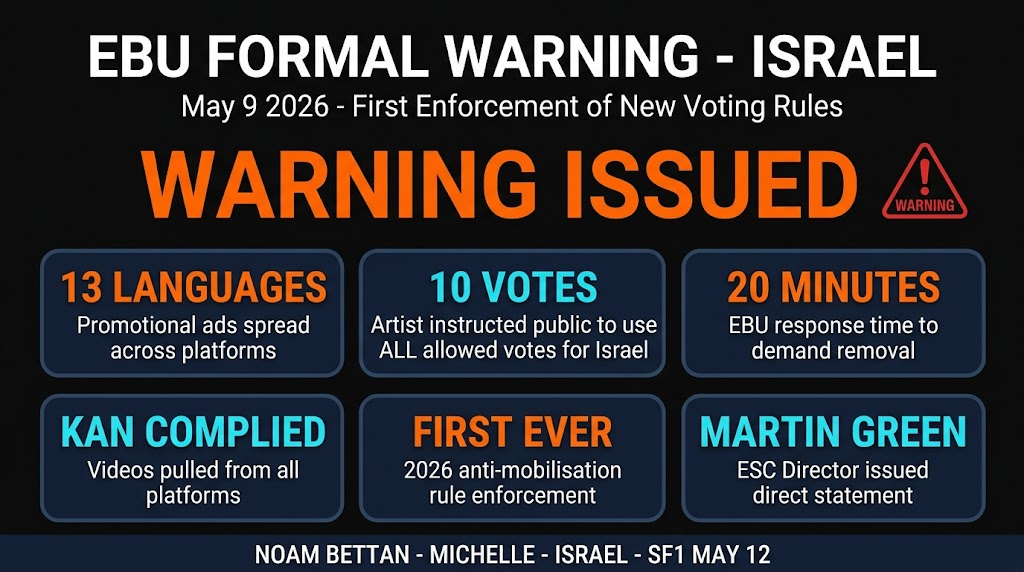
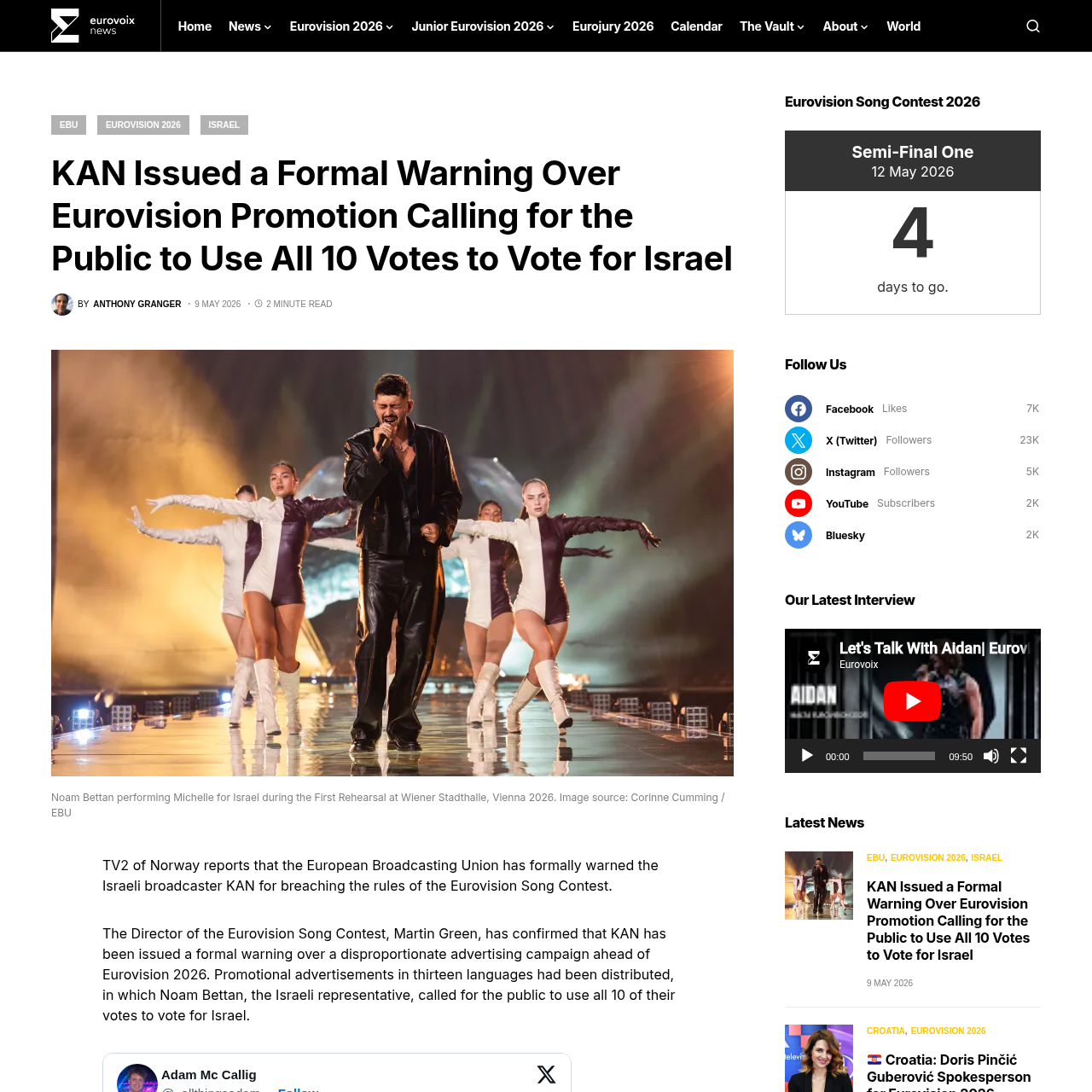
For the first time since the new 2026 anti-mobilisation rules were introduced, the European Broadcasting Union has actually used them. On May 9, 2026, the EBU issued a formal warning to KAN, the Israeli public broadcaster, after Noam Bettan's promotional campaign distributed videos in 13 different languages telling viewers to use all 10 of their available votes on Israel.

18+ | New customers only | T&Cs apply | Please gamble responsibly
The EBU's response was rapid. ESC Director Martin Green confirmed that the broadcaster's delegation was contacted within 20 minutes of the videos surfacing, with an immediate demand to remove every clip from every platform. KAN complied. The damage to Israel's televote-mobilisation strategy is already done.
This matters for one specific reason: Israel's entire 2026 betting case rests on the 33% Polymarket televote winner probability. That number — backed by $6.5 million in real trading volume — was built on the implicit assumption of an organised, multilingual, embassy-supported mobilisation campaign. The new rules just shut that assumption down.
The bookmaker markets haven't fully repriced. The window for sharp Eurovision punters to act is short — perhaps 4 days before SF1's dress rehearsal on May 11 closes the gap. This article is the complete impact analysis with specific recommendations across the affected markets.
Betfred — Bet £10 Get £50 in Free Bets on Eurovision Televote Markets

What Actually Happened — The Timeline
The chain of events on May 9, 2026, played out faster than any previous Eurovision rules enforcement in the contest's history. Here's the documented timeline.
| Time (CET) | Event | Source |
|---|---|---|
| Pre-May 9 | Noam Bettan publishes promotional videos in 13 languages instructing viewers to use 10 votes for Israel | KAN distribution channels |
| ~10:00 May 9 | EBU becomes aware of videos via media monitoring | Martin Green statement |
| ~10:20 May 9 | EBU contacts Israeli delegation, demands immediate removal | Martin Green: "Within 20 minutes" |
| ~10:30 May 9 | KAN compliance — videos pulled from all platforms | KAN statement |
| ~12:00 May 9 | EBU issues formal warning to KAN | TV2 Norway report |
| ~14:00 May 9 | News breaks across European Eurovision press | Eurovoix, Reddit, Wiwibloggs |
Martin Green's exact statement, via TV2 Norway:
"We were made aware that videos instructing people to vote ten times for Israel had been published and released by the artist representing KAN. Within 20 minutes, we had contacted the Israeli delegation and asked them to immediately stop all distribution of the videos and remove them from all platforms where they had been published. They did so… a direct call to use the ten votes you have available on one artist or song is also not in line with our rules or the spirit of the competition. We have sent a formal warning to KAN and will continue to monitor their promotional activities closely and take action if necessary."
KAN's defence statement, also via TV2 Norway:
"The incident in question comes from the artist's own initiative, without any form of illegal funding, and is similar to similar advertising by other artists in the competition. Following the EBU's desire to avoid being asked to vote ten times, the artist has stopped using the videos."
The EBU's position: this is the first enforcement of 2026 rule changes specifically designed to discourage "disproportionate promotion campaigns… particularly when undertaken or supported by third parties, including governments or governmental agencies." Those rules were introduced in December 2025 in direct response to allegations that Israel's 2025 vote campaign — which encouraged ex-pat citizens to use 20 allocated votes — violated the spirit of the contest.
Why This Matters for Israel's Betting Case
Israel's entire Eurovision 2026 betting position is built on an extraordinary asymmetry between jury and televote markets. Here are the numbers as priced before the warning.
| Market | Israel Probability | Polymarket Volume | Position |
|---|---|---|---|
| Jury Winner | 1% | $2.1M | Bottom tier |
| Televote Winner | 33% | $6.5M | 1st (favourite) |
| Overall Winner | 3% | $132.8M | 9th |
| SF1 Qualification | 95% | $1.8M | Lock |
Pre-warning probabilities. Source: Polymarket and Eurovisionworld bookmaker aggregate, captured May 8, 2026.
The 32-percentage-point gap between Israel's jury (1%) and televote (33%) probabilities is the second-largest split in the contest, behind only Australia's 27-point gap in the opposite direction. Every cent of that 33% televote probability assumed organised mobilisation. The 13-language ad campaign was the visible expression of that strategy — and it was just shut down.
How Big Is the Reprice?
Three forces are now operating on Israel's televote probability simultaneously, and they don't all push in the same direction.
Force 1: Constrained Mobilisation (Drag of -5 to -8 Percentage Points)
Without the 13-language campaign and the embassy-supported promotion, Israel's televote ceiling shrinks. Casual European viewers without a Jewish or Israeli connection are less likely to encounter Israel-specific voting instructions. The promotional infrastructure that drove 2025's televote dominance has been visibly stripped.
Historical reference: in 2024, the Israeli embassies in seven European countries actively promoted Eden Golan's entry on social media. Polymarket data later attributed an estimated 4-6 percentage points of Israel's televote share to this promotion. The 2026 warning specifically targets that mechanism.
Force 2: Streisand Effect (Lift of +1 to +3 Percentage Points)
Counter-balancing the constraint: the warning itself generates massive press coverage. Every Eurovision news outlet covered the story within hours. Israeli diaspora communities — especially those motivated by perceived European bias — may now be more determined to vote. The lift is real but smaller than the constraint.
Historical reference: when Russia received negative coverage at Eurovision (pre-2022 ban), the Russian televote share typically jumped 2-3 percentage points in the immediate aftermath of controversy. Diaspora motivation can partially offset rule constraints.
Force 3: Boycott Compounding (Drag of -2 to -4 Percentage Points, Already Priced)
The five boycotting countries — Spain, Ireland, Iceland, Slovenia, the Netherlands — already represent televote markets where Israel cannot earn votes. Their absence was already priced into the 33%. The May 9 warning compounds the structural ceiling that the boycott created. Israel can no longer rely on aggressive cross-border mobilisation in non-boycotting countries to offset the lost markets.
Net Estimated Reprice: -3 to -5 Percentage Points
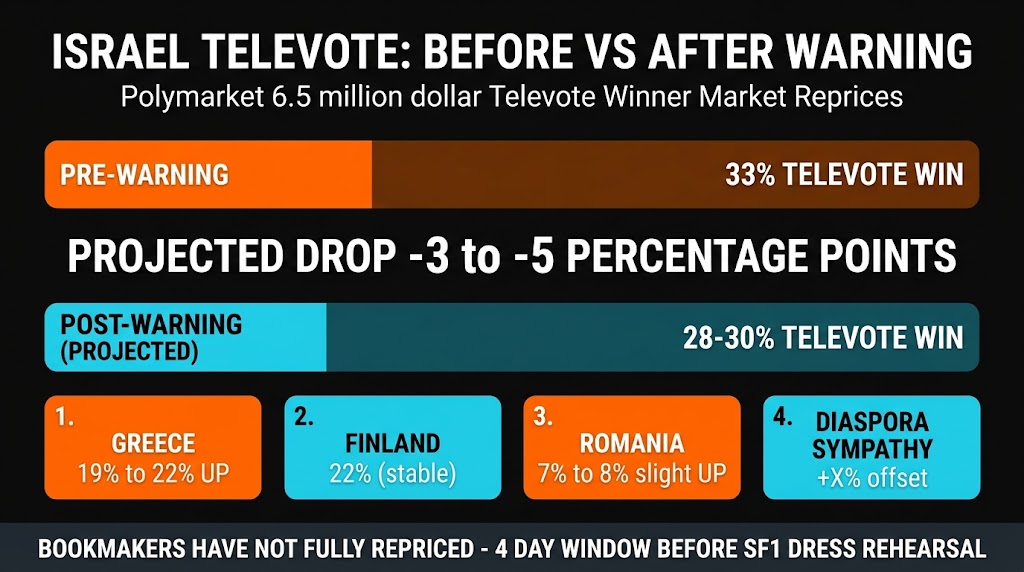
Combining the three forces, the realistic post-warning Israel televote probability is 28-30%. Down from 33%, but still leading. The market hasn't moved that far yet — the 33% Polymarket price reflects positions taken before May 9.
Who Gains from Israel's Constrained Position?
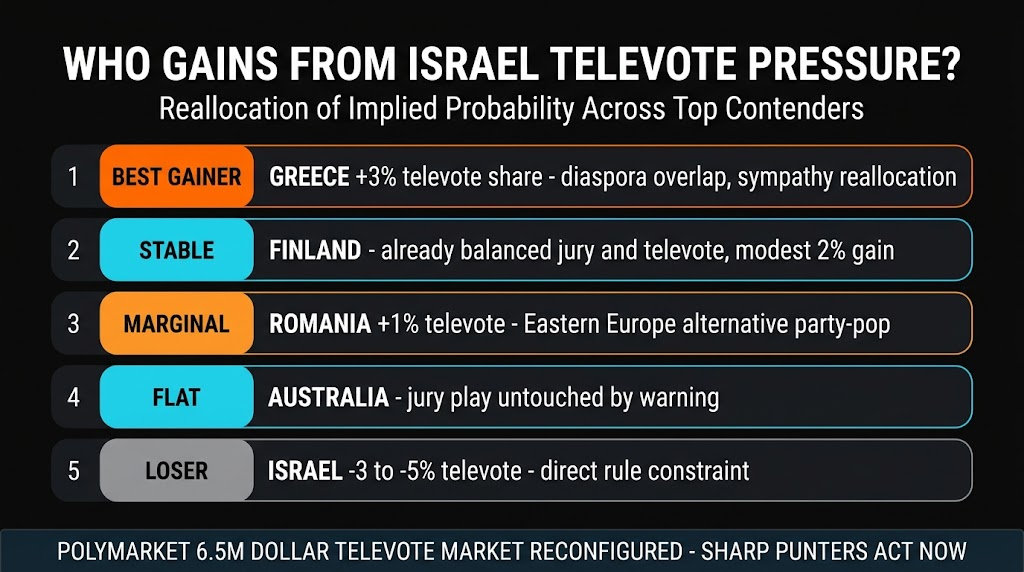
Televote probability isn't created or destroyed — it's reallocated. When Israel's projected share drops 3-5 percentage points, those points flow to other entries. Here's where the data suggests they go.
Greece (Akylas — Ferto)
The biggest structural beneficiary. Greece's pre-warning televote probability was 19%, second behind Israel's 33%. The Greek diaspora overlaps significantly with the European Mediterranean voter base where Israel had been building support. Without the 13-language campaign instructing viewers in Spanish, Italian, German, and French markets to vote Israel, those casual votes redistribute toward the most familiar Mediterranean alternative.
Projected post-warning Greece televote: 22-24% (up from 19%). The market has not yet repriced.

Finland (Linda Lampenius x Pete Parkkonen — Liekinheitin)
Finland sits at 22% televote probability and 19% jury probability — the only top contender that bridges both votes. The warning doesn't change Finland's position directly, but it removes the structural threat to Finland's televote ceiling. Israel was the only entry priced ahead of Finland in the televote market. If Israel falls back to 28-30%, Finland becomes the de facto co-favourite for the televote alongside the diminished Israel.
The compounding effect: Finland's overall winner probability of 41% — already the highest in the contest — strengthens further when Israel's televote drag on the overall market diminishes. The realistic post-warning Finland overall probability is 43-45%.

Romania (Alexandra Căpitănescu — Choke Me)
Romania's 7% televote probability gets a marginal lift. The provocative "Choke Me" aesthetic and broadcast-ready staging place Romania as a tertiary televote beneficiary, especially in Eastern European markets where Israel had embassy-supported promotion in 2025. Projected post-warning Romania televote: 8-9%.
Australia, France, Denmark (No Material Change)
These three countries are jury plays. Their televote ceilings are already structurally low (Australia <1%, France 2%, Denmark 1%). The warning doesn't affect them. Their overall probabilities stay essentially unchanged.
The Reddit and Eurovision Community Reaction
The Eurovision community's response on Reddit was rapid and divided. The thread on r/eurovision attracted 134+ comments within hours, with two distinct camps emerging.
The pro-enforcement view: "The rules were changed specifically to address the potential vote manipulation which according to the EBU isn't possible and also didn't happen last year." This camp argues the warning vindicates the December 2025 rule changes and demonstrates the EBU is willing to enforce equally across delegations.
The skeptical view: The 2025 vote campaign — which encouraged 20 votes per supporter — was, according to Israel's defence, similar to advertising by other artists. KAN's framing positions the warning as inconsistent enforcement rather than principled rule application.
For betting purposes, both camps support the same conclusion: Israel's televote campaign infrastructure has been materially curtailed. Whether this represents fair enforcement or selective targeting is a question of Eurovision politics. The market impact is the same.

Stake — Crypto Betting with Instant Payouts on Eurovision Markets
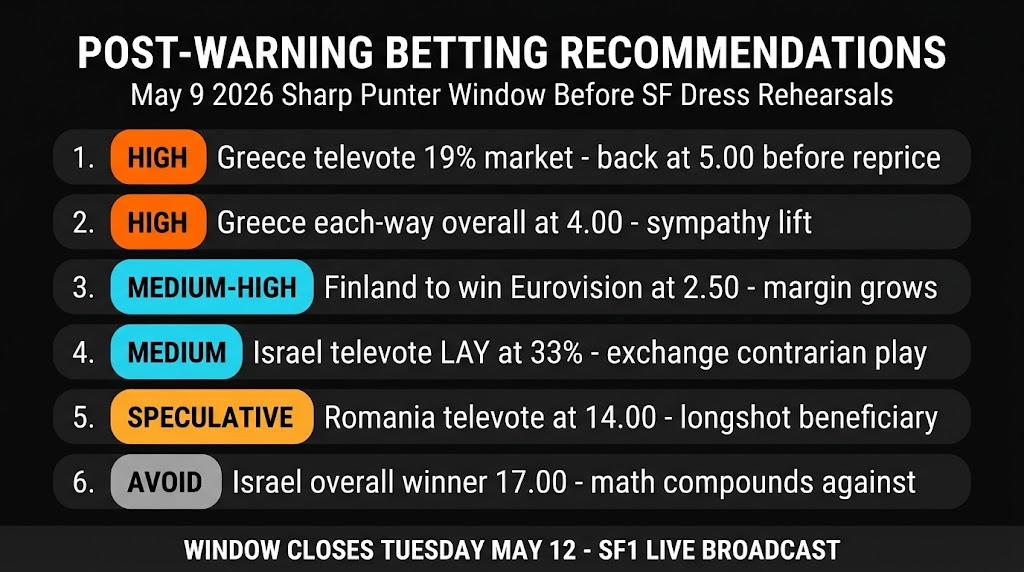
The Betting Strategy: Sharp Punter Window Before SF Dress Rehearsals
The window for repositioning around the warning is short. Bookmakers will reprice as the news consolidates and second-rehearsal buzz from other countries accelerates. Here's the actionable strategy ranked by confidence.
HIGH CONFIDENCE
Greece in the televote winner sub-market at 5.00-5.50. Currently priced at the 19% Polymarket implied probability. The post-warning probability is closer to 22-24%, putting fair odds at 4.10-4.55. At 5.00-5.50, you have positive expected value. This is the cornerstone bet of the warning trade.
Greece each-way overall winner at 4.00-5.00. Greece's overall winner probability was 12% pre-warning. Add the televote share gain and the realistic probability climbs to 14-15%. At 4.00-5.00, the fair-value math works strongly in favour of each-way Greece.
Finland to win Eurovision overall at 2.20-2.50. Already the favourite at 41% Polymarket. Post-warning probability climbs to 43-45%. At 2.20-2.50 (40-45% implied), this remains fair value with directional momentum. The bet isn't more profitable than before — it's just more secure.
MEDIUM CONFIDENCE
Israel televote winner LAY at 33% on Smarkets or Betfair. If you trade exchanges, laying Israel at 3.00 (33% implied) is the contrarian play. The post-warning probability is 28-30%, putting fair odds at 3.30-3.55. Laying at 3.00 captures the gap. Note that exchange liquidity for this market is thin — only viable if you trade exchanges actively.
Romania televote at 14.00-16.00. Speculative tertiary beneficiary play. The post-warning Romania televote probability is 8-9%, putting fair odds at 11.00-12.50. At 14.00-16.00, this is positive expected value but with longshot risk profile.
SPECULATIVE
Greece SF1 winner at 6.00-8.00. Greece's SF1 winner probability gets a small additional boost from the televote shift. With Finland still the favourite to win SF1, Greece at 6.00-8.00 represents the second-best longshot. Small stake.
AVOID
Israel overall winner at 17.00-25.00. The math compounds against. Israel was already structurally limited by 1% jury probability. With the televote ceiling now constrained, the overall winner probability drops from 3% to 1.5-2%. The 17.00 price implied 5.9% probability. Even at 25.00 (4.0%), this is negative expected value.
Israel SF1 winner at 4.50-5.50. Same structural problem on a smaller scale. Israel's SF1 win required overwhelming televote dominance — now constrained.
Australia, France, or Denmark on the basis of warning impact. These countries are jury plays. The warning doesn't materially help them. Bet them on their own merits, not as warning beneficiaries.
Thunderpick — 100% First Deposit Bonus on Eurovision Sub-Markets
The Historical Parallel: Russia's Pre-Ban Era
The closest historical parallel for the EBU's current enforcement posture is the Russia situation pre-2022. Russia received multiple warnings and rule clarifications between 2014-2021 over delegation conduct, prompting incremental constraints on promotional activity.
| Year | Country | Issue | Outcome |
|---|---|---|---|
| 2014 | Russia (Tolmachevy Sisters) | Booing over Crimea | EBU warned delegations on conduct |
| 2017 | Russia (Yulia Samoilova) | Ukraine entry ban dispute | Russia withdrew, EBU clarified host rights |
| 2019 | Iceland (Hatari) | Pro-Palestine flag display | EBU fined Iceland for political messaging |
| 2022 | Russia | Ukraine invasion | Russia banned entirely from EBU |
| 2025 | Israel (Yuval Raphael) | 20-vote campaign allegations | EBU adopted new rules in December 2025 |
| 2026 | Israel (Noam Bettan) | 13-language 10-vote campaign | First-ever formal warning under new rules |
The pattern: EBU enforcement escalates incrementally before significant action. The May 9 warning is the first step under the 2026 rules. If Israel violates again before the Grand Final, more severe action — including potential fine or sanction — becomes available to the EBU under the same rule framework.
What to Watch Through SF1 Week
The dress rehearsals begin Monday May 11. Here are the three signals that will determine whether the warning's impact compounds or fades.
| Signal | If Bullish for Israel | If Bearish for Israel |
|---|---|---|
| SF1 dress rehearsal vocal performance | Strong delivery sustains televote sympathy | Vocal issues compound the campaign damage |
| Further KAN promotional activity | Stays within new rules | Triggers second warning or sanction |
| Diaspora mobilisation organic visibility | Streisand effect produces +3-5% televote | Constrained activity drops below pre-warning baseline |
The asymmetry favours the bearish case. Two of three signals would push Israel's probability lower; only one would partially recover. Sharp punters should commit Greece and Finland positions now and reassess after Monday's SF1 dress rehearsal.
Cloudbet — Up to 5 BTC Welcome Bonus on Eurovision Markets
The Bottom Line: The First Real Test of the 2026 Rules
The May 9 warning is more than a procedural announcement. It's the first time the EBU has actually used the powers it gave itself in December 2025 to constrain disproportionate vote campaigns. The system worked exactly as designed: detect, contact, demand removal, formally warn. Within four hours, the entire chain of events was complete.
For Israel's betting case, the structural impact is meaningful but not catastrophic. Israel's televote probability falls from 33% to 28-30%. Israel remains the televote favourite, but the gap to Finland (22%) compresses, and Greece (19% → 22-24%) closes from third place into a real challenger. Israel's overall winner probability drops from 3% to 1.5-2%, locking in the structural inability to convert televote success into overall victory.
The actionable plays: Greece televote at 5.00, Greece each-way overall at 4.00, and Finland overall at 2.20-2.50. Avoid Israel overall at 17.00 and Israel SF1 winner at 4.50. The exchange traders' option of laying Israel televote at 3.00 captures the same trade with less variance.
The window is approximately 4 days before bookmakers reprice fully. Sharp Eurovision punters watching for moments like this don't get many opportunities per contest. This is one of them.
Betfred — Bet £10 Get £50 in Free Bets on All Eurovision Markets
Frequently Asked Questions
Why did the EBU issue a formal warning to Israel at Eurovision 2026?
The EBU formally warned Israeli broadcaster KAN on May 9, 2026, after Noam Bettan published promotional videos in 13 different languages instructing viewers to use all 10 votes for Israel. The 2026 rule changes — introduced in December 2025 — specifically discourage "disproportionate promotion campaigns" and direct calls to use multiple votes for a single artist. ESC Director Martin Green said: "a direct call to use the ten votes you have available on one artist or song is also not in line with our rules or the spirit of the competition." KAN complied with the EBU's removal demand within minutes and the videos were pulled from all platforms.
How does the EBU warning affect Israel's Eurovision 2026 betting odds?
Israel's pre-warning televote winner probability was 33% on Polymarket ($6.5M volume) — the highest of any 2026 entry. The post-warning realistic probability is 28-30%, a 3-5 percentage point drop. Israel's overall winner probability falls from 3% to 1.5-2%. The bookmaker markets have not yet fully repriced — sharp Eurovision punters have approximately 4 days before SF1 dress rehearsal on May 11 to act on the gap.
Which countries benefit most from the Israel warning?
Greece is the biggest beneficiary. Greek televote probability projects to climb from 19% to 22-24% as the Mediterranean voter base previously targeted by Israel's 13-language campaign reallocates. Finland benefits indirectly — Finland's overall winner probability of 41% strengthens to 43-45% as Israel's drag on the market diminishes. Romania sees a marginal lift from 7% to 8-9% televote share as the tertiary beneficiary in Eastern European markets.
Is this the first time the EBU has used the new 2026 rules?
Yes. The May 9, 2026, warning to KAN is the first-ever enforcement of the disproportionate-promotion rules introduced in December 2025. The rules were created in direct response to allegations that Israel's 2025 vote campaign — which encouraged supporters to use 20 allocated votes — violated the spirit of the contest. The 2026 rules tighten constraints specifically on multi-language promotion campaigns and government-supported voting drives.
What's the best bet on the Eurovision 2026 EBU warning impact?
Greece in the televote winner sub-market at 5.00-5.50 is the cornerstone play — fair odds are 4.10-4.55, putting current prices at clear positive expected value. Greece each-way overall at 4.00-5.00 doubles up the same thesis with overall-market exposure. Finland overall at 2.20-2.50 remains the safest portfolio anchor. Avoid Israel overall winner at 17.00+ — the math compounds against. Exchange traders can lay Israel televote at 3.00 for the cleanest contrarian trade.
Related Articles
- Eurovision 2026 Jury vs Televote Predictions: Country-by-Country Breakdown
- Eurovision 2026 Boycott Effect: How Missing Countries Change Winner Odds
- Why Finland Will Win Eurovision 2026: Full Betting Analysis
- Can Greece Win Eurovision 2026? Akylas 'Ferto' Odds Analysis
- Eurovision 2026 Semi-Final 1: Who Qualifies? Post-Rehearsal Predictions
- Eurovision 2026 Winner Predictions: Grand Final Top 10 After Rehearsals
All odds sourced from Eurovisionworld.com and Polymarket, verified May 9 2026. Source for EBU warning details: Eurovoix citing TV2 Norway. 18+. Please gamble responsibly. BeGambleAware.org. When the fun stops, stop.