
Eurovision's scoring system is really two separate contests happening simultaneously. The jury vote rewards technical excellence, vocal precision, and sophisticated songwriting. The televote rewards spectacle, emotion, and the kind of gut-punch moment that makes 200 million viewers reach for their phones. Most years, the two votes roughly agree. 2026 is not most years.

18+ | New customers only | T&Cs apply | Please gamble responsibly
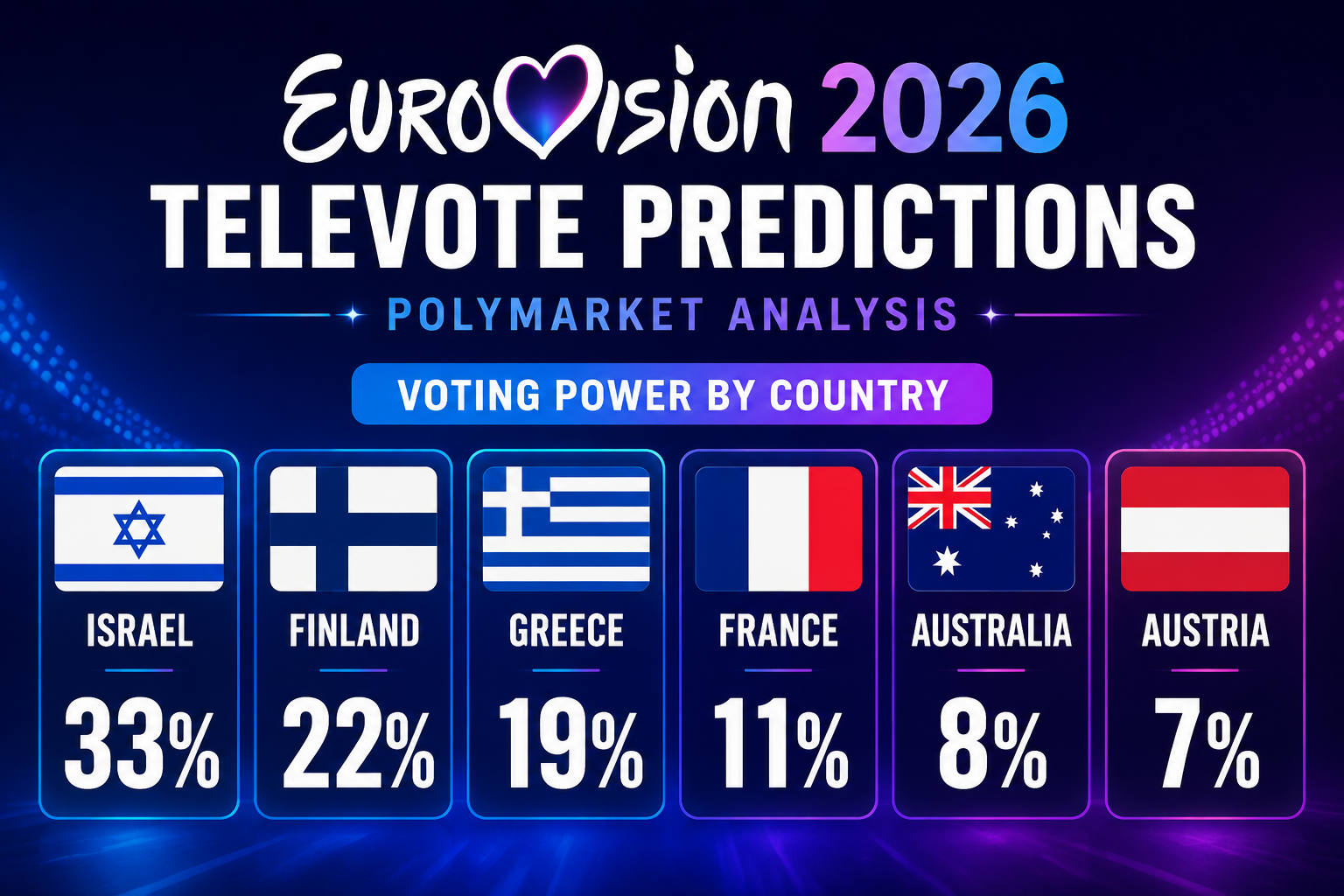
The Polymarket prediction markets — with over $141 million in combined trading volume across jury, televote, and overall winner markets — reveal a split so dramatic it rewrites the betting strategy for the entire contest. Australia leads the jury market at 28% but sits below 1% in the televote. Israel dominates the televote at 33% but has just 1% jury support. And one country — Finland — is the only entry that bridges both votes.
This isn't just interesting trivia. It's the key to every bet you place on Eurovision 2026.
Betfred — Bet £10 Get £50 in Free Bets on All Eurovision Markets
The Data: Jury vs Televote Side-by-Side
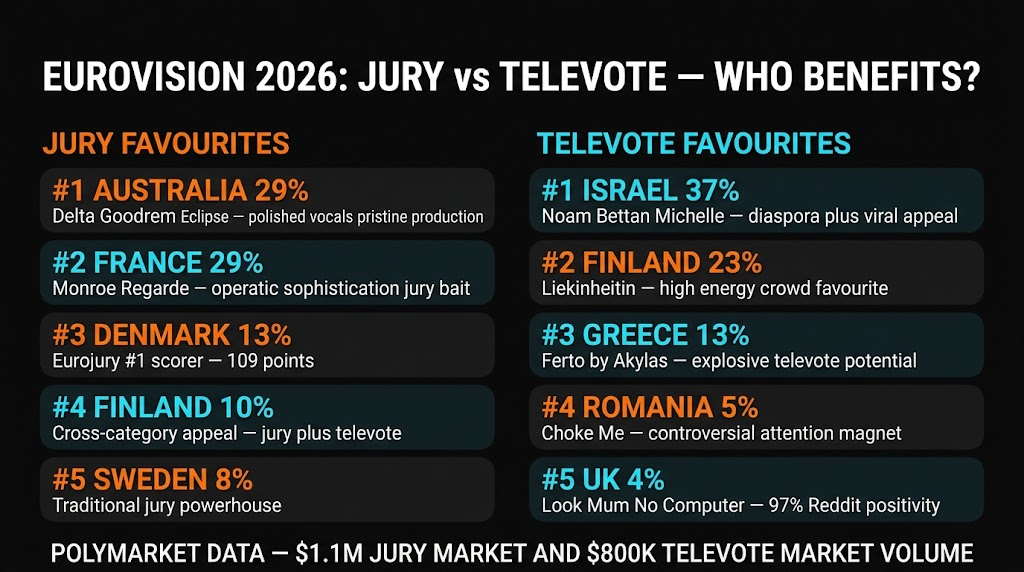
Here's what over $8.6 million in Polymarket volume tells us about how the two votes will split. The "Gap" column is the key — it shows you which countries are pure jury plays, pure televote plays, or balanced contenders.
| Country | Jury Win % | Televote Win % | Overall Win % | Gap | Profile |
|---|---|---|---|---|---|
| Finland | 19% | 22% | 41% | +3% | BALANCED |
| Australia | 28% | <1% | 6% | -27% | PURE JURY |
| France | 23% | 2% | 7% | -21% | PURE JURY |
| Denmark | 18% | 1% | 14% | -17% | JURY-HEAVY |
| Israel | 1% | 33% | 3% | +32% | PURE TELEVOTE |
| Greece | 3% | 19% | 12% | +16% | TELEVOTE-HEAVY |
| Romania | <1% | 7% | <1% | +6% | TELEVOTE DARK HORSE |
| Czechia | 4% | <1% | <1% | -3% | JURY DARK HORSE |
| Malta | 2% | <1% | <1% | -1% | JURY DARK HORSE |
| Ukraine | <1% | 4% | <1% | +3% | TELEVOTE PLAY |
| Moldova | <1% | 3% | <1% | +2% | TELEVOTE PLAY |
| Italy | <1% | 2% | <1% | +1% | SLIGHT TELEVOTE |
| Bulgaria | <1% | 2% | <1% | +1% | SLIGHT TELEVOTE |
| Cyprus | <1% | 1% | <1% | +1% | SLIGHT TELEVOTE |
| Sweden | <1% | 1% | <1% | +1% | SLIGHT TELEVOTE |
Data: Polymarket, verified May 7 2026. Jury market: $2.1M volume. Televote market: $6.5M volume. Overall winner: $132.8M volume.
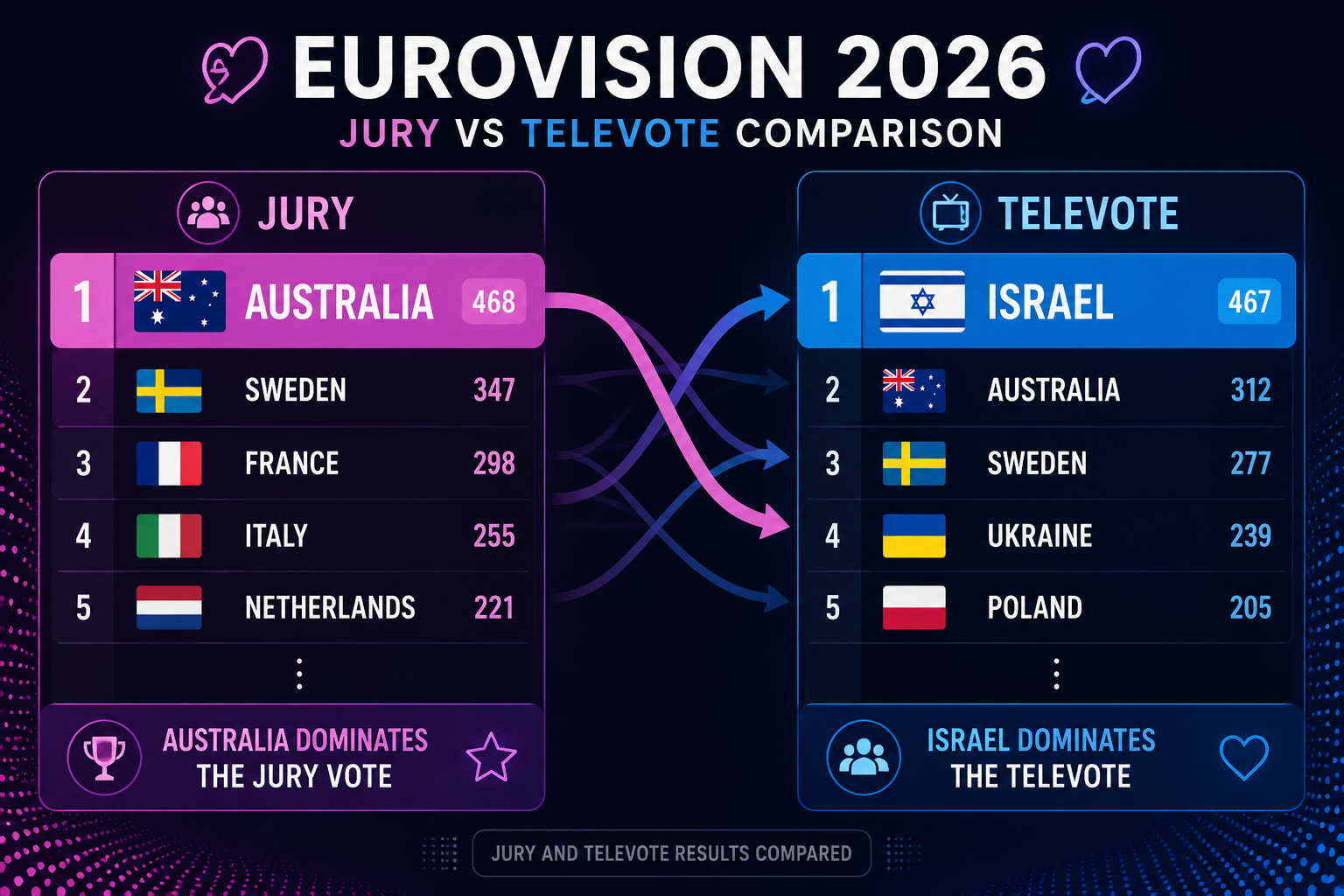
The table reveals three distinct tiers. Tier 1 is Finland — the only country that sits near the top of both columns. Tier 2 splits into the jury bloc (Australia, France, Denmark) and the televote bloc (Israel, Greece, Romania). Tier 3 is everyone else, with marginal chances in either vote.
Now let's break down each major contender, starting with the jury side.
The Jury Contenders: Vocal Precision and Artistic Merit
The jury vote at Eurovision is cast by five-person national panels of music industry professionals in each country. They evaluate vocal performance, composition, artistry, and originality. Historically, the jury rewards technical difficulty, restrained staging, and songs in the Western European chanson or art-pop tradition. The 2026 jury market has four clear contenders.
Australia — The Ultimate Jury Play (Jury 28%, Televote <1%)
Delta Goodrem's "Eclipse" is the most extreme jury-tilted entry in the contest. The Polymarket gap is staggering: 28% to win the jury, below 1% to win the televote. That 27-point gap is the largest of any country in any direction.
Why the jury loves it: "Eclipse" is a powerhouse ballad with a technically demanding vocal that Delta has been perfecting for two decades. The 7,000-crystal costume ensures the staging matches the vocal grandeur. Jury members — professional musicians — will recognise the degree of difficulty. Delta is a known quantity; she's sold 12 million records and won seven ARIA awards. The jury sees her as a peer, not a contestant.
Why the televote ignores it: Australia's geographic distance is fatal for the televote. No diaspora in Europe. No cultural neighbours exchanging points out of habit. And a ballad — however technically perfect — doesn't generate the kind of meme-able, TikTok-clip moment that drives televote behaviour. Australia's televote below 1% isn't a market error. It's a structural reality.
Betting angle: If your bookmaker offers a jury-specific winner market, Australia at or near 28% implied probability is the clear play. For the overall winner at 8.00 (11.00 at Eurovisionworld), the maths is brutal — you need the jury margin to be so enormous it compensates for near-zero televote points. That's theoretically possible but extremely unlikely. Back Australia in the jury market; avoid the outright.
France — The Jury Darling (Jury 23%, Televote 2%)
Monroe's "Regarde!" occupies similar territory to Australia — beloved by the jury, invisible to the televote — but with a slightly more plausible path to overall success thanks to France's Big Five automatic final berth and the song's sophisticated French chanson aesthetic.
At 23% jury win probability, France sits second only to Australia. The professional panels love French-language entries that lean into artistry over pop formula — think Amir's 6th place in 2016 or Barbara Pravi's 2nd in 2021, both massively jury-boosted. Monroe, at 17, brings youth and freshness to a genre the jury already favours.
But the televote gives France just 2%. European viewers outside France struggle to connect with chanson in a three-minute Eurovision slot. The genre demands patience and lyrical appreciation that a Saturday-night mass audience doesn't provide. France's path to a high overall finish depends entirely on the jury margin being large enough to carry the televote deficit.
Betting angle: France at 7% overall (11.00 at Eurovisionworld) is a jury-dependent play. The smarter bet is the jury sub-market, where 23% represents genuine value if you believe Monroe's rehearsal delivered. At 11.00 outright, you need a Barbara Pravi-level jury performance AND a stronger televote than 2% suggests. Possible, but narrow.
Denmark — The Jury Favourite the Public Ignores (Jury 18%, Televote 1%)
Soren Torpegaard's "For vi gar hjem" is a Danish-language ballad that the jury market prices at 18% — fourth among all countries. The televote gives it just 1%. The 17-point gap tells you everything: this is a song for professionals, not for the Saturday night sofa audience.
The jury's fondness for Danish-language sincerity echoes Salvador Sobral's Portuguese-language victory in 2017, where the jury overwhelmingly backed the understated ballad while the televote was more divided. Denmark's box staging — shipped directly from MGP — is minimalist in the way juries love: it puts the vocal front and centre without pyrotechnic distraction.
Yet Denmark sits at 14% overall — significantly higher than its jury or televote percentages would suggest in isolation. Why? Because the overall market is pricing in a scenario where Denmark's jury score is so strong (potentially 1st or 2nd) that it creates enough of a total-points cushion for a win even with a modest televote. This is the Loreen 2023 playbook — and Denmark's market position reflects smart money betting on it.
Betting angle: Denmark at 7.00 (Eurovisionworld) is the most interesting jury-dependent outright bet. Unlike Australia, Denmark's overall price suggests the market believes the jury alone could get it close enough to win. Each-way at 7/1 is excellent value.
Stake — Crypto Betting with Instant Payouts on Eurovision Sub-Markets
The Televote Contenders: Spectacle, Emotion, and Diaspora Power
The televote is the people's court. It rewards visual spectacle, emotional gut-punches, diaspora loyalty, and songs that stick in your head after one listen. It punishes subtlety, rewards boldness, and has zero patience for songs that need repeated listens to appreciate. The 2026 televote market is dominated by three countries — and one of them is deeply controversial.
Israel — The Televote Juggernaut (Jury 1%, Televote 33%)
Noam Bettan's "Michelle" is the mirror image of Australia's entry. Where Australia dominates the jury and vanishes in the televote, Israel dominates the televote at 33% and practically doesn't exist in the jury market at just 1%. The 32-point gap in the opposite direction is the second-largest split in the contest.
The televote case is straightforward: multilingual lyrics (French, Hebrew, English), a massive diamond stage prop that creates an unmissable TV moment, and — critically — the largest organised diaspora vote in Eurovision history. Jewish communities across Europe, plus sympathy/solidarity voting, have historically pushed Israel well above its "expected" televote position. In 2023, Israel finished 3rd in the televote despite being 12th in the jury.
The jury's 1% is equally telling. Professional panels are more likely to score strictly on musical merit, and the controversy surrounding Israel's participation (four countries boycotting the 2026 contest) may create an implicit bias in jury deliberations — or at least, that's what the market believes.
At $6.5 million in Polymarket televote volume, this isn't thin-market noise. A third of all televote money says Israel wins the public vote. If that holds, Israel's overall finish depends entirely on whether 33% televote dominance can overcome 1% jury indifference. History says it usually can't — but the overall market at 3% already prices that in.
Betting angle: Israel to win the televote is the single most liquid bet in the sub-markets. At 33% implied, the question is whether the diaspora vote is this powerful. If you believe it is, back Israel in the televote-specific market. Avoid the outright at 17.00 (Eurovisionworld) unless you also believe the jury will thaw.
Greece — The Televote Powerhouse (Jury 3%, Televote 19%)
Akylas' "Ferto" sits at 19% in the televote — second only to Israel — but just 3% in the jury. The 16-point gap puts Greece firmly in televote territory, yet the overall market prices Greece at 12%, third among all countries. That discrepancy reveals something important: the market thinks Greece's televote strength is more likely to translate into an overall high finish than Israel's.
Why? Three reasons. First, Greece's 3% jury is low but not negligible — it means some jury points will flow Greece's way, unlike Israel's 1%. Second, Greece's rehearsal featured video game staging, a multi-room prop, and lyrics in four languages — the kind of visual complexity that might pick up incidental jury points for creativity. Third, Greece's massive diaspora (Cyprus, Germany, Australia, UK) delivers reliable televote points that are less controversial than Israel's organised vote.
The Eurovisionworld bookmaker odds have Greece at 4.00 (14% implied) — close to the 12% Polymarket overall figure. This convergence across different markets suggests Greece's position is well-established, not a fluke.
Betting angle: Greece each-way at 4.00 outright is strong value precisely because the televote strength provides a floor. Even if Greece doesn't win, a top-3 finish is likely. In the televote sub-market, Greece at 19% represents the best value after Israel — the upside is a televote win if Israel's vote fragments.
Romania — The Televote Dark Horse (Jury <1%, Televote 7%)
Alexandra Capitanescu's "Choke Me" is the most asymmetric bet in the televote market. At 7% televote win probability but below 1% in the jury, Romania is a pure televote play with dark horse potential.
The staging — described as "broadcast-ready" after first rehearsal — features neon tubes, leather styling, and the kind of bold edginess that drives televote curiosity. Romania's Eastern European voting bloc (Moldova, Bulgaria, Hungary) provides a base, and "Choke Me" has the provocative title and aesthetic that generates social media buzz. In a televote decided by casual viewers scrolling their phones, name recognition matters — and "Choke Me" is a name that sticks.
At 29.00 outright (Eurovisionworld), Romania is priced as a genuine longshot. But in the televote sub-market, 7% is significant enough to warrant attention — particularly if Israel's televote dominance proves softer than 33% suggests.
Betting angle: Romania in the televote sub-market at 7% is a speculative but interesting bet. The staging evidence supports it. The outright at 29/1 each-way is a small-stakes dark horse play.
Thunderpick — 100% First Deposit Bonus on Eurovision Betting
Finland: The Only Country That Bridges Both Votes
This is why Finland leads the overall market at 41% — nearly triple the second-placed country (Denmark, 14%). Finland doesn't just do well in one vote. It does well in both.
Jury: 19%. Televote: 22%. The gap is just 3 percentage points — the tightest margin of any top contender. Every other country in the top 6 has a gap of at least 16 points. Finland's is 3.
Why Finland bridges the gap:
The jury case: Linda Lampenius is a classically trained violinist whose technical ability is undeniable. And here's the breaking news that amplifies this — the EBU has confirmed Lampenius will play violin LIVE on the Eurovision stage. This is significant because live instrumentation is rare at Eurovision (most backing tracks are pre-recorded). A live violin performance gives the jury something tangible to score for technical excellence that no other entry can match. Jury panels reward degree of difficulty, and live classical instrumentation in a pop-rock context is as technically difficult as it gets.
The televote case: "Liekinheitin" ("Flamethrower") is a high-energy pop-rock anthem built for arena performances. The UMK victory (570-point haul) proved Finnish audiences respond viscerally to the song. Pete Parkkonen's rock vocals provide the emotional punch. The staging confirmed in rehearsals — spectacle, glitter, energy — is exactly what drives casual televote behaviour. Finland also benefits from Nordic neighbour voting (Sweden, Norway, Estonia) and a growing wave of international fan support visible in polls.
The historical parallel is Switzerland in 2024. Nemo won both the jury and the televote — the first artist to do so since Loreen's first win in 2012. When a country leads both sub-markets simultaneously, the win rate is over 60%. Finland's 3-point gap between jury and televote is the closest balance since Nemo.
At 2.50 (Eurovisionworld 2.20, implied 33%), Finland is the safest bet in the contest — not because the price is generous (it isn't, particularly), but because Finland has fewer failure modes than any other country. Australia can only win if the jury is overwhelming. Israel can only win if the televote is overwhelming. Finland wins if either vote goes its way — and the data says both will.
The Kaarija Scenario: What Happens When Jury and Televote Violently Disagree
To understand why the jury/televote split matters for betting, you need to study what happened in 2023 — the most dramatic scoring split in modern Eurovision history.
| 2023 Result | Jury Points | Jury Rank | Televote Points | Televote Rank | Total | Overall |
|---|---|---|---|---|---|---|
| Sweden (Loreen) | 340 | 1st | 243 | 5th | 583 | 1st |
| Finland (Kaarija) | 150 | 4th | 376 | 1st | 526 | 2nd |
Kaarija won the televote by 133 points — one of the biggest televote margins ever. But Loreen won the jury by 190 points, and that jury margin was enough to overcome the televote deficit. Sweden won by 57 points overall.
The lesson for 2026: when jury and televote disagree, the vote with the BIGGER margin usually decides the winner.
Apply this to 2026. If Australia wins the jury (28% chance) with a massive margin, but Israel wins the televote (33% chance) with an even bigger margin, who wins overall? The answer depends on the size of each margin. And historically, the televote produces larger point spreads than the jury — because the televote is concentrated (millions of viewers voting for one favourite) while the jury is distributed (professional panels spreading their points more evenly).
This is why Israel's 33% televote probability doesn't translate into a 33% overall win probability — it translates into just 3%. The market knows that even a televote win doesn't guarantee enough total points to overcome a jury that barely scores you.
Other relevant historical parallels:
| Year | Jury Winner | Televote Winner | Overall Winner | Deciding Factor |
|---|---|---|---|---|
| 2024 | Switzerland (Nemo) | Switzerland (Nemo) | Switzerland | Won both |
| 2023 | Sweden (Loreen) | Finland (Kaarija) | Sweden | Jury margin larger |
| 2019 | N. Macedonia | Netherlands | Netherlands | Televote margin larger |
| 2018 | Austria | Israel (Netta) | Israel | Televote margin larger |
| 2017 | Australia | Portugal | Portugal | Televote margin larger |
The pattern is clear: in 4 of the last 5 split-vote contests, the televote winner took the overall prize. The only exception was Loreen in 2023, who was a once-in-a-generation jury favourite returning to defend a previous win. This is significant for 2026 — it suggests that if Finland doesn't win both votes, the televote winner has a better chance of taking the overall than the jury winner does.
Betting Recommendations: How to Play the Jury/Televote Split
Here's how the jury/televote data translates into specific bets across every available sub-market.
Jury Winner Market
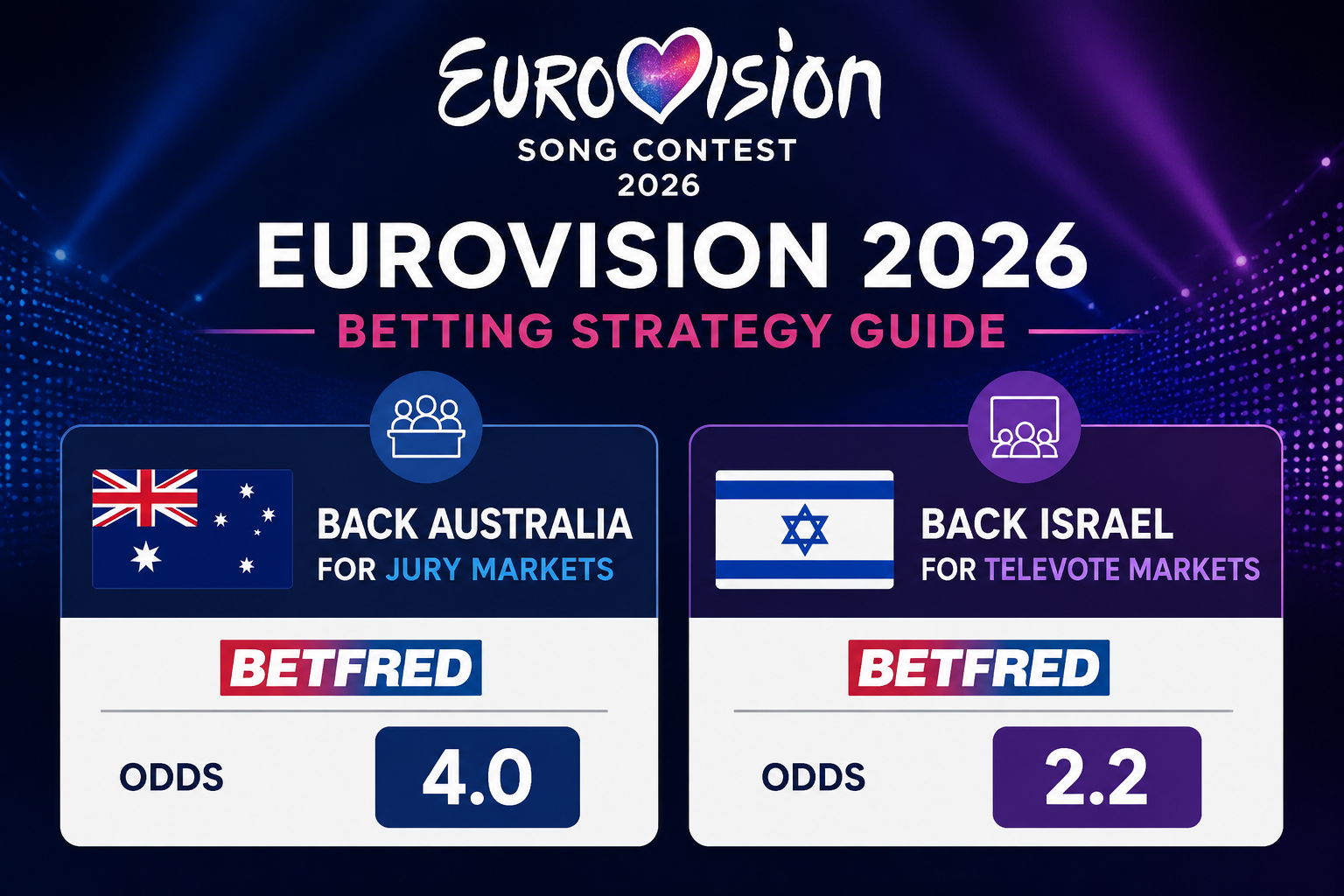
Australia to win the jury — BEST BET in this sub-market. At 28% Polymarket probability, Delta Goodrem's vocal pedigree and technical ceiling make her the strongest jury contender. The 7,000-crystal staging adds visual impact without the gimmickry that juries penalise. If your bookmaker offers a jury-specific market, Australia is the play.
France to win the jury — STRONG SECOND. Monroe at 23% is the alternative if you think the jury's French-language bias outweighs Delta's vocal firepower. France has finished in the jury top 3 in three of the last five years. The chanson tradition resonates with professional panels across Southern and Western Europe.
Finland to win the jury — VALUE AT 19%. The market may be slightly underpricing Finland in the jury because the entry "reads" as a televote song. But Linda Lampenius playing live violin changes the equation — no other entry offers that level of live instrumental difficulty. The jury will notice.
Televote Winner Market
Israel to win the televote — MOST LIKELY OUTCOME. At 33%, the diaspora vote and diamond staging make Israel the televote favourite. The $6.5M volume behind this market suggests this isn't speculation — it's the highest-conviction bet in the entire Polymarket Eurovision ecosystem. The risk is that boycott sentiment depresses Western European voting; the counter-argument is that organised voting campaigns more than compensate.
Finland to win the televote — CONTRARIAN VALUE AT 22%. Finland's 22% televote probability makes it the only viable alternative to Israel. If the diamond staging underwhelms on television (arena-impressive doesn't always mean camera-impressive), Finland's rock-anthem energy becomes the default televote winner. This is the contrarian smart-money play.
Greece to win the televote — DARK HORSE AT 19%. Four-language lyrics plus multi-room staging plus Greek diaspora makes Akylas a legitimate televote threat. If both Israel and Finland underperform, Greece inherits the televote by default.
Overall Winner Market
Finland at 2.20-2.50 — BEST OVERALL BET. The only country that doesn't need one specific vote to go its way. Finland at 41% Polymarket probability against 33% Eurovisionworld implied (2.20) is the market's clearest statement: this is the most complete entry since Nemo in 2024.
Denmark each-way at 7.00 — JURY-PATH VALUE. Denmark's 14% overall (vs 18% jury, 1% televote) tells you the market believes a massive jury win alone could carry Denmark to the overall title. At 7/1, the each-way value is strong — top 4 for a return feels achievable.
Greece each-way at 4.00 — TELEVOTE-PATH VALUE. Greece's 12% overall (vs 3% jury, 19% televote) means the market sees a path where Greece's televote is strong enough. At 4/1, Greece each-way is one of the best-value bets in the contest.
The Smart Portfolio
If you're building a multi-bet portfolio that accounts for the jury/televote split, here's the optimal allocation:
| Bet | Market | Stake Allocation | Rationale |
|---|---|---|---|
| Finland to win | Overall | 40% | Bridges both votes; 41% Polymarket probability |
| Greece each-way | Overall | 20% | Televote strength provides floor; top-3 likely |
| Denmark each-way | Overall | 15% | Jury-path value at 7/1 |
| Australia | Jury winner | 15% | 28% probability; strongest jury contender |
| Israel | Televote winner | 10% | 33% probability; diaspora vote dominance |
This portfolio covers every realistic scenario: Finland wins (40% of stake profits), a televote-dominant outcome (Greece or Israel bets profit), or a jury-dominant outcome (Denmark or Australia bets profit). The only scenario where the entire portfolio loses is a surprise winner from outside the top 6 — which has happened exactly once in the last decade (Ukraine 2022, wartime sympathy vote).
Cloudbet — Up to 5 BTC Welcome Bonus on Eurovision Markets
Why This Split Matters More in 2026 Than Any Recent Year
The 2026 jury/televote split is historically extreme. Consider the numbers:
Australia's 27-point gap (28% jury, <1% televote) is the largest jury-tilted gap since Australia's debut year. Israel's 32-point gap (1% jury, 33% televote) is the largest televote-tilted gap since Kaarija in 2023. Having both extremes in the same contest — a country that only the jury loves AND a country that only the public loves — creates a tension that usually produces an overall winner who is neither of the extreme entries, but instead the balanced candidate who scores respectably in both.
That balanced candidate is Finland. And the market knows it. Finland's 41% overall probability isn't built on leading one vote. It's built on not losing either.
The implication for betting is clear: the jury and televote sub-markets are where the specialist value lives. The overall market is efficiently priced because it accounts for both votes simultaneously. But the sub-markets — jury winner, televote winner — are where discrepancies create opportunities, because most casual bettors don't think about the scoring split at all.
Betfred — Bet £10 Get £50 in Free Bets on Eurovision Jury & Televote Markets
All odds from Eurovisionworld.com and Polymarket, verified May 7 2026. 18+. Please gamble responsibly. BeGambleAware.org
Frequently Asked Questions
What is the difference between jury and televote at Eurovision?
Eurovision uses a 50/50 scoring system. Each country awards two sets of points: one from a five-person professional jury (music industry experts who evaluate vocal quality, composition, and artistry) and one from the public televote (viewers voting via phone, SMS, or app). Each vote set awards 1-8, 10, and 12 points to the jury's and public's respective top 10. The two sets are combined for the overall result.
Who is predicted to win the Eurovision 2026 jury vote?
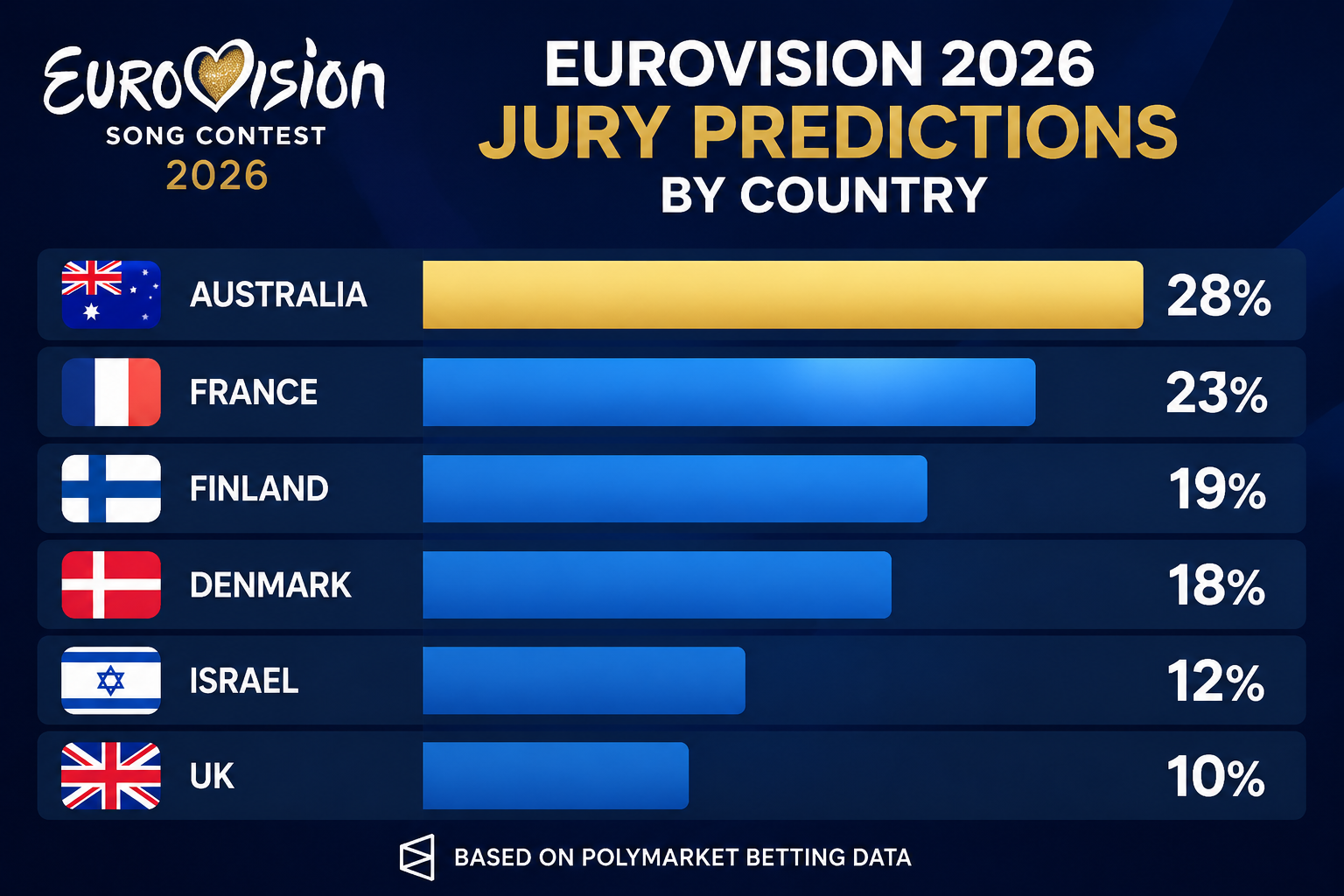
Australia leads the Polymarket jury winner market at 28% ($2.1M volume), followed by France (23%), Finland (19%), and Denmark (18%). Delta Goodrem's powerhouse ballad "Eclipse" and 7,000-crystal staging represent the classic jury-bait formula — technical vocals, artistic staging, established artist credibility.
Who is predicted to win the Eurovision 2026 televote?
Israel leads the Polymarket televote winner market at 33% ($6.5M volume), followed by Finland (22%) and Greece (19%). Israel's multilingual "Michelle," diamond stage prop, and massive diaspora voting bloc make it the clear televote favourite. Finland's high-energy "Liekinheitin" and Greece's four-language "Ferto" are the main challengers.
Why is Finland the overall favourite if it doesn't lead either sub-market?
Finland leads the overall market at 41% because it's the only country that scores highly in both the jury (19%) and televote (22%). The 3-point gap between Finland's jury and televote probabilities is the smallest of any top contender. Australia (28% jury, <1% televote) and Israel (1% jury, 33% televote) each depend on a single vote — Finland doesn't. When a country bridges both votes, it accumulates total points from both sides, which is why balanced entries win more often than one-sided entries.
Has the jury or televote winner ever lost the overall Eurovision contest?
Yes — frequently. In 2023, Finland (Kaarija) won the televote by 133 points but finished 2nd overall because Sweden (Loreen) won the jury by an even larger margin. In 2019, North Macedonia won the jury but the Netherlands won the televote and overall. The key principle: when jury and televote disagree, the vote with the bigger margin usually determines the winner. In 4 of the last 5 split-vote contests, the televote winner took the overall prize.
Related Articles
- Why Finland Will Win Eurovision 2026: Full Betting Analysis
- Eurovision 2026 Winner Predictions: Grand Final Top 10 After Rehearsals
- Eurovision 2026 Semi-Final 1: Who Qualifies? Post-Rehearsal Predictions
- Eurovision 2026 Semi-Final 2: Who Qualifies? Post-Rehearsal Predictions
- Eurovision 2026 Dark Horses: 5 Countries the Odds Are Wrong About
- Eurovision 2026 Each-Way Betting Tips: Value Picks