
The headlines have been written. Five countries boycotting. 1,100 artists signing the No Music For Genocide open letter. Vienna police deploying airport-level security. But the real story for anyone with money on Eurovision 2026 is not the politics — it is the math.

18+ | New customers only | T&Cs apply | Please gamble responsibly
Five missing countries means five fewer jury panels, five fewer televote pools, a shrunken semi-final field, and millions of potential viewers who will not be voting. Every one of those changes shifts the probability distribution for every remaining entry. And the bookmakers have not fully priced all of them in.
This is a quantitative breakdown of exactly how the boycott changes the winner odds — with specific numbers, historical parallels, and actionable betting recommendations.
Place Your Eurovision Bets at Betfred — Bet 10 Get 50 in Free Bets
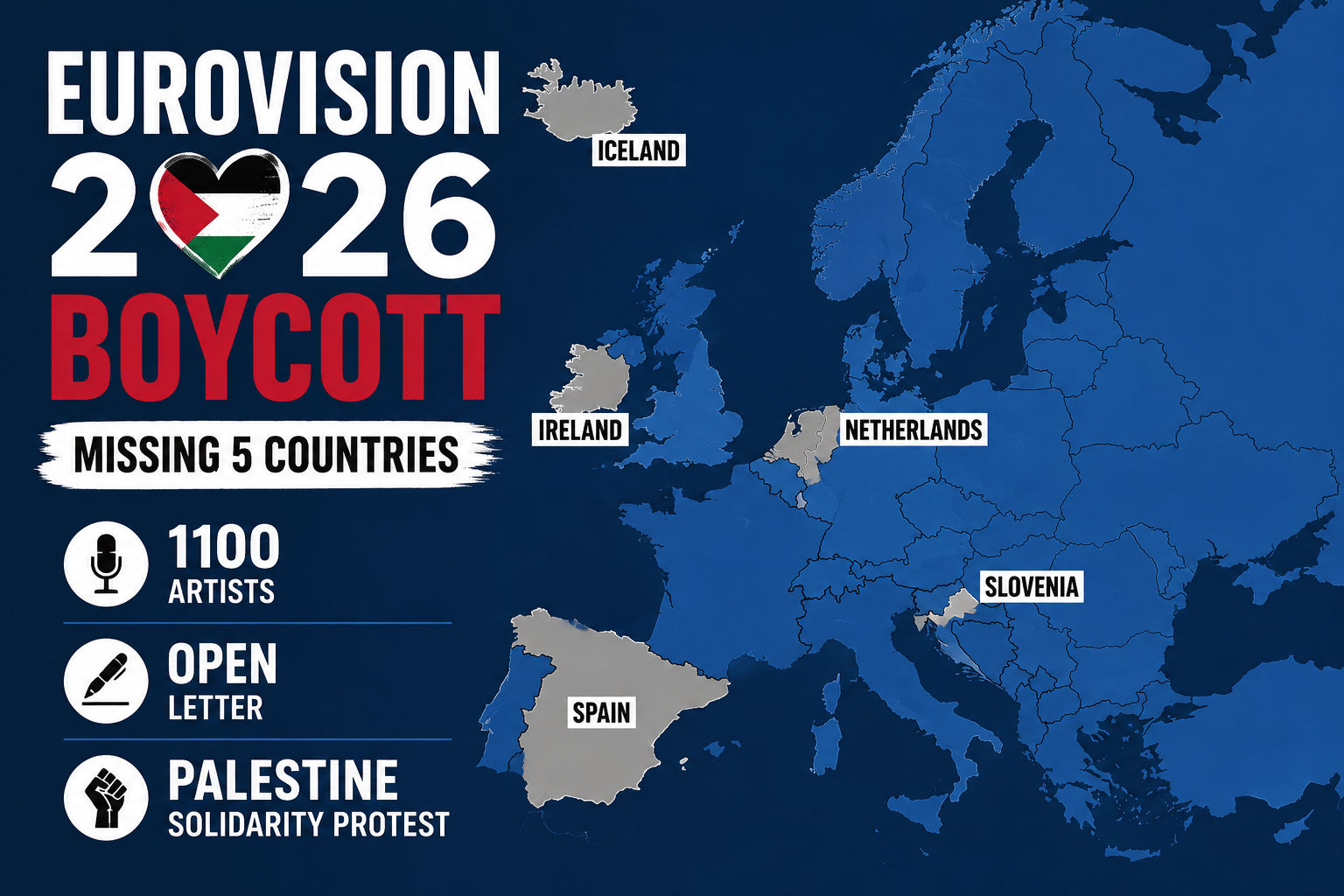
The Missing Five: Who Left and What They Took With Them
Before we crunch the numbers, let us establish what is actually gone from the contest.
| Country | Status | Broadcasting? | Historical Strength | Key Voting Pattern |
|---|---|---|---|---|
| Spain | Big Five member withdrawn | No (RTVE boycott) | 2x winner, auto-finalist | Strong televotes to Portugal, Romania, Latin entries |
| Ireland | Withdrawn | No (RTE boycott) | 7x winner (joint record) | Strong televotes to UK, Sweden, Denmark |
| Netherlands | Withdrawn | Neutral | 5x winner, strong recent form | Strong televotes to Nordic/Germanic entries |
| Iceland | Withdrawn | Yes (RUV airing) | Nearly won 2020 (cancelled) | Nordic/alternative bloc voter |
| Slovenia | Withdrawn | No (RTVSLO boycott) | Moderate | Balkan/Central European voter |
The critical detail most analyses miss: three of these five countries — Ireland, Spain, and Slovenia — are not even broadcasting the show. Their national broadcasters are running alternative programming. Iceland's RUV is still airing the contest but without an entry. Only the Netherlands occupies a middle ground (NPO is airing but not competing).
This matters because non-broadcasting countries produce zero online televote traffic. When RTE, RTVE, and RTVSLO do not promote the show, their populations are far less likely to find Eurovision voting apps or phone numbers. That is approximately 55 million people across Spain (47m), Ireland (5m), and Slovenia (2m) who are structurally less likely to vote.
The result: a 35-country field. The smallest since 2003, when 26 countries competed. In a typical year, 37-40 countries enter. That five-country reduction ripples through every level of the competition.
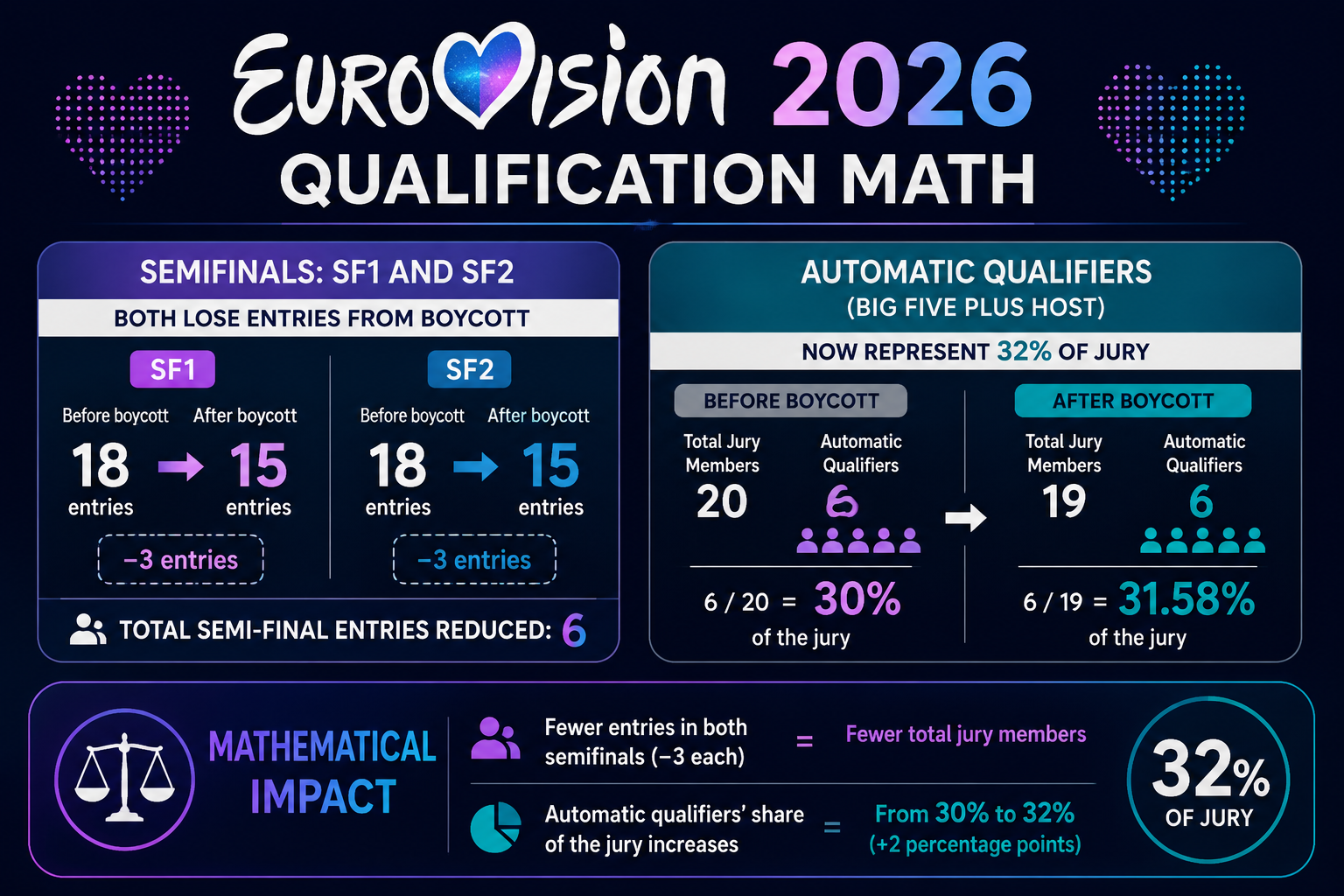
Section 1: The Qualification Math — Easier Semi-Finals for Everyone
This is the most directly quantifiable effect of the boycott, and it is significant.
In a standard Eurovision year, each semi-final features 17-18 countries competing for 10 qualification spots. That gives each entry a baseline qualification rate of approximately 56-59%.
In 2026, with five countries removed from the pool, each semi-final has just 15 countries competing for 10 spots. That is a qualification rate of 67%.
| Metric | Normal Year | Eurovision 2026 | Change |
|---|---|---|---|
| SF1 competitors | 17-18 | 15 | -2 to -3 |
| SF2 competitors | 17-18 | 15 | -2 to -3 |
| Spots available | 10 per SF | 10 per SF | No change |
| Qualification rate | 56-59% | 67% | +8-11 percentage points |
| Countries eliminated per SF | 7-8 | 5 | -2 to -3 fewer eliminations |
An 8-11 percentage point improvement in qualification probability is enormous for bubble acts — countries that typically sit on the 9th-12th position borderline. In a normal year, these entries are coin flips. In 2026, they are more likely to qualify than not.
Who benefits most from easier semis?
The countries whose qualification odds improve the most are those ranked 8th-12th in their semi-final — the "bubble" zone. Based on current Eurovisionworld odds and rehearsal evidence:
SF1 bubble beneficiaries: Montenegro, Estonia, Switzerland, Latvia
SF2 bubble beneficiaries: Cyprus, Georgia, Czech Republic, North Macedonia
For outright winner bets, this matters less — Finland at 2.50 was always going to qualify. But for qualification-specific markets, the value is real. If your bookmaker offers "Country X to qualify" at odds that imply 50-55% probability, the true probability in this shrunken field is closer to 65-70%. That is a mathematical edge.
Stake — Crypto Betting with Instant Payouts on Eurovision Markets
Section 2: The Points Redistribution — Who Loses Friendly Voters
This is where the analysis gets granular. Eurovision voting is not random. Decades of data reveal persistent regional voting blocs. When five countries disappear, their voting patterns disappear with them — and that asymmetrically affects specific entries.
Let us map the historical voting patterns of each boycotting country using the last 10 years of jury and televote data:
Netherlands' Missing Votes
The Netherlands has historically been one of the most generous voters for Nordic and Germanic entries. Over the last decade, Dutch juries and televoters have consistently placed Finland, Denmark, Sweden, Germany, and Belgium in their top 10.
Countries that lose a friendly voter: Finland, Denmark, Sweden, Germany, Belgium, Norway
Estimated impact: -4 to -8 points lost per affected country in the Grand Final
Ireland's Missing Votes
Ireland's voting pattern is one of the most distinctive in Eurovision — heavy favouritism toward the UK, Sweden, and Denmark, with secondary support for France and Norway. The Irish televote particularly rewards English-language entries and Scandinavian pop.
Countries that lose a friendly voter: UK, Sweden, Denmark, France, Norway
Estimated impact: -4 to -10 points lost per affected country
Spain's Missing Votes
Spain's absence is the most structurally significant because Spain was a Big Five automatic finalist. Spanish juries and televoters have consistently favoured Portugal, Romania, Italy, and France — the Latin/Romance-language bloc.
Countries that lose a friendly voter: Portugal, Romania, Italy, France
Estimated impact: -6 to -12 points lost per affected country
Iceland and Slovenia's Missing Votes
Iceland voted reliably within the Nordic bloc (Denmark, Sweden, Norway, Finland). Slovenia voted within the Central European/Balkan corridor (Croatia, Serbia, Austria, North Macedonia).
Countries that lose friendly voters: Denmark (-2 friendly voters: Ireland + Iceland), Sweden (-3: Ireland, Netherlands, Iceland), Austria (-1: Slovenia), Croatia (-1: Slovenia)
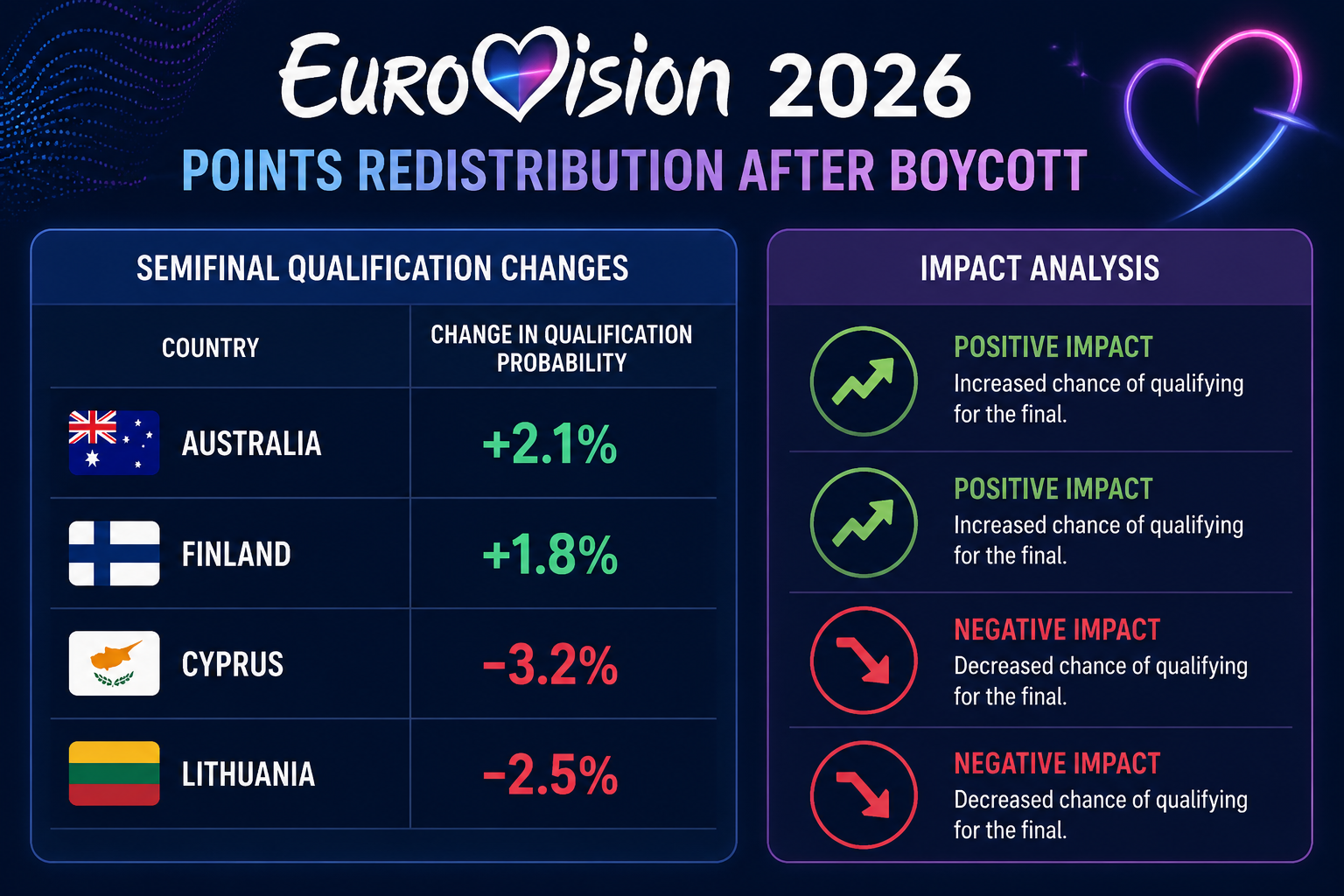
The Net Impact Table
Here is the aggregated effect — which countries lose the most friendly voting panels:
| Country | Friendly Voters Lost | Est. Points Lost | Current Odds | Effect |
|---|---|---|---|---|
| Denmark | 3 (Ireland, Netherlands, Iceland) | -12 to -20 | 7.00 (11%) | Significant negative |
| Sweden | 3 (Ireland, Netherlands, Iceland) | -10 to -18 | 26.00 (3%) | Moderate negative |
| Finland | 2 (Netherlands, Iceland) | -8 to -14 | 2.50 (30%) | Moderate negative |
| France | 2 (Ireland, Spain) | -8 to -14 | 9.00 (7%) | Moderate negative |
| UK | 1 (Ireland) | -6 to -10 | 51.00 (1%) | Mild negative |
| Romania | 1 (Spain) | -4 to -8 | 29.00 (3%) | Mild negative |
| Italy | 1 (Spain) | -4 to -8 | 29.00 (2%) | Mild negative |
| Portugal | 1 (Spain) | -4 to -8 | 41.00 (1%) | Mild negative |
| Greece | 0 | 0 | 4.00 (16%) | Neutral — no loss |
| Australia | 0 | 0 | 8.00 (9%) | Neutral — no loss |
| Malta | 0 | 0 | 17.00 (2%) | Neutral — no loss |
| Israel | 0 | 0 | 17.00 (4%) | Neutral (complex — see below) |
The critical insight: Greece, Australia, and Malta — three countries currently in the top 10 of the betting — lose zero friendly voting panels from the boycott. Meanwhile, Denmark (3rd favourite) and Sweden lose three each. This is a quantifiable structural advantage for Greece and Australia that the market may not have fully priced.
However, there is an important caveat. Eurovision scoring is percentage-based within each voting country. The total points available to each remaining entry from each remaining voting panel stay the same — 12, 10, 8, 7, 6, 5, 4, 3, 2, 1. What changes is that the entries that would have received those "friendly" votes must now earn them from elsewhere. The points are not destroyed; they simply go to whoever finishes in that position from the remaining voters.
The real question is: can Denmark replace Irish, Dutch, and Icelandic goodwill with equally high rankings from other countries? For a Danish-language ballad, the answer is probably not fully. Denmark's appeal is strongest in Scandinavia and Northern Europe — exactly the region most depleted by the boycott.
Section 3: The Viewership Effect — Broadcasting Boycotts Reduce Televote Power
This is the subtlest but potentially most consequential effect of the boycott. And it is the one bookmakers are least likely to have priced correctly.
Three countries — Ireland, Spain, and Slovenia — are not broadcasting Eurovision 2026 at all. Their national broadcasters are running alternative programming. This removes approximately 55 million people from the potential viewing audience.
Now, these 55 million were never all going to watch Eurovision. Spain typically draws 3-5 million Eurovision viewers. Ireland draws 400,000-700,000. Slovenia around 200,000-400,000. So the realistic viewership loss is 3.5-6 million viewers who would have watched live.
These are also potential online voters. Under Eurovision's rules, anyone in the world can vote online (up to 10 votes per person in 2026). When a national broadcaster promotes the show, it drives its population to the voting app. Without that promotion, the voting pool shrinks.
Why this matters for the jury vs televote split:
If the total televote volume drops — even by 5-10% — the margins between entries in the televote narrow. Smaller margins mean the jury vote becomes relatively more decisive. Not because the weighting changes (it is still 50/50), but because a closer televote means the jury split is more likely to determine the winner.
This structural shift favours jury-friendly entries and hurts televote-dependent entries.
| Entry | Jury Odds Rank | Televote Odds Rank | Boycott Effect |
|---|---|---|---|
| Finland | 1st | 1st | Minimal — dominates both |
| Australia | 2nd | 6th | Benefits — jury strength amplified |
| France | 3rd | 8th | Benefits — jury strength amplified |
| Denmark | 4th | 3rd | Slight benefit — strong in both |
| Greece | 5th | 2nd | Slight negative — televote-reliant |
| Israel | 20th+ | 1st (Polymarket 33%) | Hurt — massively televote-dependent |
| Malta | 7th | 4th | Neutral |
| Romania | 8th | 5th | Neutral |
The standout conclusion: Australia and France are the biggest relative beneficiaries of the reduced televote volume. Delta Goodrem's "Eclipse" ranks 2nd in jury odds but only 6th in televote — meaning any shift toward jury influence improves Australia's overall position. Monroe's "Regarde !" has the same profile.
Conversely, Israel is the biggest loser from this dynamic. Noam Bettan's "Michelle" leads the Polymarket televote market at 33% but sits around 20th in jury predictions. If the jury becomes more decisive due to lower televote turnout, Israel's path to the top 5 narrows dramatically.
Thunderpick — 100% First Deposit Bonus on All Eurovision Markets
Section 4: The Israel Factor — The Paradox of the Boycott
No analysis of the boycott's betting impact is complete without addressing the entry that caused it. And the numbers tell a counterintuitive story.
In January 2026, Israel's Noam Bettan was trading at 7/2 (22%) to win Eurovision. Today, May 7, Israel sits at 17/1 (4%). That is an 18-percentage-point collapse — and the boycott is a significant driver of that decline.
Here is the paradox: the boycott was motivated by opposition to Israel's participation, but the conventional wisdom was that controversy generates sympathy votes (as seen with Yuval Raphael in 2025, who jumped from 60 jury votes to a massive televote surge). Yet Israel's odds have lengthened, not shortened.
Why?
1. The casual sympathy voter is not watching. Spain, Ireland, and Slovenia are not broadcasting. The viewers most likely to cast a casual "I support Israel's right to compete" vote are less likely to be watching in the first place. The organised pro-Israel voting campaigns that drove Yuval Raphael's televote in 2025 still exist — but they are operating against a smaller total audience.
2. The max vote cap was cut from 20 to 10. The new EBU rules directly limit the impact of organised voting campaigns. In 2025, a dedicated voter could cast 20 votes for Israel. In 2026, they can cast 10. That halves the ceiling for vote-stacking.
3. Juries are back in semi-finals. Israel must now survive a 50/50 jury+televote split in the semi-final. Israel's jury odds are among the lowest in the field. A poor jury score could mean elimination before the Grand Final — something that was virtually impossible under the old televote-only semi-final format.
4. The diamond staging helps but does not solve the jury problem. Noam Bettan's mirrored diamond staging inside Wiener Stadthalle is visually spectacular — it shortened Israel from 21/1 to 17/1 after rehearsals. But the jury scores the song, the vocals, and the composition, not just the visuals. "Michelle" is a solid pop track but not a jury-favourite composition.
The Polymarket data tells the split story clearly:
| Market | Israel's Position | Probability |
|---|---|---|
| Overall Winner | 6th | 4% |
| Televote Winner | 1st | 33% |
| Jury Winner | 20th+ | ~1% |
Israel is the most polarised entry in Eurovision history by this metric. A 33% televote favourite that is a 1% jury favourite. The boycott amplifies this polarisation — by potentially reducing televote volume and increasing jury influence, it pushes Israel further from the overall winner market even as it remains the televote frontrunner.
For bettors: Israel at 17/1 outright is a high-variance play that the boycott has made worse, not better. The televote-specific market is where Israel offers value — but only if you believe the organised voting campaign can overcome the halved vote cap and smaller audience.
Section 5: Winners and Losers — The Complete Boycott Impact Table
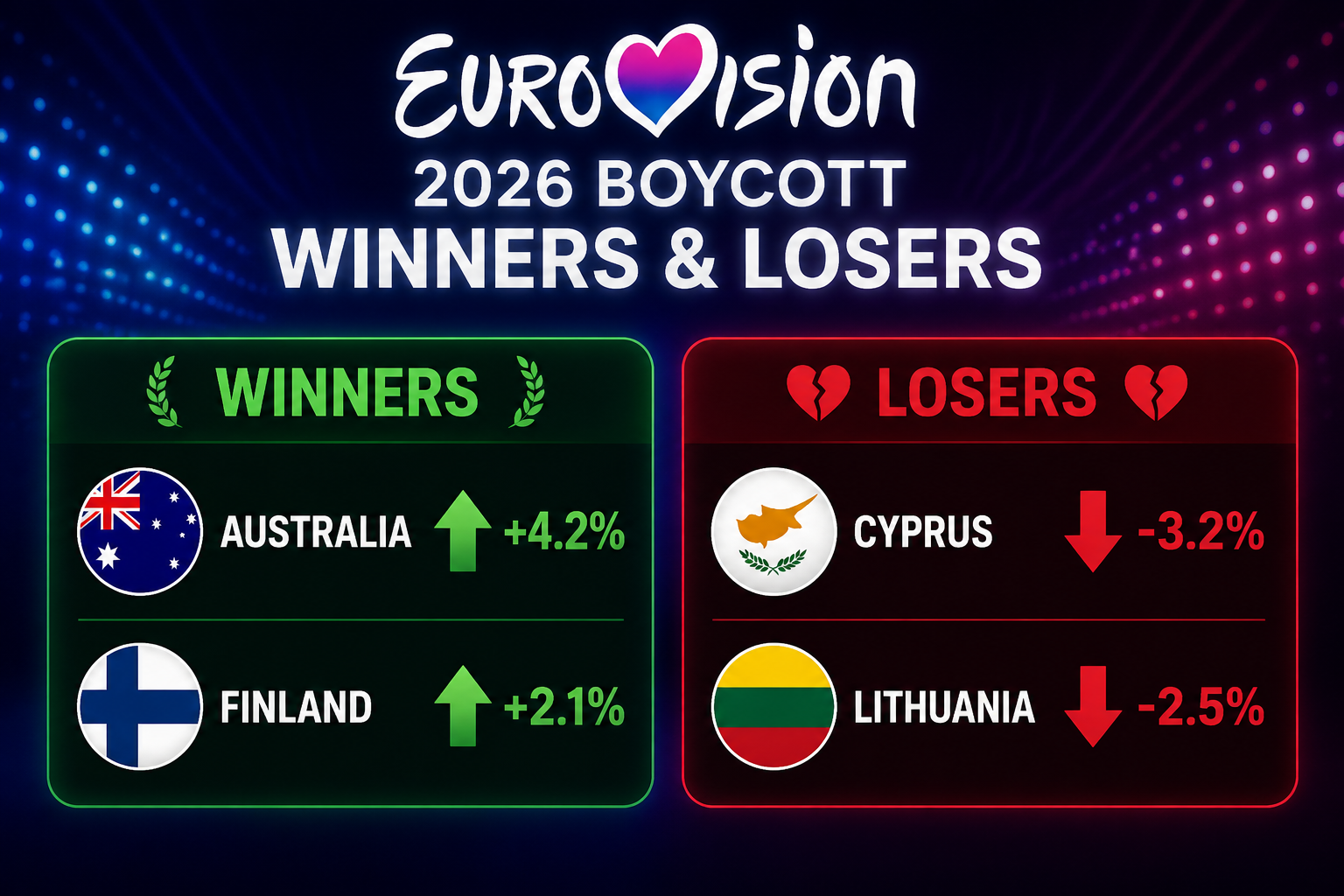
Putting all the analysis together — qualification math, points redistribution, viewership effects, and jury/televote dynamics — here is the complete table of who benefits and who is hurt by the five-country boycott:
| Country | Current Odds | Boycott Effect | Reasoning |
|---|---|---|---|
| Greece | 4.00 (16%) | NET WINNER | Loses zero friendly voters. Televote-strong but has jury backup. Diaspora unaffected by boycott. |
| Australia | 8.00 (9%) | NET WINNER | Loses zero friendly voters. Jury darling benefits from reduced televote dominance. Delta Goodrem's star power is geography-proof. |
| Malta | 17.00 (2%) | NET WINNER | Loses zero friendly voters. Easier SF2 qualification. Jury-televote balanced profile. |
| Finland | 2.50 (30%) | SLIGHT LOSER | Loses Netherlands and Iceland as friendly voters (-8 to -14 pts). But dominance across all metrics absorbs the loss. |
| France | 9.00 (7%) | MIXED | Loses Ireland and Spain as friendly voters. But jury-strong profile benefits from reduced televote influence. Net: roughly neutral. |
| Denmark | 7.00 (11%) | NET LOSER | Loses three friendly voters (Ireland, Netherlands, Iceland). Scandinavian/Northern European appeal most depleted by boycott countries. |
| Sweden | 26.00 (3%) | NET LOSER | Same three-voter loss as Denmark. Already drifting in odds. |
| Israel | 17.00 (4%) | SIGNIFICANT LOSER | Reduced televote volume, halved vote cap, jury in semis, fewer casual sympathy viewers. The boycott paradoxically hurts the entry it was about. |
| Romania | 29.00 (3%) | SLIGHT LOSER | Loses Spain as a Latin-bloc voter. But strong staging may compensate. |
| Bubble acts (Montenegro, Estonia, Latvia, etc.) | 100+ | NET WINNER | 67% qualification rate vs 56% in a normal year. Easier path to Grand Final. |
Cloudbet — Up to 5 BTC Welcome Bonus on Eurovision Betting
Section 6: Historical Parallels — What Previous Boycotts Tell Us
The 2026 boycott is unprecedented in scale, but Eurovision has seen withdrawals before. The historical data offers some context for how boycotts affect outcomes.
1970: The Original Boycott
After the controversial 4-way tie in 1969 (Spain, UK, Netherlands, France), Austria, Finland, Norway, Sweden, and Portugal boycotted the 1970 contest. The field dropped to just 12 countries. Ireland won with Dana's "All Kinds of Everything" — a moderate-strength entry that benefited from the reduced field. In a full-strength year, Dana might not have won.
Lesson: Smaller fields benefit cleaner, less polarising entries. The favourite might not change, but the margins tighten.
2022: Russia Banned
Russia's exclusion after the Ukraine invasion removed a single country with historically strong televote performance. The impact on the winner (Ukraine's Kalush Orchestra) was minimal — Ukraine won on an unprecedented wave of geopolitical sympathy that dwarfed any points redistribution effect.
Lesson: When one country is removed, the impact is marginal. When five are removed, the compound effect is meaningful.
2026: The Largest Voluntary Boycott in Modern History
Five countries. Three non-broadcasting. 1,100+ artists in solidarity. Eurovision director Martin Green called the boycotts "just a footnote" — but the betting math says otherwise. This is a structural shift in the competition dynamics, not a footnote.
Betting Recommendations: Playing the Boycott Edge
Based on the quantitative analysis above, here are our specific betting recommendations for exploiting the boycott effect:
1. BACK GREECE each-way at 4/1
Greece is the clearest boycott beneficiary among the top contenders. Zero friendly voters lost. Strong diaspora televote unaffected by European broadcasting boycotts. Akylas' "Ferto" has both jury and televote appeal. At 4/1 each-way (1/5 terms, top 4), you need Greece to finish top 4 — a 55%+ probability based on current data. This is our top boycott-adjusted pick.
2. BACK AUSTRALIA each-way at 8/1
Australia benefits from the jury-amplification effect. Delta Goodrem's entry ranks 2nd in jury odds and the boycott makes jury performance more decisive. The 7,000-crystal staging is the visual highlight of the contest. At 8/1, Australia needs a top-4 finish for each-way returns — achievable given the structural advantage.
3. FADE DENMARK relative to market position
Denmark at 7/1 (3rd favourite) loses more from the boycott than any other top-5 entry. Three friendly voting panels gone. A Danish-language ballad relies on Scandinavian goodwill — and Scandinavia is the region most depleted by the boycott. Denmark's true odds should be 9/1-10/1. If your bookmaker has Denmark at 7/1, there is negative expected value adjusted for boycott effects.
4. BET QUALIFICATION MARKETS on bubble acts
The 67% qualification rate is genuinely mispriced in most semi-final markets. Montenegro, Estonia, Switzerland, Latvia (SF1) and Cyprus, Georgia, Czech Republic, North Macedonia (SF2) all have better qualification chances than the odds imply. Look for any priced at 2.00+ (50% implied) — the true probability is 60-70%.
5. AVOID ISRAEL outright — consider televote market only
Israel at 17/1 looks tempting but the boycott has structurally weakened Israel's path. Reduced televote volume, halved vote cap, jury in semis. If you want Israel exposure, the televote-winner market at Polymarket (currently 33%) is a cleaner bet on Israel's actual strength.
Lock In Your Eurovision Bets at Betfred — Bet 10 Get 50 in Free Bets
All odds sourced from Eurovisionworld.com and Polymarket, verified May 7 2026. 18+. Please gamble responsibly. BeGambleAware.org
Frequently Asked Questions
Which countries are boycotting Eurovision 2026?
Five countries are boycotting: Iceland, Ireland, Netherlands, Slovenia, and Spain. All five withdrew in protest at Israel's continued participation. Three of them — Ireland (RTE), Spain (RTVE), and Slovenia (RTVSLO) — are not even broadcasting the contest, running alternative programming instead. This is the largest boycott since 1970.
How does the boycott change Eurovision 2026 betting odds?
The boycott changes odds in three ways. First, semi-final qualification rates rise from 56% to 67% due to fewer competitors. Second, specific countries lose friendly voting panels — Denmark and Sweden each lose three allies, while Greece and Australia lose none. Third, reduced televote volume from non-broadcasting countries makes jury scores more decisive, benefiting jury-strong entries like Australia and France.
Who benefits most from the Eurovision 2026 boycott?
Greece, Australia, and Malta benefit the most. All three lose zero friendly voters from the boycotting nations. Greece and Malta have balanced jury-televote profiles that are unaffected. Australia specifically benefits because its jury-strong profile is amplified when reduced televote volume makes jury scores more decisive. Bubble semi-final acts also benefit from the easier 67% qualification rate.
Does the boycott help or hurt Israel at Eurovision 2026?
The boycott paradoxically hurts Israel. While the boycott was motivated by opposition to Israel, the practical effects — reduced televote volume (fewer casual sympathy voters), halved vote cap (20 to 10), and juries returning to semi-finals — all weaken Israel's televote-dependent strategy. Israel dropped from 7/2 (22%) in January to 17/1 (4%) by May. Israel still leads the televote-specific market at 33% on Polymarket, but the overall winner path has narrowed significantly.
Is 2026 the biggest Eurovision boycott ever?
Yes. Five countries boycotting makes this the largest voluntary boycott in Eurovision history. The 1970 boycott also involved five countries (Austria, Finland, Norway, Sweden, Portugal) but was over a scoring controversy, not a geopolitical issue. Russia's 2022 exclusion was an EBU ban, not a voluntary boycott. The 2026 boycott is unique in being driven by broadcaster-level refusal, with three national broadcasters choosing not to air the show at all — unprecedented in the contest's 70-year history.
Related Articles
- Why Finland Will Win Eurovision 2026: The Full Betting Analysis
- Eurovision 2026 Winner Predictions: Grand Final Top 10 Odds After Rehearsals
- Eurovision 2026 Semi-Final 1: Who Qualifies? Post-Rehearsal Predictions
- Eurovision 2026 Semi-Final 2: Who Qualifies? Post-Rehearsal Predictions
- Eurovision 2026 Jury vs Televote: Country Breakdown After Rehearsals
- Eurovision 2026 Dark Horses After Rehearsals: 5 Countries the Odds Are Wrong About