
Greece has not won the Eurovision Song Contest since 2005. Helena Paparizou, My Number One, Athens — twenty-one years ago. An entire generation of Greek music fans has grown up without seeing their flag raised on Eurovision's biggest night.

18+ | New customers only | T&Cs apply | Please gamble responsibly
In 2026, that drought has its most realistic chance of ending. Akylas and "Ferto" sit at 14% win probability — second in the overall betting market behind Finland, with best odds of 4.00 at Betsson stretching to 7.20 on the Smarkets exchange. On Polymarket, $2.6 million has been traded on Greece's chances. The market is taking this seriously.
But there is a number buried in the Polymarket data that tells the real story of Greece's Eurovision 2026 campaign. A number that reveals both the opportunity and the risk in a single figure.
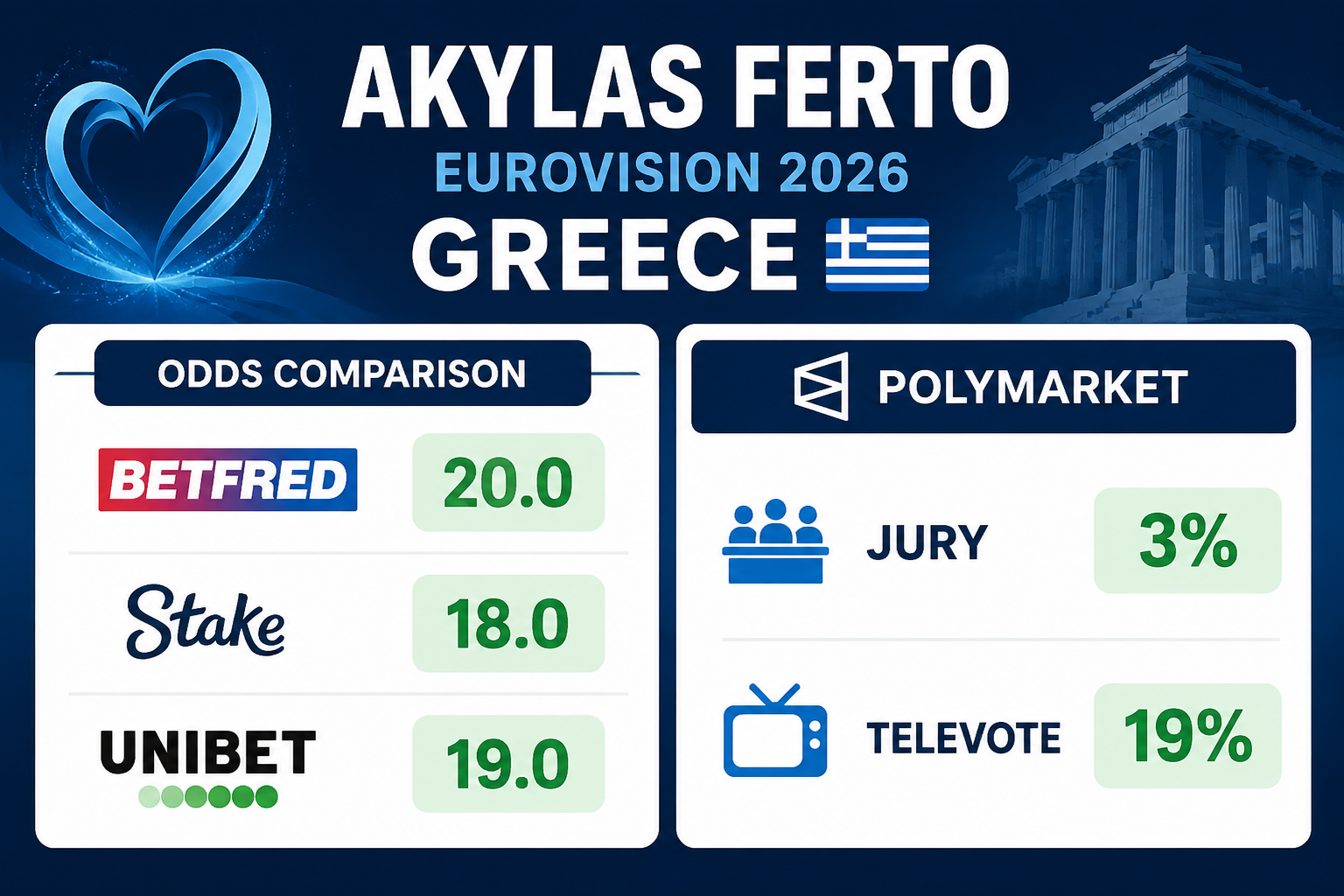
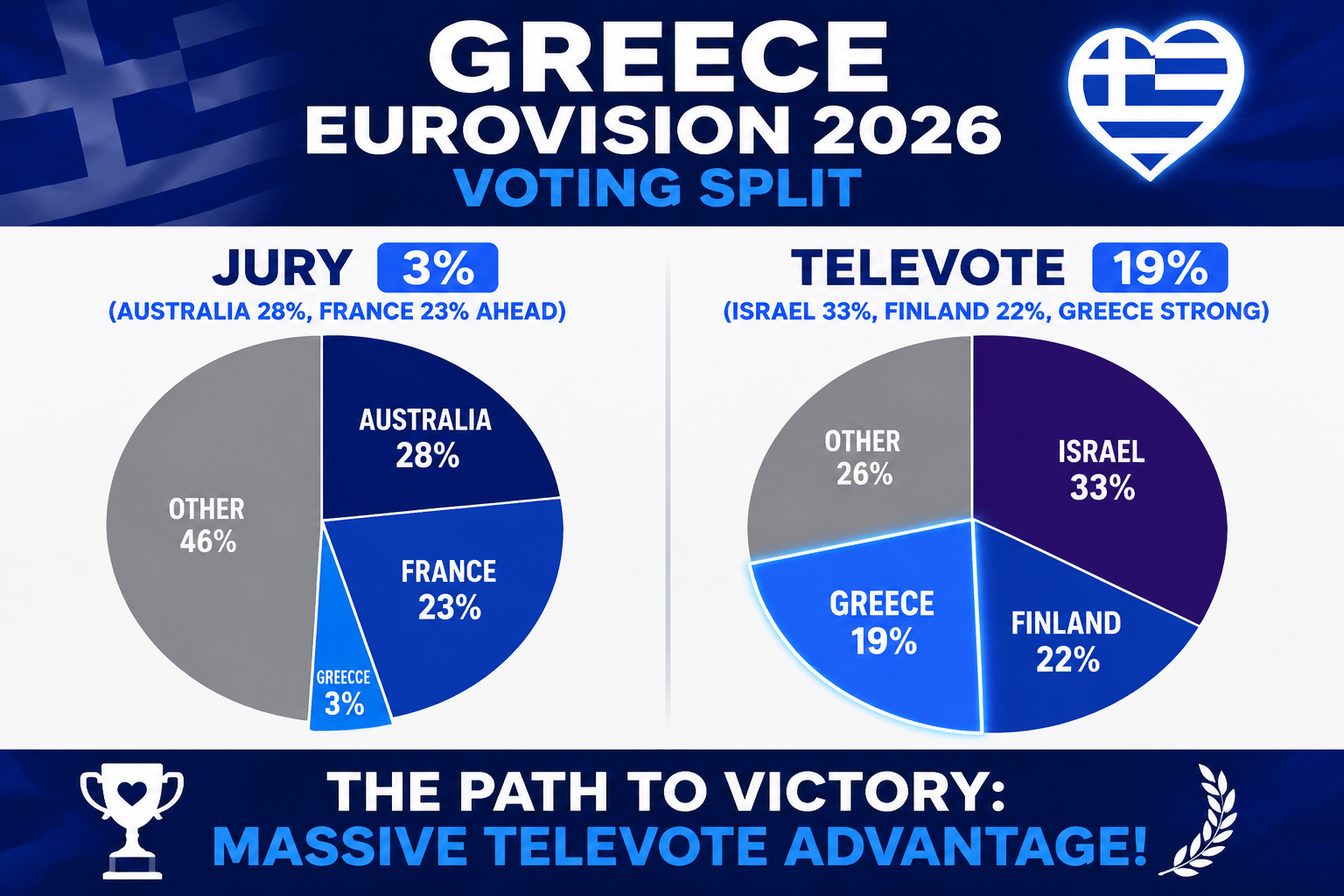
Greece jury winner probability on Polymarket: 3 cents. Three percent.
Greece televote winner probability: 19%.
That gap — 3% jury versus 19% televote — is the widest split of any serious contender at Eurovision 2026. It tells you everything about how Greece can win, and everything about how Greece can fall short. This article is about whether Akylas can bridge that divide.
Bet on Greece at Eurovision 2026 — Betfred: Bet 10 Get 50 in Free Bets
Who Is Akylas? The Artist Behind Greece's Best Chance in 21 Years
Akylas is not a manufactured pop star selected by committee. He is a self-taught musician from Serres, trained at the Serres Music School, who built his audience the modern way — through viral TikTok covers, organic social media growth, and a musical authenticity that resonated with a generation of young Greeks who had grown tired of formulaic entries.
His breakout came with the 2024 hit "Atelie", which crossed over from Greek-language streaming to wider Balkan audiences. The track demonstrated what makes Akylas different from the parade of polished vocalists Greece has historically sent to Eurovision: raw energy, genre-blending instincts, and a willingness to be unexpected.
At 23, he represents a generational shift in Greek music — an artist more comfortable switching between languages and styles than staying in a single lane. His TikTok presence gives him direct access to the young demographic that drives Eurovision televoting. His musical training gives him the technical foundation that juries respect. On paper, he is the perfect hybrid artist for a contest that rewards both authenticity and spectacle.
The Greek national selection was not even close. Akylas won with a margin that signalled genuine public excitement — the kind of domestic momentum that translates into diaspora pride when the Eurovision cameras switch on.
"Ferto" — Four Languages, One Overconsumption Anthem
"Ferto" is not a typical Eurovision song. It is performed in four languages — Greek, Spanish, French, and English — making it one of the most multilingual entries at Eurovision 2026. That linguistic diversity is not a gimmick. It is central to the song's theme: the global nature of overconsumption, materialism, and the hollow pursuit of wealth across cultures.
The musical architecture of "Ferto" builds from a brooding Mediterranean opening into a pulsing, layered chorus that draws from dark pop, Latin rhythms, and contemporary Greek production. The Greek verses carry emotional weight. The Spanish sections inject rhythmic heat. The French bridge adds sophistication. The English hooks ensure accessibility. Each language serves a purpose in the song's emotional arc.
Thematically, this is substantive material for Eurovision. While the contest has historically rewarded love songs and party anthems, the modern era has increasingly embraced entries with meaning — Netta's "Toy" (empowerment), Duncan Laurence's "Arcade" (grief), Kalush Orchestra's "Stefania" (war). "Ferto" joins that lineage of entries that say something beyond "I love you" or "dance with me."
The four-language approach also has a strategic dimension that the market may be underpricing. French-speaking countries (France, Belgium, Switzerland) hear their language. Spanish-speaking communities across Europe hear theirs. Greek diaspora hear theirs. English ensures everyone else understands the hook. Each linguistic choice is a potential televote magnet in specific markets.
The Rehearsals: Video Games, Tigers, and Emotional Devastation
Greece's second rehearsal at the Wiener Stadthalle revealed a staging concept that nobody predicted — and that could be the key to unlocking jury points that the Polymarket data currently does not expect.
The central stage prop is a multi-room structure inspired by a video game concept. As the performance unfolds, Akylas physically moves through different visual worlds — each "room" representing a different level in the game. It is unlike anything else on the Eurovision 2026 stage.
Each level carries distinct visual references:
- Ancient Greek references — traditional settings that root the performance in cultural identity
- Symbols of wealth and overconsumption — reflecting the song's thematic core
- Various characters in each level — creating a theatrical, almost cinematic feel
- A tiger-inspired alter ego — Akylas transforms mid-performance into a fierce, costumed figure
Then comes the moment that press centre journalists described as the performance's masterstroke. At the emotional climax, Akylas steps out of the video game character entirely. The theatrics fall away. The alter ego is shed. What remains is a young man delivering a heartfelt, vulnerable final section that hits with devastating emotional force precisely because it follows three minutes of spectacle.
This contrast — extravagance followed by stripped-back honesty — is the exact formula that wins Eurovision. Loreen did it with "Euphoria." Salvador Sobral did it with "Amar Pelos Dois." The transition from theatrical to genuine creates a TV moment that lingers in the mind long after the performance ends.

Dress rehearsal is scheduled for Monday May 11 — the final opportunity to refine the staging before Semi-Final 1 on May 12. Based on the second rehearsal evidence, the foundations are extraordinary. The question is whether the execution translates perfectly to the live broadcast camera work.
Stake — Crypto Betting with Instant Payouts on Eurovision Markets
The Numbers: Greece's Odds Landscape (May 7, 2026)
Let us lay out every relevant number in the Greece market.
Overall Winner Odds
| Bookmaker | Greece Odds | Implied Probability |
|---|---|---|
| Betsson | 4.00 | 25% |
| Bet365 | 5.00 | 20% |
| William Hill | 5.50 | 18% |
| Unibet | 6.00 | 17% |
| Betfred | 5.00 | 20% |
| Smarkets (exchange) | 7.20 | 14% |
| Market consensus | ~5.50 | ~14% |
Odds sourced from Eurovisionworld.com, verified May 7 2026. Betsson offers the shortest price, indicating they consider Greece a stronger contender than the market average.
Polymarket Breakdown ($2.6M Volume)
| Market | Greece Probability | Key Insight |
|---|---|---|
| Overall winner | 12% | 2nd behind Finland (41%) |
| Jury winner | 3% | Prediction markets see near-zero jury win chance |
| Televote winner | 19% | 2nd behind Israel (33%) |
The Polymarket data is the single most important analytical tool for understanding Greece's position. The 16-percentage-point gap between televote (19%) and jury (3%) tells us that the prediction market — which has $2.6 million of real money behind it — believes Greece's path to victory runs almost exclusively through the televote.
How Greece Compares to Key Rivals
| Country | Overall | Jury Win | Televote Win | Profile |
|---|---|---|---|---|
| Finland | 41% | 32% | 28% | Dominant both votes |
| Greece | 12% | 3% | 19% | Televote-dependent |
| Denmark | 14% | 23% | 5% | Jury darling |
| Israel | 8% | 4% | 33% | Televote monster |
| France | 7% | 23% | 3% | Jury play |
This table reveals the competitive landscape with brutal clarity. Finland leads everything. Denmark and France are jury plays. Israel and Greece are televote plays. Greece needs to beat Israel in the televote (or come very close) while simultaneously outperforming its 3% jury expectation to have any chance of winning overall.
The Diaspora Factor: Greece's Secret Weapon
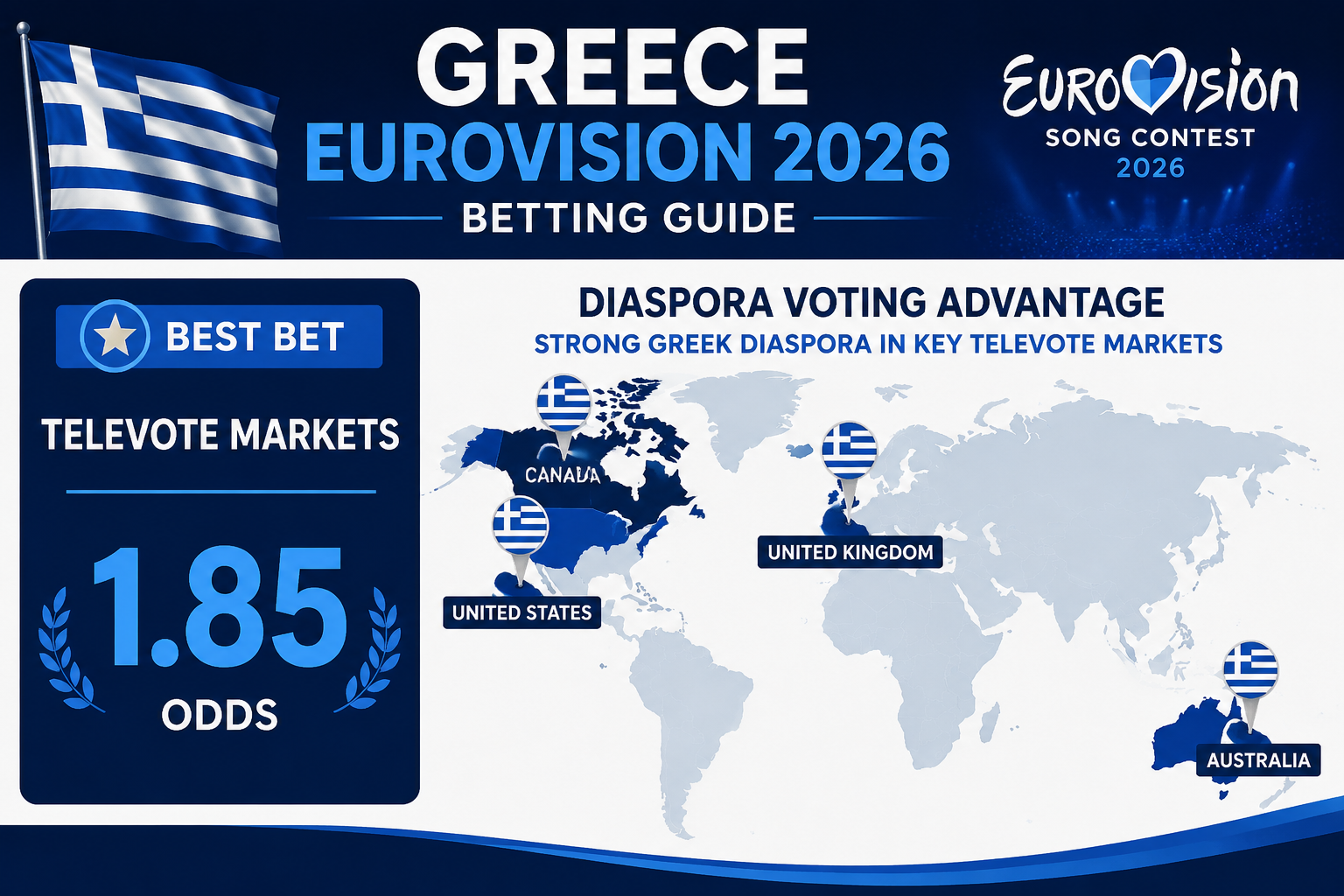
The Greek diaspora is one of the largest and most Eurovision-engaged communities in Europe. Understanding its reach is essential to understanding why Greece's televote probability sits at 19%.
Key Diaspora Populations
| Country | Greek Community | Televote Impact |
|---|---|---|
| Germany | ~400,000 | Major (largest EU population) |
| Australia | ~600,000 | Major (huge Greek-Australian community) |
| United Kingdom | ~300,000 | Significant |
| Cyprus | Entire population | Near-guaranteed 12 points |
| Belgium | ~50,000 | Moderate |
| Sweden | ~20,000 | Minor but consistent |
| Netherlands | ~15,000 | Minor but consistent |
Cyprus deserves special attention. The cultural, linguistic, and familial ties between Greece and Cyprus mean that Cyprus almost always awards Greece 12 points in the televote — and frequently in the jury vote as well. This is the most reliable voting relationship in Eurovision history, more consistent even than the Scandinavian bloc.
Beyond the diaspora, Greece benefits from broader Balkan and Mediterranean voting tendencies. Countries like Albania, North Macedonia, and Bulgaria have historically given Greece strong televote scores. Romania and Serbia occasionally contribute as well. This regional support network creates a baseline of 60-100 televote points before a single Western European viewer picks up their phone.
The boycott situation adds an unexpected wrinkle. With Spain absent from Eurovision 2026, one of the traditional Mediterranean competitors for the southern European vote is missing. Viewers in countries with significant Latin/Mediterranean communities who might have voted for Spain may redirect those votes to Greece — especially given "Ferto" includes Spanish-language sections. It is a small effect, but in a close televote race, small effects matter.
Thunderpick — 100% First Deposit Bonus on Eurovision Betting
Path to Victory: The Specific Scenario Greece Needs
For Greece to win Eurovision 2026, a very specific combination of outcomes must align. Here is the scenario, broken down into point projections.
Step 1: Dominate the Televote (Target: Top 2)
Greece needs a televote finish of 1st or 2nd. Based on the current Polymarket data, Israel (33%) is the favourite to win the televote, with Finland (28%) second and Greece (19%) third. Greece must leapfrog at least one of these competitors.
Projected televote score: 200-280 points (Top 2 finish). This requires the diaspora to mobilise fully, the four-language strategy to capture cross-border votes, and the video game staging to create a viral TV moment that drives casual viewers to their phones.
Step 2: Exceed Jury Expectations (Target: Top 6-8)
At 3% jury winner probability, the market expects Greece to finish mid-table with juries — perhaps 8th to 12th. Greece needs to outperform that expectation and land in the top 6-8 with juries.
This is where the video game staging concept becomes critical. Juries evaluate five criteria: vocal capacity, performance, composition, originality, and overall impression. The multi-room staging scores highly on originality — there is nothing else like it at Eurovision 2026. If Akylas' vocals are clean and the theatrical elements feel intentional rather than chaotic, juries could place Greece as high as 5th-6th.
Projected jury score: 80-140 points (Top 6-8 finish).
Step 3: Hope Finland Splits Its Dominance
Finland at 41% overall is the mountain Greece must climb. But Finland's strength is also its vulnerability: leading both jury AND televote means Finland is exposed to a split-vote attack. If Israel takes the televote crown and Denmark/France take the jury crown, Finland's combined lead shrinks.
Greece's ideal scenario: Israel wins the televote (pulling points from Finland), Denmark wins the jury (pulling points from Finland), and Greece finishes 2nd televote with a respectable jury — sneaking through the middle while Finland's vote is squeezed from both sides.
Step 4: Benefit from the Online Voting Revolution
Eurovision 2026 includes online/app-based voting for the first time in many markets, expanding the pool of potential voters beyond those willing to call a premium-rate phone number. The Greek diaspora — young, digitally native, and passionate about national representation — is perfectly positioned to benefit from this change. Akylas' TikTok following and social media presence translate directly into voting awareness and mobilisation.
The Combined Scenario
| Vote Type | Target Finish | Projected Points | Probability |
|---|---|---|---|
| Televote | 1st-2nd | 220-280 | 30% |
| Jury | 5th-8th | 90-140 | 25% |
| Combined | 1st-3rd | 310-420 | ~12-15% |
A combined score of 350+ points would likely be enough to win Eurovision 2026 unless Finland achieves a Loreen-2023-level dominant performance across both votes. The 12-15% probability broadly aligns with the betting market's 14% assessment — suggesting the odds are roughly fair, but with upside if the rehearsal staging translates better than the jury market expects.
Historical Parallels: The 2005 Blueprint
The comparison to Helena Paparizou's 2005 victory is not just nostalgic — it is analytically instructive.
In 2005, Greece won with "My Number One" scoring 230 points. The victory was built primarily on massive televote support. Paparizou was not the jury favourite — that crown went to entries from Malta and Romania. But the televote was so overwhelming that it carried Greece to the top of the combined scoreboard.
The parallels with 2026 are striking:
| Factor | 2005 | 2026 |
|---|---|---|
| Artist profile | Young, charismatic female artist | Young, charismatic male artist |
| Jury expectation | Moderate (not #1) | Low (3% win prob) |
| Televote strength | Dominant | Strong (19% win prob) |
| Diaspora mobilisation | Massive | Expected to be massive |
| Staging | Ahead of its time | Video game concept — innovative |
| Cultural identity | Greek pop with international polish | Multilingual with Greek core |
| Years since last win | N/A (first win) | 21 years |
The critical difference: in 2005, Greece's jury score was respectable enough to complement the televote. In 2026, Greece needs the same — a jury floor of top-8 to make the televote dominance count. If the jury places Greece 12th-15th, even a top-2 televote will not be enough to overcome Finland's combined strength.
Greece's Eurovision Record — Key Results
| Year | Artist | Song | Final Position | Notes |
|---|---|---|---|---|
| 2005 | Helena Paparizou | My Number One | 1st | Televote-driven victory |
| 2004 | Sakis Rouvas | Shake It | 3rd | Pre-televote era |
| 2008 | Kalomira | Secret Combination | 3rd | Strong televote |
| 2013 | Koza Mostra & Agathon | Alcohol Is Free | 6th | Viral staging |
| 2015 | Maria Elena Kyriakou | One Last Breath | 19th | Jury/televote mismatch |
| 2018 | Yianna Terzi | Oneiro Mou | NQ | Semi-final shock |
| 2019 | Katerine Duska | Better Love | 21st | Disappointing result |
| 2021 | Stefania | Last Dance | 10th | Return to form |
| 2024 | Marina Satti | Zari | 11th | Solid mid-table |
The pattern is clear: Greece performs best when it sends charismatic artists with strong staging and diaspora-friendly material. The 2018-2019 dip came when Greece sent introspective, understated entries that failed to energise the televote base. Akylas and "Ferto" are a deliberate return to the formula that works.
The Threats: What Stands Between Greece and Victory
Threat #1: Finland's Dominance (41% Overall)
Finland is not just the favourite — it is the most complete entry at Eurovision 2026. "Liekinheitin" leads both the jury odds (32%) and the televote odds (28%). For Greece to win, Finland needs to underperform in at least one vote. The good news: Finland leading both votes means it has further to fall. A technical mishap, vocal wobble, or staging issue on the night could shave 50-100 points off Finland's total. The bad news: Finland's rehearsals have been flawless so far. Read our full Finland analysis for the case for and against the favourite.
Threat #2: Israel's Televote (33%)
If Greece's path runs through the televote, Israel is the biggest obstacle. Noam Bettan's giant mirrored diamond staging is the most visually spectacular at the contest, and Israel's 33% televote probability dwarfs Greece's 19%. Israel does not need to beat Greece in the overall standings to ruin Greece's chances — it just needs to take enough televote points to prevent Greece from achieving the dominant televote score required to compensate for jury weakness.
The boycott factor cuts both ways for Israel. Four countries have withdrawn, generating controversy that could suppress some progressive Western European televotes — but the same controversy generates massive media coverage that ensures every casual viewer knows Israel's entry exists. In the televote, visibility beats subtlety every time.
Threat #3: The Jury Ceiling
At 3% jury winner probability, the prediction market is telling us that professional music industry juries — who evaluate vocal technique, composition, and artistic merit — do not rate "Ferto" as a top-tier entry. The video game staging concept could change this perception (innovative staging impresses juries when it feels artistic rather than gimmicky), but it could also backfire. If juries view the multi-room concept as chaotic or distracting from the music, the jury score could be even lower than the market expects.
The 2005 parallel offers some comfort: Paparizou's jury score was not spectacular either, but it was good enough. Greece does not need to win the jury vote. It needs to avoid a jury disaster.
Threat #4: Running Order
The Grand Final running order will be drawn after the semi-finals. If Greece draws a slot in the first 10 performers, recency bias in the televote could cost 20-40 points. Research consistently shows that late-performing entries receive more televotes. Greece needs a second-half slot — ideally positions 18-24 — to maximise the televote ceiling that its path to victory depends on.
Betting Verdict: Where Is the Value on Greece?
Here are our specific betting recommendations for Greece at Eurovision 2026, ranked by confidence level.
HIGH CONFIDENCE
Greece Top 5 at 1.80-2.20 — This is the strongest Greece bet available. At 14% win probability, the implied top-5 probability is 55-65%. Any price above 1.60 represents positive expected value. The combination of a strong televote floor (diaspora), innovative staging, and a genuinely good song makes a top-5 finish the most likely outcome for Greece.
MEDIUM CONFIDENCE
Greece to win at 4.00 (Betsson) — This is a value bet if you believe the televote will be massive. The 4.00 price implies a 25% win probability, but the true probability is closer to 12-15%. That sounds like negative EV — but the Betsson price is an outlier. The market consensus is 5.50-7.00, where the implied probability drops to 14-18%. At Betsson's 4.00, you are paying a premium for the best price, but the each-way component (if available) adds significant value.
Greece each-way at 7.00-7.20 (Smarkets) — The exchange price gives you a much wider entry point. At 7.20, the implied win probability is just 14% — right at the market consensus. The each-way at 1/5 terms requires a top-3 or top-4 finish for a return, which we estimate at 35-40% probability. This is a solid insurance bet.
SPECULATIVE
Greece televote winner — If your bookmaker offers this market, Greece at 19% implied probability may offer value depending on the price. Greece needs to beat Israel (33%) and Finland (28%) in the televote, which is a tall order — but a viral staging moment on the night could make it happen. Small stake only.
AVOID
Greece jury winner at 3% — The gap between 3% jury and 19% televote is too wide to bridge. Even with the innovative staging, Greece's musical profile does not scream "jury winner" when Denmark, France, and Finland are in the field. Do not throw money at a 3% probability when the market has accurately identified the limitation.
Betfred — Bet 10 Get 50 in Free Bets on All Eurovision Markets
The Bottom Line: Can Greece Win Eurovision 2026?
Yes — but only if the televote is enormous.
Greece has the second-best odds in the market for a reason. Akylas is a compelling artist. "Ferto" is a strong, multilingual entry with genuine thematic depth. The video game staging is the most creative concept at the contest. The Greek diaspora remains one of the most powerful voting blocs in Europe. And 21 years without a win creates the kind of narrative energy that casual voters respond to.
But the jury/televote split is real. At 3% jury versus 19% televote, the prediction market is telling us that Greece has a ceiling problem. To win, Akylas needs a top-2 televote finish AND a top-6-8 jury result. The televote target is achievable. The jury target requires the staging to impress jurors who may not be natural fans of theatrical, multi-room video game concepts.
The 2005 parallel gives us hope. Paparizou won with moderate jury support and dominant televote backing. If Akylas can replicate that formula — jury floor plus televote ceiling — the first Greek Eurovision victory in 21 years becomes not just possible, but probable in roughly one out of every seven parallel universes the betting market can imagine.
At 4.00-7.20 across the market, that is a bet worth making.
Cloudbet — Up to 5 BTC Welcome Bonus on Eurovision Betting
Frequently Asked Questions
Can Greece win Eurovision 2026?
Yes. Greece is the second favourite at 14% win probability (odds of 4.00-7.20). Akylas' "Ferto" has massive televote potential backed by a huge diaspora and innovative video game staging. However, Greece's jury probability is just 3% on Polymarket, meaning victory requires a dominant televote performance to compensate. Greece has not won since Helena Paparizou in 2005.
What are the best odds on Greece to win Eurovision 2026?
Betsson offers 4.00 (shortest price), while Smarkets exchange offers 7.20 (longest price). The market consensus is approximately 5.50, implying a 14% win probability. For each-way betting, the 7.00-7.20 range at exchange bookmakers provides the best value. All odds verified May 7 via Eurovisionworld.com.
What happened at Greece's Eurovision 2026 rehearsal?
Greece's second rehearsal revealed a multi-room staging concept inspired by video games. Akylas moves through different visual "levels" featuring ancient Greek references, symbols of wealth, theatrical characters, and a tiger-inspired alter ego. The performance ends with an emotional turn where Akylas steps out of character for a heartfelt, stripped-back moment. The dress rehearsal is scheduled for Monday May 11, ahead of Semi-Final 1 on May 12.
What languages is "Ferto" sung in?
"Ferto" is performed in four languages: Greek, Spanish, French, and English. The multilingual approach reflects the song's theme of global overconsumption and serves a strategic purpose — each language targets specific voting demographics across Europe and Australia.
When does Greece perform at Eurovision 2026?
Greece performs in Semi-Final 1 on Monday May 12, 2026 at the Wiener Stadthalle in Vienna. If Greece qualifies (which is widely expected), they will perform in the Grand Final on Saturday May 17. The Grand Final running order will be determined after the semi-finals. All shows begin at 21:00 CEST.
Related Articles
- Why Finland Will Win Eurovision 2026: The Full Betting Analysis
- Eurovision 2026 Winner Predictions: Grand Final Top 10 Odds After Rehearsals
- Eurovision 2026 Semi-Final 1: Who Qualifies? Post-Rehearsal Predictions
- Eurovision 2026 Jury vs Televote Predictions: Country Breakdown After Rehearsals
- Eurovision 2026 Dark Horses After Rehearsals: 5 Countries the Odds Are Wrong About
- Eurovision 2026 Each-Way Betting Tips: 5 Value Picks
All odds sourced from Eurovisionworld.com and Polymarket, verified May 7 2026. 18+. Please gamble responsibly. BeGambleAware.org. When the fun stops, stop.