
Burgas is hosting Eurovision 2027. On 13 August 2026 the EBU and Bulgarian National Television named the Black Sea port city as the home of the 71st Eurovision Song Contest, and in doing so eliminated the city that every aggregated market had made a runaway favourite. Sofia reached the final two. Sofia lost.

18+ | New customers only | T&Cs apply | Please gamble responsibly
We wrote the host-city market up on 20 May, with Sofia at 84.5%. This is the autopsy.

What was actually decided
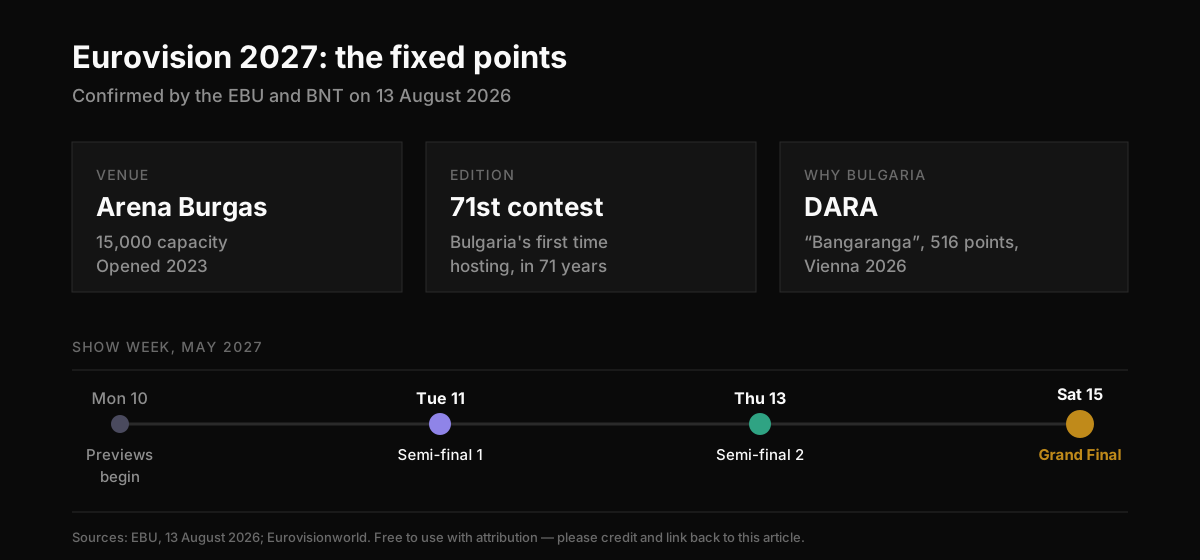
The contest goes to Arena Burgas, a 15,000-capacity hall opened in 2023, with three live shows: semi-finals on Tuesday 11 May and Thursday 13 May 2027, and the Grand Final on Saturday 15 May. Six preview shows run alongside from Monday 10 May. It is Bulgaria's first time staging the contest in its 71-year history, earned by DARA's “Bangaranga” and its 516 points in Vienna.
Contest director Martin Green framed the choice around the city rather than the building: “Burgas brings something really special to the Eurovision Song Contest. It is a vibrant, welcoming city on the Black Sea with a strong musical and cultural identity.” Mayor Dimitar Nikolov went further: “This is not about one city hosting Eurovision. This is Bulgaria hosting Eurovision — an entire community, united and inspired.”
Plovdiv and Varna were cut at the first stage. Sofia and Burgas went to the final round.
Where the 84.5% came from — and what it was actually pricing
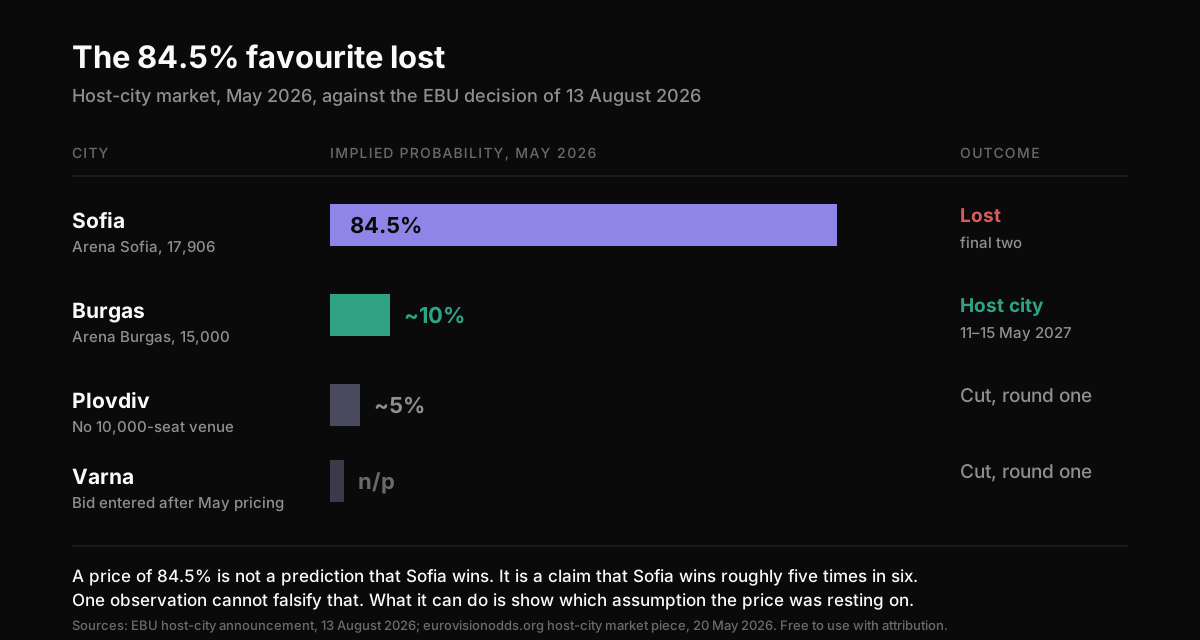
Our May piece gave three reasons for the price, and it is worth being precise about which of them failed.
Reason one: capitals host. We pointed at Vienna 2026, Basel 2025, Malmö 2024, Liverpool 2023, Turin 2022 and Rotterdam 2021 and called the capital “the default”. Look at that list again. Basel is not the Swiss capital. Malmö is not the Swedish capital. Liverpool is not the UK capital. Turin is not the Italian capital. Rotterdam is not the Dutch capital. Four of the six examples we cited as evidence for a capital-city rule were not capital cities. The pattern was real — large media-and-transport hubs win — but we stated it in a form the evidence did not support, and the stated form is the one that produced the confidence.
Reason two: venue arithmetic. We noted Arena Sofia at 17,906 against Arena Burgas at 15,000 and treated the extra 2,906 seats as decisive. It was not decisive, and on reflection it could not have been. The EBU floor is 10,000. Both venues clear it. Once two bidders are over a threshold, the margin above it stops being a discriminator and becomes a rounding detail — the production bowl reduces both halls to something in the same band anyway. We were scoring a criterion that had already been satisfied.
Reason three: infrastructure and air access. This one held up better and still lost. Burgas Airport handles a Black Sea summer tourist season; the city's hotel inventory exists precisely because several million holidaymakers pass through it. The EBU's own stated rationale listed hotel accommodation, transport connectivity and international access among the reasons Burgas won. A coastal resort city in May is not short of beds. We treated seasonal tourist infrastructure as inferior to capital-city infrastructure without checking the numbers.
The part the model could not see
Read the mayor's quote again, then read the EBU's phrase about “capacity to transform the entire city into a Eurovision experience.” Burgas has roughly 200,000 people. Sofia has roughly 1.2 million. A contest lands on Burgas the way a contest landed on Malmö or Liverpool: it takes the place over completely, and the host broadcaster gets footage of a city visibly rearranged around the show. It cannot do that to a capital, because a capital absorbs it.
That is a preference the EBU has expressed repeatedly through its choices and rarely states as a criterion. It is also, crucially, not a number. Any model built from venue capacities and airport statistics will systematically underprice the small-city bid, because the thing the small city is selling does not appear in the inputs.
Was the price actually wrong?
Here is the uncomfortable honest answer: one observation cannot tell you.
84.5% is not a forecast that Sofia wins. It is a claim that a Sofia-shaped bid wins about five times in six. A single Burgas result is exactly what the remaining one-in-six looks like. If you insist that every 84.5% must land, you have not understood what the number means.
What the result can do is expose the reasoning. And the reasoning had a false premise in it — the capital-city rule that four of our own six examples contradicted. That is not variance. That is a bad input. A price built on a corrected premise would not have been 84.5%; on the strength of the actual evidence, a favourite in the 55–65% band would have been defensible, which makes Burgas an ordinary outcome rather than an upset.
Three things to take into the next host-city market
1. Check whether your historical rule survives its own examples. Ours did not. Write the list out, count the exceptions, and if the exceptions outnumber the confirmations, you have a tendency, not a rule — and tendencies do not support 84.5%.
2. Above a threshold, stop scoring the threshold. Venue capacity discriminates between bidders who clear the EBU minimum and bidders who do not. Between two who clear it, it is close to noise. Plovdiv's absence of a qualifying venue was the real signal in the May table; Sofia's extra seats were not.
3. Price the unquantified criterion. Civic transformation, political will and municipal commitment decided this. None of them are in any dataset. When the deciding factors sit outside your model, your model's confidence should come down, not up.
Update, 25 August: Bulgaria has since allocated €20 million to Eurovision 2027, explicitly including the promotion of Bulgaria as a tourism destination — the civic-transformation thesis with a price tag on it. Sofia has separately demanded its criterion-by-criterion bid scores from BNT. If those are published, this post-mortem can be checked against the actual marking.
What is now live for 2027
The host city is settled, so that market is done. What remains open is the participation question — which broadcasters actually turn up in Burgas — and a proposed overhaul of the public vote that would change how every outright market has to be modelled. We track the live participation prices in a separate piece.
Twenty-one broadcasters have expressed interest so far, including Canada as a debutant and North Macedonia returning after a five-year absence. Formal applications are due to the EBU by mid-October 2026, with the confirmed list expected before the end of the year.
Quick answers
Where is Eurovision 2027? Arena Burgas, Burgas, Bulgaria — announced 13 August 2026.
What are the 2027 dates? Semi-final 1 on 11 May, semi-final 2 on 13 May, Grand Final on 15 May 2027.
How big is Arena Burgas? 15,000 capacity. It opened in 2023 and clears the EBU's 10,000-seat minimum comfortably.
Why not Sofia? Sofia made the final two and lost. The EBU cited arena infrastructure, hotels, transport, international access, municipal commitment and the capacity to turn the whole city into a Eurovision host — the last of which favours a city of 200,000 over one of 1.2 million.
Did the betting markets get it wrong? The aggregated market had Sofia at 84.5% and Burgas near 10%. A 10% shot landing is not proof the price was broken, but the published reasoning behind the price contained a capital-city rule that its own supporting examples contradicted.