
Kazakhstan has formally asked to be let into the Eurovision Song Contest 2027. Khabar Agency, the Kazakh state broadcaster, has applied to the European Broadcasting Union for full membership and for a place at the contest in Burgas next May. The application surfaced on 9 September 2026 in the Kazakh Ministry of Information and Culture’s written reply to a public letter, reported by Eurovoix. The EBU has not commented on it and has published no timeline for a decision.

18+ | New customers only | T&Cs apply | Please gamble responsibly
This is the third time in nine years that Kazakhstan has tried to get through this particular door, and it is the first time it has tried the door that actually opens. What follows is what was applied for, why the previous attempts failed, and why the prediction market barely moved on the news — which, on the evidence, is the correct reaction.

What Khabar Agency actually applied for

Two things, together: full EBU membership, and participation in Eurovision 2027. They are separate requests and the second depends on the first.
Khabar has been an EBU associate member since 2015 — Eurovoix dates it to 2015, Wikipedia to January 2016, and neither cites the other, so treat the exact month as unsettled. Associate membership is the status held by broadcasters outside the European Broadcasting Area. It buys access to EBU services and events. It does not buy an entry to the Eurovision Song Contest.
The disclosure route matters for how much weight to put on this. It is not a Khabar press release and not an EBU announcement. It is a government ministry answering a letter. The underlying diplomacy is older: Kemelbek Oishybayev, chairman of Khabar Agency’s board, raised Eurovision participation directly with EBU Director General Noel Curran at the 2025 EBU General Assembly in London.
Why associate membership was never enough
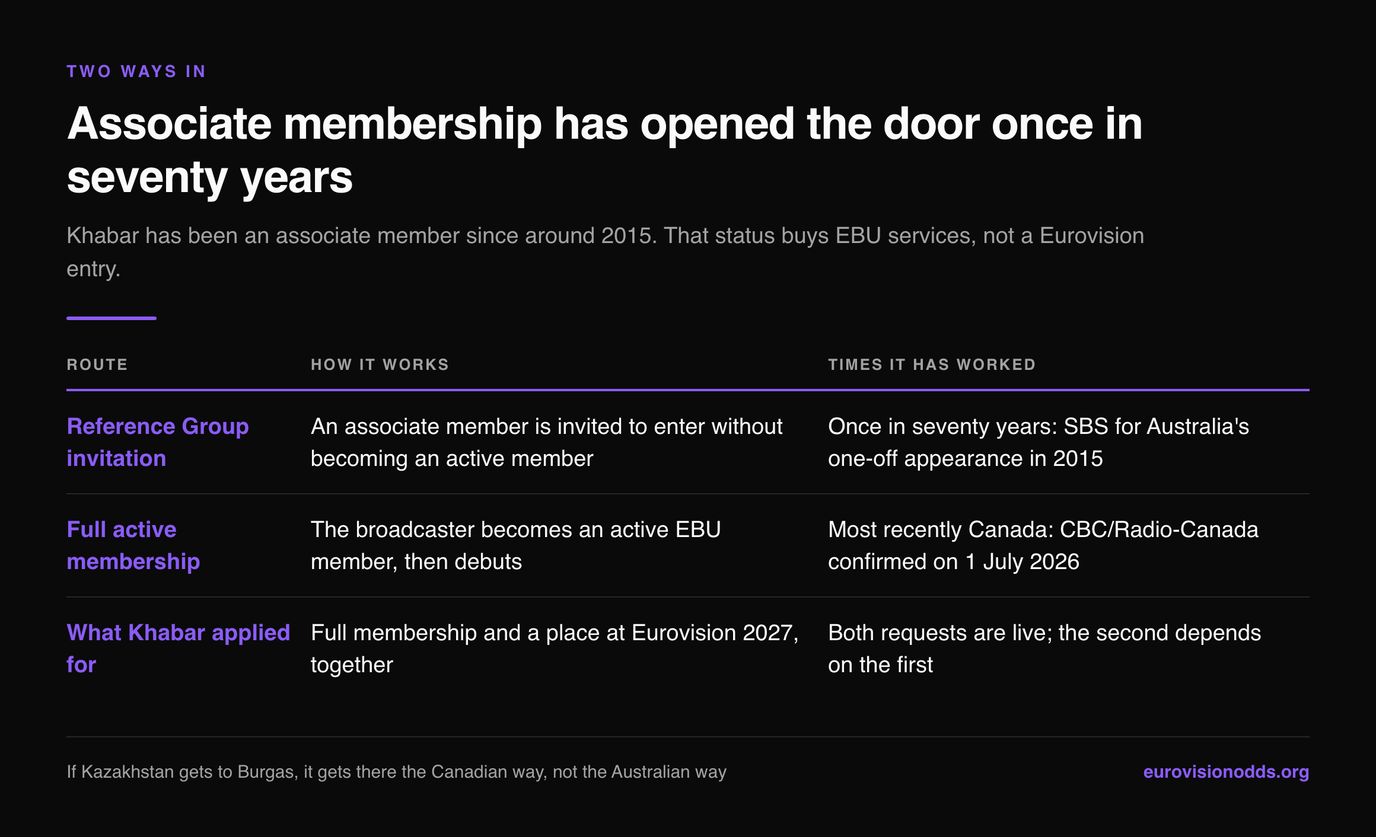
An associate member cannot simply enter Eurovision. It has to be invited by the contest’s Reference Group. That has happened exactly once in seventy years: SBS was invited for Australia’s one-off appearance in 2015, and Australia has been there ever since.
One precedent in seven decades is not a route. It is an exception, and it was granted to a broadcaster with a forty-year unbroken record of airing the contest to a large domestic audience. Nothing in the EBU’s conduct since suggests it wants to repeat the manoeuvre on request.
The route that has demonstrably worked recently is the one Khabar is now attempting. Canada did not get invited. CBC/Radio-Canada became an active EBU member and then debuted, confirmed on 1 July 2026 in a joint EBU/CBC announcement. Its artist applications closed on 9 September, the same day the Kazakh application became public. If Kazakhstan gets to Burgas, it gets there the Canadian way, not the Australian way.
Kazakhstan has been here before, twice
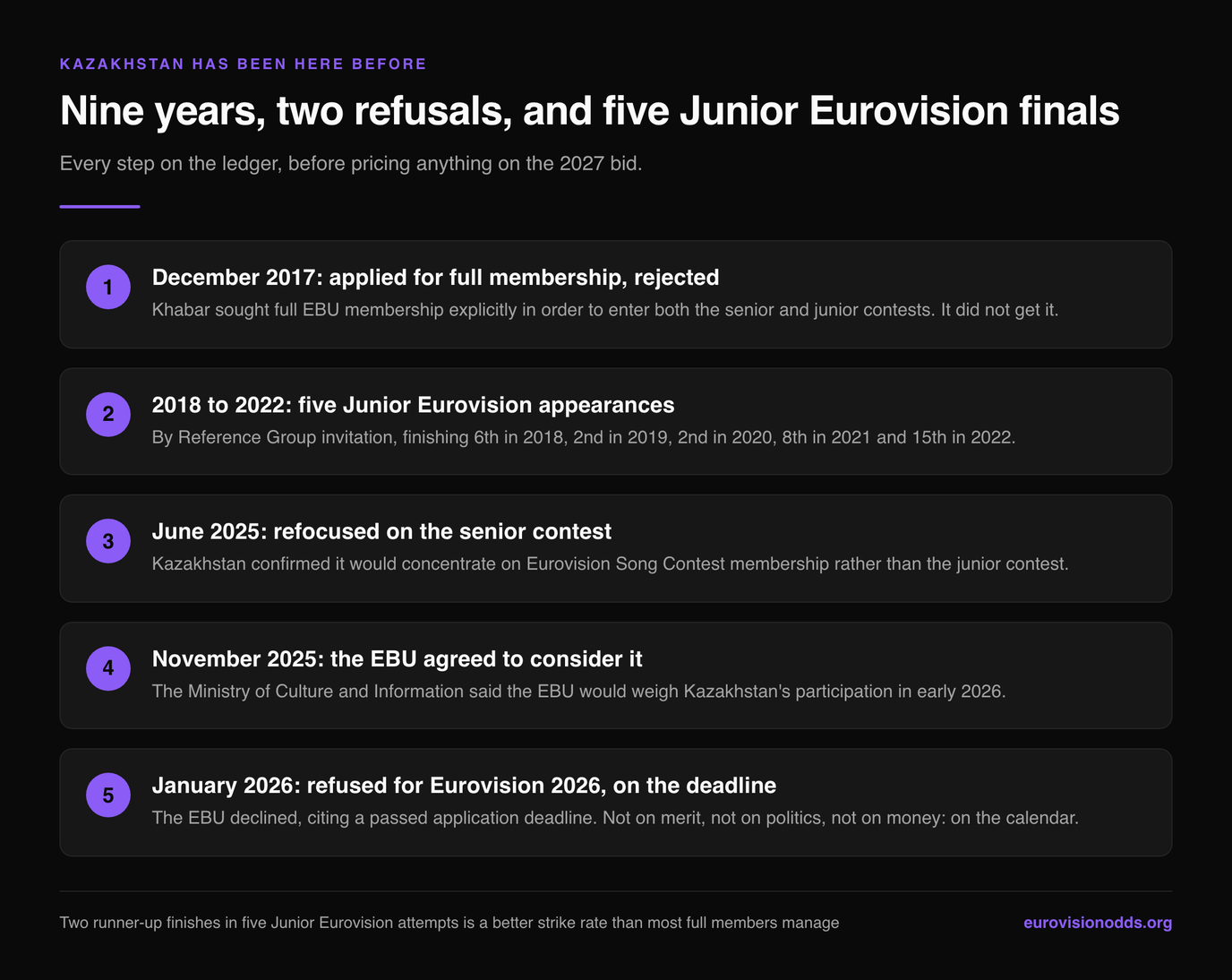
The bid has history on both sides of the ledger, and the ledger is worth reading in full before pricing anything.
- December 2017 — applied for full membership, rejected. Khabar sought full EBU membership explicitly in order to enter both the senior and junior contests. It did not get it.
- 2018–2022 — five Junior Eurovision appearances. Kazakhstan competed at Junior Eurovision by Reference Group invitation and was good at it: 6th in 2018, 2nd in 2019, 2nd in 2020, 8th in 2021, 15th in 2022. Two runner-up finishes in five attempts is a better strike rate than most full members manage.
- June 2025 — refocused on the senior contest. Kazakhstan confirmed it would concentrate on Eurovision Song Contest membership rather than the junior contest.
- November 2025 — the EBU agreed to consider it. The Ministry of Culture and Information said the EBU would weigh Kazakhstan’s participation in early 2026.
- January 2026 — refused for Eurovision 2026, on the deadline. The EBU declined, citing a passed application deadline. Not a refusal on merit, on politics or on money: on the calendar.
That last one is the most instructive item on the list, and it is the one the 2027 bid has to solve.
The two obstacles: money and the calendar
The Kazakh government has been unusually candid about the first. In its November 2025 statement the Ministry said participation “would require significant financial investment” and that “the current budget does not take this into account”. That is a broadcaster’s own government saying, on the record, that the money is not allocated. Nothing published since 9 September says it now is.
The second obstacle is the one that already killed the 2026 attempt. Eurovision participation runs on a hard application deadline, and the EBU has shown it will enforce it against Kazakhstan specifically. The 2027 deadline falls in the autumn; the only publicly reported flexibility is an exceptional extension to 7 December 2026, which Hungarian outlet 24.hu reported on 3 September that MRTV had negotiated for itself. That extension was reported for Hungary, by a Hungarian outlet, and neither the EBU nor MRTV has confirmed its terms. Do not assume it generalises to Kazakhstan.
Membership decisions add a third clock. Full EBU membership is not granted by the secretariat on receipt of a form; it goes through the union’s governance. Khabar therefore needs a membership decision and then a participation decision, both inside the 2027 window. The EBU has not said when either would happen. Our running tracker of the field is on the Eurovision 2027 page, where Kazakhstan now sits in the undecided column.
What the Kazakhstan market is actually saying
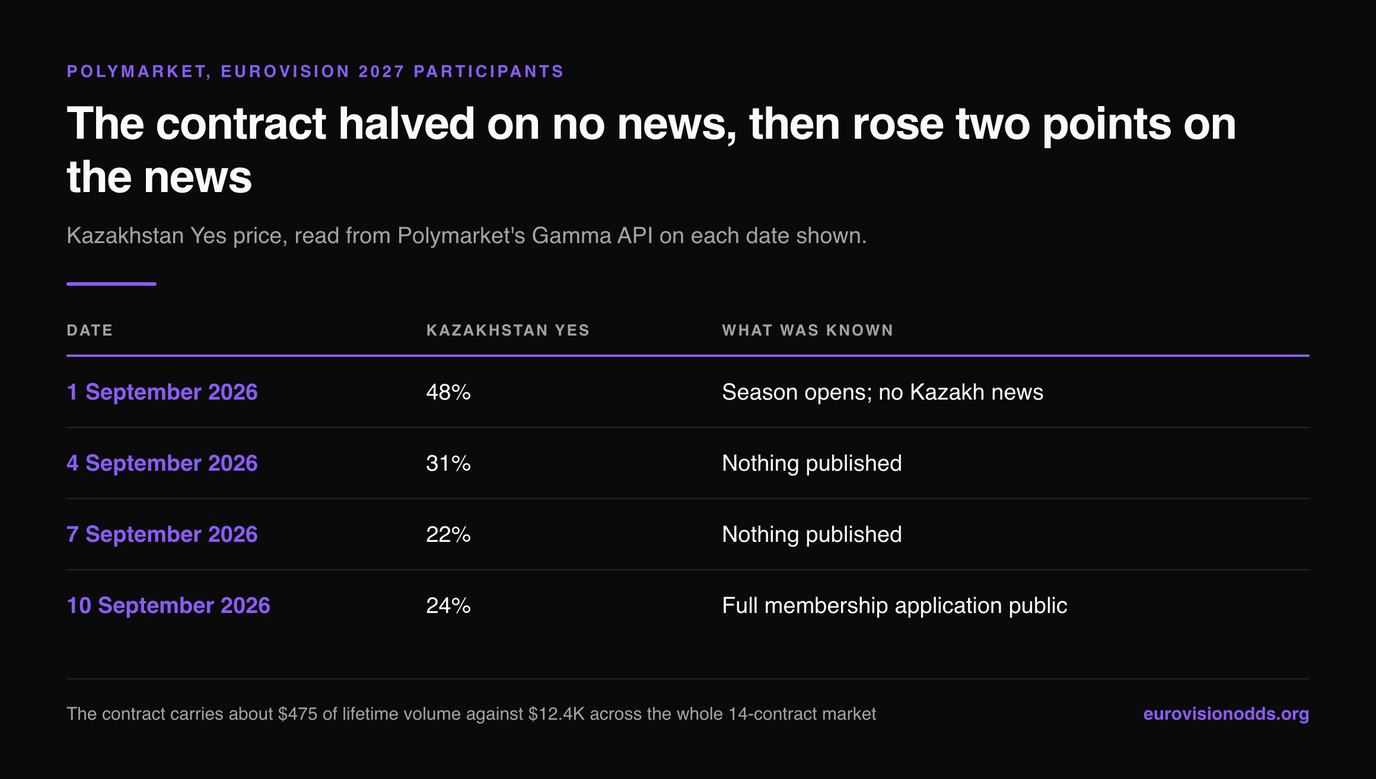
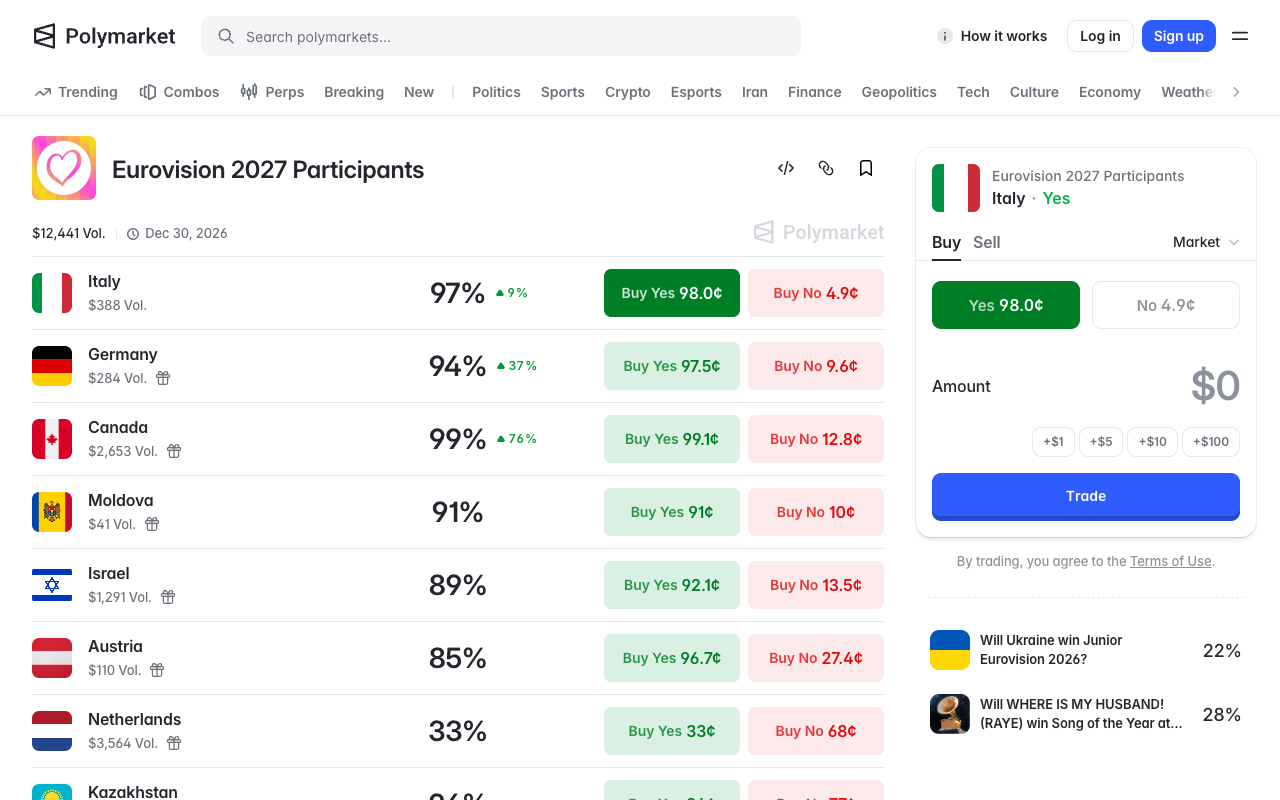
Polymarket lists a Kazakhstan contract inside its Eurovision 2027 Participants market, so unusually for a story like this there is a live price to read. Here is the path, each figure read from Polymarket’s Gamma API on the date shown.
| Date | Kazakhstan “Yes” | What was known |
|---|---|---|
| 1 September 2026 | 48% | Season opens; no Kazakh news |
| 4 September 2026 | 31% | — |
| 7 September 2026 | 22% | — |
| 10 September 2026 | 24% | Full membership application public |
The contract halved over nine days without a single piece of Kazakh news, then rose barely two points on the day the country formally applied. It would be easy to call that a mispricing and a buy. We think it is close to right, for three reasons.
First, an application is a request, not an outcome. Khabar applied in December 2017 and was rejected. The market is pricing the EBU’s answer, not Kazakhstan’s question, and the answer is unchanged since 9 September because there is no answer yet.
Second, the deadline risk is real and already tested. The 2026 attempt died on the calendar, and the 2027 bid needs two governance decisions to clear the same calendar. A 24% probability for “full membership approved and participation approved and funded and inside the window” is not obviously cheap.
Third, and this is the caveat that governs everything above: read the volume before you read the price. The Kazakhstan contract carries about $475 of lifetime volume, against $12.4K across the whole 14-contract market. At that size a price is one or two participants’ opinion, not a consensus, and the drift from 48% to 22% on no news is better explained by thin-book noise than by anyone learning anything. We made this mistake in reverse in August, treating a low-liquidity Netherlands price as stale when it turned out to be closer to right than the news report we set against it. Thin is hard to trade. Thin is not the same as wrong.
There is no bookmaker market on Kazakhstan’s 2027 participation at any of the books we track, and no prediction market other than the Polymarket contract above. If you want to see how prediction-market pricing compares with fixed odds on the questions that are priced, start with the winner market.
The Eurovision Asia angle, and why Khabar chose Europe
Kazakhstan is the one country with a live claim on both contests this site covers. Voxovation, which produces Eurovision Song Contest Asia, has named a target of 12 to 14 countries for future editions and Kazakhstan has been publicly discussed as a candidate for that expansion. The inaugural Asia contest runs in Bangkok on 14 November 2026 with eleven countries, and its field is closed.
Khabar has gone to Europe instead, and the choice makes sense on its own terms. Eurovision Asia has no second edition confirmed, no host, no bidding outcome and no betting market of any kind — we have checked Polymarket eight consecutive times since August and found nothing. Eurovision 2027 has a date, a venue in Burgas and 24 confirmed broadcasters. A state broadcaster choosing between an established contest and an unproven one picks the established contest.
It is worth noting what the two applications have in common, because it cuts against the easy reading of the EBU as closed. Canada is in for 2027. Australia has been in since 2015. The contest’s geography has been notional for a decade, and the barrier Kazakhstan faces is membership and money, not the map.
What would actually move the price
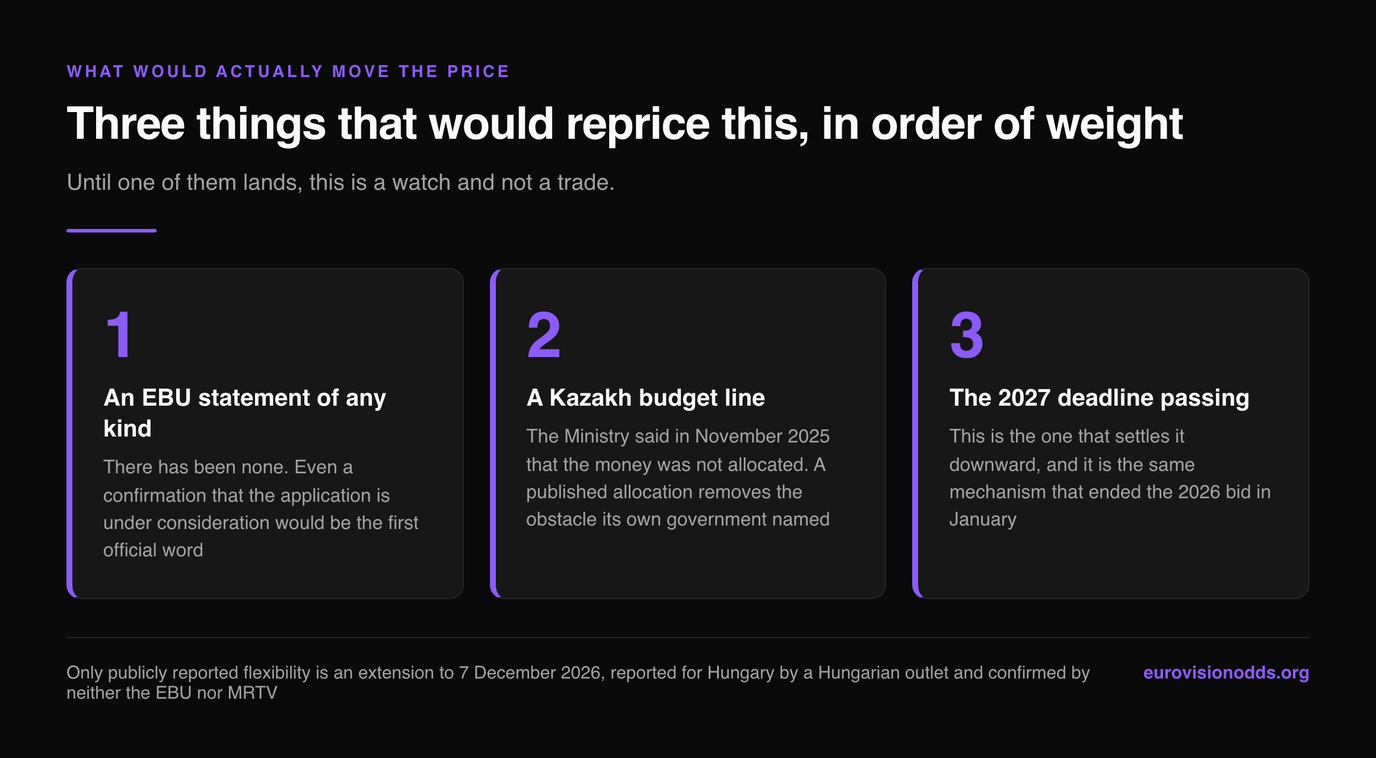
Three things, in rough order of how much each would matter.
- An EBU statement of any kind. There has been none. Even a “the application is under consideration” would be the first official word and would reprice the contract immediately.
- A Kazakh budget line. The Ministry said in November 2025 that the money was not allocated. A published allocation would remove the obstacle its own government named.
- The 2027 application deadline passing without Kazakhstan on the list. This is the one that settles it downward, and it is the same mechanism that ended the 2026 bid in January.
Until one of those lands, this is a watch and not a trade — and at $475 of lifetime volume it would be a difficult trade even if it were a good one. We poll the market daily and will update the 2027 tracker the day the EBU says anything. For the wider state of the field, including the eight broadcasters whose 2027 song submission windows close this autumn, see our season-opening round-up.
Sources
Primary reporting: Eurovoix, 9 September 2026 and Eurovoix, 29 November 2025. Junior Eurovision results and membership history via Wikipedia. All prices read from Polymarket’s Gamma API on 10 September 2026; prices move, and these were correct at the time of checking and not after.