
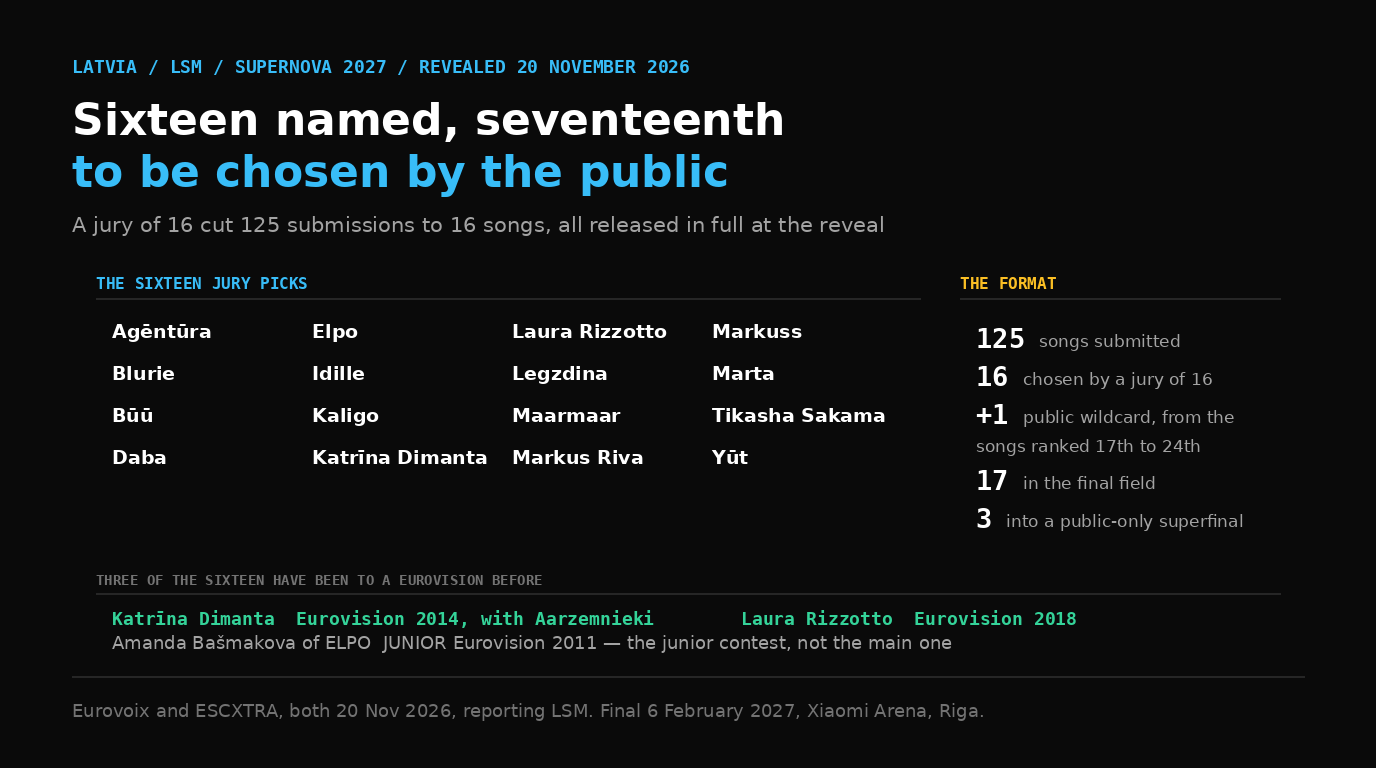
Latvia has named the sixteen acts who will compete at Supernova 2027, and with Estonia it now holds one of only two complete national-final fields anywhere in the 2027 season. LSM revealed the line-up on the morning of 20 November 2026, with all sixteen songs released in full at the reveal rather than trickled out over the following weeks.

18+ | New customers only | T&Cs apply | Please gamble responsibly
A seventeenth act is still to come, and the way it arrives is the most interesting thing about this selection.
The sixteen Supernova 2027 finalists
| Artist | Song |
|---|---|
| Agēntūra | “Raudi” (Cry) |
| Blurie | “Cold as Ice” |
| Būū | “Wild Woman” |
| Daba | “Promised Land” |
| Elpo | “Labākās dienas” (The best days) |
| Idille | “About Love” |
| Kaligo | “Raganeņa” (Little witch) |
| Katrīna Dimanta | “Inner Bear” |
| Laura Rizzotto | “Suar (VII)” (Sweat) |
| Legzdina | “Lelle” |
| Maarmaar | “Stāt” (Halt) |
| Markus Riva | “Rēgs” (Ghost) |
| Markuss | “Closer to the Cut” |
| Marta | “Make It a Vibe” |
| Tikasha Sakama | “Sexyish” |
| Yūt | “Somebody” |
A jury of sixteen professionals drawn from Latvia and abroad selected these sixteen songs from the 125 entries submitted to LSM. The submission window opened on 1 August 2026 and closed on 1 October, and the 125 count was announced on 13 October. Foreign songwriters were allowed to compete provided non-Latvian rights holdings did not exceed 49%, and the jury was asked to weigh relevance to current music-industry trends, vocal ability, originality of composition and the lyrical message.
The seventeenth place belongs to the public
Supernova 2027 is a 16 plus 1 field, not a field of sixteen. The final place goes to a wildcard chosen by the public from the eight songs the jury ranked seventeenth to twenty-fourth. Those eight will be played on Latvijas Radio 5, and LSM says the names and the voting mechanics will be published in December.
It is a small design choice with a real effect. A jury-only shortlist is the most common way a national final narrows a large submission pile, and it is also the stage at which audiences most often complain that a favourite was cut by a committee. Giving the public a single reversal, drawn from exactly the songs that just missed, is a cheap way to buy legitimacy for the other sixteen choices. It also produces a second news event in December out of a selection that would otherwise have gone quiet until February.
Three of the sixteen have been to a Eurovision stage before
Katrīna Dimanta represented Latvia at Eurovision 2014 in Copenhagen as part of Aarzemnieki with “Cake to Bake”, during the run of non-qualifications that defined Latvia’s 2010s.
Laura Rizzotto competed at Eurovision 2018 in Lisbon with “Funny Girl”. She returns with “Suar (VII)”.
Amanda Bašmakova, of ELPO, represented Latvia at the Junior Eurovision Song Contest 2011 with “Moondog”. That is the junior contest and not the main one, a distinction worth keeping straight because lists of returning representatives routinely blur it.
The best-known domestic name in the field is Markus Riva, a fixture of Latvian pop who has entered Supernova repeatedly without ever winning it, and who competes this year with “Rēgs”. Note the two separate entrants whose names look alike in a list — Markus Riva and Markuss are different artists with different songs.
How the final works
The final takes place on 6 February 2027 at the Xiaomi Arena in Riga, and it runs in two parts. In the first, all finalists perform and are scored by a combination of public voting and an international jury. The three acts with the highest combined totals go through to a superfinal, which is decided by public voting alone.
That structure matters for anyone trying to read the selection early. A jury has influence over who reaches the top three and none at all over who wins, so a song that juries like and audiences tolerate can reach the superfinal and lose it decisively. Televote-only superfinals reward recognisable artists and big endings, which is a structural argument for the established names in a field this size.
Latvia comes into this from a bad year. Atvara represented the country at Eurovision 2026 with “Ēnā” and finished 13th in the second semi-final on 28 jury points and 21 public points, leaving Latvia out of the final for the first time since 2024. The country’s wider record is one of long droughts punctuated by sudden form: a debut third place with Brainstorm in 2000, a win with Marie N and “I Wanna” in 2002, then six consecutive non-qualifications between 2009 and 2014 and a seven-year gap before Dons qualified with “Hollow” in 2024.
Nine of the sixteen songs are in English
Counting the published titles gives a language split worth noting, because Latvia has spent two decades arguing with itself about it. Six songs carry Latvian titles — “Raudi”, “Labākās dienas”, “Raganeņa”, “Lelle”, “Stāt” and “Rēgs” — and Laura Rizzotto’s “Suar (VII)” is glossed as “Sweat”. The other nine are titled in English.
A title is not the same as a lyric, and several of these may turn out to be bilingual once the full songs are examined. But a roughly 60-40 split toward English at the title stage is a meaningful indicator in a country whose two best results came from very different places: Marie N won Eurovision 2002 with “I Wanna” in English, while Latvia’s recent revival came through Dons and “Hollow” in 2024, also in English. The Latvian-language entries in this field are competing against that history rather than with it.
What 125 submissions tells you about the selection
One hundred and twenty-five songs is a healthy pile for a country of under two million people, and LSM’s cultural editor Agnese Strause-Kublina said in October that it contained both names familiar to Eurovision audiences and artists entirely new to the selection. The final sixteen bear that out: three acts with Eurovision history of some kind, one long-standing domestic name, and a majority who have not been through this process before.
The filter is worth being precise about, because it shapes what reaches February. A sixteen-strong jury of Latvian and international professionals cut 125 to 16 on four stated criteria — relevance to current music-industry trends, vocal ability, originality of composition, and the lyrical message. Three of those four are craft judgements and one, relevance to current trends, is a commercial judgement. Juries applying a trends test tend to produce fields that sound like the present rather than fields that take risks, and that is the main structural reason to expect the public wildcard in December to look different in character from the sixteen chosen here.
Latvia and Estonia have taken opposite routes
The two Baltic neighbours now offer a clean comparison. Estonia’s Eesti Laul 2027 runs a twelve-song field with a single show on 30 January at the Unibet Arena in Tallinn: a jury-and-televote round picks three, and a televote-only superfinal picks the winner. Latvia runs seventeen songs on 6 February with the same two-stage shape — combined scoring, then a public-only superfinal of three.
The formats converge on the same end point, which is that in both countries the actual winner is chosen by the public alone. The difference is at the entry gate: Estonia published its twelve names and song titles on 17 and 18 November and releases the songs themselves on 27 November, while Latvia released all sixteen songs at the reveal. Latvia has therefore given its audience more than two months to live with the field before voting on it; Estonia will give its audience nine weeks with the music and has already drawn a prediction market, where Latvia has not.
Is there a market on Supernova 2027?
No, and it is worth saying so plainly rather than implying otherwise. No bookmaker and no prediction market has opened a book on Supernova 2027. Polymarket opened its first Eurovision 2027 books on 18 November 2026, including two national finals — Eesti Laul 2027 in Estonia and Festivali i Këngës 65 in Albania — and Latvia is not among them.
Latvia does appear on the 2027 winner market, as one of 36 contracts, but that is a market on winning Eurovision rather than on winning Supernova, and at this stage it is a quote rather than an opinion: the book’s midpoints add up to 165.5% of a question exactly one country answers. Reading a Supernova forecast off it would be a category error.
If a Supernova book does open it will most likely follow the pattern the Eesti Laul book set, which is to appear only once the songs are public. All sixteen Latvian songs are already out, which makes Latvia an unusually complete candidate for a national-final market by the standards of November.
What the 2027 winner book says about Latvia, and why it is nearly meaningless
For completeness: on the Polymarket 2027 winner book, read at 17:04 UTC on 20 November 2026, the Latvia contract is quoted 1.1c against 8.0c for a midpoint of about 4.55c, with a last trade at 5.2c on about $184 of lifetime volume. Estonia, its neighbour and the only other country with a published field, sits at about 6.0c.
Those numbers should be treated as placeholders rather than forecasts, and the book’s own arithmetic shows why. The 36 contracts have midpoints adding up to 165.5% of a question that exactly one country answers, on roughly $4,430 of lifetime volume across the entire market. A book carrying that much overround is quoting a spread, not expressing a view, and a Latvian contract priced before anyone knows which of seventeen songs is going to Burgas is pricing the country rather than the entry.
The useful test over the coming weeks is whether these contracts move when the music arrives. Estonia releases its twelve songs on 27 November and Albania picks an actual 2027 entry between 17 and 20 December. If the winner book reprices on those events, it is becoming a market. If the numbers sit where they opened, they remain quotes, and the sensible reading of Latvia at about 4.55c is that nobody has thought about it yet.
Where Latvia sits in the 2027 calendar
Thirty-six countries are confirmed for Burgas, where the semi-finals are on 11 and 13 May 2027 and the final on 15 May. Very few of them have a field yet. Albania’s Festivali i Këngës 65 runs 17 to 20 December 2026 with 29 acts and will be the first 2027 entry chosen anywhere. Estonia publishes its twelve Eesti Laul songs on 27 November and holds its final on 30 January, one of three finals that night alongside Moldova and Luxembourg. Lithuania announces its Eurovizija.LT participants by 25 November for a 20 February final. Sweden’s Melodifestivalen line-up of 30 artists is expected at a press conference on 1 December.
Against that, a complete field with songs attached in November puts Latvia near the front of the season. Our full country-by-country tracker, with the selection dates and formats as broadcasters confirm them, is on the Eurovision 2027 page, and the winner odds archive and bookmakers guide cover where the 2027 markets that do exist are listed. For the first 2027 market of any kind, see our report on the opening of the winner book, and for the first national final that will actually resolve one, Festivali i Këngës 65.
Sources: Eurovoix and ESCXTRA, both 20 November 2026, reporting LSM. Note that ESCXTRA headlines the field as seventeen acts while naming sixteen; that is the 16 plus 1 wildcard structure rather than a contradiction between the two reports.