
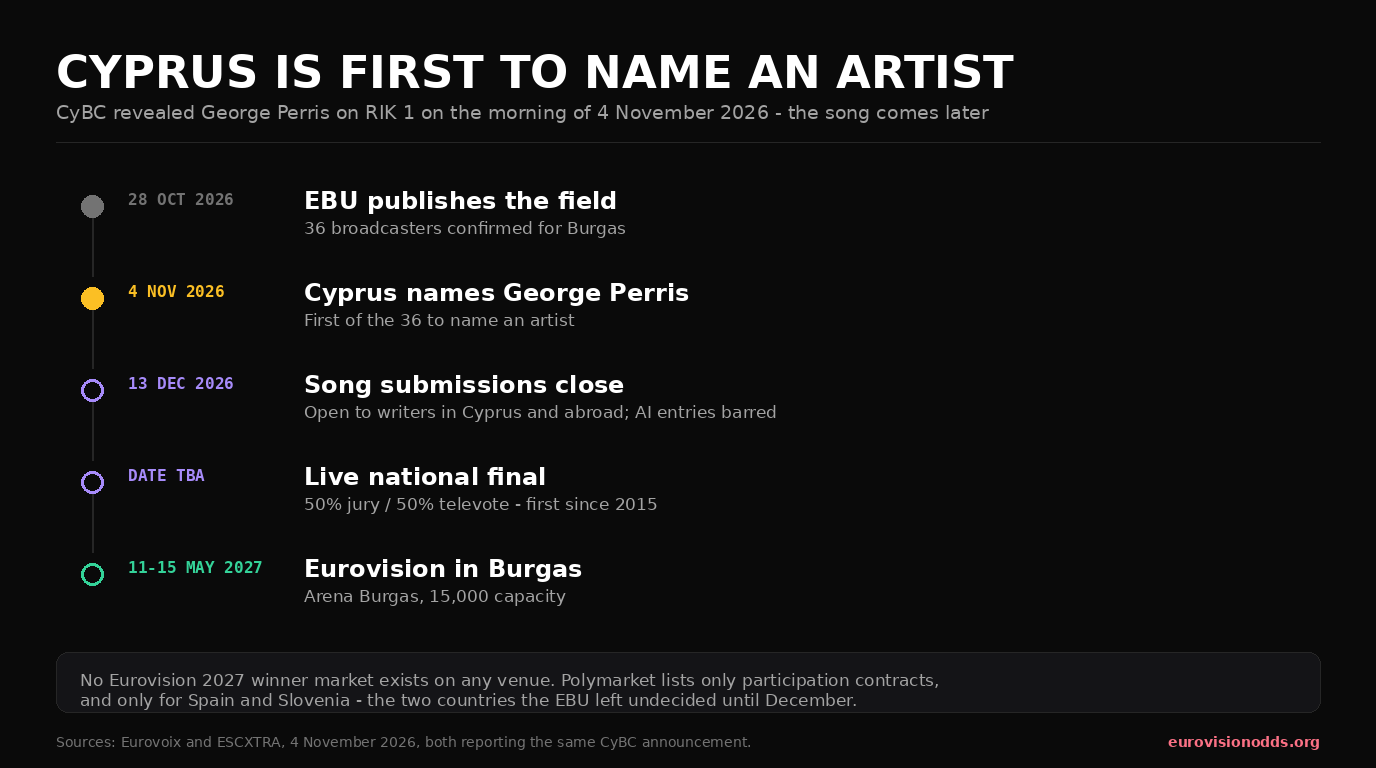
Cyprus has become the first country to name an artist for the Eurovision Song Contest 2027. CyBC revealed George Perris on the morning of 4 November 2026 on RIK 1’s programme Omorfi mera, saying he will “fly the flag for the Mediterranean island at Eurovision 2027 in Burgas”. None of the other 35 broadcasters in the confirmed field has named an act.

18+ | New customers only | T&Cs apply | Please gamble responsibly
The song does not exist yet, and the route CyBC has chosen to find it is the more interesting half of the announcement: an open submission window closing on 13 December 2026, then a live national final scored 50% jury and 50% public televote. That would be the first televised Cypriot national selection since 2015.
Who George Perris is
Perris is a Greek-French singer, 43, born in Athens to a Greek father and a French mother. He began touring at 18 with the composer Mimis Plessas and released his debut album, Kainouria mou mera, in 2005. He performs in Greek, French, English and Spanish, and has played the Lincoln Center in New York and the Odeon of Herodes Atticus in Athens. He has recorded with Michel Legrand, Plácido Domingo and Lara Fabian — who herself represented Luxembourg at Eurovision in 1988. He has two PBS television specials to his name, was made a Chevalier de l’Ordre des Arts et des Lettres by the French Ministry of Culture, and became a UNICEF Goodwill Ambassador in June 2022.
He is also not a new name to Cypriot Eurovision watchers. Perris was reported as one of the artists put to CyBC before it settled on Antigoni for the 2026 contest in Vienna. The broadcaster has not explained how he was chosen this time, and there was no public call for artists.
A national final, for the first time in twelve years
CyBC has selected internally in recent years, which makes the format change the substantive news. The broadcaster is inviting song submissions from writers in Cyprus and abroad, saying it is looking for entries with a “strong artistic identity, contemporary aesthetics and international perspective”. Several songs will then go forward to a live show, where a jury and the public will each decide half the result. The rules and the submission form are on the RIK website. Submissions close on 13 December. No date has been announced for the final itself, or for the song reveal.
One rule in the submission terms is worth flagging on a site that has written about this before: AI-generated entries are prohibited. Broadcasters have been adding that clause through the 2027 season, and it is becoming standard rather than notable — but it is the first time a 2027 selection has paired it with an artist who is already named.
This also answers a question that has sat unresolved on our Eurovision 2027 tracker since August. Cypriot media reported then that a production company had offered to fund and stage a televised national selection for CyBC, which would have been the first since 2015. The broadcaster never confirmed the offer. A national final is now happening; whether that company is behind it has still not been said, so we are recording the two facts separately rather than joining them.
Why the format change matters more than the name
An internal selection and a national final are not just two routes to the same place. An internal pick lets a broadcaster match a song to an artist in private and present a finished package; a national final hands part of that decision to a jury and a televoting public, and does it in public, months before the contest. For a country that has chosen internally for a decade, that is a real change in how the entry gets made.
It has consequences a betting audience should note early. A national final produces a song that has already been tested on an audience, which tends to reduce the variance in how an entry lands in May — but it also produces weeks of public form before any market opens, and in Eurovision that form is routinely over-read. Countries that run competitive national finals generate more pre-contest noise than countries that do not, and the noise is not always information.
The 50/50 split CyBC has set for its final is also, by coincidence, the same weighting the EBU uses in the Eurovision Grand Final itself. That is a reasonable way to pick an entry for a contest scored the same way, and a better guide to how a song might travel than a jury-only or televote-only show would be.
Cyprus has reached the Grand Final in each of its recent appearances and has never won; its best results remain the second place of 2018 with Eleni Foureira’s “Fuego” and the fifth of 2004. A singer with a classical-crossover catalogue is a departure from the uptempo pop that produced those results, though with no song announced it is too early to say what the entry will actually sound like.
Where this leaves the 2027 field
The EBU published its official participant list for Burgas on 28 October: 36 countries, with Canada debuting and North Macedonia returning. Cyprus’s place in it was never in doubt — Burgas will be its 43rd consecutive appearance, and it has not missed an edition it was eligible for since returning in 1982.
Two countries are still outside that list and still deciding. Spain and Slovenia were both given until December by the EBU, which is the first published deadline either has carried. RTVE’s president told the Senate in September that he would propose a second consecutive absence, and the Santander board vote trailed for mid-October still has no reported result — roughly eight weeks late. RTVSLO has published nothing about Burgas since 22 September. Of the five broadcasters that boycotted 2026, the EBU has confirmed that Iceland, Ireland and the Netherlands will not return.
So Cyprus naming an act on 4 November is an early marker in a season whose shape is not settled. Most of the 36 will choose through national finals between January and March 2027; the contest itself runs 11, 13 and 15 May at Arena Burgas.
The betting position: there is nothing to bet on
There is no Eurovision 2027 winner market at any bookmaker or on any prediction market, and naming an artist eleven months out does not create one. We say this plainly rather than implying prices exist: Polymarket’s only live Eurovision 2027 event is a participation market, and after the EBU’s 28 October list resolved twelve of its fourteen contracts, the only two still trading are Spain and Slovenia. Read on 4 November, Spain was about 16.3% quoted 10c against 22.6c, and Slovenia about 16.2% quoted 13.8c against 18.6c — both on wide spreads and almost no turnover, and neither has anything to do with Cyprus.
When outright markets do open, an artist named this early is usually priced off reputation rather than material, and Perris has a long catalogue and no song. The thing worth watching is the national final in the new year: a 50/50 jury-and-televote show is the first point at which there will be an actual entry to judge. Our Eurovision winner odds page will carry prices as soon as the books put any up, and our bookmaker comparison covers which operators price Eurovision at all.
For context on how Cyprus has fared recently, the 2026 results and our Eurovision statistics pages both carry its record.
What to watch next
- 13 December 2026 — Cypriot song submissions close.
- December 2026 — the EBU’s deadline for Spain and Slovenia, the last two undecided countries.
- January–March 2027 — the bulk of the national finals, including the Cypriot one, date still to be announced.
- 11, 13 and 15 May 2027 — the semi-finals and Grand Final at Arena Burgas.
Sourced to Eurovoix and ESCXTRA, both 4 November 2026 and both reporting the same CyBC announcement. CyBC had not published an English-language release at the time of writing. Field and deadline detail from the EBU participant-list announcement of 28 October 2026.