
CBC/Radio-Canada has named the five artists competing to represent Canada at Eurovision 2027. William Cloutier, Josiane, Rêve, Talk and Tyler Shaw were revealed on 27 October 2026 as the finalists of Canada’s Choice / Le choix du Canada, the country’s first-ever Eurovision selection. Public voting opened the same day and runs until 11:59 p.m. Pacific Time on Thursday 5 November.

18+ | New customers only | T&Cs apply | Please gamble responsibly
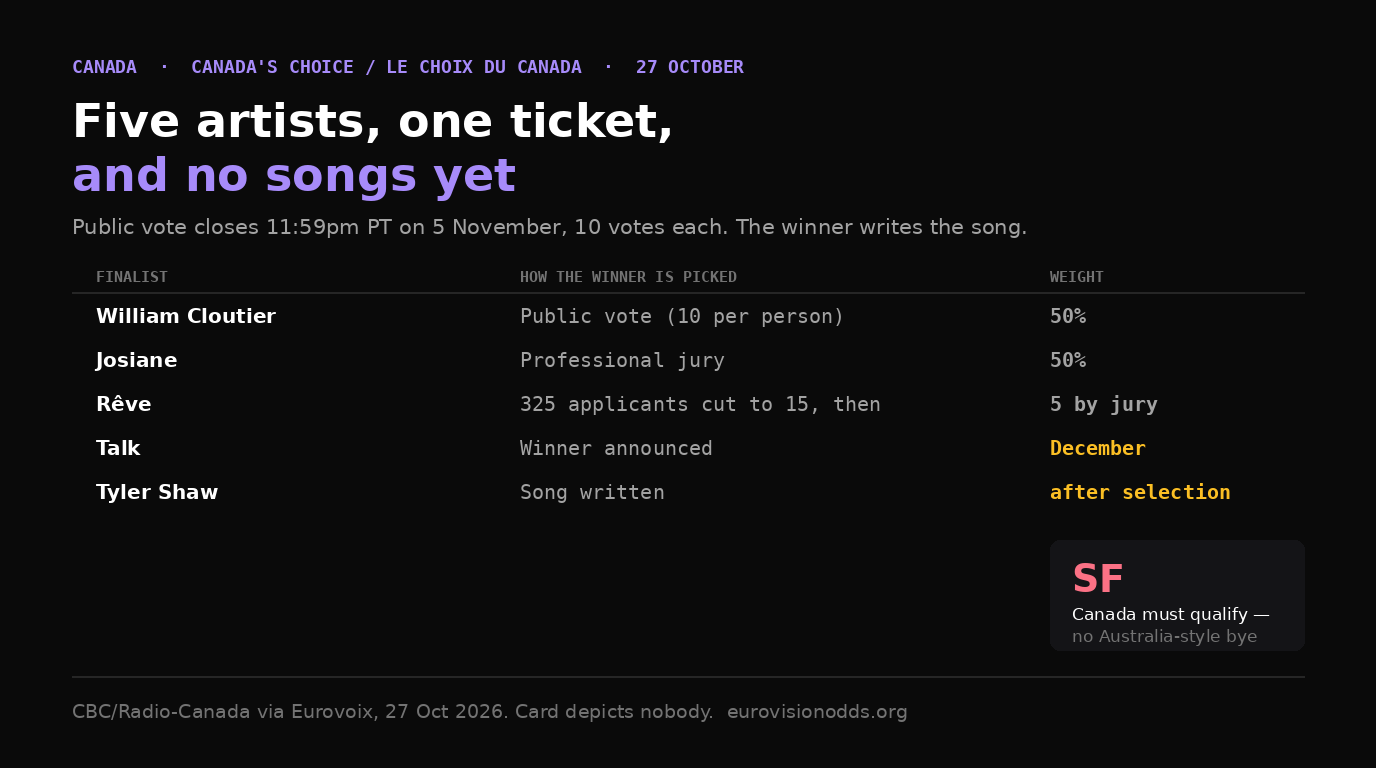
Illustration: a designed card setting out the finalists and the voting mechanics. No real person is depicted — we hold no licensed photographs of these artists.
Key takeaways
- The five: William Cloutier, Josiane, Rêve, Talk and Tyler Shaw were named on 27 October 2026 as the finalists of Canada’s Choice / Le choix du Canada, the country’s first Eurovision selection.
- How they got there: 325 applications (31 August – 9 September), cut to a longlist of 15 by CBC/Radio-Canada’s music teams, then to five by a jury meeting in Toronto on 8 October.
- The vote: 50% public, 50% professional jury, on the broadcaster’s own website, up to 10 votes per person. The winner is announced in December.
- Get the deadline right: CBC/Radio-Canada says 11:59 p.m. Pacific on Thursday 5 November; Eurovoix has reported 16:59 CET the same day. Those are about sixteen hours apart, and the broadcaster’s figure falls on the morning of 6 November in continental Europe. Go with the broadcaster.
- Artist first, song later: no songs were performed at the reveal and none are in front of voters. The winner writes the entry afterwards, in both of Canada’s official languages, with roughly three months to the EBU’s March 2027 submission deadline.
- Canada does not get Australia’s deal: Australia’s 2015 debut came with a Grand Final place attached. Canada joined as a full EBU member and must qualify from a semi-final.
- The betting position: no bookmaker and no prediction market has opened a market on Canada’s Choice. The participants contract that did exist asked only whether Canada would appear on the EBU list, and resolved YES at 99.9c on 28 October.
What’s on this page
The five finalists · How the vote works — and a deadline worth getting right · The order is the unusual part: artist first, song later · Canada does not get Australia’s deal · Where this sits in the 2027 calendar · The betting position: there is nothing to bet on · What to watch · What these mechanics actually reward
The five finalists
| Artist | Given name | From | Style |
|---|---|---|---|
| William Cloutier | — | Quebec | Pop vocalist |
| Josiane | Josiane Comeau | New Brunswick | Singer-songwriter |
| Rêve | Briannah Donolo | Montreal | Dance-pop |
| Talk | Nicholas Durocher | Ottawa | Pop-rock |
| Tyler Shaw | — | British Columbia | Pop |
The selection is run jointly by CBC and Radio-Canada and the shortlist spans Quebec, New Brunswick, Montreal, Ottawa and British Columbia, which is consistent with a confirmed entry in both official languages. Note what the table cannot show: none of these artists has a song. There is nothing to compare except the acts themselves.
They came out of 325 applications submitted between 31 August and 9 September 2026. CBC/Radio-Canada’s music teams cut that to a longlist of 15, and a jury then chose the final five at a meeting in Toronto on 8 October, assessing vocal quality, stage presence, artistic experience, musical vision, availability and the potential to perform internationally.
The jury was made up of music-industry professionals alongside the executive vice-presidents of CBC and Radio-Canada — Douglas Smith and Dany Meloul. The industry members have been reported as Montreal International Jazz Festival programming director Maurin Auxéméry, choreographer Samuel Chouinard, television composer Orin Isaacs, social-media strategist and Eurovision specialist Shawn Myers, and soprano Élisabeth St-Gelais. Spellings of two of those names differ between outlets, so treat them as reported rather than confirmed.
How the vote works — and a deadline worth getting right
The result is split 50% public vote, 50% professional jury. Voting is on the CBC/Radio-Canada website, and each person can vote up to 10 times. The winner is announced in December.
There is a discrepancy on the closing time that is worth flagging, because it is large. CBC/Radio-Canada gives the deadline as 11:59 p.m. Pacific Time on Thursday 5 November 2026, and ESCToday reports the same. Eurovoix has reported it as 16:59 CET on 5 November. Those are not the same moment — they are about sixteen hours apart, and the broadcaster’s own figure actually falls on the morning of 6 November in continental Europe. We are going with the broadcaster. If you are voting from Europe, do not rely on the earlier time.
The order is the unusual part: artist first, song later
Canada is picking an artist, not a song. Unlike a conventional national final, Canada’s Choice puts no songs in front of the voters at all — none were performed at the reveal. The winning act composes their Eurovision entry afterwards.
That matters for anyone trying to read this contest early. In most national finals you can hear the song before judging the entry. Here, whoever wins in December arrives in Burgas with a song nobody has heard, including the people who voted for them. CBC/Radio-Canada confirmed in August that the entry will include both of Canada’s official languages and may include others, with the chosen artist consulted on their comfort in each.
It also compresses the calendar. A December announcement leaves roughly three months to write, record and stage an entry before the EBU’s submission deadline in March 2027.
Canada does not get Australia’s deal
Canada is the first country to debut at Eurovision since Australia in 2015, and the comparison is made constantly. It is also misleading in the way that matters most.
Australia’s debut came with a place in the Grand Final attached. It was an invitation tied to the contest’s 60th anniversary, extended to SBS as an associate EBU member through a Reference Group invitation — a mechanism used exactly once in the contest’s history.
Canada has no bye. CBC/Radio-Canada joined as a full EBU member, the ordinary route, and an ordinary member competes in a semi-final. Whoever wins Canada’s Choice must qualify before they reach the Saturday night. Any read of Canada’s chances that starts from Australia’s 5th-place debut is starting from a structurally different situation.
Where this sits in the 2027 calendar
The timing was close enough to be confusing. Canada named its field on 27 October; the EBU published its official 36-country participant list on 28 October, confirming Canada among them. The two are separate events — the EBU list settles who competes, the selection settles who goes.
| Date | Stage | Field size |
|---|---|---|
| 31 August – 9 September 2026 | Applications open | 325 received |
| 8 October 2026 | Jury meets in Toronto | 15 → 5 |
| 27 October 2026 | Finalists revealed; public voting opens | 5 |
| 5 November 2026, 11:59 p.m. PT | Public voting closes | 5 |
| December 2026 | Winner announced; the song is written afterwards | 1 |
| 11, 13 and 15 May 2027 | Eurovision 2027 in Burgas; Canada competes in a semi-final | 36 confirmed |
The gap between the fourth row and the fifth is the one to watch. Voting closes on 5 November and the result is held until December — roughly four weeks in which the outcome is decided and unpublished — and then about three months to write, record and stage an entry before the EBU’s March 2027 submission deadline.
The betting position: there is nothing to bet on
No bookmaker and no prediction market has opened a market on Canada’s Choice. We checked Polymarket and Kalshi on 28 October 2026 and neither lists one. That is the plain answer and we would rather give it than imply a price exists.
There is a structural reason this selection is a poor candidate for one, too. It is decided half by a public vote on a broadcaster’s own website — with ten votes per person, which rewards organised fanbases over broad appeal — and half by a jury whose final-round composition has not been published, on five artists competing without songs. There is very little for a market to price except name recognition, and Tyler Shaw and Rêve carry most of that.
Canada did have a contract on Polymarket’s participants market, but that asked whether the country would appear in the EBU’s first official list, not who would represent it. It led the board for weeks and resolved YES at 99.9c on 28 October when the list was published. There is still no outright winner market for Eurovision 2027 anywhere, from any bookmaker. When one opens we will price it on the winner odds page; the books that cover Eurovision are listed under bookmakers, and the full participation picture sits on our Eurovision 2027 page.
What to watch
Not the vote result so much as the song commission. A debuting country with no Eurovision track record, picking an artist in December and a song afterwards, is attempting the hardest version of this. For comparison, the United Kingdom launched its own 2027 search on the same day, working to the same March deadline with an internal selection, established label and publisher relationships and decades of experience — and has finished 25th or lower in four of its last six attempts. Experience is not the variable that has been failing.
What these mechanics actually reward
Put the three design choices together — a 50/50 split, up to ten votes per person on the broadcaster’s own website, and five artists with no songs — and it becomes clear what the public half of this vote can and cannot measure.
Ten votes per person is a mobilisation test, not a preference test. A single-vote poll approximates which act the most people prefer; a ten-vote poll approximates which act has the most organised following willing to use all ten. Those are different questions, and with no songs in front of voters the only inputs available to the public half are name recognition and existing fanbase. On that measure Tyler Shaw and Rêve start ahead, which is a statement about their back catalogues rather than about their Eurovision prospects.
The jury half is the only part weighted on the criteria the selection itself used. The longlist of 15 and the cut to five were assessed on vocal quality, stage presence, artistic experience, musical vision, availability and the potential to perform internationally. Those are the things that survive a contest with no songs, and the jury is where they get a second hearing.
And the jury is the part nobody outside can read. The composition of the final-round jury has not been published. The 8 October panel was reported — with two names whose spellings differ between outlets — but there is no published confirmation that the same people decide the result. So half the outcome rests on a body whose membership is not on the record, which is the single biggest reason this selection is unpredictable rather than merely close.
One practical consequence of all that: if you intend to vote from Europe, the deadline discrepancy matters more than it looks. A sixteen-hour error on a vote where each person can cast ten is not a rounding problem — it is an entire evening of fan voting, and the broadcaster’s own figure is the one that closes the poll.
Sources: CBC/Radio-Canada via Eurovoix, 27 October 2026; ESCToday, 27 October 2026; CBC News, 27 October 2026. Market availability checked on Polymarket and Kalshi, 28 October 2026.