
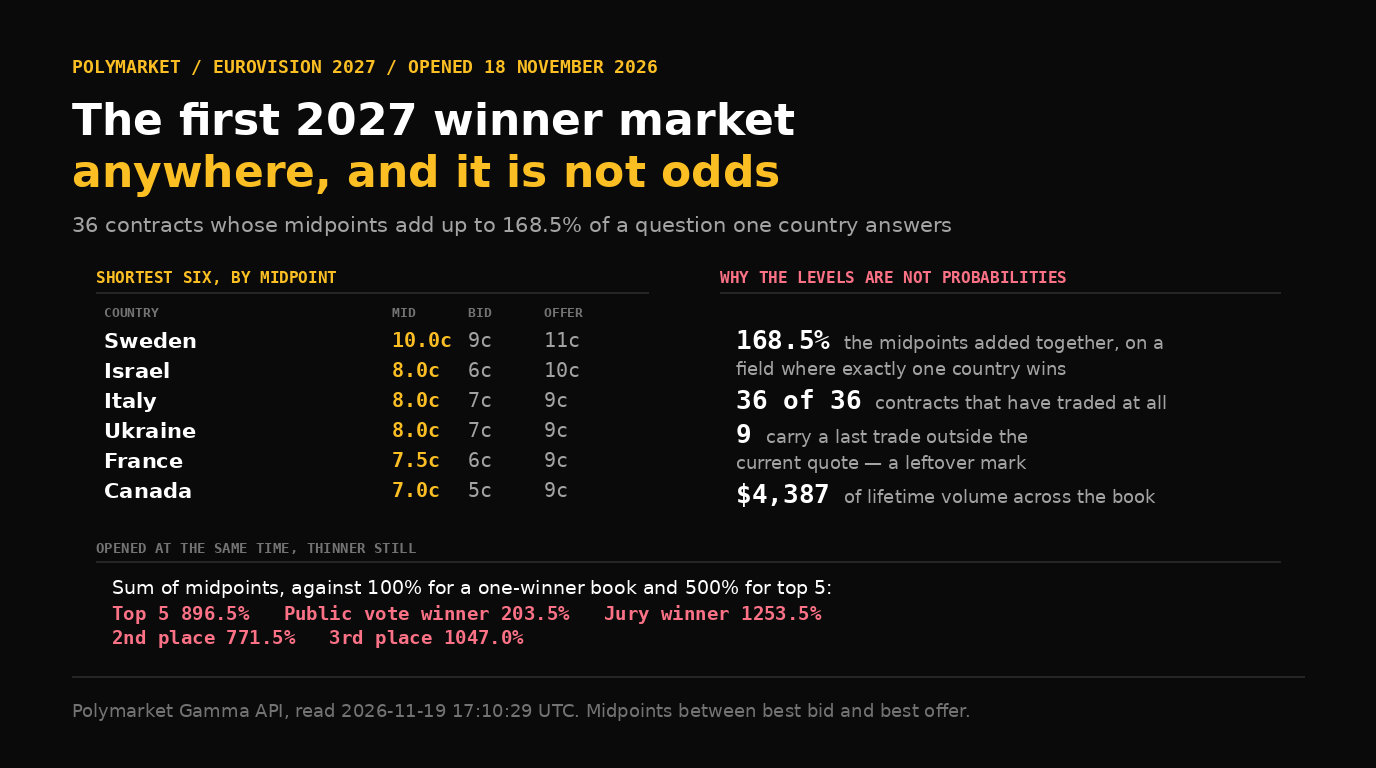
Polymarket has opened the first Eurovision 2027 winner market on any venue. It listed 36 country contracts at about 21:10 UTC on 18 November 2026, alongside second-place, third-place, jury-winner, public-vote and top-five books, and followed them at 21:25 and 21:35 with the first national-final markets of the season on Eesti Laul and Festivali i Këngës 65. For the first time since Vienna, there is a Eurovision winner price to argue with.

18+ | New customers only | T&Cs apply | Please gamble responsibly
It is also, on the evidence of its own order book, close to meaningless as a forecast — and this article is going to spend most of its length explaining why, because a new market is exactly when a betting site is most tempted to quote numbers it has not examined. The honest summary: the order of these prices carries a little information, the levels carry almost none, and five of the six books should not be quoted at all yet.
What opened, and when
Eight events appeared on Polymarket inside twenty-five minutes on the evening of 18 November. Until then the only open Eurovision market anywhere — on any venue, for either contest — was the 2027 participants board, which has been running since May and asks who will take part rather than who will win.
- Eurovision 2027 winner — 36 contracts, opened about 21:10 UTC.
- Top 5, public vote winner, jury winner, 2nd place and 3rd place — same field, same minute.
- Eesti Laul 2027 — 12 acts, opened about 21:25 UTC, closing 31 January 2027.
- Festivali i Këngës 65 — 29 acts, opened about 21:35 UTC, closing 21 December 2026.
The timing of the two national-final books is not a coincidence. Estonia published its twelve-song Eesti Laul field on 17 November and Albania’s 29-act Festivali i Këngës line-up went into rehearsals on 18 November. A market needs a list of names before it can list contracts, and those were the first two complete fields of the 2027 season.
One correction this site owes immediately. Our Eesti Laul article, published on 18 November, said plainly that “no market exists on Eesti Laul, at any venue” and that neither Polymarket nor Kalshi had a market on any 2027 national final. That was true when we checked at 17:07 UTC and false about four hours later. The post now carries a dated correction, as do four others that said no 2027 winner market existed anywhere. We would rather publish the correction than quietly edit the sentence away.
The Eurovision 2027 winner odds, read at 17:10 UTC on 19 November 2026
These are midpoints between the best bid and the best offer, in cents, where 1c is nominally a 1% chance. Our Eurovision 2027 page renders the full 36-country board from the same data file, refreshed daily, so it will be newer than this table.
| # | Country | Mid | Best bid | Best offer | Last trade |
|---|---|---|---|---|---|
| 1 | Sweden | 10.0c | 9.0c | 11.0c | 10.0c |
| 2= | Israel | 8.0c | 6.0c | 10.0c | 10.0c |
| 2= | Italy | 8.0c | 7.0c | 9.0c | 9.0c |
| 2= | Ukraine | 8.0c | 7.0c | 9.0c | 9.0c |
| 5 | France | 7.5c | 6.0c | 9.0c | 9.0c |
| 6 | Canada | 7.0c | 5.0c | 9.0c | 9.0c |
| 7 | Estonia | 6.0c | 2.0c | 10.0c | never traded |
| 8 | Denmark | 4.8c | 1.1c | 8.6c | never traded |
| 9 | Croatia | 4.8c | 1.0c | 8.6c | never traded |
| 10 | Greece | 4.7c | 1.0c | 8.4c | never traded |
Read the shape before the numbers. Sweden, Ukraine, Italy, Israel and France at the front is roughly what a market would produce from recent history and nothing else, because there is nothing else: not one of the 36 countries has both chosen an artist and released a song. Cyprus has named George Perris and Albania will have chosen an entry by 20 December, and neither of those facts is visible anywhere in this board.
Why these are not odds, in four numbers
The single most important figure in this article is not a price. It is the sum of the prices.
The 36 midpoints add up to 168.5% of a question exactly one country can answer. On a fairly priced book with no margin that total would be about 100%. A bookmaker’s Eurovision outright typically runs 115% to 130%, and that overround is how the book makes money. This is neither: it is 168.5%, which on a prediction market with no house margin at all means the quotes simply have not been arbitraged into coherence yet.
Second: a midpoint is not a price anyone has paid. It is halfway between the best bid and the best offer. When a contract is quoted 0.3c bid against 8.8c offered — which describes several rows in the full board — the midpoint of 4.55c is the average of two people who disagree by a factor of thirty. Nobody has transacted there. Six countries sat on exactly 4.55c at our read, not because the market assesses Moldova, Germany, Georgia, Cyprus, Armenia and Montenegro identically, but because they all carry the same untouched 0.3c/8.8c quote.
Third: 9 of the 36 contracts carry a last trade outside the current quote. Romania’s last trade printed at 12c while the book offers it at 6c; a mark above the offer is a leftover from a quote that has since moved, not an opinion anyone holds now. Our 18 November piece found the identical pattern on Kalshi, where Switzerland showed a 60c last trade under an 89c bid.
Fourth: $4,387 of lifetime volume across the whole book, with individual contracts between about $78 and $443. For scale, the Eurovision Asia winner market turned over about $150,841 before it settled, and the 2027 participants board has done about $97,374. This book has traded roughly 3% of what the participants board has.
The other five books are worse, and two should be ignored entirely
If the winner book is thin, the five that opened beside it are barely books at all. The same health test applied to each:
| Book | Midpoints total | Should total | Contracts traded | Lifetime volume |
|---|---|---|---|---|
| Winner | 168.5% | 100% | 36 of 36 | $4,387 |
| Top 5 | 896.5% | 500% | 19 of 36 | $2,670 |
| Public vote winner | 203.5% | 100% | 36 of 36 | $586 |
| Jury winner | 1253.5% | 100% | 1 of 36 | $1 |
| 2nd place | 771.5% | 100% | 2 of 36 | $2 |
| 3rd place | 1047.0% | 100% | 0 of 36 | $0 |
Work down that table. The top-5 book should total about 500%, because five of the 36 countries finish in the top five; it totals 896.5%. The jury-winner book totals 1253.5% on one dollar of lifetime volume, with 29 of its 36 contracts showing no bid at all; its midpoints cluster near 41c for the arithmetic reason given above, which is that half of an 82c offer is 41c. The third-place book has not traded at all. Quoting a 43.5c “chance” of Israel finishing third from a book with zero volume would be inventing a number, which is the one thing this site has promised not to do.
There is a useful general rule here, and it is not specific to Eurovision. When several books open simultaneously on the same field, money concentrates in the simplest question and accuracy does not follow it. We measured exactly this at the Asia settlement: the winner book alone took 55% of lifetime volume across six books, and the worst-priced of them, 2nd place at $6,189, was also the least traded. The 2027 set is reproducing that pattern on day one.
The field is the EBU’s 36, which tells you something
The winner board carries exactly 36 contracts, and they are precisely the 36 countries on the EBU’s confirmed participant list of 28 October. There is no Spain contract and no Slovenia contract — the only two broadcasters in Europe whose participation is genuinely undecided, both now working to an EBU deadline of December.
That is the correct construction for a winner market: a country that may not enter cannot win, and including it would require a joint view on two questions at once. It is worth noting because it is the opposite of what we found on Kalshi on 18 November, whose 38-contract board is about participation and yet carries no Spain and no Slovenia contract either — which on that board is a real gap, since those are the only two open participation questions in Europe.
The participants book is still the only one with real money in it
Everything above is about markets days old. The participants board has been trading since May and has about $97,374 of lifetime turnover, which is more than twenty times the six new 2027 books combined. It has two contracts left open.
- Slovenia — 16.6c mid, quoted 13.2c against 19.9c, last trade 13.2c, about $15,799 of volume.
- Spain — 9.8c mid, quoted 6.1c against 13.6c, last trade 7.3c, about $13,629 of volume.
Slovenia moved, and nothing was published to justify it. At 17:07 UTC on 18 November its bid was 10.6c against a 20.9c offer. At 17:05 today the bid had reached 14.7c, a one-day change on the midpoint of about +5.7 points, and by our 17:10 read it had eased back to 13.2c. We searched for a catalyst and found none: RTVSLO has said nothing about 2027 since confirming on 31 October that it will not return to Junior Eurovision, a different contest. Its last word on Eurovision itself was September, when it said only that informative conversations were taking place and cited its finances.
This is the behaviour we documented on this contract through late October, when it made a nineteen-point round trip inside twenty-four hours with nothing published by the broadcaster. A quote moving is not news arriving. On a book this thin the bid can travel several points because one participant repriced, and the last trade — still 13.2c — is the figure that tells you what anyone actually paid.
The first national-final markets of the season
The two national-final books are the more interesting development commercially, because national finals are where the betting demand actually is: “melodifestivalen odds” alone runs about 2,400 searches a month in Sweden, peaking near 18,100 in March. Neither of these is Melodifestivalen, which remains unpriced.
Eesti Laul 2027 lists all 12 acts, matching the field ERR published on 17 November. Shortest by midpoint: Rita Ray 42.5c, Johanna Elise 42.0c, OLLIE 40.5c, Pale Alison x Minimal Wind 39.5c. Only 2 of the 12 contracts have traded, on $66 in total, and the midpoints sum to 244.5%. The songs have not been heard yet — they air on ETV at 19:00 CET on 27 November — so this is a market on twelve titles and twelve reputations.
Festivali i Këngës 65 lists 29 acts and closes on 21 December, the day after the festival ends. Shortest: Kejsi Jazxhi 29.5c, Sara Bajraktari 26.0c, Arsi Bako 23.5c, Gjergj Jorgaqi 23.4c. The field includes Kejsi Tola, who won Festivali i Këngës 47 and represented Albania at Eurovision 2009, and Amela Qemalja, who joined the line-up on 18 November as rehearsals began and is quoted at the field’s floor price along with most of the board.
Both books carry the same disease as the winner market in concentrated form: 6 of 29 Albanian contracts have traded, twenty of the twenty-nine sit on an identical 4.5c midpoint, and the total comes to 260.4%. The price differences between the bottom twenty are not assessments. They are the absence of one.
What we would actually do with this
Nothing, yet, and that is a position rather than a dodge.
- Do not trade the five derivative books. Jury winner, public vote, 2nd, 3rd and top 5 have between $0 and $2,670 of lifetime volume and overrounds between 203.5% and 1253.5%. There is no edge to find in a book where you are the only participant.
- Treat the winner book as a watchlist. Its value right now is that it exists and will absorb information as national finals run from December to March. The first real test is whether prices move when Albania picks on 20 December.
- Read bid and offer separately, never the midpoint alone, on any contract where the gap is wider than about ten cents.
- Nothing here is a bookmaker price. No fixed-odds bookmaker has opened a Eurovision 2027 winner book, so there is no best-price comparison to make and no each-way market. Our bookmaker guide covers who priced 2026 and when 2027 books typically appear, which is as entries are confirmed in the new year.
A note on access, because it affects a large share of this site’s readers: Polymarket is blocked or close-only in a number of countries, among them the United Kingdom, the United States, Australia, Thailand, France, Germany, Italy, Poland and Singapore. If you are reading from one of those, the board above is information rather than something you can act on.
What to watch next
- Latvia’s Supernova 2027 field, 20 November at 07:30 CET on RePlay.lv: sixteen jury-chosen songs plus a seventeenth public wildcard, from 125 submissions.
- Lithuania’s participants by 25 November.
- Eesti Laul’s twelve songs on 27 November — the first 2027 entries anyone can hear, and the first real test of whether that new book reprices on music.
- Festivali i Këngës 65, 17 to 20 December: the first 2027 entry chosen anywhere.
- RTVE and RTVSLO, both against an EBU deadline of December.
Sources
- Polymarket Gamma API, read directly at 17:05 and 17:10 UTC on 19 November 2026. All prices, volumes and book totals above are computed from that read and stored in
data/markets/polymarket-2027.json. - Eurovoix, 17 and 18 November 2026, for the Eesti Laul field and the Festivali i Këngës 65 line-up and dates.
- Kalshi public API, all eleven
KXEUROVISION*series swept on 19 November 2026.