
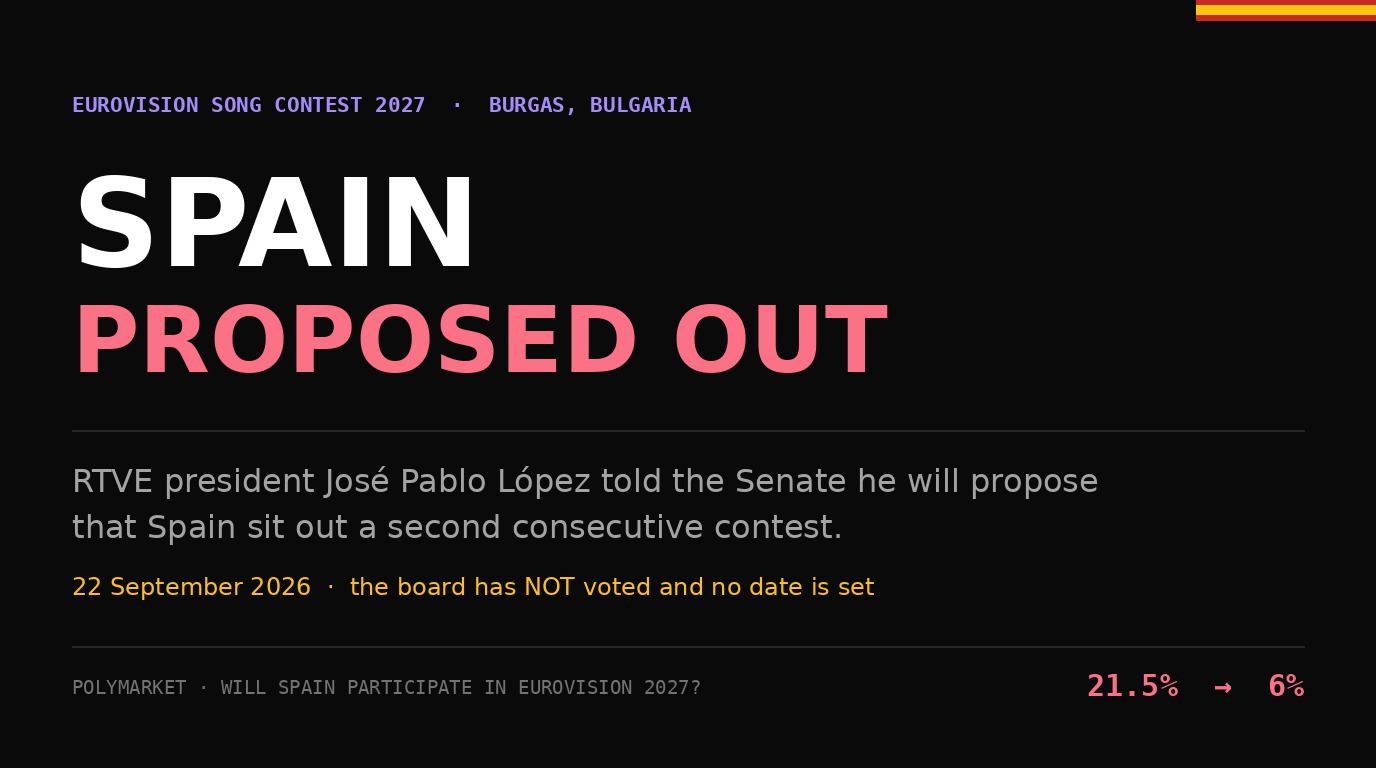
RTVE president José Pablo López said on 22 September 2026 that he will ask the broadcaster’s board to keep Spain out of Eurovision 2027, a second consecutive absence, because the Israeli public broadcaster KAN is still in the contest. He made the announcement during his periodic appearance before the Spanish Senate’s joint commission for parliamentary control of RTVE.

18+ | New customers only | T&Cs apply | Please gamble responsibly
His words were unambiguous: “Voy a proponer al Consejo de Administración de RTVE mantener la suspensión de nuestra participación en Eurovisión para la edición de 2027” — I am going to propose to RTVE’s board that we maintain the suspension of our participation in Eurovision for the 2027 edition.
What Spain has actually decided — and what it has not
This is the part most coverage will blur, and it matters if you are pricing anything. López has announced a proposal. He does not personally decide Spain’s participation; RTVE’s Consejo de Administración does, and that board has not voted. No date for the vote has been published.
That is not a technicality invented for the sake of caution. This same board was expected to settle the question on 16 September 2026 and instead postponed it with no new date, which is how Spain arrived at the EBU’s application window undecided in the first place. A board that has already declined to decide once is not a rubber stamp by definition.
What has changed is that the undecided position now has a direction, publicly stated by the person who sets the agenda, in a parliamentary setting where he is on the record. The honest description of Spain’s status is: recommended out, not yet ruled out.
Why: the one condition that was not met
Spain did not frame this as a blanket refusal. RTVE spent the year negotiating, and López was careful to say so — that Spain, with other broadcasters, had “led a demand for the regeneration of the EBU” and negotiated to strengthen governance rules, penalise political manipulation and guarantee the neutrality of the contest.
He also conceded the limit of that effort: “no hemos conseguido todos nuestros objetivos” — we have not achieved all our objectives. The objective that was not achieved is the one Spain treated as central. KAN remains in the 2027 field. López called it “profundamente doloroso que a pesar de todo, y en esta situación que se sigue viviendo en Gaza, la radiotelevisión pública de Israel vaya a seguir participando” — deeply painful that, despite everything, and in the situation still being lived through in Gaza, Israel’s public broadcaster will continue to participate — describing it as an evident outstanding issue in ethical terms.
This tracks with RTVE’s formal position since 25 February 2026, when it proposed an EBU rule change barring countries in active military conflict. That proposal has never been adopted, and it would have implications well beyond Israel — Ukraine’s Suspilne represents a nation in active military conflict too, which is one reason the rule has not moved.
The market repriced hard, and slightly overshot
Polymarket’s “Will Spain participate in Eurovision 2027?” contract traded at 21.5% on 19 September. On 22 September, after López spoke, it was 6% — a fall of more than fifteen points on one of the heavier books in that market, around $2,700 of lifetime volume. Prices read from Polymarket’s Gamma API on 22 September 2026.
Read against the previous three days, the move is instructive. Spain’s contract was flat across the 16 September postponement — 21% before, 21.5% after — because a delay genuinely told the market nothing. A stated recommendation from the president told it a great deal.
Whether 6% is right is a separate question from whether the direction is right. At 6% the market is pricing the board vote as very close to a formality. That is a defensible read of an organisation whose president has publicly committed himself, but it is not what the paperwork says, and this board has form for not doing the expected thing on schedule. We are not telling you there is value in the gap; on a book this thin, a few hundred dollars can move the price several points on its own. We are telling you the gap exists and what sits inside it.
Where this leaves the 2027 field
Five broadcasters boycotted Eurovision 2026 over Israel’s participation: Iceland, Ireland, the Netherlands, Slovenia and Spain. As of 22 September 2026:
- Netherlands — out. AVROTROS withdrew on 24 August 2026 and handed the mandate back to NPO. KRO-NCRV, BNNVARA and Omroep MAX have each ruled themselves out as replacements. Trading at 39%, still the heaviest book in the market.
- Ireland — out. RTÉ ruled itself out on 17 September 2026 and will not broadcast the contest either. Trading at 8.6%, which is drift on a settled, announced fact rather than any expectation of a reversal.
- Spain — recommended out. As above. 6%.
- Slovenia — the live one. RTVSLO said on 17 September that it and the EBU would discuss participation “in the coming days”, and the EBU has extended its deadline — the only case of a slot being publicly held open. It spiked to 74.5% on that news and has since eased to 58.5% with nothing further published.
- Iceland — silent. RÚV was expected to decide in September and has published no outcome. 30%, on a book of barely $200.
So the pattern that has held all season holds again: none of the five has signalled a return. Every resolution so far has been an absence, and the two genuinely open cases are Slovenia and Iceland. If Slovenia comes back it will be the first reversal of a 2026 boycott, and that is the single most interesting unpriced event left in this market.
The betting position
There is one live Eurovision market of any size: Polymarket’s Eurovision 2027 Participants event, fourteen country contracts and about $20.4K of lifetime volume. That is not a deep market. For scale, the European Eurovision 2026 winner market closed near $194M. No traditional bookmaker we track at our bookmaker comparison prices 2027 participation at all, and there is no 2027 winner market worth the name yet — our winner odds page tracks what exists as it appears.
Two practical notes. First, the contracts that have already resolved in spirit — Ireland at 8.6%, North Macedonia at 57.1% despite MRT confirming its return on 14 September — show how loosely this book tracks published fact at the extremes. That is an argument for reading it as sentiment, not as a probability you can lean on. Second, the thing that would actually move Spain now is a board date. There is no date. Until there is, the 6% is the market pricing a man’s stated intention, which is a real signal and not a decision.
For the fuller picture of who is in, who is out and who is still deciding for Burgas, see our Eurovision 2027 hub, and for how the 2026 contest actually finished, the 2026 results.
Sources: José Pablo López’s appearance before the Senate’s joint commission for parliamentary control of RTVE, 22 September 2026, as reported by Infobae and ESCToday; prices from Polymarket’s Gamma API, read 22 September 2026.