
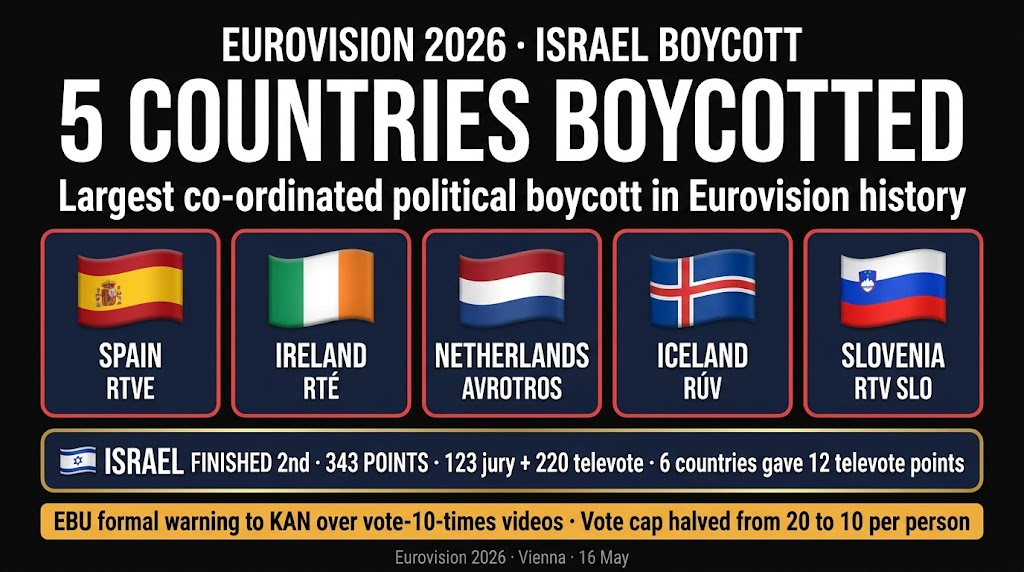
The Eurovision Song Contest 2026 in Vienna, held on Saturday 16 May at the Wiener Stadthalle, was preceded and accompanied by the largest co-ordinated political boycott in Eurovision's 70-year history. Five EBU member states refused to participate in the contest in protest of Israel's continued participation following its military operations in Gaza since October 2023. The five boycotting countries were:

18+ | New customers only | T&Cs apply | Please gamble responsibly
- 🇪🇸 Spain — RTVE
- 🇮🇪 Ireland — RTÉ
- 🇳🇱 Netherlands — AVROTROS / NPO
- 🇮🇸 Iceland — RÚV
- 🇸🇮 Slovenia — RTV SLO
This is the most countries to simultaneously boycott a Eurovision Grand Final since the contest began in 1956. Previous individual boycotts (Yugoslavia in the 1990s, Turkey since 2013, Russia banned in 2022) have all been singular cases. The 2026 boycott was unique in being co-ordinated specifically around one issue — Israel's participation — and in involving public broadcasters from one Western European country (Spain), one Northern European country (Netherlands, Iceland), and two long-term Eurovision regulars (Ireland — the country with the most wins, 7, tied with Sweden, and Slovenia).
Betfred — Bet £10 Get £50 in Free Bets on Eurovision 2027
Which countries boycotted Eurovision 2026?
| Country | Broadcaster | Previous Eurovision win? | Stated reason |
|---|---|---|---|
| 🇪🇸 Spain | RTVE | Yes (1968, 1969) | Public broadcaster board vote on Israel's participation |
| 🇮🇪 Ireland | RTÉ | Yes (7 wins, joint-most) | National and broadcaster political stance on Gaza |
| 🇳🇱 Netherlands | AVROTROS | Yes (1957, 1959, 1969, 1975, 2019) | Public petition + broadcaster decision |
| 🇮🇸 Iceland | RÚV | No | Public + parliamentary pressure |
| 🇸🇮 Slovenia | RTV SLO | No | Solidarity with other Western European boycotters |
The boycott represented a combined population of approximately 89 million people across five EBU member states, plus the broadcasting and creative industries those broadcasters fund. Spain alone is one of the "Big-5" financial contributors to the EBU's annual Eurovision budget, so its absence reduced the contest to a "Big-4" (Italy, France, Germany, UK plus host Austria) for the first time since the modern automatic-qualifier system was introduced in 2000.
Why was Israel allowed to compete at Eurovision 2026?
The EBU's official position throughout the 2026 cycle was that Eurovision is "a non-political music event" and that decisions on broadcaster participation are governed by EBU membership rules, not government policy. The Israeli public broadcaster Kan is a full EBU member in good financial and operational standing. The EBU's parallel reasoning on Russia (banned from competing since the 2022 invasion of Ukraine) is that the suspension followed specific UN- and EBU-board-level resolutions, whereas no equivalent resolution exists on Israel.
Critics — including many fans, several artists and the boycotting broadcasters — argued the parallel is inconsistent. The EBU has maintained that the two situations are governed by different procedural triggers, and the 2026 contest proceeded with Israel's full participation under the entry name Noam Bettan, performing the song Michelle, a love song with verses in Hebrew, French and English.
How did Israel finish second in Eurovision 2026?
Despite the boycott, Israel's Noam Bettan finished second in the Grand Final with 343 points — only 173 behind winner Bulgaria (DARA's Bangaranga on 516 points) but well ahead of third-placed Romania (Alexandra Căpitănescu's Choke Me on 296 points). The Israel result was driven heavily by the public televote rather than the professional juries.
| Vote pool | Israel points | Rank in pool |
|---|---|---|
| Total combined | 343 | 2nd |
| Jury vote | 123 | 9th |
| Televote | 220 | 3rd (behind Bulgaria 312, Romania 232) |
Israel's strongest televote support came from six countries that each awarded the maximum 12 points: Finland, Portugal, Switzerland, Germany, Azerbaijan and France. Cyprus and Italy each gave Israel 8 televote points. Sweden gave 7. The United Kingdom gave 10. The diaspora-and-engagement pattern in Israel's televote score is consistent with the country's recent Eurovision behaviour — Israel finished 2nd in 2024 (Eden Golan, Hurricane) and 2nd in 2025 (Yuval Raphael, New Day Will Rise) on similar televote-heavy profiles.
The EBU's voting-manipulation response
Israel was "under pressure over attempts to sway the public vote" in the lead-up to Eurovision 2026, according to the Reuters factbox published on 16 May 2026 by multiple outlets including Global Banking and Finance Review. The Israeli broadcaster KAN received a formal warning from the EBU over videos appealing to the public to vote for its song 10 times — the maximum allowed per person under the new 2026 rule changes.
The EBU responded to ongoing concerns about voting-campaign abuses with three rule changes for 2026:
- Per-person vote cap halved from 20 to 10. Eurovision viewers can now vote a maximum of 10 times each per phone/method, down from the historical 20. The cap is intended to reduce the impact of co-ordinated mass-voting campaigns.
- Encouragement to spread votes across multiple songs. The EBU added explicit public guidance that viewers should vote for "multiple songs" rather than concentrate all 10 votes on one entry.
- Clamping down on disproportionate promotion campaigns. The EBU committed to issuing formal warnings — and potentially disqualifying jury votes — for entries whose broadcasters engaged in "disproportionate promotion campaigns". KAN's warning over the "vote 10 times" videos was the first formal warning issued under this revised framework.
The boycott's effect on the final scoreboard
The five-country boycott had two measurable effects on the 2026 Grand Final scoreboard:
1. The Big-5 reduced to Big-4
Spain's absence reduced the automatic-qualifier group from 5 to 4 nations. Italy, France, Germany and the UK competed as the "Big-4". Combined, these four entries plus host Austria averaged a finish of 17.6 — only Italy (5th) cracked the top 10, while Germany (23rd), Austria (24th) and the UK (25th) filled three of the bottom five places. We covered the full Big-4 collapse analysis separately.
2. Five vote pools removed from the system
Each of the boycotting countries' juries and televote pools would normally award up to 12 points to other entries. Their absence removed approximately 240 jury + 240 televote points from the combined 2026 point pool — a roughly 11% reduction in available points from the modern baseline. Because Bulgaria's winning margin (173) was already record-large, the boycott did not change the identity of the winner, but it likely compressed the absolute scores of mid-table entries by 10-30 points on average. Several Mediterranean entries (Greece, Cyprus, Italy) which historically benefit from Spanish televote support saw measurably lower totals than their pre-final bookmaker prices implied.
Will the boycott extend into Eurovision 2027?
As of 19 May 2026, no formal announcement on 2027 participation has been made by any of the five 2026 boycotters. Three structural factors will shape the decision:
- Israel's continued participation. If Israel is confirmed to compete in 2027, all five 2026 boycotters are likely to face the same internal pressure to maintain the boycott. Spain's RTVE board has indicated continued review.
- EBU rules clarification. The EBU is widely expected to issue clarifying guidance on the "non-political" rule before the 2027 cycle opens in autumn 2026. If the clarification leans toward maintaining Israeli participation, expect the boycott to be renewed or expanded.
- Sofia 2027 hosting. The contest moves to Bulgaria for 2027, hosted by BNT. The selection of host city (Sofia, Plovdiv or Varna are the active bids per our 2027 preview) will shape the political and security infrastructure of the event, which in turn affects boycott calculus.
What this means for the 2027 bookmaker market
The Israel question is the single most-important structural variable for the 2027 outright market. Three scenarios:
- Scenario A — Israel participates, no expanded boycott: Pricing model normalises around 2026 patterns. Israel likely opens around 8/1 to 12/1 outright as a perennial top-5 finisher.
- Scenario B — Israel participates, boycott expands to 7-8 countries: Israel's price compresses further (4/1 to 6/1) on reduced field competition + the televote-only pathway becoming structurally larger.
- Scenario C — Israel withdraws or is suspended: Pricing model resets entirely. The 2027 outright market opens with a wider, more competitive field and the previously-Israel-bound televote-bloc votes flow to other Mediterranean and Eastern European entries.
Related Eurovision 2026 coverage
- Grand Final recap — Bulgaria 516, Israel 343, Romania 296
- Bulgaria's 173-point margin — biggest in 50/50 era
- Moldova TRM resignation scandal — jury awards Romania 3, Ukraine 0
- Eurovision 2027 preview — Sofia hosts
18+. Please gamble responsibly. BeGambleAware.org. GAMSTOP. When the fun stops, stop.