
Eurovision 2026 in Vienna ran with 37 competing nations across two semi-finals plus the Grand Final. That figure is sharply lower than the 2010-2015 era when up to 43 nations regularly competed. Three structural pressures — political boycotts (5 countries in 2026), broadcaster funding constraints (multiple low-budget eastern broadcasters), and historic political pullouts (Hungary 2019, Russia 2022 ban) — have shrunk the contest's footprint.

18+ | New customers only | T&Cs apply | Please gamble responsibly
The 2027 cycle in Bulgaria has the strongest broadcaster-return picture in over a decade. Eight separate national broadcasters are in active discussion about returning. The EBU is widely expected to confirm the 2027 participant list in autumn 2026 (typically October-November). Here is the current state of all eight discussions, ranked by likelihood of return.
Betfred — Bet £10 Get £50 in Free Bets on Eurovision 2027
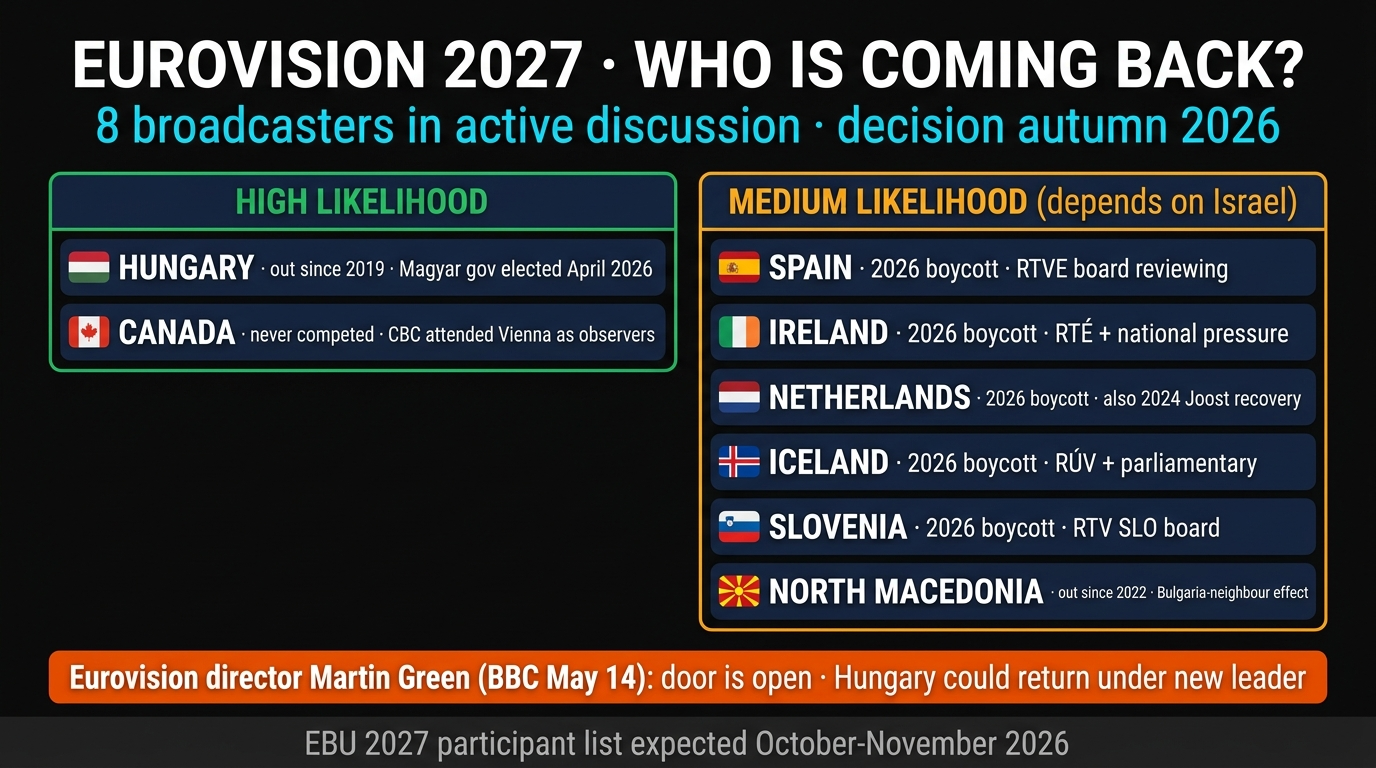
The full 2027 returners watch-list
| Country | Last competed | Why out | Likelihood of 2027 return |
|---|---|---|---|
| 🇭🇺 Hungary | 2019 Tel Aviv | Withdrew citing "public broadcaster's choice"; widely linked to Orbán-government LGBTQ+ political pressure | HIGH — Magyar election win April 2026 changed political conditions |
| 🇨🇦 Canada | Never competed | EBU eligibility under associate-member framework; 2022 CBC declined as "prohibitively expensive" | HIGH — Martin Green "door is open"; CBC attended Vienna as observers; 2025 federal budget mentioned exploration |
| 🇪🇸 Spain | 2025 Basel | 2026 boycott over Israel participation (RTVE board decision) | MEDIUM — depends on Israel status |
| 🇮🇪 Ireland | 2025 Basel | 2026 boycott (RTÉ + national political pressure) | MEDIUM — depends on Israel status |
| 🇳🇱 Netherlands | 2025 Basel | 2026 boycott (NPO/AVROTROS board decision) | MEDIUM — also recovering from 2024 Joost Klein disqualification |
| 🇮🇸 Iceland | 2025 Basel | 2026 boycott (RÚV + parliamentary pressure) | MEDIUM — depends on Israel status |
| 🇸🇮 Slovenia | 2025 Basel | 2026 boycott (RTV SLO board decision) | MEDIUM — solidarity with other boycotters |
| 🇲🇰 North Macedonia | 2022 Turin | Budget constraints + Selektor brand exit | LOW-MEDIUM — Bulgaria-neighbour effect possible |
Hungary — the most-discussed 2027 returner
Hungary's MTVA last competed at Eurovision in 2019 (Joci Pápai, Az én apám, Tel Aviv). The Hungarian withdrawal was never formally explained by the broadcaster as political, but international Eurovision media has widely linked it to the Orbán government's 2018-2019 escalation of conservative cultural messaging, including specific public criticism of LGBTQ+ Eurovision narratives by Orbán-affiliated MPs.
Three things changed in April-May 2026:
- Péter Magyar's Tisza Party won an absolute majority in the Hungarian parliamentary elections, ending Orbán's continuous tenure since 2010. The change of government opens fresh political conditions at MTVA.
- Péter Magyar himself has publicly stated he wants Hungary back at Eurovision. Multiple Hungarian and international media outlets — including EuroMix on 13 April 2026 and EurovisionFun on 14 April 2026 — reported Magyar's stated intention to push for return.
- Eurovision director Martin Green hinted Hungary could return. In a 14 May 2026 BBC interview, Green said Hungary could return under its "more" (the quote was reported as "more progressive") new leadership, without committing to a specific timetable.
The structural calculation: with the contest moving to neighbouring Bulgaria for 2027, the geographic-and-political case for Hungarian return is at its strongest point in seven years. MTVA's national-final selection model (the "A Dal" format, paused 2020) would need to be restarted by autumn 2026 to deliver a 2027 entry.
Canada — the only credible non-European new entrant
Canada is not currently an EBU member but qualifies for Eurovision under the associate-member framework that admitted Australia in 2015. The 2027 Canadian discussion has three distinct layers:
- Martin Green's BBC quote, 14 May 2026: "The door is open" for Canada to join Eurovision, but the country has not yet made a formal application. Speaking to the BBC, Green added that "nothing's particularly" about to happen imminently.
- CBC/Radio-Canada attended Eurovision 2026 as observers. Eurovoix confirmed on 14 May 2026 that representatives of the Canadian national broadcaster attended Vienna 2026 in an observer capacity, the typical pre-application due-diligence step.
- Canada's 2025 federal budget mentioned Eurovision exploration. The 2025 Canadian budget — published in November 2025 — included a line item exploring potential CBC/Radio-Canada participation in Eurovision. This is the first time a Canadian federal budget has formally referenced Eurovision.
The blocking factor remains cost. In 2022 the CBC ruled out a Eurovision bid as "prohibitively expensive". The 2027 cost structure — production participation fees plus delegation costs plus competing-entry production — typically falls in the £1.5M-£3M range for a debut nation. Canadian observer attendance at Vienna 2026 was a clear signal that the CBC is re-examining the cost case in light of likely streaming-revenue and brand-partnership opportunities.
The five 2026 boycotters — return depends on Israel
The five countries that boycotted Eurovision 2026 over Israel's participation — Spain, Ireland, Netherlands, Iceland and Slovenia — face a coordinated decision for 2027. The structural calculation is unchanged: if Israel competes in 2027, the same political pressure that drove the 2026 boycott will largely persist. Three scenarios:
- Scenario A — Israel competes, all 5 boycotters stay out: 2027 field returns to ~32 nations (counting Hungary's return + Canada's debut).
- Scenario B — Israel competes, partial return: Spain (RTVE board reviewing) returns; the other four stay out. Field returns to ~33 nations.
- Scenario C — Israel withdraws or is suspended, full return: All 5 return + Hungary + Canada + potentially North Macedonia = ~40 nations. Field reaches pre-2020 levels.
The EBU has, as of 19 May 2026, made no formal statement on Israel's 2027 participation status. The EBU position throughout the 2026 cycle was that Israel's continued participation is governed by EBU membership rules, not political decisions, and there are no current indications that this position will change before autumn 2026.
What the EBU will announce, and when
| Stage | Expected timing | Status update |
|---|---|---|
| BNT-government hosting MOU | June 2026 | First meeting 18 May 2026 |
| EBU 2027 participant-list opening | July 2026 | Application window opens |
| Boycotter return decisions | August-September 2026 | National broadcasters publicly state intent |
| EBU 2027 participant-list confirmation | October-November 2026 | Final list of competing nations |
| National-final selection cycles begin | December 2026 | Sanremo / Melodifestivalen / etc |
| 2027 contest dates announced | December 2026 | Sofia hosting, May 2027 |
What this means for the 2027 outright market
Each potential returner materially affects pricing for the 2027 outright market. Three pricing implications:
- Hungarian return = Central European bloc realignment. Hungary's traditional voting allies (Romania, Croatia, Slovakia, Czechia, Serbia) have all competed in 2026 and benefited from a less-crowded jury pool. Hungary's return adds 2 voting blocs that historically favour Central European entries. Bulgarian entry pricing for 2027 may compress slightly if Hungarian return is confirmed.
- Canadian debut = televote diaspora math change. Canada brings ~38M population and a significant Italian-Canadian, Portuguese-Canadian, Greek-Canadian and Ukrainian-Canadian diaspora base. Pre-contest Spotify and YouTube positions for Italian, Portuguese, Greek and Ukrainian entries may compress slightly if Canada is added.
- Five-boycotter return = full field reset. A full return scenario (all 5 boycotters + Hungary + Canada) takes the field above 40 nations — the largest Eurovision field since 2018. With a larger field, individual outright pricing decompresses (a 40-nation field has structurally longer prices on each entry than a 32-nation field).
Related Eurovision coverage
- Israel boycott controversy — 5 countries refused to compete in 2026
- Eurovision 2027 host city race — Sofia vs Plovdiv vs Varna vs Burgas
- Eurovision 2027 full preview page
18+. Please gamble responsibly. BeGambleAware.org. GAMSTOP. When the fun stops, stop.