
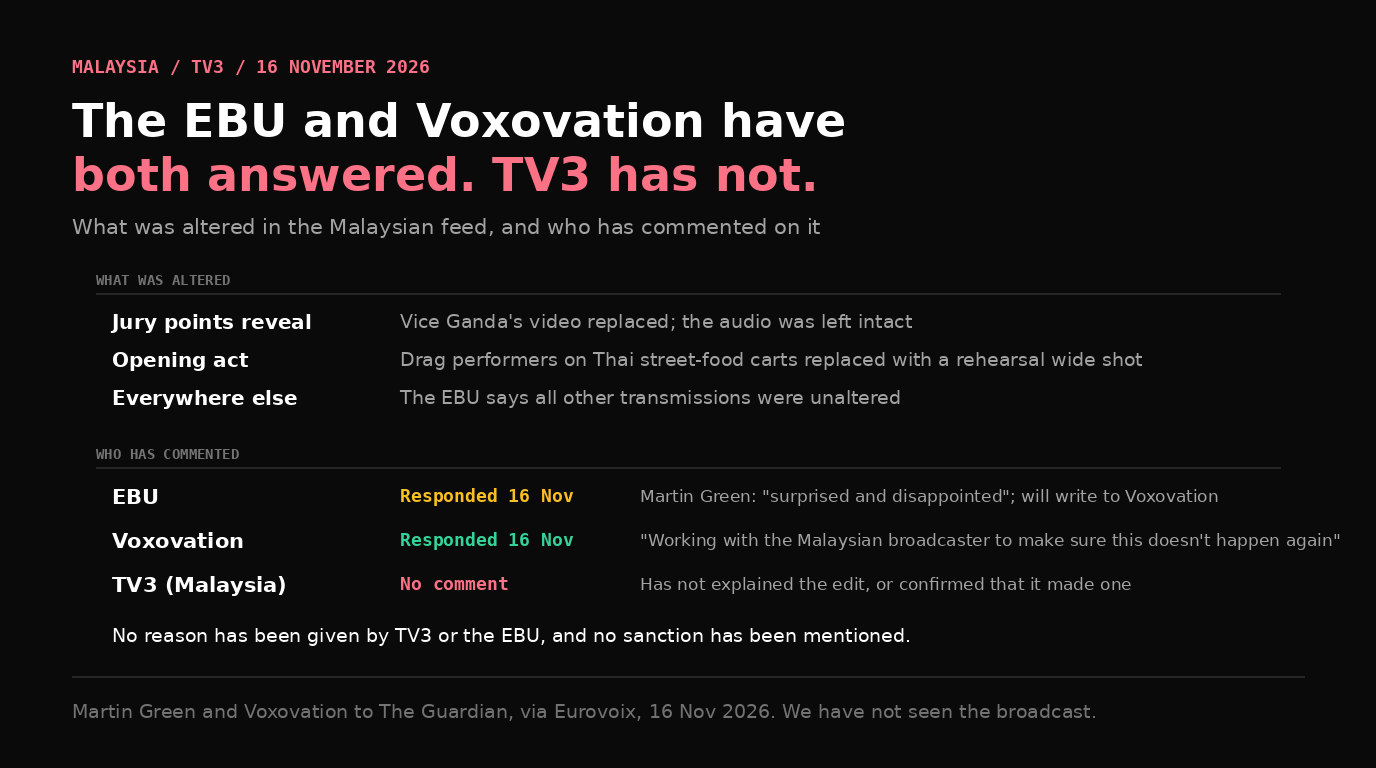
The European Broadcasting Union and Voxovation have both responded to Malaysian broadcaster TV3 altering its feed of the Eurovision Song Contest Asia Grand Final, two days after viewers noticed that Philippine spokesperson Vice Ganda had been replaced on screen during the jury points reveal. TV3 itself has still said nothing.

18+ | New customers only | T&Cs apply | Please gamble responsibly
Martin Green, Director of the Eurovision Song Contest, told The Guardian: “We are surprised and disappointed to learn that the broadcast of Eurovision Song Contest Asia was altered in Malaysia.” He added that the change “appears to be isolated to the Malaysian broadcast of the show, and all other transmissions were not altered.” The EBU said it will write to Voxovation, the contest’s producer, to seek clarification and to ask it to establish with TV3 why the edit was made.
Voxovation’s own statement was shorter: it is “working with the Malaysian broadcaster to make sure this doesn’t happen again.”
That is the first substantive comment from either organisation since the story emerged, and it closes the gap this site flagged a day earlier, when all three parties were silent.
What TV3 is reported to have altered
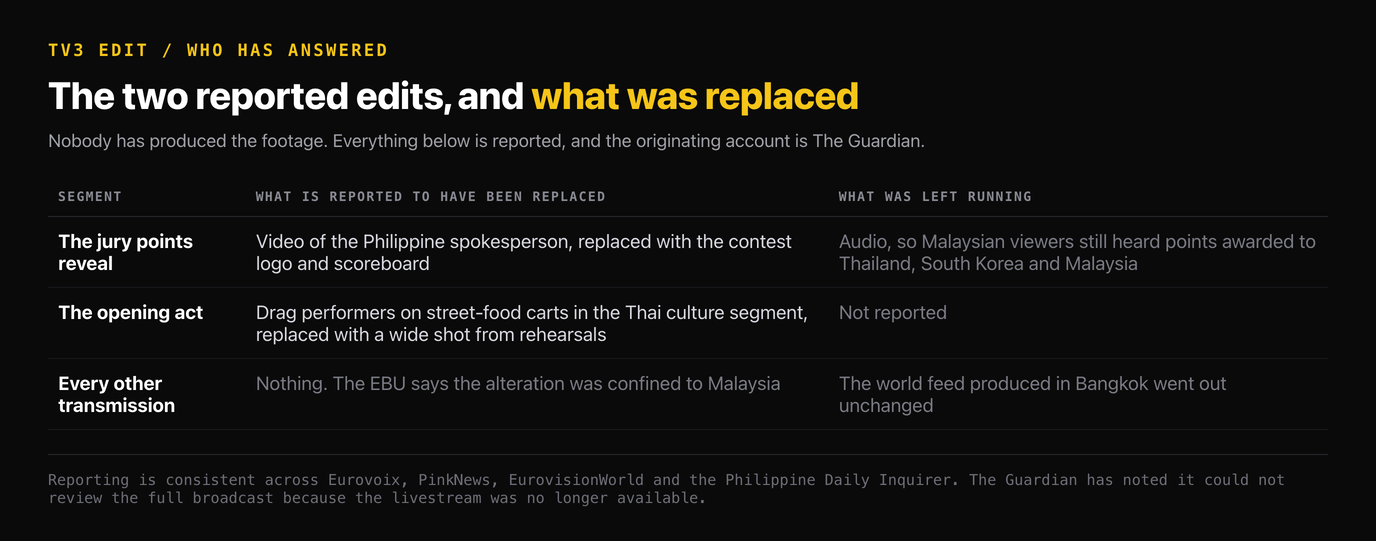
Two separate edits have been reported, and they are wider than the original account.
- The jury points reveal. Vice Ganda, a Filipino comedian, television host and drag performer, delivered the Philippine jury’s points. On the TV3 feed the video of the spokesperson was replaced — reports describe the contest logo and scoreboard being shown instead — while the audio was left running, so Malaysian viewers still heard the points being awarded to Thailand, South Korea and Malaysia.
- The opening act. In the segment showcasing Thai culture, drag performers appearing on street-food carts were reportedly replaced with a wide shot taken from rehearsals.
The EBU’s statement says the alteration was confined to Malaysia and that every other transmission went out unchanged. That is a meaningful detail: it makes this a single broadcaster’s decision about its own feed rather than anything done to the world feed produced in Bangkok.
One honest caveat, and it is the same one we carried yesterday: we have not seen the Malaysian broadcast. Everything above is reported, and the originating account is The Guardian, which has itself noted that it could not review the full broadcast because the livestream was no longer available. The reporting is consistent across Eurovoix, PinkNews, EurovisionWorld and the Philippine Daily Inquirer, and the EBU’s own words confirm that something was altered. What nobody has produced is the footage.
Why TV3 has not explained it, and why that matters
TV3, operated by Media Prima, has not commented, has not confirmed that it made an edit, and has given no reason for one. The widely drawn inference is Malaysia’s restrictions on LGBTQ+ content in broadcasting, and the circumstantial case is not nothing: both edits involved drag performers, and in 2025 TV3 publicly apologised after attendees at one of its events were reported to have dressed as women.
But that is inference, not a stated reason, and it is worth keeping the two apart. Neither TV3 nor the EBU has given an explanation. A betting and analysis site has no business converting a plausible motive into a reported fact, and on a story where three organisations are choosing their words this carefully, the gap between “what happened” and “why it happened” is the whole story.
The governance gap nobody has addressed
The more consequential silence is not TV3’s. Neither the EBU nor Voxovation has said whether participating broadcasters are contractually obliged to transmit Eurovision Asia unaltered, and no sanction of any kind has been mentioned.
For the European contest this question has a long and well-documented history, and the answer has usually been that the EBU leans on its members in private rather than publishing penalties. Eurovision Asia is five days old as a finished product. It has no precedent of its own, no published rulebook on transmission integrity that we have been able to find, and — crucially — a different ownership structure: Voxovation is a commercial producer working with the EBU, not a union of public broadcasters. Where the obligation sits, and who could enforce it, has not been stated by anyone.
Green’s wording is careful in a way that is worth reading closely. The EBU is not announcing an investigation; it is writing to the producer and asking the producer to establish the facts with the broadcaster. That is a chain of three organisations, and the one at the end of it is the only one that knows what happened.
Why this lands on the 2027 expansion plan
This is where a one-broadcaster editing decision stops being a curiosity. The organisers’ stated ambition for the second edition runs directly into the same problem.
Executive producer Assaf Blecher told AFP before the final that 16 or 17 countries and territories have expressed interest in 2027, naming China, Hong Kong and Taiwan. Christer Björkman, Voxovation’s music lead, separately put his own expectation at 16 countries competing, and said talks with the eleven 2026 broadcasters begin about a week after the contest — so from roughly 21 November. Our full read of that is in the 2027 outlook.
Every one of those prospective markets has its own content rules, and several have stricter ones than Malaysia. A contest that wants to roughly fifty per cent more participants across a region with this much regulatory variation needs a published answer to the question that TV3 has just posed, because the alternative is eleven or sixteen or seventeen separate feeds each quietly solving the problem locally. The inaugural edition has produced exactly one such incident and the EBU has called it isolated. The question is whether it stays isolated when the field grows.
There is also the matter of who was edited. Vice Ganda was not an incidental performer: the Philippines won the contest, and its spokesperson was cut from parts of the sequence in which its jury’s points were read out. CARMELLE took the title for the Philippines with 211 points, topping both the jury and public halves of the vote — the only country to do so. The full scoreboard and how the night unfolded are in our results and scoreboard report.
The audience this was edited for
It is worth being concrete about scale, because the inaugural contest’s real reach is still largely unmeasured and that shapes how much weight one incident carries.
The EBU says votes came from 183 countries and territories, which measures participation rather than viewership. Only one broadcaster has published an audience figure of its own: Vietnam’s VTV3 reported reaching over 5 million viewers with an average audience of 1,025,178 — the largest reach of any show on the channel that Saturday, and a substantial increase on its own national selection. No worldwide total has been published by anyone, and the Vietnamese figure should not be read as one; headlines that present it as a global number are misreading a single market’s overnight.
Malaysia has not published a figure for the Grand Final. What is known is that TV3 is part of Media Prima, the country’s largest commercial broadcaster, and that Malaysia finished fourth with 152 points on a strong jury score — 82 of them — so its own audience had a live stake in the result it was watching. Aina Abdul’s campaign is covered in our report on Malaysia’s fourth place.
That combination is what makes the governance question practical rather than abstract. Eurovision Asia needs committed national broadcasters far more than it needs any individual market, because in year one the broadcasters are the distribution. An organiser with eleven partners and an expansion target has limited leverage over any one of them, which is a reasonable explanation for the mildness of both statements — and also the reason the question of whether unaltered transmission is actually required will not stay unanswered indefinitely.
The betting angle: there is nothing to bet on, and that is the honest answer
No market of any kind exists on this story, and none exists on Eurovision Asia 2027 either. We checked both venues directly on 16 November.
Eurovision Asia 2026 is now fully settled on both exchanges that priced it. Polymarket closed all six of its books at 04:59 UTC on 15 November, four of them on the Philippines, with third place going to Vietnam and second to Thailand; lifetime turnover across the six finished at about $271,796. Kalshi, the CFTC-regulated US exchange that opened the first Eurovision Asia market back on 14 September, finalised all eleven of its contracts at 19:46 UTC the same day, also paying out on the Philippines. Our account of that settlement, and of how badly Kalshi’s closing marks tracked the actual result, is in the Kalshi settlement piece.
So: no host-city market, no participants market, no winner market, and no fixed-odds bookmaker has ever priced this contest at all. The only Eurovision market still trading anywhere on either venue is Polymarket’s Eurovision 2027 Participants book, on the European contest, where Slovenia and Spain remain the last two open contracts. Read at 17:04 UTC on 16 November, Slovenia sits at about 16.5% and Spain at about 7.4%, on roughly $97,000 of lifetime volume. Both are wide, thin quotes rather than firm prices, and both hinge on broadcaster decisions due by the EBU’s December deadline.
If a 2027 Eurovision Asia market opens — on participants, on a host city, or on a winner — it will be listed on our Eurovision Asia hub, which carries both boards and the full eleven-country breakdown. Until then, anyone offering you odds on this contest is not quoting a market that exists.
What would actually move this story
Three things, in rough order of how much they would change the picture:
- A statement from TV3 or Media Prima. It is the only party that can explain the edit, and the only one that has not spoken. A confirmation and a reason would settle the inference question in one sentence.
- A published rule, or a sanction. If the EBU or Voxovation states that broadcasters must transmit unaltered — or declines to — that sets the precedent for every broadcaster joining in 2027.
- The 2027 broadcaster talks, from about 21 November. Whether transmission integrity appears in them, and whether Malaysia returns, will say more about how seriously this is being taken than any statement will.
We will carry each of those as it lands. For now the position is precise and small: two of the three organisations involved have spoken, both expressed disapproval, neither described an obligation or a consequence, and the broadcaster that made the edit has not acknowledged making it.
Sources: Martin Green and Voxovation quoted by The Guardian, reported by Eurovoix on 16 November 2026 and corroborated by PinkNews, EurovisionWorld and the Philippine Daily Inquirer. Market state read directly from the Polymarket Gamma and Kalshi APIs at 17:04 UTC on 16 November 2026. This site has not seen the Malaysian broadcast.