
Right now, Polymarket carries the only live Eurovision markets anywhere. Not "the best odds" or "the sharpest prices" — the only ones. No bookmaker has an open Eurovision 2027 book, none has opened Eurovision Asia, and none can legally touch Junior Eurovision at all. If you want a tradeable Eurovision position today, there is exactly one venue.

18+ | New customers only | T&Cs apply | Please gamble responsibly
This piece is a working guide to what is actually on there, what the prices are as of 27 August 2026, how a prediction market differs from the bookmaker you are used to, and — because we got this wrong in public three days ago — what these thin markets can and cannot tell you.

What's on this page
What is live right now · The market moving on real news · Junior Eurovision — the one bookmakers can't offer · How this differs from a bookmaker · How to actually place one · The liquidity problem · What we got wrong · Kalshi and the alternatives · FAQ
What is live right now
One Eurovision event, fourteen contracts, and a second on Junior Eurovision. That is the entire Eurovision surface across every betting venue on earth as of this morning.
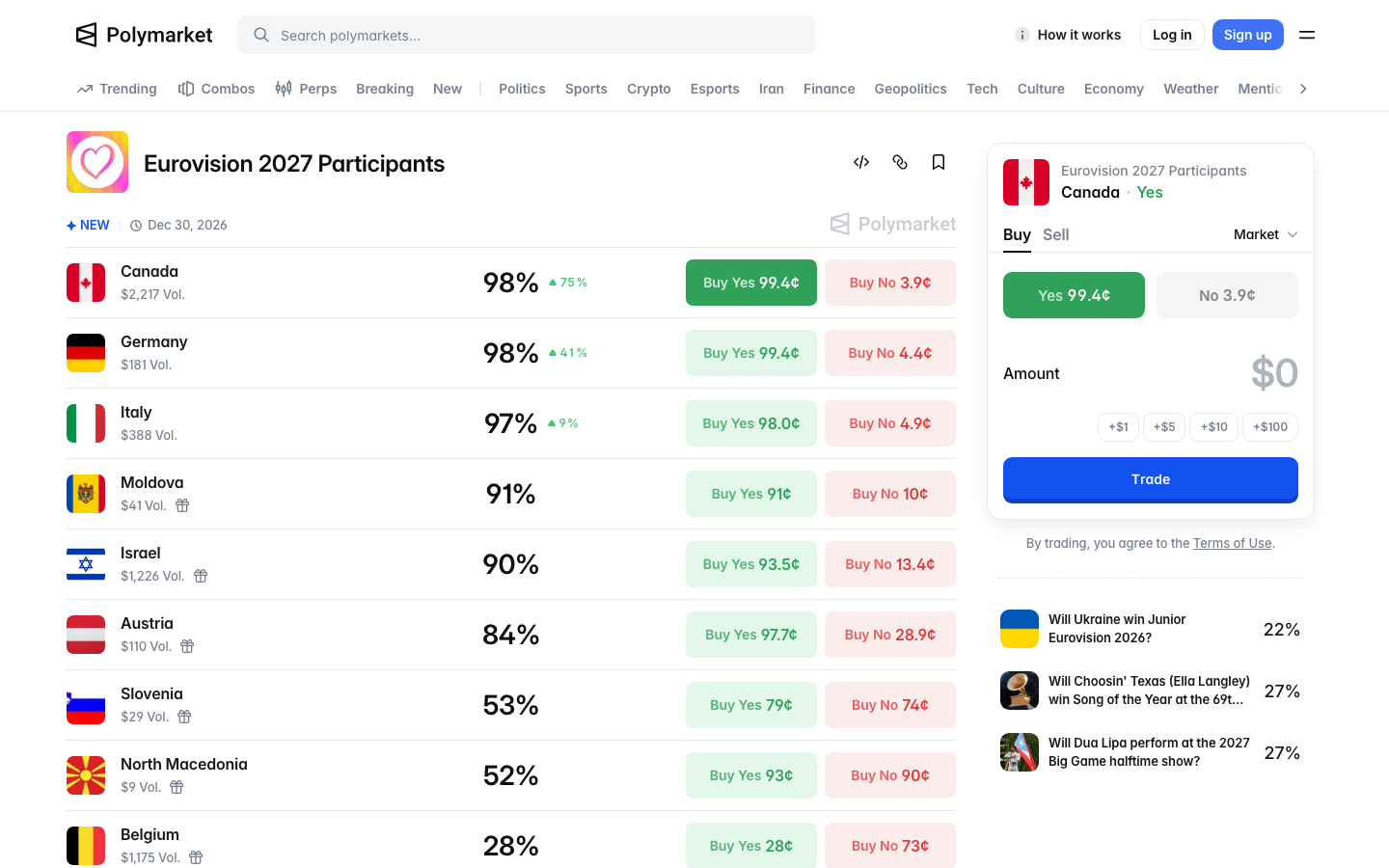
The Eurovision 2027 Participants market asks a single question fourteen times over: will this country actually compete in Burgas next May? It has taken ,969 in lifetime volume against ,070 of standing liquidity, and it resolves when the EBU publishes its confirmed list — expected before the end of 2026, with broadcaster applications closing in mid-October.
That resolution date is the reason this market is interesting rather than academic. Most Eurovision betting resolves in May. This resolves in about eight weeks, on a question that is being answered in public, one broadcaster statement at a time.
The prices divide into three tiers. Canada at 98%, Germany 97%, Italy 97%, Moldova 91% and Israel 90% are the settled group — the Big Five automaticity, the reliable returners, and a Canada debut the EBU has already confirmed. Austria at 84.5%, Iceland 54%, Slovenia 53%, North Macedonia 52% and Kazakhstan 48% are genuinely uncertain. And Belgium 28%, Ireland 17.5%, the Netherlands 17.5% and Spain 15.5% are the broadcasters that either withdrew in 2026 or are threatening to.
The market moving on real news
Three days ago the bottom tier looked completely different. Then AVROTROS announced it would not compete at Eurovision 2027, and the board repriced.
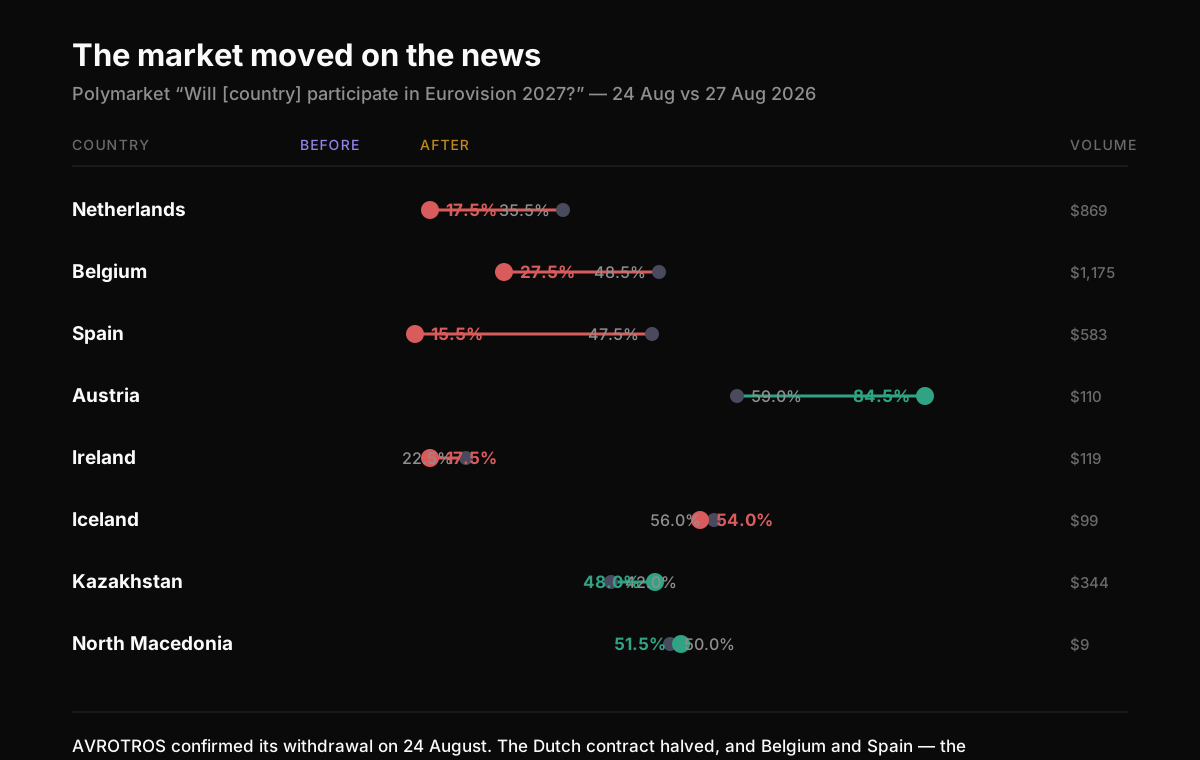
The Dutch contract halved, from 35.5% to 17.5%. That is the obvious move. The interesting one is what happened either side of it: Belgium fell from 48.5% to 27.5% and Spain from 47.5% to 15.5%, on news that was not about Belgium or Spain at all.
That is the market pricing correlation properly. Ireland, Spain, Slovenia, Iceland and Belgium are all weighing the same question about the same dispute. They were never five independent coin flips, and when one of them answered, the others moved. Traders who had those contracts priced as independent got repriced against.
Austria going the other way — 59% up to 84.5% — is the same logic inverted. Every broadcaster that confirms makes the field look more normal, and a more normal field makes the wobblers likelier to turn up.
Junior Eurovision — the one bookmakers can't offer
This is the part of the Eurovision betting landscape almost nobody writes about, for a reason that is structural rather than editorial.
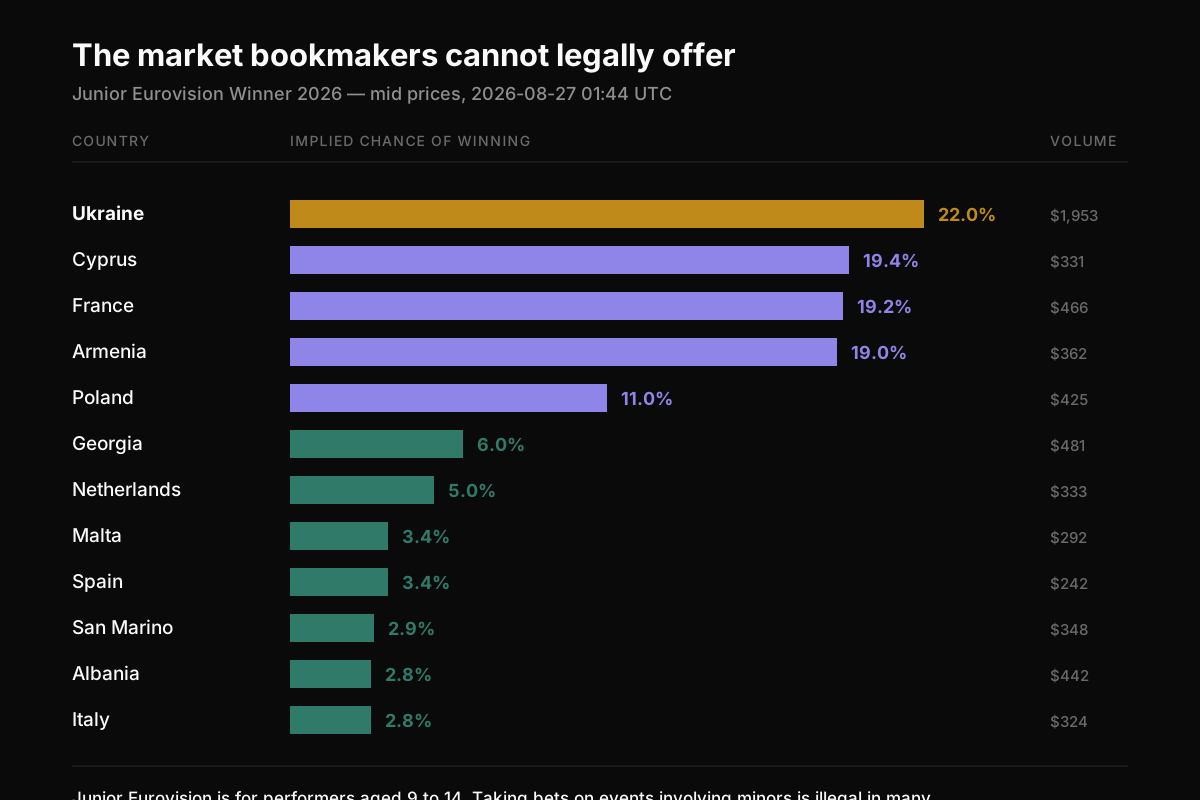
Junior Eurovision 2026 is on 24 October at the Malta Fairs & Conventions Centre in Ta' Qali — under eight weeks away. The performers are aged nine to fourteen, and in many jurisdictions it is illegal to accept bets on events involving minors. Mainstream bookmakers therefore do not price it. Not "choose not to" — cannot.
Polymarket does. The Junior Eurovision Winner 2026 market has ,144 in volume against ,637 of liquidity — deeper standing liquidity than the entire 2027 participants board — with Ukraine at 22% ahead of Cyprus 19.4%, France 19.2% and Armenia 19.0%.
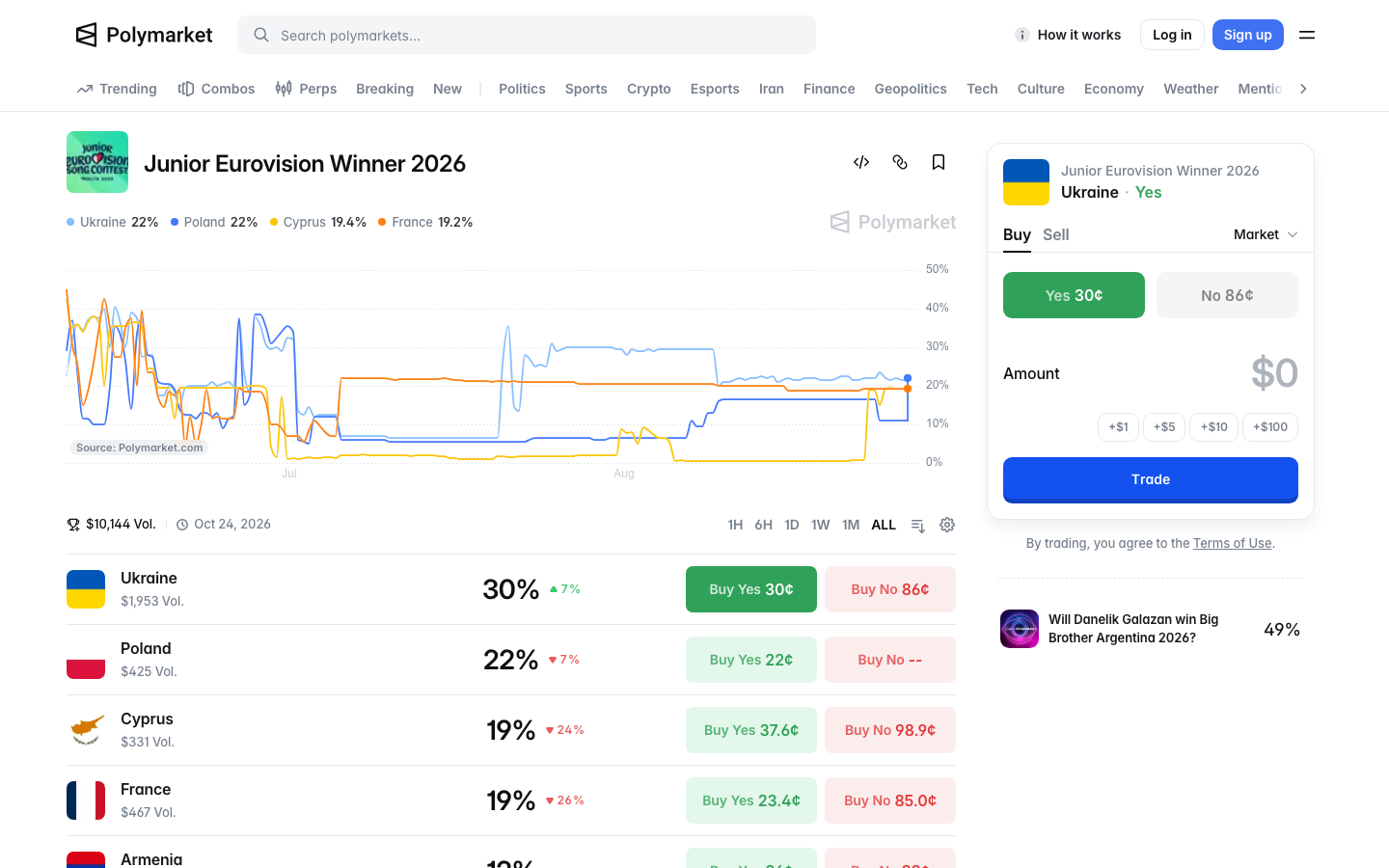
A trap worth understanding before you read any of these prices. Look at that screenshot: the chart legend says Ukraine 22% and the row underneath says 30%. Both are correct. The legend shows the mid — the market's actual implied probability — while the big number on the row tracks the ask, which is what it would cost you to buy right now. On a thin market that spread can be wide, and quoting the ask as though it were the forecast will make every market look more confident than it is. Our figures throughout this piece use the mid.
Two things follow. First, this is genuinely the only place to take a position on the contest. Second, and more useful: the liquidity-to-volume ratio here is unusual. ,637 of standing liquidity against ,144 traded means market makers are quoting real size that nobody has taken. On a thin market that normally signals prices which have not been properly tested.
A word on tone, because this is a children's contest. Treat it as a forecasting market rather than a punt, keep stakes trivial, and do not go looking for edges in individual performers. The interesting question here is whether a public probability estimate on a low-coverage event is any good — not who to back.
How this differs from a bookmaker
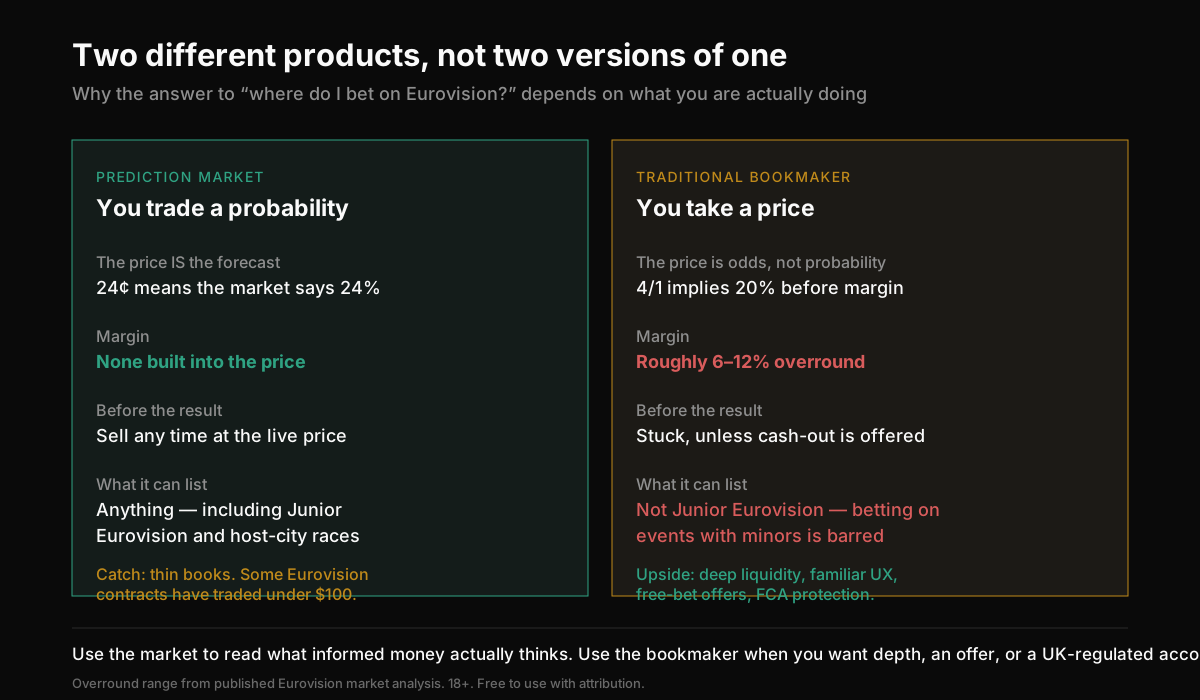
The single most useful difference: the price is the forecast. When Ukraine trades at 24¢, the market is saying 24%. There is no conversion, no overround to strip out, no "that 4/1 is really 18% after the book's margin." You read it directly.
Second: you can sell before the result. If the Netherlands contract is at 17.5% and NPO announces a substitute broadcaster tomorrow, that contract reprices and you can exit into the move. A bookmaker's ante-post bet is generally stuck until settlement unless cash-out is offered.
Third, and least discussed: a prediction market will list things a bookmaker won't. Junior Eurovision. Host-city races. Whether a specific broadcaster participates. These are questions with genuine public interest and no traditional book behind them.
The bookmaker wins on depth, familiarity, welcome offers and — for UK users — FCA-regulated dispute resolution. If you want to place a straightforward outright on the 2027 winner in May with real money and a familiar interface, a bookmaker is the right venue. Our bookmaker comparison covers who prices Eurovision and what they offer.
How to actually place one
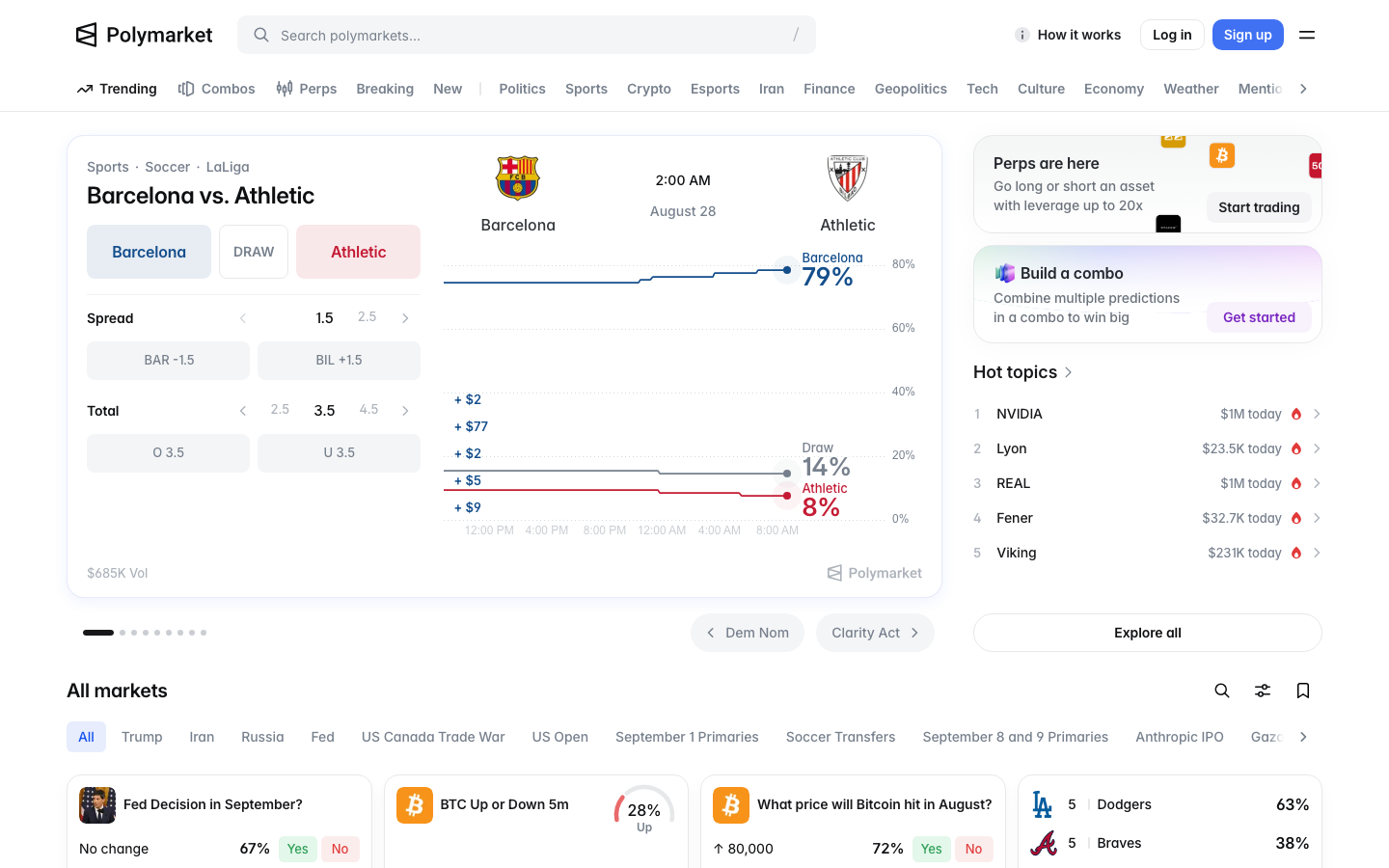
The mechanics are simpler than the interface suggests. Every contract settles at either 100¢ or 0¢. Buying "Yes" on Ukraine at 24¢ costs you 24 cents per share; if Ukraine wins you receive 100 cents, and if it does not you receive nothing. Your maximum loss is what you paid, and there is no stake-versus-liability distinction to think about.
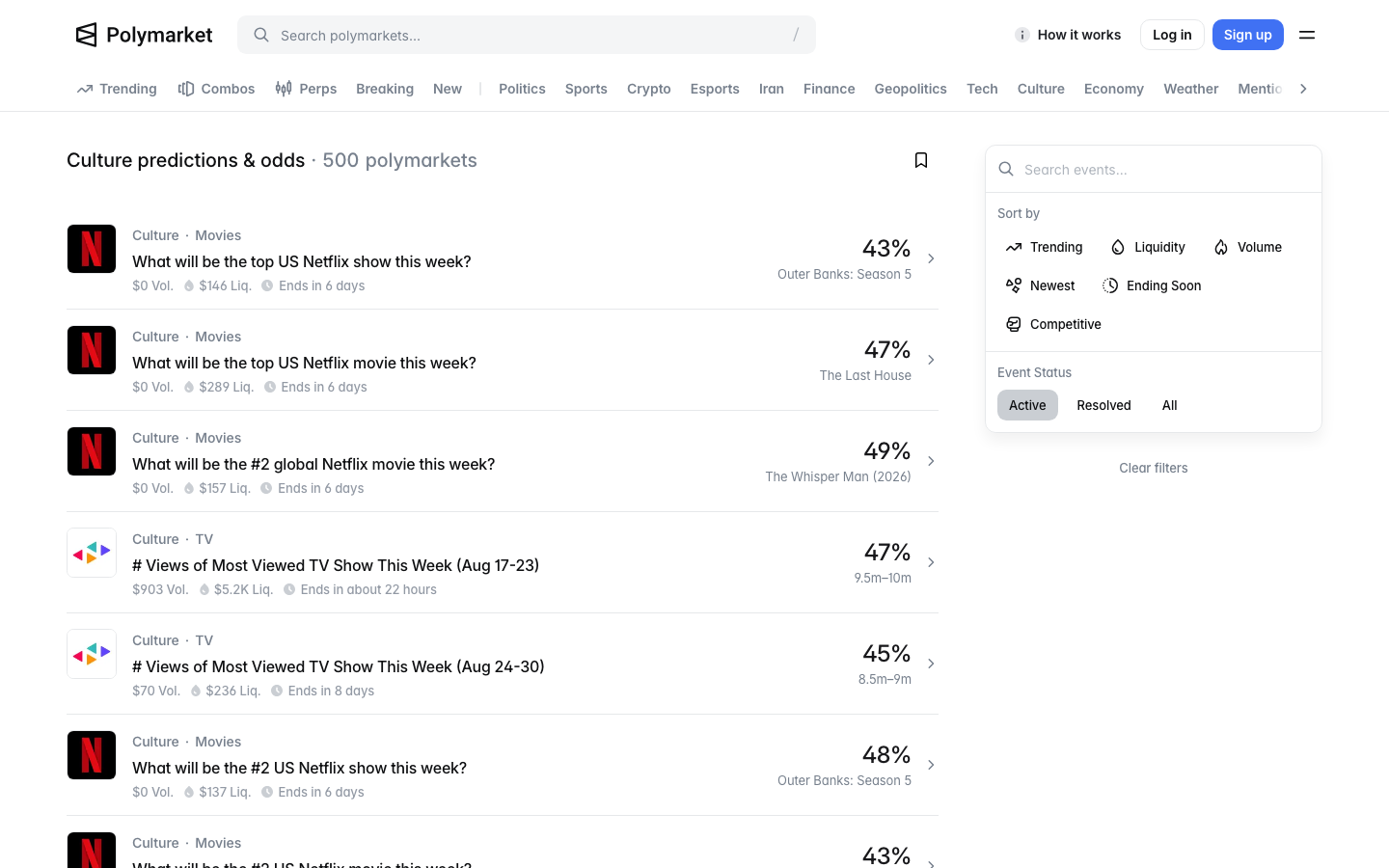
Finding Eurovision takes a moment because it is not filed where a bettor expects. It sits under Culture rather than Sports, and the fastest route is the search box.
Two mechanical details worth knowing before you fund anything. The platform settles in USDC, a dollar stablecoin, so a UK user carries currency exposure on top of contest risk. And Polymarket restricts access from some jurisdictions — check whether you can legally use it where you live before going further.
Read the resolution criteria on the specific contract. This matters more here than at a bookmaker, because these are bespoke questions rather than standard markets. "Will the Netherlands participate in Eurovision 2027?" — does that resolve yes if AVROTROS stays out but a different Dutch broadcaster enters? That ambiguity is live right now, and it is the sort of thing you want settled in your head before you have money on it.
The liquidity problem, stated plainly
Everything above comes with one caveat large enough to change your behaviour: these markets are thin.
Look at the volume column on the 2027 board. Canada has taken ,217 in its lifetime. Germany has taken . North Macedonia has taken nine dollars. That last one is not a market opinion — it is an untouched initialisation value that happens to look like a forecast.
Three consequences. The bid-ask spread on a contract this thin routinely eats any theoretical edge you think you have found. If you are right, you may not find anyone to close against. And a price nobody has traded carries no information at all, however confidently it displays as a percentage.
The practical rule: read the volume before you read the price. On this board, Canada (,217), the Netherlands (,448), Belgium (,175) and Israel (,226) have enough money behind them to be treated as opinions. Most of the rest are closer to placeholders.
What we got wrong, three days ago
On 24 August we published a piece arguing the Netherlands contract at 35.5% was too cheap, because Dutch television had reported that AVROTROS had already decided to return. Hours later AVROTROS announced the opposite. The contract is now at 17.5%.
The thin market was closer to right than the media scoop was, and two mistakes in that piece are worth naming because they are easy to repeat.
A reported decision is not a decision. We treated a single-sourced broadcast report of an unannounced choice as a fact the market had failed to price. Reports of unannounced decisions are frequently premature or simply wrong, and a market sitting at one-in-three was a fair description of that uncertainty.
Low liquidity is not the same as low information. We used thin volume as evidence the price was stale. Thin markets are hard to trade and slow to update — neither of which means the number is wrong. The Netherlands contract had real money behind it and it was better calibrated than we were.
The part of that piece that held up was the conclusion: a watch, not a trade. Which is roughly the right posture for this entire board.
Kalshi and the alternatives
Kalshi is the obvious comparison — a CFTC-regulated US prediction exchange that settles in dollars rather than stablecoin, which for a US user is a meaningfully cleaner setup. It has not historically carried Eurovision markets with any consistency, and it does not have an open one at the time of writing, but it is the venue most likely to add one if Eurovision volume keeps growing.
Betfair's exchange is the traditional answer to "I want to trade rather than bet," and for Eurovision outright markets in May it usually has the deepest book anywhere. What it does not do is list the participation, host-city and Junior Eurovision questions that make the Polymarket board interesting right now.
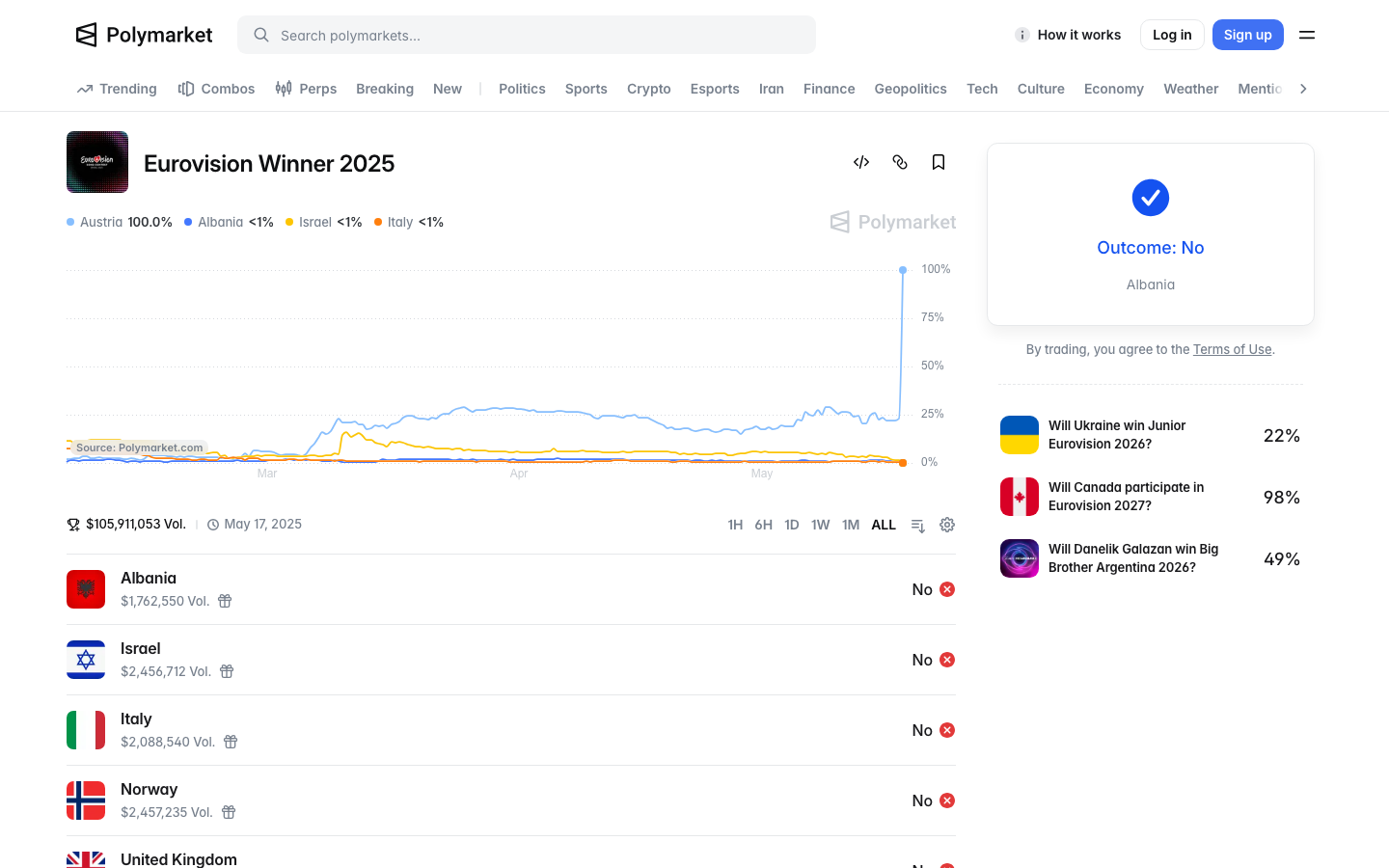
One genuine advantage of the platform that has nothing to do with betting: settled markets stay published. You can go back and see exactly what the market thought Finland's chances were the week before Vienna, and compare that to what happened. For anyone trying to work out whether Eurovision markets are any good at forecasting, that archive is the raw material.
Related reading
The Eurovision 2027 participation board — the news behind every contract on that market: 21 confirmed, 3 out, 10 still deciding.
AVROTROS boycotts Eurovision 2027 — the announcement that repriced the board, and why the Dutch question is not closed.
Will Ireland boycott too? — our call at 85% they stay out. The market now says 82.5%.
Will Iceland return? — where we still disagree with the market, and what would change our mind.
Eurovision 2027 in Burgas — dates, venue and the confirmed field.
FAQ
Can you bet on Eurovision on Polymarket? Yes. As of 27 August 2026 it carries the Eurovision 2027 Participants market (14 contracts) and the Junior Eurovision Winner 2026 market. These are currently the only live Eurovision markets at any venue.
Is Polymarket legal in the UK? Access is restricted in some jurisdictions and the position has changed more than once. Check the platform's current terms for your country before funding an account. It is not FCA-regulated, so UK bettors do not get the dispute protections a licensed bookmaker provides.
How do Polymarket odds work? Prices are quoted in cents from 0 to 100 and read directly as a probability — 24¢ means the market implies 24%. Every contract settles at 100¢ or 0¢, so your maximum loss is what you paid per share.
Can you bet on Junior Eurovision? Not with mainstream bookmakers — the performers are aged 9 to 14 and betting on events involving minors is illegal in many jurisdictions. Polymarket lists a Junior Eurovision Winner 2026 market, with Ukraine the 24% favourite ahead of the 24 October contest in Malta.
Is Kalshi better than Polymarket for Eurovision? Not currently — Kalshi has no open Eurovision market. It settles in dollars and is CFTC-regulated, which is cleaner for US users, so it is the likelier home if these markets grow.
Are Eurovision prediction markets accurate? Mixed, and the volume tells you which to trust. The 2026 winner market moved decisively before the final and was right. The 2027 participation contracts range from to ,448 in lifetime volume — the well-traded ones have been well calibrated, including on the AVROTROS withdrawal, and the untraded ones carry no information at all.
What happens to my position if a market is ambiguous? Read the resolution criteria before entering. The live example: "Will the Netherlands participate in Eurovision 2027?" is genuinely unclear on whether a substitute Dutch broadcaster would count, since AVROTROS handed the mandate back to NPO.
18+. Prediction markets carry risk and are not available in every jurisdiction. Never stake more than you can afford to lose. BeGambleAware.org.