

South Korea's Eurovision Song Contest Asia entry path is, as of this morning, eight days from closing. ENA — the SK Telecom / KT Group-affiliated broadcaster running the Korean delegation — has an open casting call live across its digital platforms, and any artist of South Korean nationality may submit. The deadline is firm: 23:59 KST on June 30, 2026. The national final goes to air on September 4, 2026, produced by Voxovation. The Grand Final itself is at the IdeaLive Arena in Bangkok on November 14, 2026.

18+ | New customers only | T&Cs apply | Please gamble responsibly
That timeline matters because of who is — and isn't — likely to apply. The K-pop major labels have well-understood commercial reasons to sit this one out (more on that below). The result is the kind of inefficient-market window that almost never exists in established music-industry contests: a televised national selection in a country with one of the world's deepest commercial pop pipelines, with the top of that pipeline functionally excluded by self-interest. Below is what the window actually looks like, who realistically fills it, and how to think about the betting angle once Polymarket eventually lists a Korea-winner market.
Track Eurovision Asia markets on Polymarket — create an account in 60 seconds

What's open right now — the ENA submission window
ENA's open casting call went live on June 18 and was reported by ESCXtra the same day. Three rules of substance govern it.
- Nationality: any artist holding South Korean nationality may apply. There is no agency-letter requirement and no requirement that the act already be signed to a major label. Solo acts, duos, groups of up to six, and self-managed indie performers are all eligible.
- Song format: standard Eurovision rules apply — maximum three minutes, maximum six performers on stage, original composition (no covers or pre-released material that fails the EBU's release-window rule).
- Submission deadline: 23:59 KST on June 30, 2026. ENA has not yet announced whether it will publish a shortlist of finalists ahead of the September 4 television broadcast, but Voxovation — the production house running every national final in this cycle, beginning with Bhutan in early August and moving through the participating countries every five to six days — has historically named finalists two to three weeks before air.

Betfred — Bet £10 Get £50 in Free Bets on Eurovision-family markets
Why the K-pop majors will likely sit it out
The shorthand assumption from outside observers is that Korea will field a HYBE, SM, JYP or YG act and run away with the contest. The commercial math doesn't support that assumption. Each of the five Korean majors has a tightly choreographed multi-year roadmap for their A-tier acts — world tours, US late-night TV cycles, Coachella slots, stadium plays in Tokyo and Bangkok already on the books. The Eurovision Asia Grand Final venue, the IdeaLive Arena, seats 4,234.
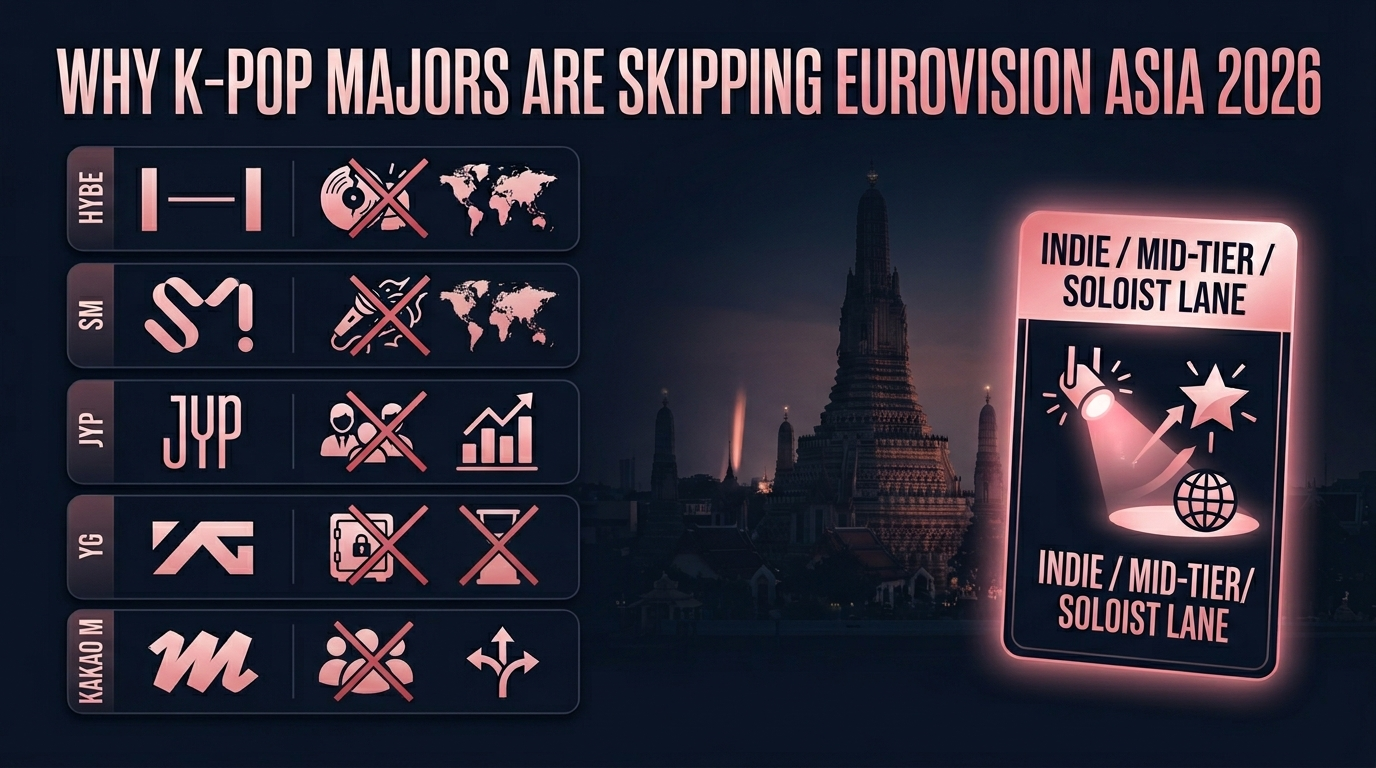
The relevant numbers:
- HYBE — the BTS solo cycles and TXT/LE SSERAFIM/ENHYPEN/KATSEYE roadmaps are already in 15-50k-seat venues globally. A 4,234-seat arena, even one televised across Asia, is a venue downgrade. The downside risk of a non-win on the night is also asymmetric: a HYBE act losing the inaugural Eurovision Asia to a Vietnamese or Thai entry is a brand event no A&R team wants to underwrite.
- SM Entertainment — aespa, NCT, Riize and the soloist roster are in the same tier. SM has historically been the most reputationally conservative of the majors with novel-format TV bookings.
- JYP — TWICE, Stray Kids and ITZY are touring at scales where the Bangkok arena is a routine tour stop, not a milestone.
- YG — BLACKPINK and BABYMONSTER's cadence is the slowest of the four, and YG specifically has avoided televised-contest formats since 2NE1.
- Kakao M — the most plausible major to enter via one of its sub-labels (Starship, IST, EDAM), but even Kakao's A-tier (IVE, MONSTA X, Apink) is past the marginal-publicity threshold for a contest entry.
None of this is to say no major-affiliated act will apply. Sub-labels, distribution partners and former-member solo projects sit just outside the A-tier and may see the contest as useful exposure. But the central expectation across the K-pop trade press as of this week is that the headline acts — the ones with name recognition in Bangkok, Hanoi, Manila and Jakarta — will not be on the September 4 shortlist.
Who actually applies — the mid-tier, indie and soloist lane
That leaves a much more interesting pool. The acts realistically in the frame for a serious ENA submission include:
- Mid-tier idol groups past the marketing-spike phase — established groups whose label support has tapered and for whom a televised Asia-wide platform is genuinely accretive. Several fourth-generation girl groups and third-generation boy groups fit this profile.
- Indie K-pop labels — smaller agencies whose acts haven't broken through the Korean domestic chart and would be willing to gamble production budget on a Bangkok televised final. This is the lane that most resembles Eurovision Europe's national-selection economics.
- Solo OST artists and ballad singers — Korea's drama-soundtrack ecosystem produces dozens of charting solo artists per year who never tour internationally. A Eurovision-format vocal showcase plays directly to their strengths and gives them an international footprint they otherwise wouldn't have.
- Former-idol soloists — ex-members of disbanded groups (the cohort of post-IZ*ONE, post-GFRIEND, post-2NE1 etc soloists) who are commercially active but operating at a smaller scale than their original group.
- Independent artists from KPop4Planet-aligned labels and indie scenes — the activist-aligned and indie-rock-K-pop crossover scenes that have grown around Sogyeokdong-based labels.
This is the inefficient-market angle. If you accept the premise that the majors sit out, the September 4 final is being contested by acts with smaller followings, smaller international name recognition, and far less predictability than a HYBE or SM entry would have brought. That's exactly the population from which surprise winners come.
How the September 4 final will work
The mechanics of the Korean national final are already known. Voxovation, the Bangkok-headquartered production house holding the rights to produce all participating-country national finals across this Eurovision Asia cycle, has set a cadence of one national final every five to six days from early August through early October. Bhutan goes first in early August; Korea is among the later slots on September 4.
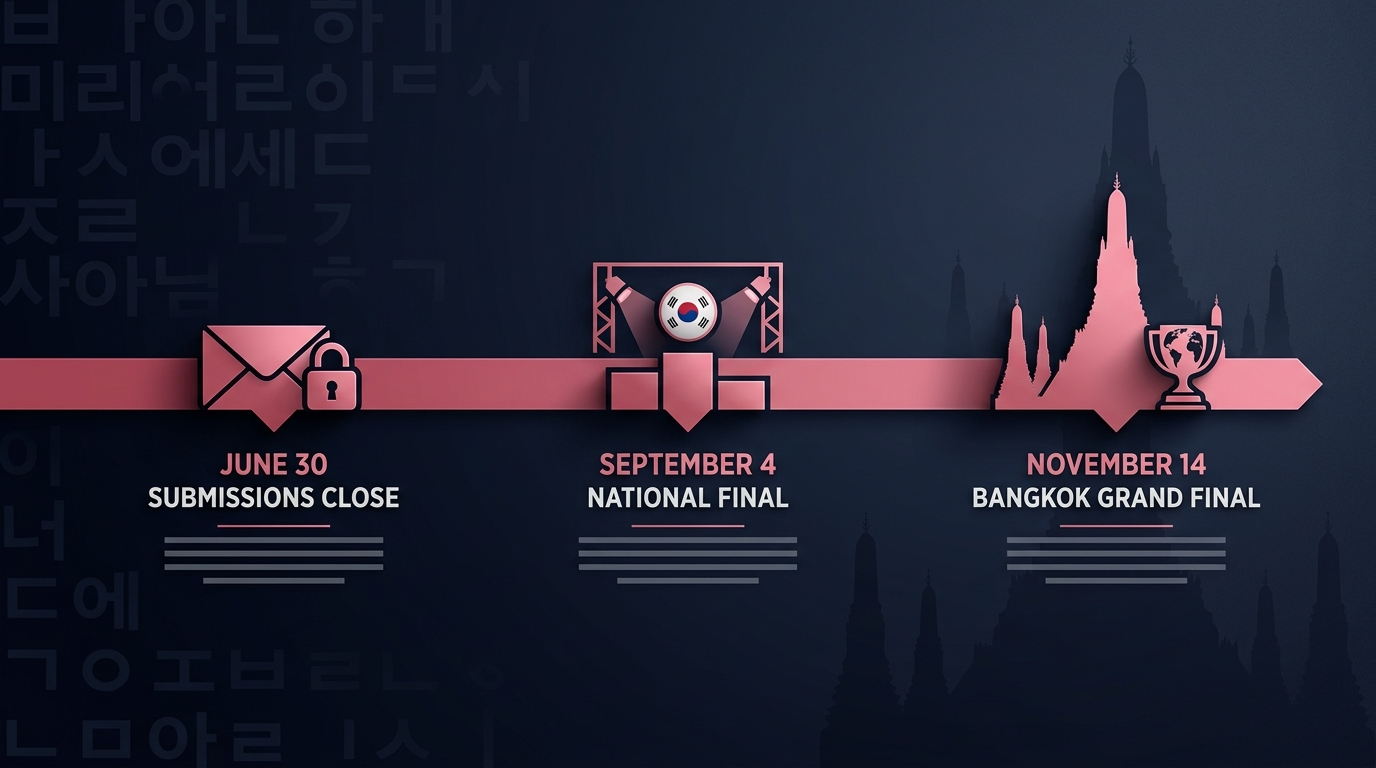
- Voting structure (national final): a 50/50 split between a domestic jury and a Korean public televote, mirroring the Grand Final's own scoring system.
- Number of finalists: not yet publicly confirmed by ENA. Voxovation's Bhutan and Maldives finals have run six to eight competing songs; Korea is likely to be at the upper end of that range given submission volume.
- Format: live-to-tape televised broadcast on ENA's main channel, with simultaneous streaming on ENA's digital platforms and a presumed Voxovation-side international stream.
- Eligibility for the Grand Final: the winner on September 4 represents Korea at the Bangkok Grand Final on November 14. There is no semi-final stage in the inaugural year — all participating countries qualify directly into a single Grand Final, scored 50/50 by an international jury panel and an Asia-wide public televote.
First-edition contest history says — surprises are likely
The 70-year precedent from the original Eurovision and its spinoffs is consistent on this point: first editions in unestablished markets very rarely produce the on-paper favourite as the winner.
- Eurovision 1956 (Lugano) — Switzerland's Lys Assia won the inaugural contest. The pre-contest favourite, in so much as the term applied in 1956, was West Germany. Switzerland was a host-country dark horse.
- Junior Eurovision 2003 (Copenhagen) — Croatia's Dino Jelusić won; the pre-contest favourites were Sweden and the UK. The contest has since seen first-time entrants Georgia, Armenia and Malta all win within their first three editions.
- Eurovision Asia-Pacific concept (Australia/SBS, 2018 conceptual) — the never-aired SBS-led attempt at an Asia-Pacific contest had a presumed Korean-Australian favourite frame; the actual rights-holder framework collapsed before any selection was run.
- Turkvision Song Contest 2013 (Eskişehir, first edition) — Azerbaijan won; the favourites at the time were Turkey (host) and Kazakhstan. Both finished outside the top three.
The pattern is structural. First editions are produced by broadcasters and production houses with no historical voting-pattern data, no template for what the public actually rewards on the night, and no incumbency to defend. Voters in those circumstances tend to reward whichever entry feels most distinctive on first viewing — which is rarely the largest-budget, most-polished, most-promoted act on the bill.
The betting angle: South Korea once a market opens
As of this morning, Polymarket has not listed an outright-winner market on Eurovision Song Contest Asia 2026. No bookmaker covered on our Eurovision Asia hub has either. The contest is too far from broadcast and the participating-country field too unsettled to attract liquidity. That will change.
When markets do list, the structural reasoning above suggests Korea is likely to be priced too short. The K-pop brand association on its own will compress Korea's outright price below where the underlying probabilities support it — particularly if speculative early traders assume a major-label entry that the K-pop trade press is already signalling won't materialise. The trade is to wait for the September 4 national final (knowing which Korean act is actually carrying the flag) and price against an over-confident pre-final book.
The same logic, in reverse, applies to Thailand (host nation, very plausibly under-priced if Korea draws all the speculative money) and to the Vietnamese, Filipino and Indonesian entries, which the first-edition pattern suggests are realistic dark horses.
What to track between now and June 30
The eight-day window between today and the submission deadline is short, but watchable:
- Korean entertainment trade press — OSEN, Newsen and Sports Chosun will be the first outlets to publish leaked submission lists. Soompi will translate within hours.
- Twitter/X K-pop fandom accounts — major fan accounts for individual idol groups will often confirm or deny their group's submission before the agencies do.
- ENA's own digital platforms — ENA may publish a submission counter or a preview of high-profile entrants in the closing 48 hours.
- Voxovation's international stream announcement — once Voxovation confirms the Korean broadcast slot and stream window, the production-side confidence in submission volume becomes measurable.
- Polymarket and bookmaker market listings — we'll flag the moment any operator opens an outright-winner market on Asia 2026, and the moment any Korean act trades to a single-figure price. The EurovisionOdds sentiment dashboard will pick up that listing event automatically.
The combination of an open public-submission window, a credible production house, a real televised national final, an inaugural-year contest with no incumbency, and an A-tier industry that is structurally incentivised to skip is unusual. The next eight days resolve who actually carries Korea's flag into a contest whose pricing — once it exists — is likely to misvalue them in both directions.
Related
- Eurovision Song Contest Asia 2026 hub — all participating countries
- South Korea country page — full ENA selection tracker
- Full pre-call analysis: why Korea is the structural favourite
- Thailand host-country preview
- Best Polymarket Eurovision markets to trade in 2026 and 2027
- Polymarket-vs-public-opinion sentiment dashboard
18+. Please gamble responsibly. BeGambleAware.org. GAMSTOP. When the fun stops, stop.