
The first Eurovision Song Contest Asia Grand Final takes place in Bangkok on 14 November 2026. With five months to go, the most consequential national-selection process in the contest belongs to South Korea — not because Korea has confirmed a single artist, but because the structure of its open call has created a betting-market puzzle that nobody outside the K-pop industry has properly priced yet.

18+ | New customers only | T&Cs apply | Please gamble responsibly
South Korea's host broadcaster is ENA. This is worth restating because the early international press — and large swathes of Twitter and YouTube — have repeatedly attributed the Korean entry to KBS. That is wrong. ENA, the cable network owned by Skylife TV and operated under the KT Group umbrella, is the EBU's confirmed Korean broadcast partner for Eurovision Asia 2026. ENA opened a public open call on 1 June 2026 that runs until 30 June 2026, with the televised national final scheduled for 4 September 2026. That window is the most concrete fact in the market right now, and it is closing fast.
Betfred — Bet £10 Get £50 in Free Bets on Eurovision 2027
The ENA open call — what we actually know
ENA's selection process for Eurovision Asia 2026 follows a three-phase template that mirrors several established European national finals — most closely Sweden's Melodifestivalen and Italy's Sanremo, but with a Korean broadcast cadence. Phase one is the open submission window. Phase two is internal A&R selection plus invited entries. Phase three is the live televised final on 4 September, where a jury-and-public split decides the act that travels to Bangkok.
A 31 March 2026 ENA promo video — the first official marketing asset the broadcaster published — featured a rotating set of artist shots that the Korean Eurovision fan account @esc_asia identified as JJ, Kiss of Life, P1Harmony, AB6IX, Byrd & Heart, and AtHeart. ENA has not confirmed that any of these artists are entered. The promo was a creative direction asset, not a line-up announcement. But the act selection is informative: ENA chose mid-tier export-grade idol groups and singer-songwriter acts rather than the global top-tier the K-pop industry routinely associates with overseas promotion. That signal is consistent with the structural argument below.
Why HYBE, SM, JYP, YG and Kakao M will almost certainly stay out
The five labels that control K-pop's globally exported A-tier are HYBE (BTS, NewJeans-era ADOR, Le Sserafim, Enhypen, TXT, Seventeen via Pledis, Katseye via Geffen-HYBE), SM Entertainment (aespa, NCT, Riize, Red Velvet), JYP Entertainment (Stray Kids, ITZY, Twice, Nmixx), YG Entertainment (Blackpink, Babymonster, Treasure), and Kakao M / Kakao Entertainment (IU, Ive via Starship, Cravity). To this list you can reasonably add ADOR (NewJeans, post-HYBE arbitration) and Cube Entertainment (G-Idle, Lightsum).
None of these labels has confirmed a Eurovision Asia entry. None is expected to. The commercial calculus runs against participation on four separate axes.
| Label | A-tier roster sample | Likely Eurovision Asia participation | Primary reason |
|---|---|---|---|
| HYBE | BTS, Seventeen, Le Sserafim, Enhypen, TXT, Katseye | Very unlikely | Global tour and US Billboard strategy already structured around non-Eurovision narrative |
| SM Entertainment | aespa, NCT, Riize, Red Velvet | Very unlikely | SMTOWN brand prioritises label-owned showcases over external contests |
| JYP Entertainment | Stray Kids, ITZY, Twice, Nmixx | Very unlikely | US and Japan promotion calendar conflicts with September/November window |
| YG Entertainment | Blackpink (solos), Babymonster, Treasure | Very unlikely | Brand positioning treats competition-show formats as off-tier |
| Kakao M / Kakao | IU, Ive (Starship), Cravity | Unlikely | Roster scheduling and concert-tour priorities through Q4 2026 |
| ADOR | NewJeans | Very unlikely | Post-arbitration roster still consolidating; no externally-judged formats |
| Cube Entertainment | (G)I-DLE, Lightsum | Possible but unlikely | (G)I-DLE international tour activity dominates the window |
The first axis is Eurovision stigma inside the Korean industry. Eurovision is widely understood inside major-label Korean A&R as a European cultural product rooted in kitsch, irony, and pan-European political voting blocs. The format's reputation for novelty staging and one-off song concepts runs against the carefully managed multi-album narrative arcs major K-pop labels build around their flagship groups. For BTS's individual members in their post-enlistment relaunch year, or for Blackpink's solo expansion, a Eurovision Asia entry would compress the artist into a single song judged by a panel they do not control — a risk no A-tier label takes voluntarily.
The second axis is schedule conflict. The 4 September national final and 14 November Bangkok final collide directly with the Q4 album cycle that drives Korean year-end music-award nominations (MAMA, MMA, Golden Disc, Seoul Music Awards). A-tier groups release their flagship Q4 record in the September-October window precisely so the album dominates year-end vote totals. Two televised live appearances in a competition format would force a release-window compromise no A-tier label is incentivised to make.
The third axis is brand-tier risk. Major K-pop labels position their A-tier acts as global headliners. Losing a Eurovision Asia final to a mid-tier act — or finishing outside the top three in Bangkok — would compress global brand positioning that the label has spent years building. The downside variance is asymmetric.
The fourth axis is FANOMENON. Billboard reported in April 2026 that HYBE and others are involved in a joint K-pop festival product for 2026-2027 that consolidates the largest label rosters into a co-promoted touring brand. The strategic logic of FANOMENON — label collaboration on closed-format showcases — is the opposite of the externally-judged Eurovision format. Labels participating in FANOMENON have less, not more, incentive to enter Eurovision Asia.
The net effect: the ENA open call exists in a market where the five labels with the strongest export-grade rosters have de facto opted out. That is the inefficiency.
The mid-tier candidate pool — who is actually plausible
If the A-tier sits out, the candidate pool collapses to mid-tier idol acts, singer-songwriter acts, audition-show winners, and OST-driven vocalists. These artists have professional studio infrastructure, broadcast experience, and meaningful domestic chart performance — they are not amateurs — but they sit a tier below the global-tour-headlining ranks. They are also the artists for whom a Eurovision Asia win produces the largest career upside.
Below is the set of acts active in fan discussion in late May and early June 2026, cross-referenced against verified-active status (recent releases, active social presence, no announced hiatus, no current military enlistment, no scheduling conflict yet disclosed). No artist on this list has confirmed an entry. Inclusion here means the act is fan-discussed and not ruled out — nothing more.
| Artist | Tier | Recent activity | Plausibility signal |
|---|---|---|---|
| JJ | Solo singer-songwriter | 2026 single releases, active social | Featured in ENA 31 Mar promo |
| Kiss of Life | Mid-tier idol group | Active comeback cycle | Featured in ENA 31 Mar promo |
| P1Harmony | Mid-tier boy group (FNC) | 2026 mini-album, world tour | Featured in ENA 31 Mar promo |
| AB6IX | Mid-tier boy group (Brand New Music) | Active discography, member solo work | Featured in ENA 31 Mar promo |
| Byrd & Heart | Indie duo | Active touring and streaming | Featured in ENA 31 Mar promo |
| AtHeart | Singer-songwriter | Active release schedule | Featured in ENA 31 Mar promo |
| AKMU | Sibling duo | Recent releases, active touring | Fan-discussed; broad cross-demo appeal |
| NELL | Veteran rock band | Active touring | Fan-discussed; established export experience |
| Lee Mujin | Singer-songwriter | Strong domestic charting | Fan-discussed; Mujin Service variety profile |
| Lee Seung Yoon | Audition-show winner / rock vocalist | Active discography | Fan-discussed; competition-format experience |
| Ailee | Power vocalist | Active OST and live work | Fan-discussed; Eurovision-friendly vocal profile |
| Sohyang | Power vocalist | Active live work | Fan-discussed; King of Mask Singer profile |
| Naul | R&B vocalist (ex-Brown Eyed Soul) | Active | Fan-discussed; technically gold-standard vocal |
| Kim Bum Soo | Veteran ballad singer | Active live work | Fan-discussed; cross-Asia name recognition |
| Huh Yunjin | Le Sserafim member (HYBE) | Solo singer-songwriter activity | Fan-discussed; HYBE involvement would change the calculus |
The reading of this pool matters. The six artists in ENA's 31 March promo are the strongest signal — not because ENA has confirmed any of them, but because the broadcaster's creative selection clusters around mid-tier idol acts and singer-songwriters with the kind of cross-demographic appeal Eurovision rewards. The fan-discussed second tier (AKMU through Kim Bum Soo) reflects what Korean Eurovision viewers want to see — vocal-heavy acts with international appeal. The Huh Yunjin entry is the outlier: a solo entry from a HYBE-adjacent artist would invert the major-label calculus and would, on its own, reset every other betting assumption in this article.
What K-pop fanbase scale means for Polymarket liquidity once markets open
The structural argument for South Korea as the Eurovision Asia favourite is not about which artist enters. It is about what the K-pop fanbase does to prediction-market liquidity the moment markets open. The 2026 European Eurovision cycle on Polymarket produced over $175 million of total trading volume — and that liquidity skewed heavily toward countries with mobilised diaspora fanbases (Ukraine, Israel, Bulgaria) and away from countries with smaller social-media activation. K-pop is the global benchmark for fanbase mobilisation. The implication for Eurovision Asia 2026 is direct.
| European 2026 cycle | Polymarket signal | Asia 2026 read-across |
|---|---|---|
| Total Eurovision 2026 winner market | $175M+ traded across the cycle | First-edition Asia markets typically open with one-tenth to one-fifth of established cycle volume |
| Bulgaria pre-final pricing | Single-digit % implied, despite SF2 dominance | Mid-tier Korean acts at first-edition Asia will likely also be underpriced |
| Diaspora-driven late moves | Israel, Bulgaria, Ukraine all moved on fanbase activation in the final week | Korean fan mobilisation is structurally larger than any European diaspora |
| Bookmaker overround | Eurovision UK books carried 110-115% overround during the cycle | First-edition Asia overrounds will run wider; expect 120%+ |
The K-pop fanbase scale is the closest thing in global music to an organised voting bloc. Spotify monthly listener counts for second-tier K-pop groups routinely exceed the monthly listener counts of Eurovision-winning European acts pre-contest. When Eurovision Asia 2026 opens its first public-vote phase, the Korean entry — whichever mid-tier act ENA chooses on 4 September — will have access to a global activation network that no Thai, Filipino, Japanese, or Vietnamese act has. That asymmetry is structural, not artistic.
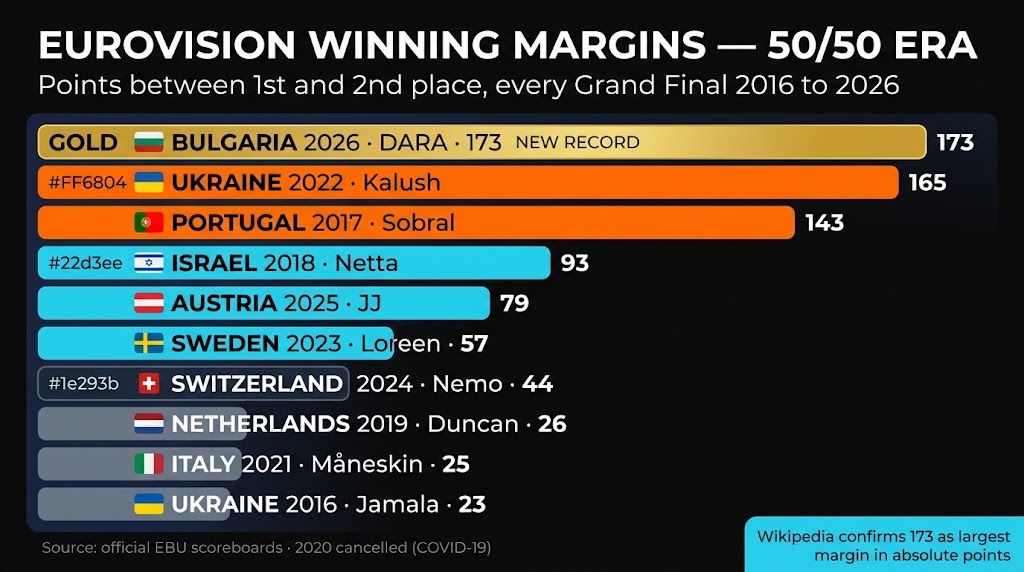
The lesson from DARA's Bangaranga at Vienna is exactly the cite-magnet stat that applies here: an unexpected Eurovision winner on a 173-point margin produced a Spotify Global Top 200 chart debut at #12 within 48 hours of winning, with #1 chart positions in 11 different countries. The streaming and brand upside of an unexpected continental Eurovision win is enormous — and the K-pop industry's hesitation to enter is what makes the Korean entry, whatever it ends up being, the act best positioned to convert a Bangkok win into a global commercial outcome.
The betting takeaway — South Korea is the structural favourite
Three structural facts compound to make South Korea the inefficient-market favourite for Eurovision Asia 2026.
- The ENA selection process is the most professionally produced national final in the Asia field. The 1-30 June open call plus 4 September televised national final mirrors the format that has produced the highest-converting Eurovision winners in the European cycle (Sweden's Melodifestivalen and Italy's Sanremo). No other Asian broadcaster has confirmed a comparably structured selection.
- The mid-tier candidate pool is professionally export-ready. Even with the A-tier labels sitting out, the acts most likely to enter are still tour-experienced, multi-language-capable, and supported by professional A&R and choreography infrastructure. The floor is high.
- The K-pop fanbase scale produces a public-vote asymmetry no other Asian country can match. Once Eurovision Asia 2026 opens its public-vote phase, Korean acts have access to a global activation network that no competing nation has. This is true regardless of which mid-tier act ENA selects.
For UK bettors, the practical implication: when first Eurovision Asia 2026 outright markets open at Betfred and on Polymarket, expect South Korea to be priced as the favourite — but expect that price to be too long given the A-tier-absence dynamic. The book that prices Korea slowest in the first 48 hours of market opening is the one to take. The window between the 30 June close of the ENA open call and the 4 September national final is the highest-information-asymmetry betting window of the entire Eurovision Asia 2026 cycle.
Re-check the open call status across late June. Re-check the 4 September final field once ENA publishes the line-up in August. And re-check the Polymarket markets the moment they open — first-edition continental events are the cleanest pricing-inefficiency environment in the Eurovision betting calendar.
Related
- Eurovision Asia 2026 — South Korea entry tracker
- Eurovision Asia 2026 — full country-by-country index
- Eurovision Asia 2026 — Thailand (host country) entry tracker
- Eurovision Asia 2026 — Philippines entry tracker
- How Polymarket misread Eurovision 2026 — Finland 44% to Bulgaria shock
- DARA's Bangaranga — 11-country Spotify #1 and the bookmaker miss
18+. Please gamble responsibly. BeGambleAware.org. GAMSTOP. When the fun stops, stop.