
Eurovision 2026 in Vienna ran under the most substantively reformed voting framework since the 50/50 jury-and-televote system was introduced in 2016. Three concrete structural changes shaped the contest, all confirmed by the EBU before the cycle opened and detailed in the official Reuters factbox published on 16 May 2026 (carried via multiple syndicated outlets including Global Banking and Finance Review).

18+ | New customers only | T&Cs apply | Please gamble responsibly
Together the changes represent the EBU's response to two distinct 2024-2025-cycle concerns: the perceived structural over-influence of co-ordinated mass-voting campaigns (driven by the 2024 Israel result, when Eden Golan finished 5th overall but topped the public vote in many countries), and the perceived structural under-representation of jury professionalism in the qualifying semi-finals (where the 2022-2025 era used televote-only qualification).
Betfred — Bet £10 Get £50 in Free Bets on Eurovision 2027
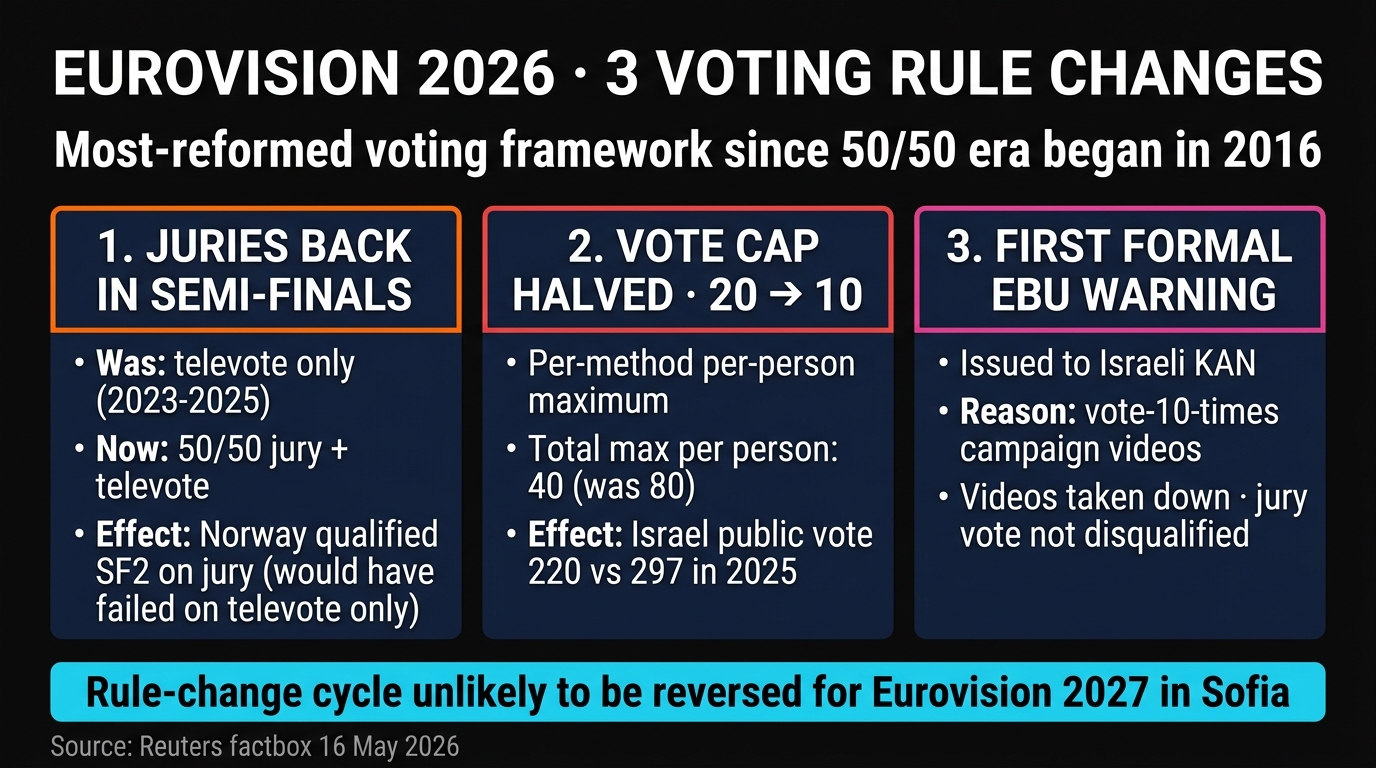
The 3 Eurovision 2026 voting rule changes — at a glance
| # | Rule change | Previously | Now (2026) | Reason cited |
|---|---|---|---|---|
| 1 | Jury voting in semi-finals | Televote only (2023-2025) | 50/50 split jury + televote | Restore jury professionalism + balance |
| 2 | Per-person public-vote cap | 20 votes per phone | 10 votes per phone | Reduce mass-campaign over-influence |
| 3 | Voting-manipulation enforcement | Informal guidance | Formal warning framework + jury-disqualification authority | Address "disproportionate promotion campaigns" |
Rule change 1: Juries return to the semi-finals
From Eurovision 2023 (Liverpool) through Eurovision 2025 (Basel), the contest's semi-finals were decided by televote only — a three-year experiment with a public-only qualification pathway. Professional juries did not vote in the semi-finals during this period. Vienna 2026 reversed this: the 50/50 jury-plus-televote split was restored to both Semi-Final 1 (Tuesday 12 May) and Semi-Final 2 (Thursday 14 May), in addition to the Grand Final's continuing 50/50 framework.
Why it mattered at Vienna 2026
The restoration of juries to the semis materially changed the qualification picture, particularly in SF2. As covered in our SF2 recap, Norway's Ya Ya Ya (JONAS LOVV) qualified largely on jury votes — Norway topped the SF2 jury but converted only 19 of 36 Grand Final televote pools' points (134 total Grand Final points, 14th finish). Under a televote-only SF2 framework (the 2023-2025 system), Norway might not have qualified at all; under the restored 50/50 framework, Norway qualified comfortably and reached the Grand Final.
Conversely, Sweden's Felicia with My System qualified from SF1 in 9th place — solidly above the qualification line — but went on to a 20th-place Grand Final finish (51 total points). The combined jury-plus-televote SF1 qualification framework had partially insulated Felicia from the public-vote deficiency that the Grand Final then exposed in full.
Structural implication for 2027
Bookmaker pre-contest pricing for 2027 will need to weight the restored jury role more heavily than 2023-2025 models did. SF qualification probabilities should now incorporate jury rehearsal-show performance, not just televote popularity.
Rule change 2: Per-person televote cap halved from 20 to 10
From 2010 through Eurovision 2025, the per-person public-vote cap in each country was 20 votes per phone, per voting method. A single Eurovision viewer could legally cast up to 20 SMS votes, 20 phone votes, 20 app votes, and 20 website votes — totalling up to 80 votes per person if all four methods were used. Eurovision 2026 halved the per-method cap to 10. The total maximum per person is now 40, down from 80.
The structural target: co-ordinated mass campaigns
The 2024 and 2025 Eurovision contests both produced high-profile concerns about co-ordinated mass-voting campaigns for specific entries — particularly Israel, where social-media campaigns reportedly encouraged supporters to use the full 80-vote-per-person ceiling to push Israel's public vote total higher. Halving the cap was the EBU's structural response: under a 40-vote-per-person ceiling, even a fully mobilised campaign cannot quite double the effect of a single passionate viewer.
Did the cap reduction work?
Per the published 2026 results, Israel's public-vote total in the Grand Final was 220 points (3rd-highest of the contest, behind Bulgaria's 312 and Romania's 232). In 2025 Israel's public vote was 297. The 220-point figure is below 2025 and below 2024 (291 public points) — consistent with the per-person cap halving having a partial structural effect. Whether the effect was the cap itself, or the campaign-warning enforcement (rule 3), or a softening of the underlying voter mobilisation, is contested.
Rule change 3: First formal voting-manipulation warning to KAN
Eurovision 2026 was the first contest under a formal voting-manipulation warning framework. The EBU committed pre-contest to issuing formal written warnings to broadcasters whose entries engaged in "disproportionate promotion campaigns", and to potentially disqualifying jury votes from offending entries.
The first warning under the new framework was issued to Israeli public broadcaster KAN over videos appealing to the public to vote for Israel's entry 10 times (the new per-method maximum). KAN immediately took the videos down and stated it was "playing by the rules", but the formal warning is now on the public EBU record.
The warning did not result in jury-vote disqualification. Israel's 2026 jury vote (123 points combined) was counted in full and contributed to the country's 2nd-place finish. The warning's significance is procedural: it establishes precedent that the EBU will publicly call out specific broadcasters for promotional behaviour the EBU considers excessive, and the regulatory pathway from warning to disqualification is now visible to all 35 competing broadcasters.
Two other procedural tweaks worth flagging
Alongside the three headline changes, Vienna 2026 also introduced two procedural tweaks:
- Encouragement to spread votes across multiple songs. The EBU added explicit pre-show guidance for viewers to vote for multiple songs across the 10-vote per-method limit, rather than concentrating all 10 votes on a single entry. This is a soft behavioural-design rule rather than a hard enforcement mechanism — the system still permits casting 10 votes for one song — but the framing pushes against single-song concentration.
- Rest-of-the-World (online) televote pool retained. The Rest-of-the-World online vote pool — introduced in 2023 to capture non-competing-country viewers — was retained for Eurovision 2026 with the same 12-point-set weight as a competing country's televote. The RoW pool contributed to Bulgaria's televote dominance in SF2 (Bulgaria's 9-set 12-pool sweep in the SF2 televote included the RoW vote).
How the rule changes shaped the 2026 result
The three structural rule changes plus the two procedural tweaks combined to produce a substantively different voting environment than Eurovision 2023-2025. The clearest evidence of structural change is in the Grand Final scoreboard:
- Bulgaria won with a record 173-point margin — the largest single-winning spread in the 50/50 era. Bulgaria's win was driven by both juries (1st on 204 points) and televote (1st on 312 points). The double-victory pattern is rare; only Sobral 2017 and Loreen 2023 produced similar cross-pool dominance in the previous 9 contests.
- Three countries scored zero televote points (Belgium, Germany, UK). Under the previous higher-cap system, even very weak entries typically collected at least 1-2 televote points from individual blocs. The lower cap + larger field of voting blocs (36 instead of 35 — RoW added) made zero-vote totals more statistically achievable for weak entries.
- The Moldova jury scandal triggered a national-broadcaster leadership resignation. As covered in our Moldova jury scandal piece, the Moldovan jury awarded Romania only 3 points and Ukraine zero points — divergences that under the older "jury-vote-treated-as-fixed" system would have generated less public scrutiny. The restored jury role in semis, combined with the EBU's more public stance on voting integrity, has raised the political stakes for national-jury decisions across all 35 panels.
What this means for Eurovision 2027 in Bulgaria
The 2026 rule-change cycle is unlikely to be reversed for 2027. Three structural implications for the Bulgaria-hosted contest:
- Jury composition transparency will tighten. The Moldova scandal — where a Deputy Director General of TRM served on the jury panel and the jury delivered a politically-sensitive result — exposed a gap in EBU jury-composition rules. Expect 2027 to introduce a formal Conflict of Interest annex for national juries.
- Voting-manipulation enforcement will expand. The KAN warning was the first under the new framework. Multiple broadcasters are expected to face similar scrutiny in 2027 — particularly entries whose pre-contest social-media campaigns target the 10-vote-per-person mechanic.
- Bookmaker pre-contest models need rebuilding. The 2023-2025 betting-model frameworks that weighted televote heavily and discounted jury rehearsal-day signal are now structurally outdated. UK books that priced 2026 entries primarily on televote-pool dominance (Finland 2.00 outright, Australia 4.10, Greece 14.00) all materially mispriced the final result. The 2027 model needs to integrate jury rehearsal-day rank with at least equal weight.
Related Eurovision 2026 coverage
- Bulgaria's 173-point margin — biggest in 50/50 era
- Moldova TRM resignation jury scandal
- Israel boycott controversy — 5 countries refused to compete
- UK bookmaker accuracy audit — 80% top-10 but 0% podium
18+. Please gamble responsibly. BeGambleAware.org. GAMSTOP. When the fun stops, stop.