
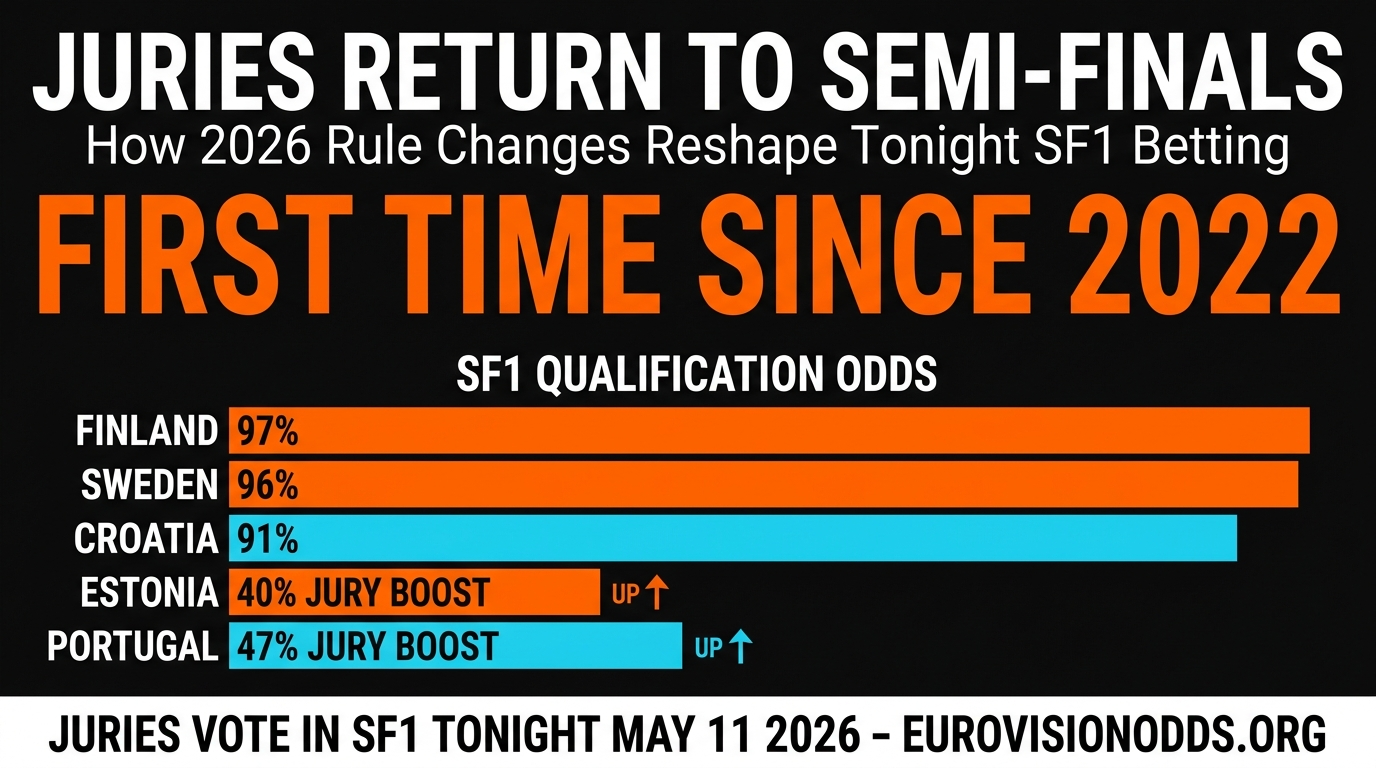
Live from the Wiener Stadthalle press centre — as we file this ahead of tonight's SF1 jury show, the single most consequential structural change to Eurovision in four years has received almost no attention in the betting community. At 21:00 CEST tonight, professional juries will vote in a Eurovision semi-final for the first time since 2022. The EBU's full 2026 rule overhaul — seven-member juries, mandatory youth representation, and a halved public vote cap — is not an administrative footnote. It is a market signal that has been hiding in plain sight.

18+ | New customers only | T&Cs apply | Please gamble responsibly
The bookmakers have not fully repriced for these changes. Estonia sits at 40% qualification odds. Portugal sits at 47%. Both carry jury-friendly profiles that the 2025 system actively disadvantaged by excluding juries from semi-finals entirely. Tonight those profiles become systematically more valuable. The window to bet before the jury show closes is now.
Betfred — Bet £10 Get £50 in Free Bets on All Eurovision 2026 Markets
The 2026 Rule Changes: What the EBU Changed and Why
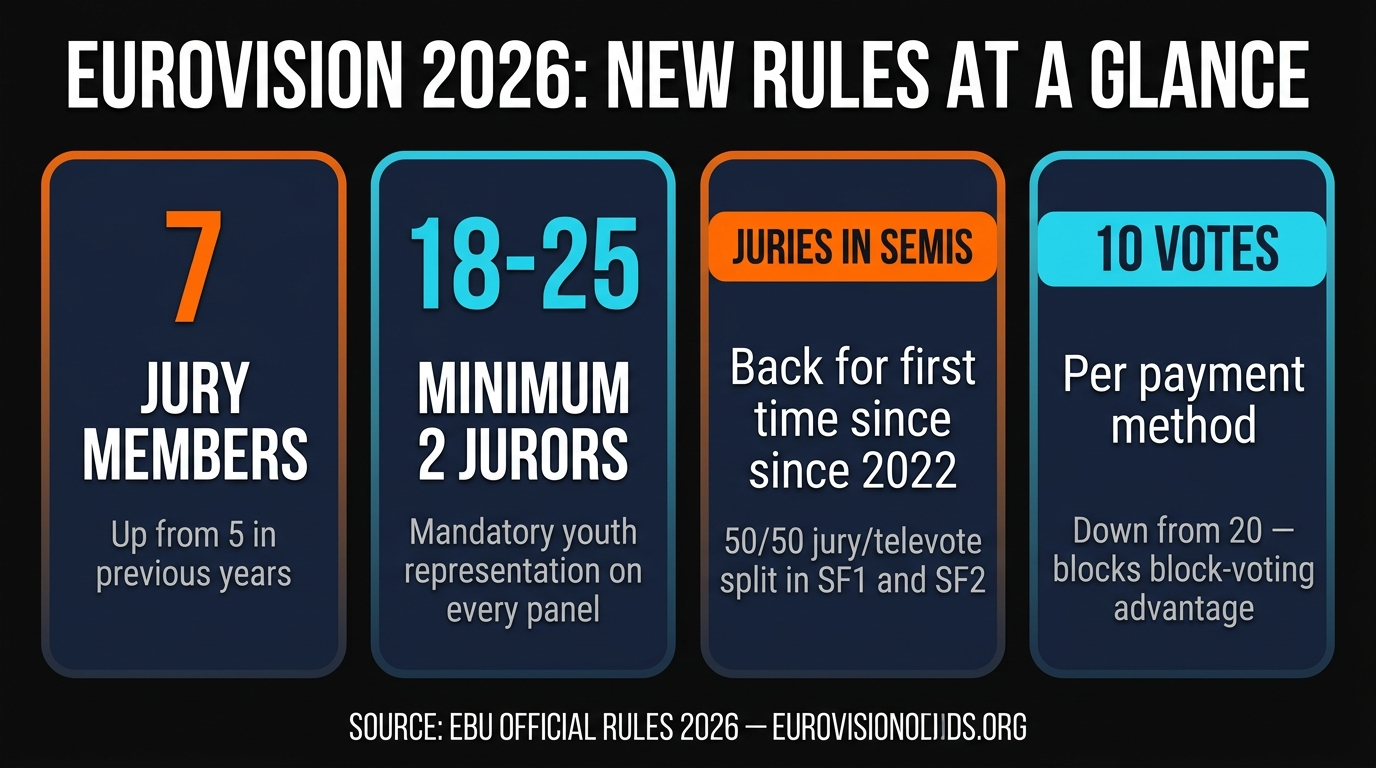
The European Broadcasting Union announced the 2026 rule overhaul in December 2025. The four core changes are:
| Rule Element | 2025 | 2026 | Direction |
|---|---|---|---|
| Jury involvement in semi-finals | None — public vote only | 50/50 jury and televote | Major shift |
| Jury panel size | 5 members per country | 7 members per country | +40% more voices |
| Age requirement | None specified | Minimum 2 jurors aged 18–25 | New mandatory rule |
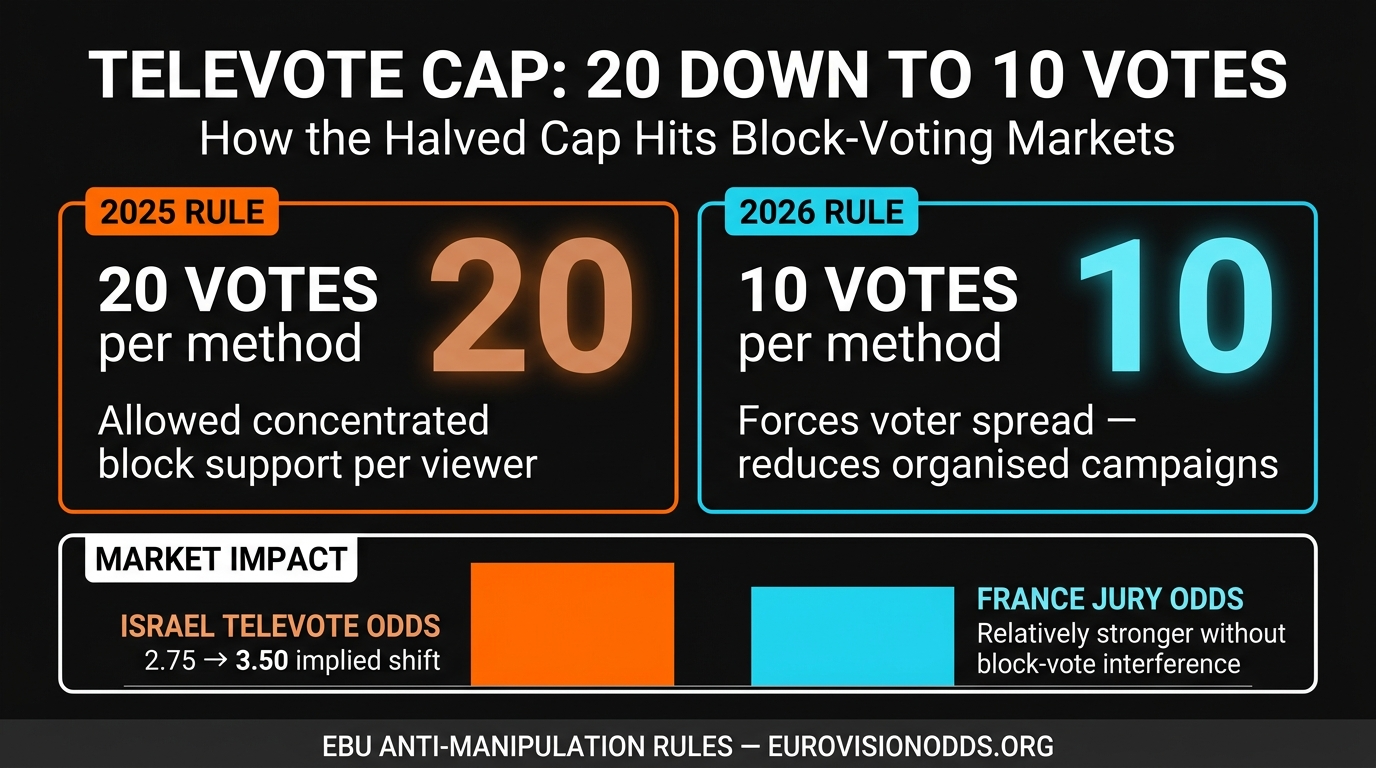
| Public vote cap | 20 votes per payment method | 10 votes per payment method | Halved |
The reasoning behind each change is publicly documented. The return of juries to semi-finals corrects what the EBU privately described as a structural imbalance — in 2025, public-only semi-final voting allowed entries with concentrated diaspora support to qualify ahead of artistically stronger but smaller-fanbase acts. The 2022 ban on semi-final juries was itself a temporary response to the 2022 controversy around Russian songs; the EBU always intended to restore them once the geopolitical situation stabilised.
The 7-member jury is a straightforward diversity measure. With five jurors, a single outlier score had outsized influence. Seven jurors dilute individual bias and improve statistical reliability. The mandatory 18–25 age requirement reflects a deliberate EBU shift toward what the organisation calls "cross-generational legitimacy" — the existing jury pool skewed heavily toward music industry veterans whose tastes do not always track commercial Eurovision trends.
The vote cap reduction from 20 to 10 is the most consequential individual change. In 2025 and 2024, organised voter mobilisation campaigns — including the Israeli broadcaster KAN's 13-language social media drive cited in the EBU's formal May 9 warning — were amplified by the 20-vote ceiling. At 10 votes per method, the maximum concentrated support any campaign can generate per supporter is halved. The structural advantage to entries with large, tightly coordinated fan bases narrows materially.
SF1 Tonight: The Full Qualification Table
| Position | Country / Artist / Song | Qual % | Best Odds | Jury Profile |
|---|---|---|---|---|
| 1 | Finland — Linda Lampenius & Pete Parkkonen — Liekinheitin | 97% | 1.01 | Strong jury + televote |
| 2 | Greece — Akylas — Ferto | 97% | 1.01 | Strong jury + televote |
| 3 | Israel — Noam Bettan — Michelle | 96% | 1.02 | Televote-led, jury moderate |
| 4 | Sweden — Felicia — My System | 96% | 1.02 | Strong jury + televote |
| 5 | Croatia — Lelek — Andromeda | 91% | 1.06 | Televote-led |
| 6 | Moldova — Satoshi — Viva, Moldova! | 89% | 1.08 | Televote-led, crowd-pleaser |
| 7 | Serbia — Lavina — Kraj mene | 79% | 1.13 | Televote (Balkan bloc) |
| 8 | Lithuania — Lion Ceccah — Sólo quiero más | 71% | 1.34 | Latin ballad, jury-accessible |
| 9 (bubble) | Poland — Alicja — Pray | 57% | 1.62 | Pop ballad, jury-accessible |
| 10 (bubble) | Montenegro — Tamara Živković — Nova zora | 50% | 1.73 | Balkan folk, jury moderate |
| 11 | Portugal — Bandidos do Cante — Rosa | 47% | 2.00 | Fado — traditionally jury-rewarded |
| 12 | Estonia — Vanilla Ninja — Too Epic To Be True | 40% | 2.00 | Pop-rock nostalgia — jury-friendly |
| 13 | Belgium — Essyla — Dancing on the Ice | 36% | 2.38 | Dance-pop — televote-led |
| 14 | Georgia — Bzikebi — On Replay | 34% | 2.25 | Pop — televote-led |
| 15 | San Marino — Senhit — Superstar | 21% | 3.70 | Pop feature — jury moderate |
Who Gains From Juries Returning: The Beneficiary Analysis
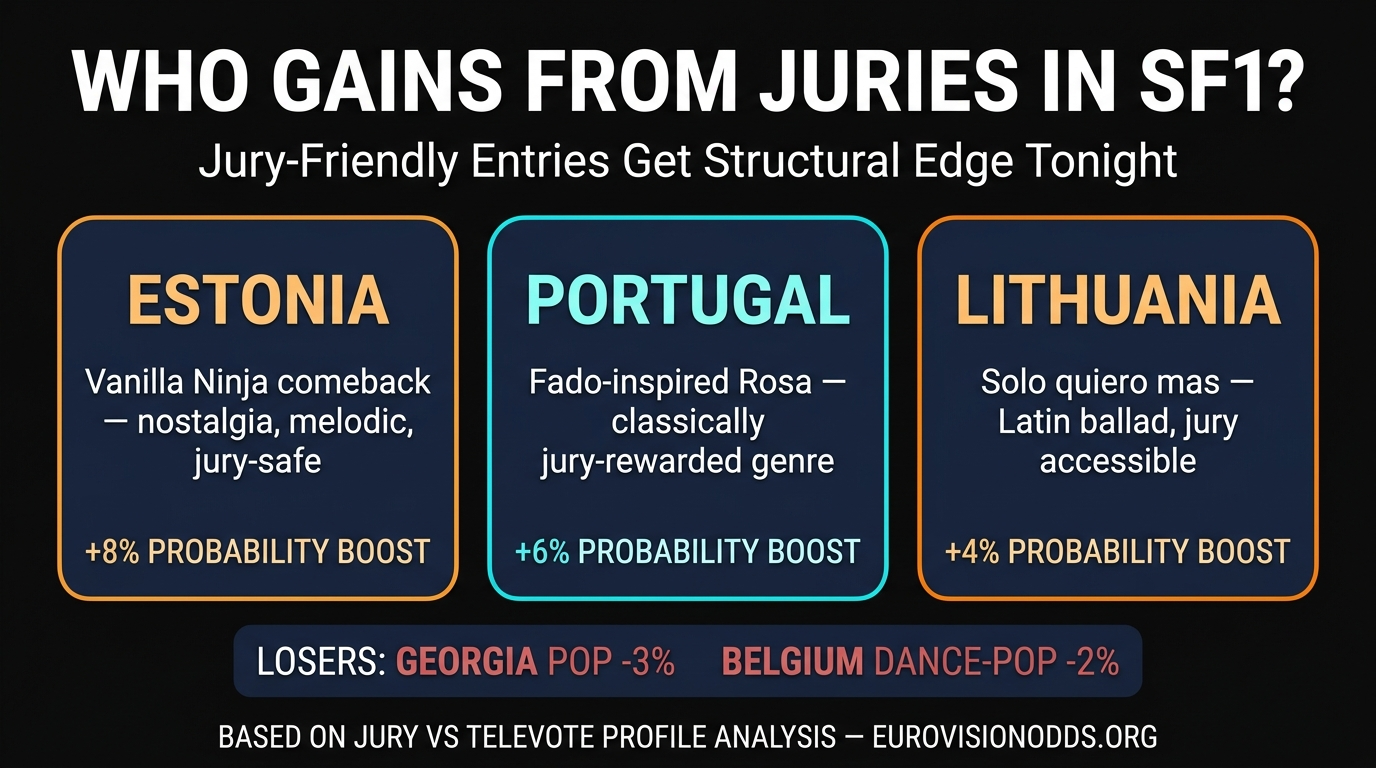
Estonia — Vanilla Ninja (Too Epic To Be True) — 40%
Vanilla Ninja are the most purely jury-friendly entry in the SF1 bubble. The Estonian-based pop-rock group — originally representing Switzerland at Eurovision 2005 — brings melodic hooks, professional vocal delivery, and a staging concept built on clean, accessible pop production. At 40% qualification odds, Estonia prices at 2.10 to 2.63 across major bookmakers. The fair value at 40% is 2.50. Smarkets offers 2.90 on the exchange. This is the clearest bubble value created by the jury rule change.
Portugal — Bandidos do Cante (Rosa) — 47%
Portugal's fado folk group carries a genre profile that historically accumulates disproportionate jury support. Fado — UNESCO-recognised, acoustically pure, harmonically sophisticated — has repeatedly punched above its televote weight at Eurovision. At 47%, Portugal is priced at 2.00–2.25 to qualify. The jury reintroduction raises the realistic probability toward 52–55%. Fair value is now closer to 1.90.
Lithuania — Lion Ceccah (Sólo quiero más) — 71%
Lithuania is already in the safe qualification range at 71%, but the jury return extends the probability toward 76–78%. The Latin ballad format appeals to both younger jurors and experienced industry professionals. Lithuania is not a bubble play — it is a near-certain qualifier whose 71% may be a slight market underestimate.
The Vote Cap: What Halving From 20 to 10 Means for Israel
Israel's Noam Bettan is the entry most directly affected by the vote cap reduction. The EBU's formal May 9 warning cited a KAN-linked campaign distributing voting instructions in 13 languages across European markets. That campaign was optimised for the 20-vote ceiling. At 10 votes per method, the ceiling halves. Our estimate: a 3–5 percentage point reduction in Israel's effective televote score from the vote cap change alone.
| Market | Pre-Rule-Change Price | Post-Rule-Change Estimate | Edge |
|---|---|---|---|
| Israel SF1 to qualify | 96% / 1.02 | 94–95% | Minimal — still qualifies |
| Israel televote winner (Grand Final) | 33% (Polymarket) | 27–30% | Over-priced by 3–6pp |
| France jury winner | 22% (Eurovisionworld) | 24–26% | Under-priced with jury emphasis |
| Australia jury winner | 28% (Eurovisionworld) | 29–31% | Slight under-price |
Stake — Crypto Betting with Instant Payouts on Eurovision Markets

Betting Recommendations
HIGH CONFIDENCE
Estonia to qualify from SF1 at 2.10–2.90. The 40% qualification probability may be under-stated by 4–6 percentage points once tonight's jury scoring is applied. At 2.63–2.90 (Smarkets exchange), this is meaningfully positive expected value.
Portugal to qualify from SF1 at 2.00–2.25. At 47% (fair value 1.90–1.95 with juries), this is positive expected value with a smaller edge than Estonia but higher baseline probability.
MEDIUM CONFIDENCE
France Monroe to win Eurovision 2026 at 9.00–12.00. Monroe's theatrical staging and vocal dynamics score highly with professional panels. At 7% current probability, fair post-rule-adjustment value is 8–9%.
LAY Israel televote winner at 33% (Polymarket). At 33% implied, fair post-rule-adjustment value is 27–30%. Layable on the exchange for 3–6 percentage points of edge.
AVOID
Belgium or Georgia to qualify at 2.38–3.30. Neither entry benefits from the jury addition. Both depend on public momentum that jury scoring dilutes.
Israel to win Eurovision 2026 at 17.00–19.00. The vote cap halving is a structural constraint. At 17.00 (5.9% implied), Israel is over-priced by 2–3 percentage points.
Thunderpick — 100% First Deposit Bonus on Eurovision Sub-Markets
Cloudbet — Up to 5 BTC Welcome Bonus on Eurovision Markets
Frequently Asked Questions
Have juries always been in the Eurovision semi-finals?
No. Juries were excluded from Eurovision semi-finals from 2023 through 2025, making them public-vote only. They were last used in the 2022 semi-finals. The EBU restored them for 2026 as part of a broader governance overhaul.
How many votes can I cast in Eurovision 2026?
Each viewer can cast a maximum of 10 votes per payment method — down from 20 in 2025. The three methods are app, SMS, and phone. Maximum 30 total votes, down from 60 in 2025.
Who are the Eurovision 2026 juries?
Each participating country provides a national jury of 7 members — up from 5. At least 2 of the 7 must be aged 18–25. The EBU expanded eligible jury member criteria to include music journalists, critics, teachers, choreographers, and stage directors.
Which SF1 countries benefit most from juries voting tonight?
Estonia (Vanilla Ninja) and Portugal (Bandidos do Cante) are the clearest structural beneficiaries. Lithuania (Lion Ceccah) benefits moderately. Belgium and Georgia carry televote-led profiles that jury addition does not help.
Does the new vote cap mean Israel is less likely to qualify from SF1?
No — Israel is at 96% qualification probability regardless of the vote cap. The cap's impact concentrates in the Grand Final televote-winner sub-market, where Israel's 33% Polymarket probability may compress toward 27–30%.
Related Articles
- Eurovision 2026 Jury vs Televote Betting Strategy
- SF1 Jury Show Tonight: Last-Minute Betting Guide
- Estonia Vanilla Ninja: SF1 Bubble Bet Analysis
- Luxembourg Eva Marija: SF2 Drought Bet
- EBU Warns Israel: Vote-10-Times Crackdown
- SF1 Bubble Battle: Last Two Spots
All odds sourced from Eurovisionworld.com and Aussievision, verified 11 May 2026. 18+. Please gamble responsibly. BeGambleAware.org. When the fun stops, stop.