
Key takeaways

18+ | New customers only | T&Cs apply | Please gamble responsibly
- Four Polymarket Eurovision books lost their offer side overnight. Between the 2026-11-24 17:57:23 UTC read and the 2026-11-25 17:14:50 UTC read, the number of contracts quoted inside 10c fell from 18 to 3 on Benidorm Fest, 10 to 3 on Eesti Laul, 35 to 21 on the public-vote book and 22 to 17 on Festivali i Këngës.
- Almost nothing traded while it happened. The number of contracts that have ever printed a price did not move at all on Benidorm Fest (10), Eesti Laul (10) or Festivali (8).
- So the midpoints rose on their own. Kejsi Tola went from 15c bid and 16c offered to 1c and 62c, and her midpoint “rose” from 15.5c to 31.5c without a single trade. Benidorm Fest’s 18 midpoints now sum to 491.8%.
- The one book that kept its shape is the one with money in it. Canada’s Choice holds 5 of 5 quotes tight and is the only book of the ten whose midpoints sum to under 100% (98.3%).
- Its trade tape also closes a question we left open on 24 November. Wallet 0xf968b20c has sold nothing: it holds 1,619.51 TALK and 904.28 Rêve for $845.00, a position that profits if either leader wins.
What’s on this page
- The offers vanished, and the prices “moved”
- Why a midpoint does this
- What actually moved: Israel, and a withdrawn Swedish bid
- The one book that held
- The $845 wallet is hedged, not informed
- What we changed on this site today
- How to read a book this thin
- What to watch next
The offers vanished, and the prices “moved”
Between two reads of the Polymarket Gamma API a day apart — 2026-11-24 17:57:23 UTC and 2026-11-25 17:14:50 UTC — the Eurovision 2027 odds on four separate prediction-market books appeared to move violently. Contracts rose fifteen, twenty, thirty-five points. On Benidorm Fest the field’s 18 midpoints went from summing 140.1% to summing 491.8%. On Festivali i Këngës 65 they went from 238.5% to 481.7%.
Nobody bought anything. The offer side of those books was withdrawn, and a midpoint is the average of the best bid and the best offer, so pulling the offers lifted the midpoints on their own. This is the single most common way a thin prediction market produces a number that looks like news and is not, and on this occasion it happened across four books in one night.
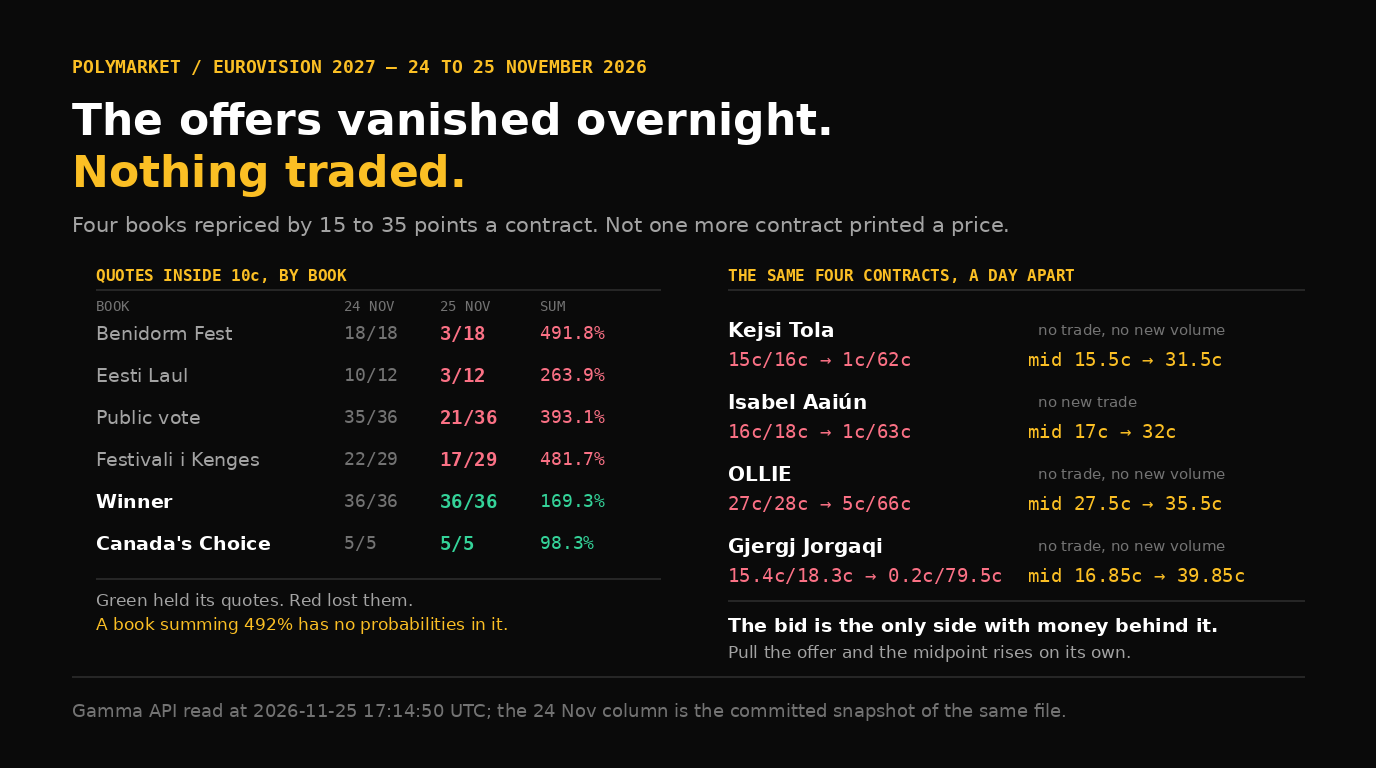
Here is every book on the 2027 complex, counted the same way on both reads. “Tight” means the gap between the best bid and the best offer is 10c or less, which is this site’s threshold for a midpoint meaning anything at all. “Printed” is the number of contracts that have ever recorded a trade.
| Book | Tight 24 Nov | Tight 25 Nov | Sum 24 Nov | Sum 25 Nov | Printed |
|---|---|---|---|---|---|
| Benidorm Fest 2027 | 18/18 | 3/18 | 140.1% | 491.8% | 10 → 10 |
| Eesti Laul 2027 | 10/12 | 3/12 | 123.2% | 263.9% | 10 → 10 |
| Public vote winner | 35/36 | 21/36 | 172.9% | 393.1% | 13 → 14 |
| Festivali i Këngës 65 | 22/29 | 17/29 | 238.5% | 481.7% | 8 → 8 |
| 3rd place | 35/36 | 31/36 | 162.4% | 205% | 11 → 11 |
| Jury winner | 23/36 | 22/36 | 196.1% | 213.7% | 16 → 17 |
| 2nd place | 32/36 | 34/36 | 204.3% | 194.4% | 16 → 17 |
| Top 5 | 17/36 | 17/36 | 970.5% | 974.4% | 22 → 22 |
| Winner | 36/36 | 36/36 | 167.4% | 169.3% | 27 → 29 |
| Canada’s Choice 2027 | 5/5 | 5/5 | 103.6% | 98.3% | 5 → 5 |
Read the last column first. Across all ten books the number of contracts that have ever printed a price moved by a handful, and on the three worst-affected national finals it did not move at all. Benidorm Fest, Eesti Laul and Festivali i Këngës finished the day with exactly the same 10, 10 and 8 traded contracts they started it with, while their midpoints went up by an average of more than twenty points each. Whatever happened to those books, it was not an opinion.
Why a midpoint does this
A Polymarket contract is quoted like any order book: somebody is willing to buy at a price (the bid) and somebody is willing to sell at a higher one (the offer). The midpoint sits halfway between. When a book is busy, the bid and the offer sit close together and the midpoint is a fair summary of what the contract is worth. When a market maker cancels its resting offers, the best remaining offer is whatever distant order is left on the book — and the midpoint is dragged up towards it.
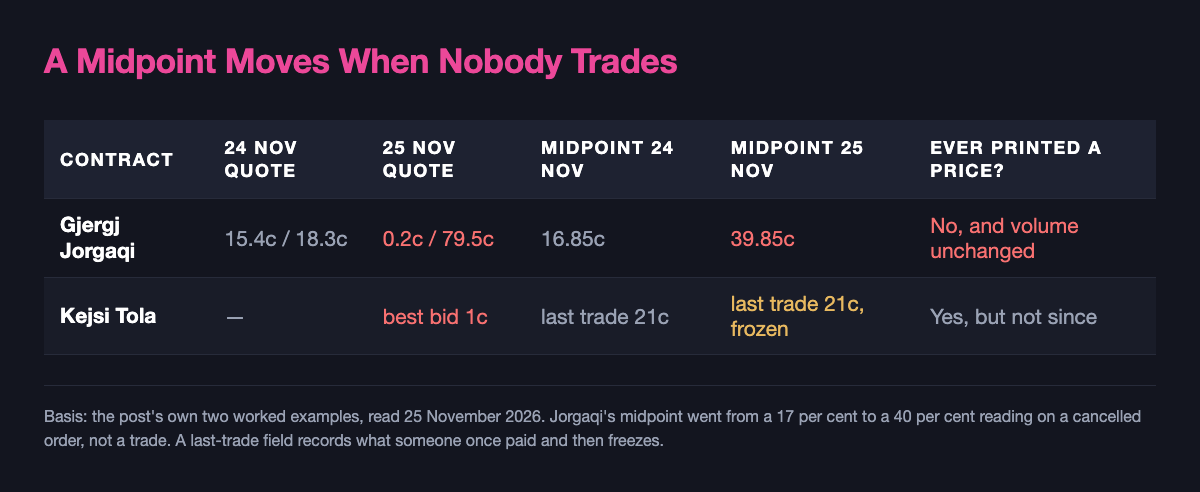
Gjergj Jorgaqi is the cleanest illustration. On 24 November his contract was quoted 15.4c against 18.3c, a tight and ordinary-looking price. On 25 November it was quoted 0.2c against 79.5c. Nobody has ever traded it — it has never printed a price in its life — and its recorded volume is unchanged. Yet its midpoint went from 16.85c to 39.85c, which on a naive reading is a contract that went from a 17% chance to a 40% chance of winning Festivali i Këngës. It did not. Somebody cancelled an order.
The sum-of-midpoints test catches this immediately, which is why this site prints it beside every price. Exactly one act wins Benidorm Fest, so an honest book’s midpoints should add up to about 100%. On 24 November they added up to 140.1%, which was already generous. On 25 November they added up to 491.8%. A book that prices its field at nearly five times certainty is not making a forecast you can read probabilities off, and no amount of staring at individual contracts will fix that.
There is a second trap stacked on top. Kejsi Tola, Albania’s Eurovision 2009 representative, still shows a last trade of 21c — the same figure as yesterday — while her best bid has collapsed to 1c. The last-trade field records the last price anyone paid and then freezes, however far the live quote travels away from it. Quoting that 21c today as “Kejsi Tola’s price” would be quoting a trade from a market that no longer exists in that shape.
One contract in that book is worth watching precisely because it did not do any of this. Sara Bajraktari held a real two-sided quote throughout, 15c/16c on 24 November and 11c/19c on 25 November, with a midpoint that went 15.5c to 15c — a half-point drift, which is what an actual market looks like on a quiet day. She is now the only act near the top of the Albanian book with a price anyone is standing behind, and the only one of the two pre-festival favourites whose song has a title: she sings “Bota rrëmujë”, while Kejsi Tola is still one of nine of the twenty-nine with no published title at all.
What actually moved: Israel, and a withdrawn Swedish bid
Two things did happen with money behind them, and they are worth separating out precisely because everything above did not.
Israel got sold in the public-vote book. Its quote went from 26c/28c to 19c/25c, the midpoint from 27c to 22c, and — the part that matters — its last traded price went from 27c to 21c on about $95 of fresh volume. Bid down, offer down, last trade down, money changed hands. That is a real five-point move on the most heavily traded contract in that book, and it is the only one of its kind on the whole 2027 complex today. Israel remains the public-vote favourite.
Sweden in the outright winner book is the counter-example to keep in your head. Its midpoint fell from 9.5c to 7.5c, a two-point drop that looks like selling. It is not: the offer held at 10c while the best bid was cut from 9c to 5c, and the last traded price is unchanged at 10c. Somebody withdrew a bid. The same mechanic as the Albanian book, running in the opposite direction — a midpoint can fall because the bid was pulled just as easily as it can rise because the offer was. The winner board was otherwise the healthiest thing on the complex today, holding all 36 of its 36 quotes tight.
The one book that held
Canada’s Choice is the exception that explains the rule. It kept 5 of 5 quotes tight through the same night, and its midpoints sum to 98.3% — the only book of the ten that comes in under 100%, and therefore the only one on the board whose levels can be read as probabilities without heavy adjustment.
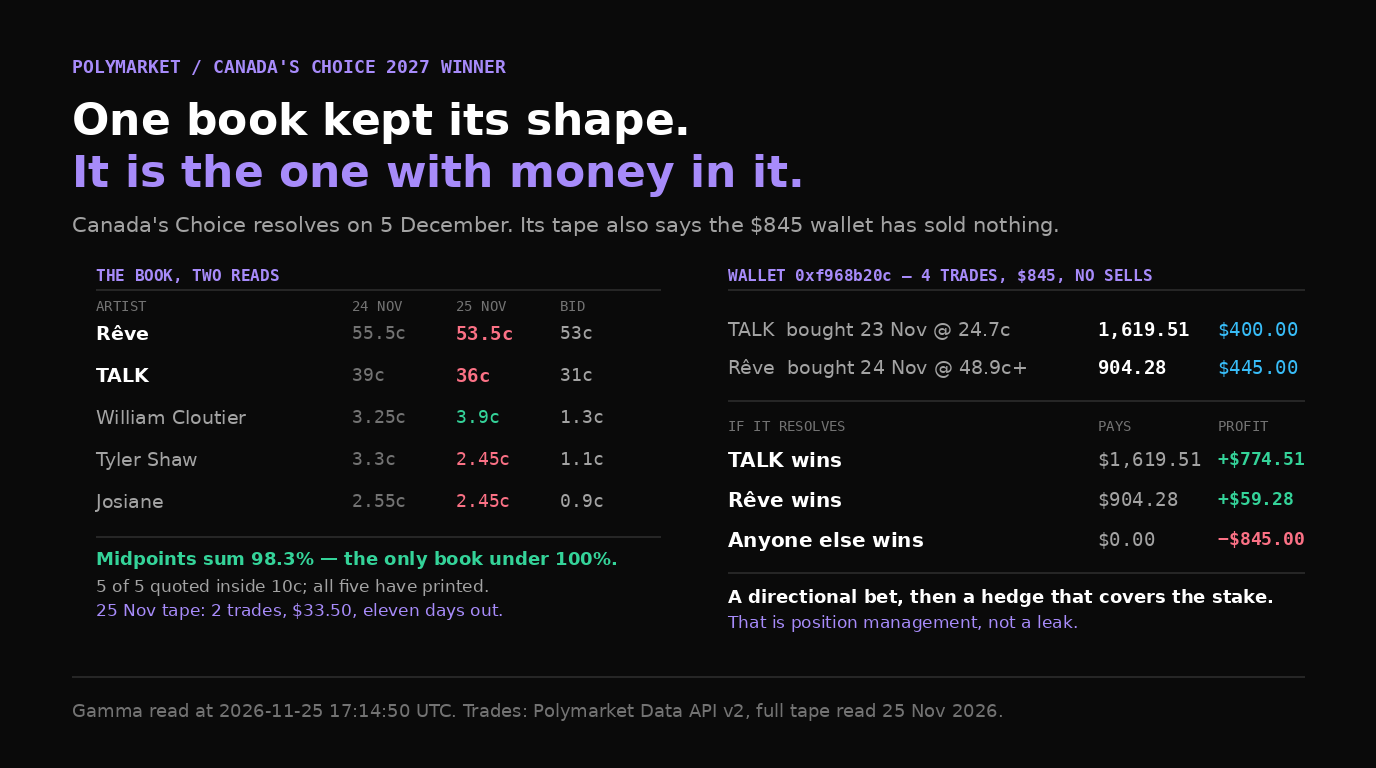
The difference is not size in the sense the volume field means. It is that people are genuinely trading it, because it resolves on 5 December 2026, when CBC reveals Canada’s representative, and a question eleven days from an answer attracts the kind of participant who posts two-sided quotes. Our report on this book from 24 November set out how its favourite changed twice in forty-eight hours.
Even here, read the tape rather than the volume field. The full trade history of all five contracts, pulled from Polymarket’s Data API this afternoon, is 279 trades and $7,050.67 of notional at the prices actually paid, against a volume field for the event reading $11,632. The two measure different things and neither is wrong; the tape is the one that tells you how much money it takes to move a price. On 25 November the entire book traded 2 times for $33.50 — a $3.00 purchase of Rêve at 02:08 UTC and a $30.50 sale of TALK at 07:24 UTC. Eleven days from resolution, that is the most liquid Eurovision book on the venue.
The $845 wallet is hedged, not informed
On 24 November this site reported that a single wallet, 0xf968b20c, had paid for both of the favourite changes in the Canada book: $400 into TALK on 23 November and $445 into Rêve on 24 November. We said then that the “someone knows something” reading had become materially weaker, and left open what the wallet would do next. The tape now answers it.
It has done nothing at all, and it has sold nothing. Its entire history across the five contracts is four trades. It holds 1,619.51 shares of TALK, bought at 24.7c, and 904.28 shares of Rêve, bought at 48.9c and topped up twice as the price ran away from it. Total outlay $845.00.
Price that position out and its shape is unmistakable. If TALK wins on 5 December the wallet collects $1,619.51, a profit of $774.51. If Rêve wins it collects $904.28, a profit of $59.28. It makes money if either of the two leaders wins, and loses its $845 only if one of the three outsiders does — and those three are collectively bid about 3.3c.
That is not what a leak looks like. It is a textbook directional bet followed by a hedge: buy the outsider cheap, and when it runs to roughly the price of the favourite, buy the favourite too in a size that returns the stake. The upside stays concentrated in the original pick and the downside is reduced to the chance that both leaders are wrong. Someone acting on private information about a decision eleven days away does not hedge into the rival.
Two honest caveats. A hedge and a change of mind look identical from outside, and we cannot see which this was. And the position is marked at the midpoint above; the wallet could not actually exit at those levels, because TALK’s best bid is 31c against a 41c offer, so selling into this book would cost it several points.
What we changed on this site today
Our own Eurovision 2027 page was ranking its national-final summaries by midpoint, which meant that as of this morning it was about to name Gjergj Jorgaqi, Eldis Arrnjeti and Herva Novaku as the shortest prices in the Albanian book — three contracts that have never traded and are bid about a cent. It was also still describing “two” national-final markets when there are now four.
Both are fixed. Those summaries now rank by best bid rather than by midpoint, because the bid is the only number in a book with somebody’s money behind it and it cannot be inflated by pulling the other side, and the count of books is now read from the data instead of typed. We also tightened what the site means by “traded”: it now requires a contract to have actually printed a price, where before a nonzero volume field was enough. That change alone took the Festivali book from a reported twenty-nine traded contracts to its true eight.
How to read a book this thin
- Read the bid, the offer and the trade count together. A midpoint on its own is a third of the information and the least reliable third.
- Add the book up. If one outcome wins and the midpoints sum to 490%, there are no probabilities in it.
- Price the move before you interpret it. Ask how many dollars it took. A thirty-point move on no volume is a cancelled order; a five-point move on fresh volume, like Israel’s today, is an opinion.
- Treat a frozen last trade as history. It records what someone once paid, not what the contract is worth now.
- Prefer the book that is close to resolving. Liquidity arrives when a question is about to be answered, and so does whatever accuracy these markets have.
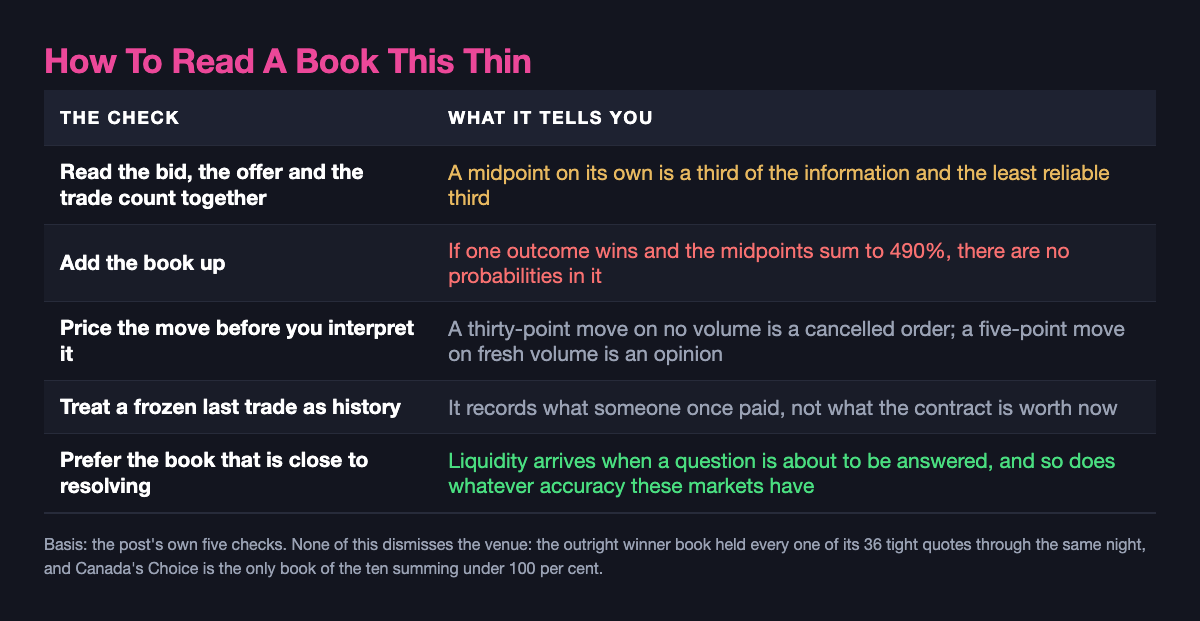
None of this is a reason to dismiss the venue. The outright winner book held every one of its 36 tight quotes through the same night, and Canada’s Choice is genuinely informative. It is a reason to check the plumbing before quoting a number, which is the whole job on a market this young. Our running account of every confirmed 2027 selection is on the Eurovision 2027 page, and the traditional-bookmaker position — still no 2027 outright anywhere — is on our bookmakers page.
What to watch next
| Date | What happens, and what it would price |
|---|---|
| 27 November 2026 | Estonia reveals the twelve Eesti Laul songs on ETV at 19:00 CET. The first real test of whether that book’s quotes come back when there is something to price. |
| 1 December 2026 | Melodifestivalen’s thirty artists. Still unpriced on any venue. |
| 4 December 2026 | Suspilne names at least six Vidbir 2027 finalists from its eighteen-act longlist. |
| 5 December 2026 | Canada’s Choice resolves, and the 0xf968b20c position pays out or does not. |
| 7 December 2026 | Hungary’s extended EBU deadline, the one date that could still add a 37th country. |
| 17–20 December 2026 | Festivali i Këngës 65, where Albania becomes the first of the 36 confirmed countries to choose. |
One calendar note that did not happen. 25 November was the day LRT had said Lithuania’s Eurovizija.LT 2027 participants would be selected, and no line-up was published: the most recent Eurovision item in the broadcaster’s own feed is dated 13 November. That date is an internal selection deadline rather than an announcement, and the precedent suggests a wait — for the 2025 edition LRT published its forty-five artists on 11 December 2024. We are not reporting a Lithuanian field until the broadcaster names one.
Prices are midpoints between the best bid and the best offer, read from the Polymarket Gamma API at 2026-11-25 17:14:50 UTC and stored in this site’s committed market feed; the 24 November column is the committed snapshot of the same file at 2026-11-24 17:57:23 UTC, so it cannot drift. Trade-level figures are the complete tape from the Polymarket Data API v2 trades endpoint, read on 25 November 2026. Festivali i Këngës song titles and the Albanian field from Eurovoix, 24 November 2026, reporting RTSH; the Lithuanian calendar from Eurovoix, 25 November 2026, checked against LRT’s own Eurovision feed. The books discussed are listed on Polymarket. Prediction-market prices move, several of the books above have no usable price at all at the time of writing, and nothing here is a tip.