
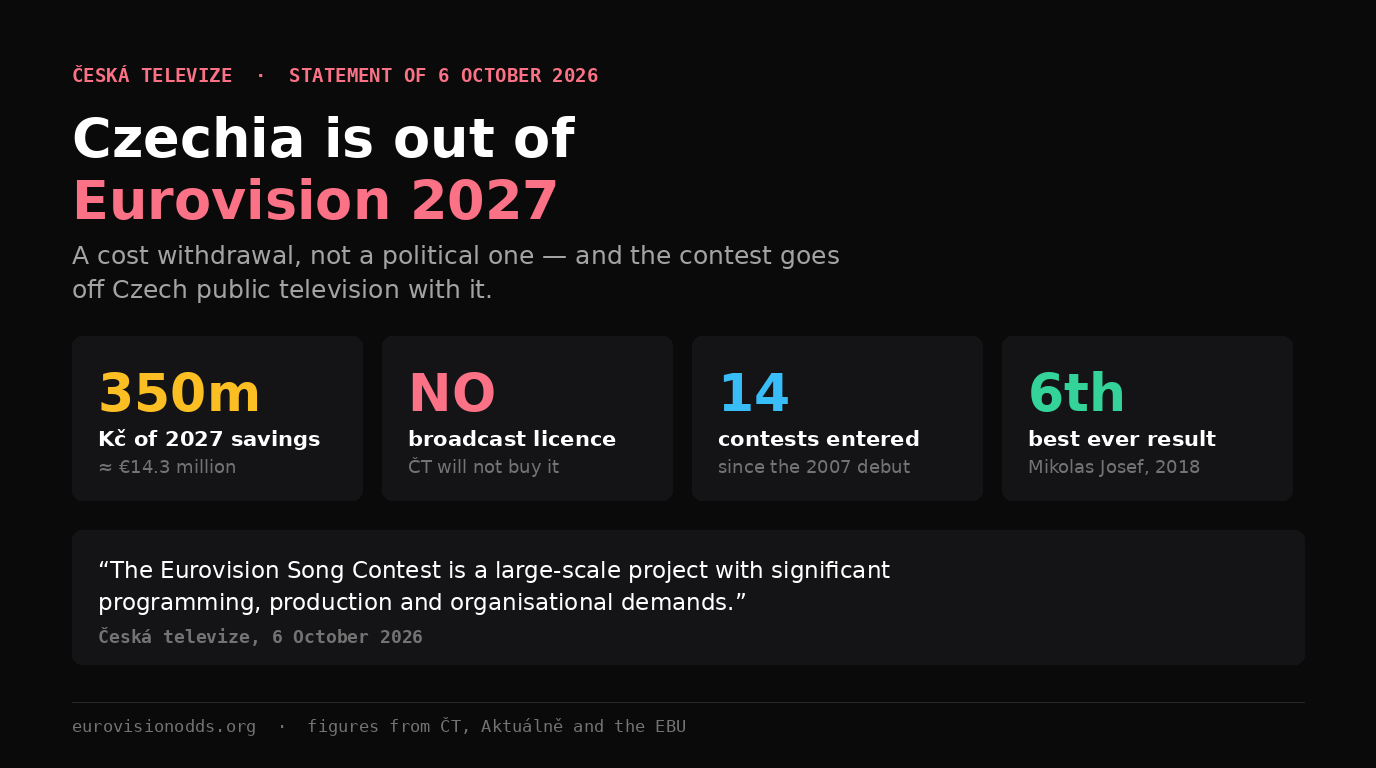
Česká televize has withdrawn Czechia from the Eurovision Song Contest 2027. The Czech public broadcaster confirmed the decision on 6 October 2026, six days after a Czech news report first named Eurovision as a line in its savings plan, and it is not buying the broadcast licence either. Czechia becomes the fifth broadcaster to rule itself out of the Burgas contest — and the third to do so purely over money.

18+ | New customers only | T&Cs apply | Please gamble responsibly
Key takeaways
- What happened: ČT confirmed on 6 October 2026 that Czechia will not enter Eurovision 2027 in Burgas.
- Why: money, not politics. ČT is planning savings of 350 million koruna (about €14.3 million) across 2027.
- The sting: ČT also says it will not buy the broadcast licence, so the contest leaves Czech public television as well as the entry list.
- Czech viewers can still watch the official YouTube stream, and their votes are counted in the Rest of the World pool.
- The betting position: there was nothing to bet on. Polymarket’s 14-contract 2027 participation board does not list Czechia, and no fixed-odds bookmaker prices participation at all.
What ČT actually said
The statement is about budgets and nothing else. “The Eurovision Song Contest is a large-scale project with significant programming, production and organisational demands,” ČT said, adding that “in view of the budget adjustments currently underway, Česká televize has decided not to take part in the 2027 contest.” The broadcaster says it assesses each edition separately and has not closed the door on a later return — the standard formula for a withdrawal that is not meant to be permanent.
The EBU replied the same day, and its response reads as an acknowledgement of a sector-wide problem rather than a disagreement: “We regret that Česká televize will not be able to participate in the Eurovision Song Contest in 2027 because of the financial pressures they are facing.” The union added that Czechia “will always be welcome”. Set that beside the EBU’s reply to RTÉ three weeks earlier, which also regretted the decision but was answering a withdrawal over Gaza. The words are warmer here because there is nothing to argue about.
The number behind it: 350 million koruna
ČT is planning savings of 350 million koruna — roughly €14.3 million — across 2027. Eurovision was first named as part of that plan on 30 September by the Czech outlet Aktuálně, alongside the crime programme Na stopě, the children’s shows Draci v hrnci and Šikulové, and overnight news output from the Brno and Ostrava studios. At that point this site recorded it as a press report of a proposal rather than a decision, because ČT had published nothing and the savings plan was reported as unfinished. Six days later the broadcaster published the decision itself.
That is worth holding on to for the next one of these. The Czech story ran the whole distance from leak to confirmation in under a week. Moldova’s TVM, by contrast, said on 1 October that it would decide “in a few days” and has still published nothing six days later. A reported proposal is not a decision — but it is not noise either.
The broadcast blackout is the part that travels
ČT also says it does not plan to buy the broadcast licence for 2027. That is the second time in three weeks that a European public broadcaster has taken the contest off air as well as out of the entry list: RTÉ did the same on 17 September, for entirely different reasons. Two broadcasters, one political and one financial, arriving at the same outcome for viewers.
Czech fans are not completely cut off. The contest streams on the official Eurovision YouTube channel, and votes cast from a non-participating country are counted into the Rest of the World pool rather than discarded. What disappears is the thing that actually sustains a Eurovision audience across decades: a national broadcast, in Czech, with commentary, on a channel people already watch. The Netherlands is the counter-example — it is back for 2027 because a second EBU member picked up a mandate the first had dropped. Czechia, like Ireland, has no second member to pass it to.
Czechia’s record, and its form on this exact decision
Czechia debuted in 2007 and has entered 14 times. It has reached the Grand Final six times — 2016, 2018, 2019, 2022, 2023 and 2026 — and its best result remains Mikolas Josef’s sixth place with “Lie to Me” in Lisbon in 2018. Daniel Žižka finished 16th in the 2026 final with “Crossroads”, which is a respectable return on a small budget and did not save the line.
The precedent matters more than the results. After three early attempts that all missed the final, ČT walked away following the 2009 contest and stayed away for six editions, returning only in 2016. The reasons given then were cost, poor results and low public interest. Only the first of those three applies this time, which is the strongest argument that 2027 is a pause rather than another six-year exit. It is an argument, not a commitment: ČT has named no return date.
Where this leaves the 2027 field
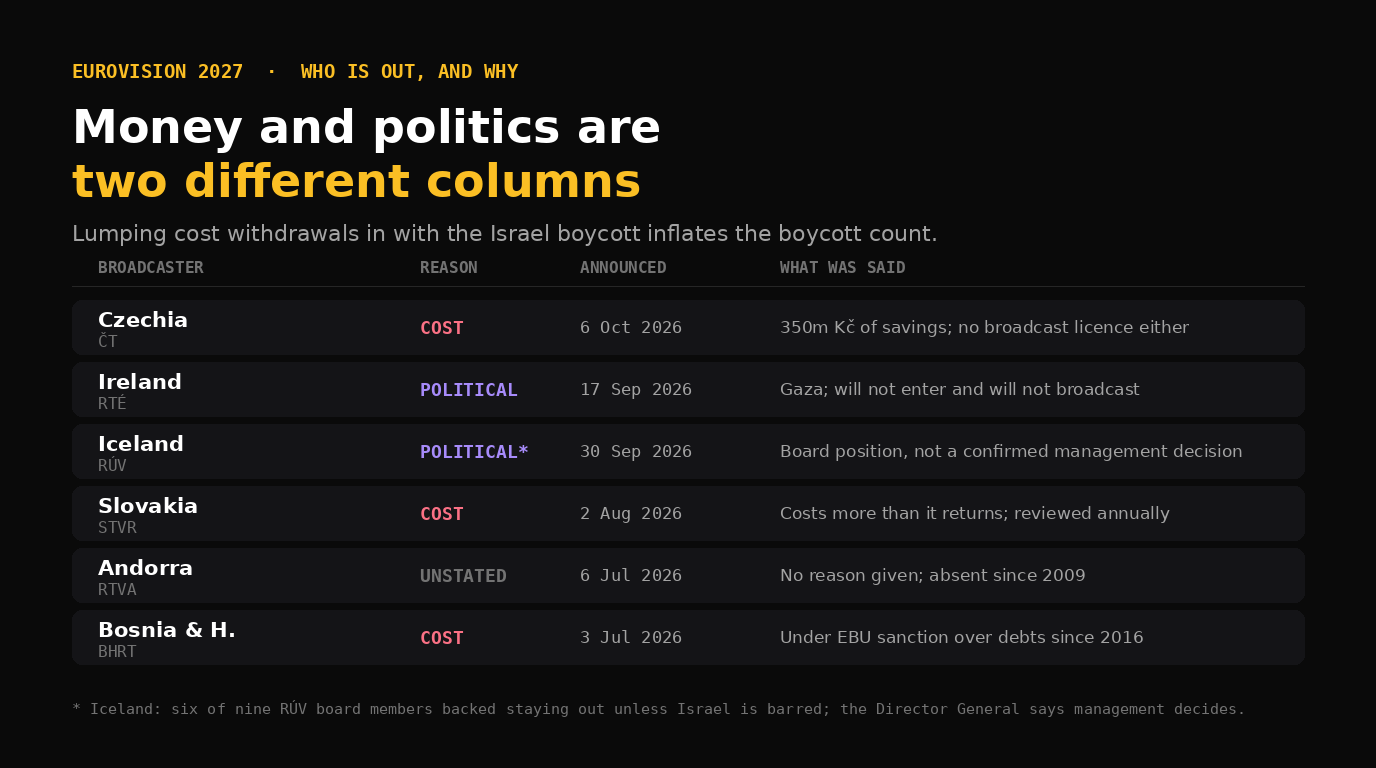
Six countries are now absent from the Burgas line-up for published reasons, and they do not belong in one column:
- Cost: Czechia (ČT, 6 October), Slovakia (STVR, 2 August), Bosnia & Herzegovina (BHRT, 3 July).
- Politics: Ireland (RTÉ, 17 September, over Gaza) and Iceland (RÚV, 30 September, conditional on Israel being barred — and still a board position rather than a confirmed management decision).
- Unstated: Andorra (RTVA, 6 July), absent since 2009 in any case.
Spain is the big one still open: RTVE’s board meets in Santander in mid-October to vote on a second consecutive absence that its president has already recommended. Slovenia is genuinely undecided and has tied the question to its 2027 Programming and Production Plan. Hungary has an EBU deadline extension to 7 December and a government consultation summary, published on 2 October, that manages to list Eurovision both as a format reaching every age group at once and as “supplementary” content whose postponement carries smaller consequences. The 2027 participation tracker carries each of these with its source.
Counting all of it as one trend is the mistake to avoid. The Israel boycott is five broadcasters, four of which have now resolved four different ways. The money story is a separate, quieter one, and it is the one picking off the smaller delegations.
The betting angle: nobody priced this
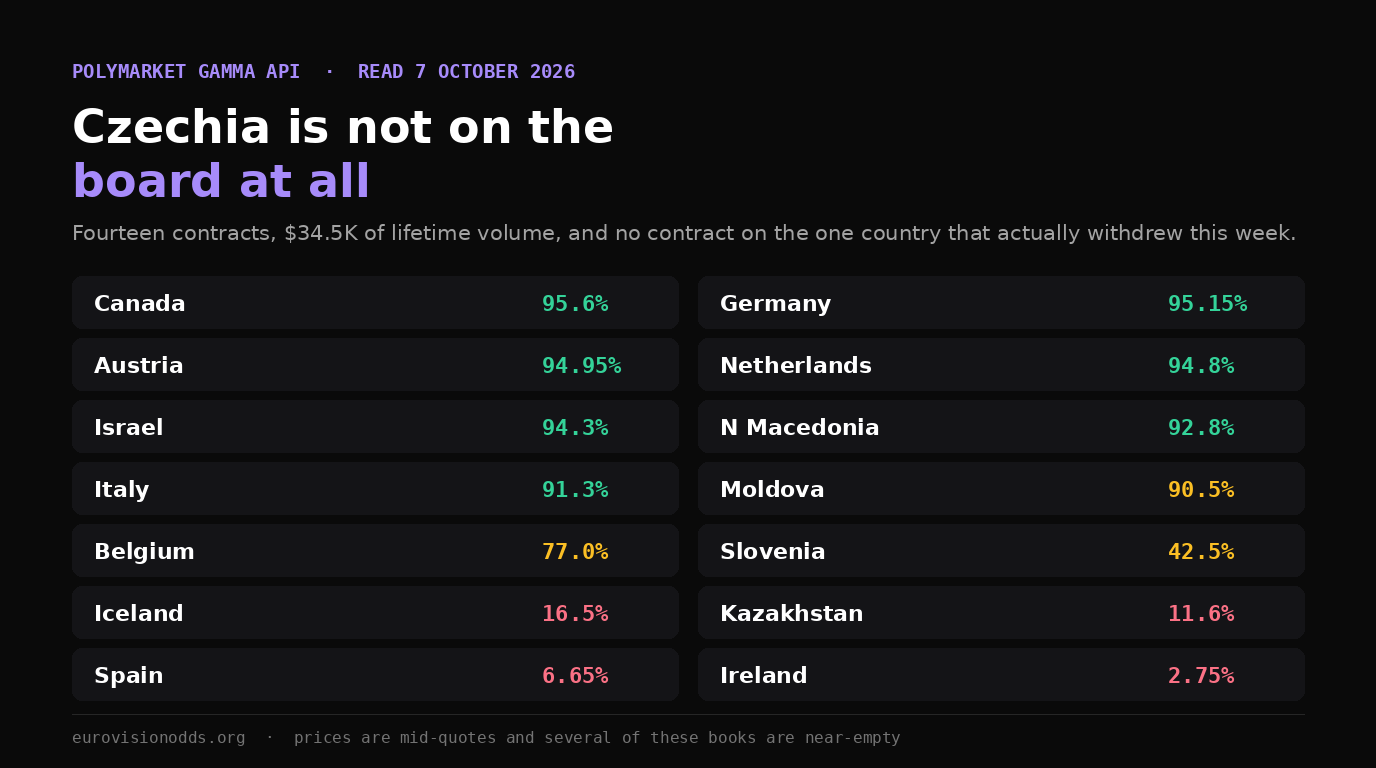
Here is the honest position: there was no market on Czechia to be right or wrong about. No fixed-odds bookmaker prices 2027 participation at all, and Polymarket’s Eurovision 2027 Participants event — the only live book on the subject, with about $34.5K of lifetime volume — lists 14 contracts, and Czechia is not one of them. The one country that actually withdrew this week was unpriced.
That is a structural point rather than a complaint. The contracts that exist cluster on the Israel boycott and on the two debutant stories, Canada and Kazakhstan, because that is where the attention was in August when the book was built. A broadcaster quietly cutting a line item does not attract a contract until after it has happened, by which point there is nothing left to trade.
Read directly from Polymarket’s Gamma API on 7 October 2026, the board stands at: Canada 95.6%, Germany 95.15%, Austria 94.95%, Netherlands 94.8%, Israel 94.3%, North Macedonia 92.8%, Italy 91.3%, Moldova 90.5%, Belgium 77.0%, Slovenia 42.5%, Iceland 16.5%, Kazakhstan 11.6%, Spain 6.65% and Ireland 2.75%.
Two of those need a flag rather than a reading. Italy at 91.3% was 81.25% in our read of the same board yesterday, and its lifetime volume has not moved a cent in between — $710.16 on both reads. Nothing traded. The quoted price is the midpoint of a wide, thinly populated book, and it wandered; we called the slide noise when it went down, and it is noise now that it has come back. Slovenia at 42.5% is quoted between a 19c bid and a 66c ask on $122 of standing liquidity, which is less a 42.5% probability than the absence of one.
Iceland 12.0% to 16.5% is the only move with a plausible story behind it, and the story is a retreat: RÚV’s Director General said on 3 October that participation decisions rest with management rather than with the board that voted to stay out, and Eurovoix reported the same day that RÚV remains undecided. The market has taken a little of the boycott back out of the price. Our winner-market coverage and bookmaker list deal with the contest itself; on 2027 participation there is still nothing to back at a traditional sportsbook.
What to watch next
- RTVE’s board, Santander, mid-October. The 2026 vote carried 10–4–1. A second absence would make Spain the sixth country out and by far the biggest name on the list.
- Moldova. Six days past “a few days”, and priced at 90.5% on $41 of lifetime volume. That is a placeholder, not a forecast.
- Hungary, by 7 December. The only country with an extended deadline, and the only plausible addition to the field.
- Whether ČT ever names a return date. It has not, and 2010 to 2015 is the reason to take that seriously.
Sources
- Eurovoix — ČT Withdraws from Eurovision 2027, 6 October 2026 (ČT statement, broadcast licence, savings figure).
- ESCToday — Czechia: ČT withdraws from Eurovision 2027, 6 October 2026 (participation record and the 2010–2015 absence).
- ESCToday — the EBU’s statement on the withdrawal, 6 October 2026.
- Polymarket Gamma API, Eurovision 2027 Participants, read 7 October 2026.