
Canada opens applications for its first Eurovision act on 31 August, and closes them on 9 September. Ten days. CBC/Radio-Canada has published the shape of the process that will produce the first North American entry in the contest's 71-year history — and it works backwards compared with almost every other country.

18+ | New customers only | T&Cs apply | Please gamble responsibly
Canada picks the singer first. The song gets written afterwards.

The process
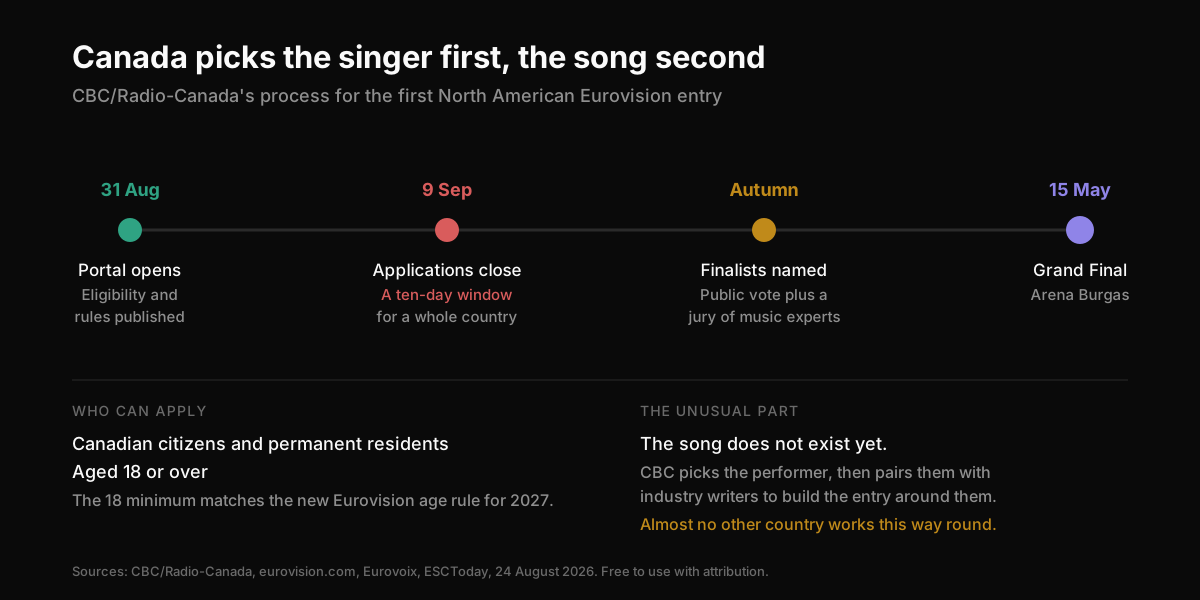
The portal opens on 31 August with full eligibility criteria and participation requirements, and closes on 9 September. Applicants must be Canadian citizens or permanent residents, aged 18 or over. A shortlist of finalists is announced in the autumn, and the act is then chosen by a combination of public vote and a jury of music experts.
The 18 minimum is not a Canadian quirk. It matches the new Eurovision age rule for 2027, which raised the floor from 16 to 18 measured at the first rehearsal. Canada has simply written the contest rule into its own entry criteria rather than discovering the problem later.
Ten days is the number to notice
A first-ever national selection, in a country of 40 million with no Eurovision culture to speak of, with a ten-day application window.
Compare that with what the contest's establishing countries do. Sweden's Melodifestivalen runs submissions for months and receives thousands of entries. Finland's UMK, whose 2027 window has just closed, is a fixture of the domestic music calendar. Those funnels are wide because the artists already know the show exists and plan around it.
Canada has none of that, and ten days to reach people who have never had a reason to think about Eurovision as a career option. The realistic effect is that this first field will be dominated by artists who are already Eurovision-aware — which in Canada means a relatively small, self-selecting group, plus whoever a management company can mobilise inside a fortnight.
That is not necessarily bad. It probably produces a more professionalised shortlist than an open flood would. But anyone expecting a broad cross-section of Canadian music to show up in year one should adjust.
Picking the performer before the song
This is the genuinely unusual choice, and CBC has been explicit that it is a year-one decision: select the artist, then pair them with industry writers to build Canada's first Eurovision song around them.
Most countries do the opposite. Melodifestivalen, Benidorm Fest, Sanremo, Philippine Selection Night — the public is choosing between finished songs, and the artist comes attached. Even internal selections usually pick an artist and a song as a package.
The case for Canada's approach is real. A country with no Eurovision instincts has no domestic sense of what a Eurovision song is, and a public vote on ten homegrown songs from a standing start would likely select something that plays well in Canada and dies in a semi-final. Choosing a performer and then commissioning to the format outsources the hardest judgement to people who understand it.
The cost is ownership. An artist singing a song built for them by committee has less to defend on stage than one who arrived with their own record, and Eurovision audiences are unusually good at detecting the difference. It also front-loads risk onto a songwriting process that will happen largely out of view, between autumn and the spring deadline.
Worth flagging plainly: nothing published so far confirms a televised national final. “Finalists announced in the autumn” plus a public-and-jury vote implies some kind of show, but the format has not been described. That is a real gap in the picture.
The betting angle, such as it is
Three things follow.
Canada will be badly priced in the first market that opens. There is no prior. No Eurovision result, no semi-final history, no established diaspora voting pattern within the contest, and a selection method nobody can pattern-match. Opening prices on debutants tend to be built from vibes and market size, and Canada has a very large market with zero contest-specific evidence behind it.
The diaspora argument is weaker than it looks. Canada is a large country with substantial communities from many participating nations, and it is tempting to assume a friendly televote. But Eurovision's public vote is cast by viewers in participating countries plus Rest of the World, and Canadian-origin communities inside Europe are not comparable to, say, the Turkish or Polish diasporas that shaped voting patterns historically. Treat “Canada has a big diaspora” as untested.
The song is the variable, and it does not exist. Anyone forming a Canada view before roughly March 2027 is pricing a performer and an intention. In a contest decided by three minutes of material, that is most of the information missing.
Canada is one of 21 confirmed for Burgas and trades at 91.1% on Polymarket to participate — the most-traded contract on that board and, with the selection now formally launched, an increasingly academic question. The rest of the field is on our participation board.
Quick answers
How do I apply to represent Canada at Eurovision? The CBC/Radio-Canada portal opens 31 August 2026 and closes 9 September 2026. Full eligibility criteria are published when it opens.
Who is eligible? Canadian citizens and permanent residents aged 18 or over.
How is the act chosen? A shortlist of finalists is announced in the autumn, then a combination of public vote and a jury of music experts selects the representative.
Does the song already exist? No. CBC selects the performer first, then pairs them with industry writers to create the entry.
Is there a televised Canadian national final? Not confirmed. The published process describes finalists and a public-plus-jury vote but does not specify the format.
When does Canada compete? Eurovision 2027 runs 11, 13 and 15 May 2027 at Arena Burgas in Burgas, Bulgaria. Canada will be the first North American country ever to take part.