
Bulgaria has put €20 million behind Eurovision 2027 — and the city that lost the hosting race wants to see the marking. Deputy Prime Minister Ivo Hristov announced the allocation in Burgas on 20 August after meeting mayor Dimitar Nikolov. In the same week, Sofia Municipality formally asked BNT for its bid scores, criterion by criterion, and for permission to publish its own proposal.

18+ | New customers only | T&Cs apply | Please gamble responsibly
Both halves of that are unusual. The second one is the more interesting.

Where the €20 million goes
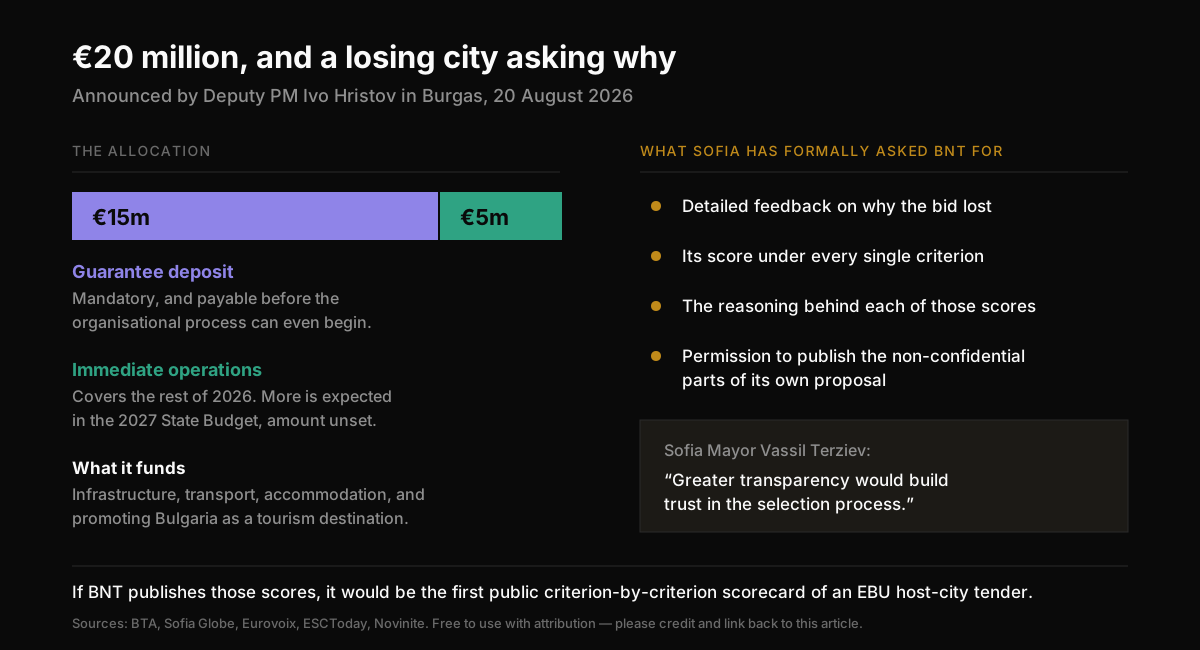
The split matters more than the headline number. €15 million is the guarantee deposit — the sum that must be lodged before the organisational process can formally begin. Only €5 million is operational money, covering immediate needs to the end of 2026. Further funding is expected in Bulgaria's 2027 State Budget, with the amount not yet set.
So this is not a €20m production budget. It is a €15m security bond plus €5m of working capital, and the actual cost of staging the contest is still to be decided in a budget that has not been passed. Anyone reporting that Bulgaria has “committed €20m to putting on Eurovision” has read the number without reading the split.
The stated scope for the money is broad: infrastructure, transport, accommodation, and promoting Bulgaria as a tourism destination. That last item is the giveaway about why a government funds this at all — and it is also the clearest evidence yet for why Burgas beat Sofia.
The bit that vindicates the host-city decision
When we wrote the post-mortem on the 84.5% Sofia favourite, the conclusion was that the market had priced venue capacity and airport connections while the EBU was buying something that appears in no dataset: a city that can be visibly taken over by the contest.
A national government putting money into “promotion of Bulgaria as a tourism destination” alongside a Black Sea resort city's infrastructure is that thesis with a price tag attached. Sofia would have absorbed Eurovision. Burgas gets rebuilt around it, and the state is funding the rebuild as tourism marketing. That is a coherent reason to pick the smaller city, and it is not a reason any capacity-based model would have generated.
Sofia wants the scorecard
Sofia Municipality has formally asked BNT director general Milena Milotinova for four things: detailed feedback on why the bid was unsuccessful, the score awarded under each individual evaluation criterion, the reasoning behind each of those scores, and permission to publish the non-confidential parts of its own proposal.
Mayor Vassil Terziev framed it plainly: “Greater transparency would build trust in the selection process.”
Set aside the local politics, which are real — a capital city losing a national showcase to a city a sixth its size is going to generate exactly this. The substance is what makes it notable.
EBU host-city tenders are not public documents. The criteria are broadly known — venue capacity, hotel inventory, transport, municipal commitment — but the weightings are not, and no losing city has previously extracted a criterion-by-criterion breakdown into the public domain. If BNT complies, this becomes the first published scorecard of an EBU host-city selection.
That is genuinely useful to anyone who prices these markets. Every host-city model, ours included, is built on inference from outcomes. A real weighting table would replace guesswork with arithmetic, and it would settle whether the capacity slack we over-weighted in May carries any marks at all.
We would not bet on BNT publishing it. Bid documents contain commercial terms from venues, hotels and municipalities, and “non-confidential portions” is a category a broadcaster can define narrowly. The likeliest outcome is a courteous letter with generalities. But the request is on the record, and a public refusal has its own cost.
What this tells you about the 2027 contest
Two things worth carrying forward.
The money is real and early. A €15m guarantee lodged in August, nine months out, is a host country moving on schedule rather than scrambling. Given that Bulgaria has never staged the contest and had no Eurovision-family experience beyond Junior Eurovision 2015 in Sofia, early is the right signal. The failure mode for first-time hosts is a late start, not a small budget.
The 2027 State Budget is the number to watch, not this one. The real production figure lands there, and it lands into a political process. If you want an early read on whether Burgas 2027 is a lavish contest or a lean one, that is the document, and it is not written yet.
The contest runs 11, 13 and 15 May 2027 at Arena Burgas, capacity 15,000. Our participation board tracks who is actually turning up.
Quick answers
How much is Bulgaria spending on Eurovision 2027? €20 million allocated so far — €15m as the mandatory guarantee deposit and €5m for immediate operations. More is expected in the 2027 State Budget, amount not yet determined.
Who announced it? Deputy Prime Minister Ivo Hristov, in Burgas on 20 August 2026, after meeting mayor Dimitar Nikolov.
What does the money cover? Infrastructure, transport, accommodation and promoting Bulgaria as a tourism destination.
What is Sofia asking for? Its criterion-by-criterion bid scores, the reasoning behind them, feedback on why it lost, and permission to publish its own proposal.
Will the scores be published? Unknown. BNT has not responded publicly. Bid documents typically contain commercial terms, so a full release would be unprecedented.