
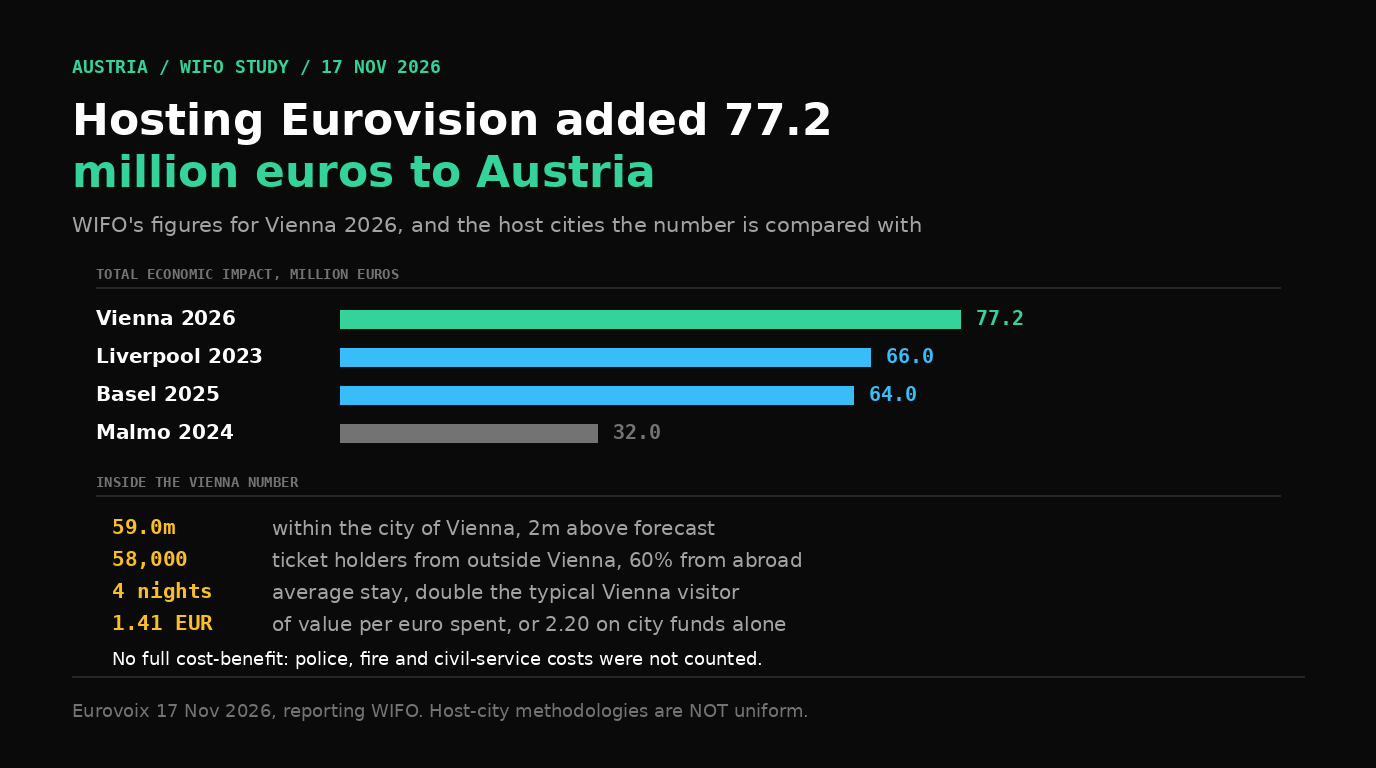
Hosting the Eurovision Song Contest 2026 added 77.2 million euros to the Austrian economy, according to a study by the Austrian Institute of Economic Research, WIFO, reported on 17 November 2026. Of that, 59 million euros landed inside the city of Vienna itself — two million euros above the city’s own forecast.

18+ | New customers only | T&Cs apply | Please gamble responsibly
The study arrives nine months before Bulgaria stages the contest in Burgas, with a state commitment of about 20 million euros already announced, and it is the most detailed published accounting of what a host actually gets back. It is also, by its authors’ own admission, not a cost-benefit analysis, and that caveat deserves to travel with every number below.
Key takeaways
- 77.2 million euros of total impact on the Austrian economy, of which 59 million was within Vienna — 2 million above the city’s forecast.
- 58,000 ticket holders came from outside Vienna, stayed about four nights on average, which is double the typical Vienna visitor, and 60% of them came from outside Austria.
- Every euro spent generated 1.41 euros of value, rising to 2.20 euros when only the city’s own funds are counted.
- Vienna came in under its approved budget of 22.6 million euros, the second time the contest has been below budget for the host city.
- This is not a cost-benefit study. Police and fire deployments and additional public-sector work were not costed at all.
- Host-city methodologies are not uniform, so the comparisons with Malmö, Liverpool and Basel are indicative rather than like-for-like.
- Burgas is a far smaller city than Vienna, so the headline figure does not transfer, and nobody should treat it as a forecast for 2027.
What’s on this page
The headline figure, broken down · Who came, and how long they stayed · Where the money went · The return per euro · How it compares with other hosts · What the study does not measure · The contest it measures · What it does and does not say about Burgas · The market position · Sources
The headline figure, broken down
WIFO put the total impact on the Austrian economy at 77.2 million euros. That total is the result of two separate flows: spending by the people who came to Vienna for the contest, and spending on the contest itself by the organisers, which fed into local business revenue.
| Measure | Figure |
|---|---|
| Total impact, Austrian economy | 77.2m euros |
| Of which, within the city of Vienna | 59.0m euros |
| Vienna’s own forecast for the city figure | 57.0m euros |
| Combined spend by visitors and organisers | about 97.0m euros |
| Forecast taxes and social security contributions | 33.0m euros |
| Forecast contribution to Austrian GDP | 86.0m euros |
Two of those rows are forecasts rather than measurements, and WIFO labels them as such: the 33 million in taxes and social-security contributions and the 86 million GDP contribution are modelled consequences of the spending and the jobs it supported, not receipts anyone has counted. The 77.2 million and the 59 million are the figures the study actually stands behind.
Who came, and how long they stayed
58,000 ticket holders came from outside the city of Vienna, and 60% of those came from outside Austria altogether. They stayed around four nights on average, which WIFO notes is double the typical Vienna overnight visitor.
That length-of-stay effect is the single most transferable finding in the study, because it has now been observed repeatedly. The same pattern of Eurovision ticket holders staying longer than average was reported in Malmö in 2024. And the 58,000-from-outside figure is almost exactly what Turin recorded in 2022, where 58,000 of the 63,000 tickets sold went to people from outside the host city. Three hosts, three editions apart, the same shape.
WIFO also asked about what happens afterwards. More than three-quarters of the visitors surveyed said they would visit Vienna again and recommend it to friends. The institute points to what followed the 2015 contest in the same city: an average annual increase of 4.8% in foreign overnight guests, amounting to 1.7 million additional overnight stays between 2015 and 2017. It is careful to say that this is a best-case reading of 2015 and does not control for new flight routes or other events marketing the city in the same period.
Where the money went
On the cost side, the city spent less than its approved budget of 22.6 million euros — the second occasion on which the contest has come in below budget for a host city. The published breakdown of the roughly 97 million euros of combined visitor and organiser spending:
| Category | Spend |
|---|---|
| Hotels and food, by visitors | 13.9m euros |
| Security | 10.8m euros |
| Event organisation | 6.0m euros |
| Approved host-city budget (not fully used) | 22.6m euros |
Accommodation and hospitality was the sector that gained most from hosting. Security, transport and logistics, and retail all saw smaller boosts. The security line is worth noting on its own: at 10.8 million euros it is the second-largest single category in the published breakdown, and it is the category most likely to scale with the host rather than with the contest.
The return per euro
WIFO expresses the result two ways, and the gap between them is the part most likely to be quoted out of context.
| Basis | Value generated per euro spent |
|---|---|
| All spending budgeted for the event, by the city, the EBU and ORF | 1.41 euros |
| Only the city of Vienna’s own funds | 2.20 euros |
The 2.20 figure is the one a host city would print on a press release, and it is correctly calculated — but it is a return on a narrower denominator. It counts the value generated against the city’s own outlay while ignoring the EBU’s and the broadcaster’s spending, which also produced some of that value. The 1.41 figure is the more complete one, and it is the number to use when comparing hosts.
How it compares with other host cities
| Edition | Host city | Reported figure | What was counted |
|---|---|---|---|
| 2026 | Vienna | 77.2m euros | Visitor and organiser spending, Austria-wide |
| 2023 | Liverpool | 66.0m euros | Spending within Liverpool |
| 2025 | Basel | 64.0m euros | Reported boost |
| 2024 | Malmö | 32.0m euros | Tourism-related economic impact only |
Do not read that table as a league table. WIFO says plainly that the methodology has not been uniform between host cities. Malmö looked only at cash spent by visitors and excluded spending related to staging the contest, which is a large part of what Vienna counted. Turin went the other way and added the equivalent value of international advertising as an economic benefit. Four cities, four scopes.
What survives the comparison is direction rather than magnitude: every published study has found a positive economic effect, and the effect has been larger where the study counted more things. That is a weaker claim than the numbers look, and it is the honest one.
What the study does not measure
WIFO is explicit that it did not look at the costs of police and fire-brigade deployments, the additional work of government employees, or similar public-sector burdens. No full cost-benefit calculation was performed. The figures above are therefore a gross accounting of money flowing in, with one side of the ledger deliberately left blank.
This is the standard shape of a host-city impact study and the standard reason to discount one. It does not make 77.2 million wrong; it means 77.2 million is not a profit. Anyone citing this study as evidence that hosting “pays for itself” is citing something the study does not say.
The contest the study is measuring
For the record, because an impact figure means little detached from the event that produced it: the Eurovision Song Contest 2026 was staged at the Wiener Stadthalle, the same venue Vienna used in 2015, with semi-finals on 12 and 14 May and the Grand Final on 16 May. Austria hosted because JJ had won in Basel the year before with “Wasted Love”.
The 70th edition was won by Bulgaria, with DARA performing “Bangaranga” — written and composed by Anne Judith Wik, Cristian Tarcea, Darina Yotova and Dimitris Kontopoulos. It was Bulgaria’s first victory, improving on a previous best of second place by Kristian Kostov in 2017, and DARA became the first artist since Salvador Sobral in 2017 to win both the public vote and the jury vote.
That matters to the economics in one specific way: the winner determines the next host, and therefore who inherits the spending profile this study describes. Vienna’s 58,000 out-of-town ticket holders are a function of a large arena in a well-connected capital. The study is a snapshot of one host’s conditions as much as of one contest’s pull.
What it does and does not say about Burgas
Bulgaria hosts the 71st contest at the Arena Burgas, capacity 15,000, with semi-finals on 11 and 13 May and the final on 15 May 2027. The state funding announced in August 2026 is about 20 million euros, made up of a 15 million guarantee deposit and 5 million for operations. It is Bulgaria’s first time hosting, after DARA won in Vienna with “Bangaranga” — the country’s first victory, and the first time since 2017 that one artist topped both the public and jury votes.
The Vienna figures do not forecast that. Vienna is a capital of about two million with the hotel stock, airport connections and conference infrastructure of a long-established host; Burgas is a Black Sea city a fraction of that size. The parts of the WIFO study that might transfer are the behavioural ones — four-night stays, 60% international ticket holders, a majority saying they would return — because those describe Eurovision audiences rather than Vienna. The absolute euro totals describe Vienna.
There is one structural point in Burgas’s favour and one against. In favour: a smaller city captures a higher share of visitor spending locally, because there are fewer alternative destinations within easy reach. Against: a 15,000-capacity arena sells fewer tickets than Vienna’s, and the 58,000-visitor figure that drives most of the Vienna total scales with tickets. Our running record of the 2027 contest is on the Eurovision 2027 page.
The market position, stated plainly
There is no market on host-city economics, and no 2027 winner market anywhere. The only live Eurovision books on either prediction-market venue concern participation. On Polymarket, the Eurovision 2027 Participants event has two open country contracts — Slovenia at 10.6c bid against 20.9c offered, last trade 12.1c; Spain at 6.3c against 13.6c, last trade 7.3c — read at 17:07 UTC on 18 November 2026. On Kalshi, a separate 38-contract participation board is open, on which Bulgaria is quoted 91c to 99c with about $55 of lifetime volume.
A correction belongs with that. On 17 November this site said Kalshi had no open Eurovision market on either contest. That was wrong: the 38-contract board above is open and has been for some time. The claim was correct only for Eurovision Asia and for the 2027 winner, host and boycott series, all of which have nothing open. The affected sentences carry dated corrections. Our winner odds page remains a 2026 archive precisely because no 2027 outright exists at any venue.
Sources
- Eurovoix, 17 November 2026 — the WIFO study and its figures.
- WIFO — the Austrian Institute of Economic Research, which produced the study.
- eurovision.tv — the official site, for the 2026 contest dates and result.
- Kalshi and Polymarket Gamma APIs, both queried directly at 17:07 UTC on 18 November 2026.
- Burgas venue, dates and state-funding figures from this site’s Eurovision 2027 record, each line dated to its source.