Beatmosphere are a Bangladeshi a cappella and beatbox group who make every sound on stage with their voices and bodies, and they represent Bangladesh at Eurovision Song Contest Asia 2026 with “Tumi Ele”, singing seventh of eleven in the Grand Final in Bangkok on Saturday 14 November. The group dates its founding to 2009 and normally performs as nine. Six of them, the most the contest allows on stage, won NTV’s first Voice of Bangladesh on 30 September and had their first Bangkok rehearsal on 8 November. Polymarket, read at 03:14 UTC on 9 November, gives Bangladesh 0.1% to win and 6.1% to finish in the top three. This profile covers who the six are, where the group came from, what the song is about, how they won the ticket and where they stand five days before the final.

18+ | New customers only | T&Cs apply | Please gamble responsibly
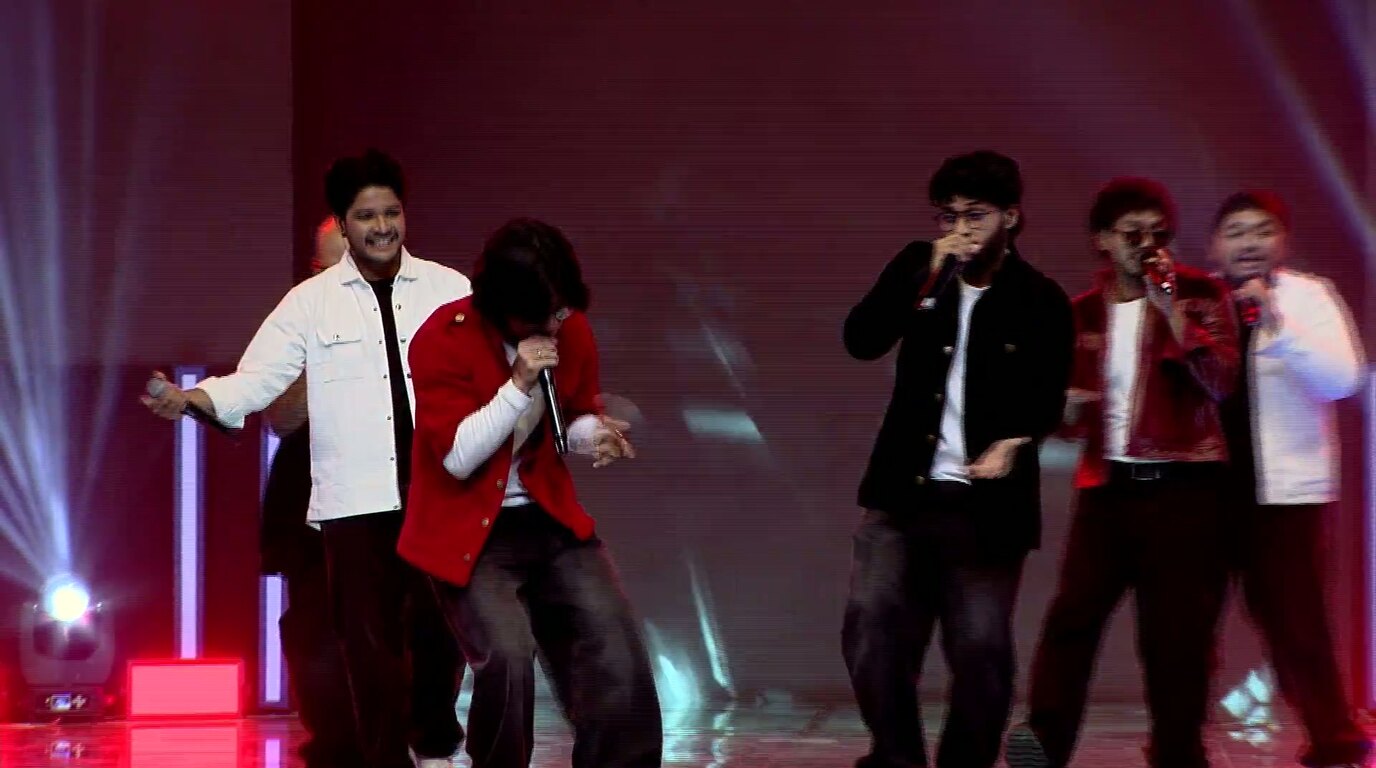
Photo: Beatmosphere performing “Tumi Ele” at Voice of Bangladesh. Frame from the official performance video, Eurovision Song Contest Asia.
Key takeaways
- Who: an a cappella and beatbox group from Dhaka. Every drum, bassline and melody comes from a voice. There are no instruments and no backing track.
- Roots: the official biography dates the group to 2009. Eurovoix traces it through Beatbox Bangladesh, started in late 2014 by Moktadir Dewan and Ronesh Biswas, to an a cappella and beatbox group in 2015.
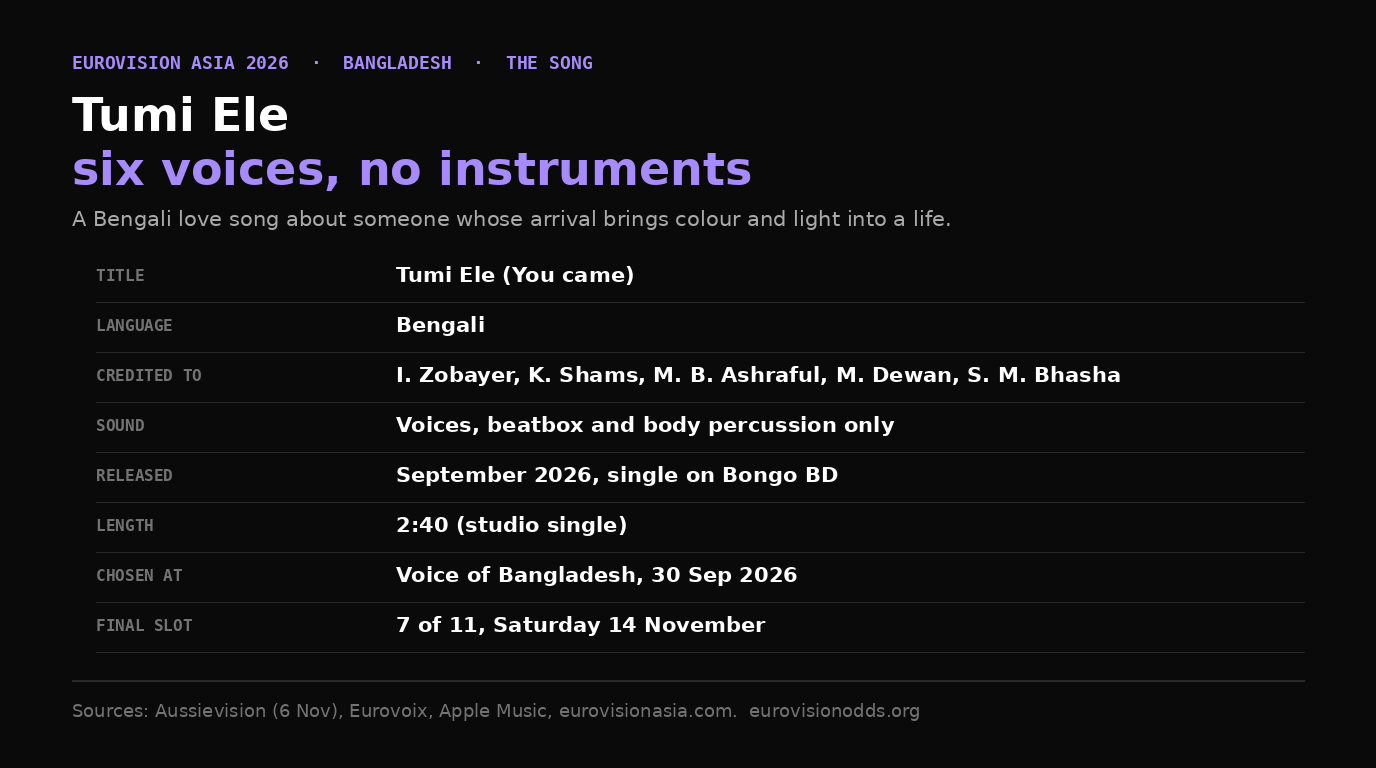
- The song: “Tumi Ele” means “You came”. It is a Bengali love song, written by members of the group and released as a single in September.
- The ticket: they won Voice of Bangladesh on 30 September against nine other acts, on a vote split 40% jury, 40% Bangladeshi public and 20% rest of world.
- Bangkok so far: third on stage at the first rehearsals on 8 November, with new outfits, new choreography and black, white and red graphics.
- The price: 0.1% to win and 6.1% for the top three on Polymarket. Their 0.5% jury price is the lowest of the eleven.
What’s on this page
Who are Beatmosphere? · Biography and career · The song · How they won the ticket · At the One Bangkok Forum · Odds · Where to watch and how to vote · By the numbers · FAQ · Sources
Who are Beatmosphere?
The official Eurovision Asia biography calls Beatmosphere Bangladesh’s “pioneering genre-bending, a cappella and beatbox performance collective”. The method is what sets them apart. Layered singing, beatboxing, body percussion and vocal imitations of instruments stand in for a band, so the group produces drums, bass, melody and electronic textures with no instruments and no electronic equipment. The same biography says the act also uses movement, storytelling, comedy and audience interaction. Wikipedia describes the group as all-male, and the organisers call them “the beat-loving boys”.
| Quick facts | |
|---|---|
| Act | Beatmosphere, an a cappella and beatbox group |
| From | Dhaka, Bangladesh |
| Founded | 2009, per the official biography; an a cappella and beatbox group since 2015, per Eurovoix |
| Members | Normally nine; six on stage in Bangkok |
| Broadcaster | NTV, with the streaming company Bongo |
| National selection | Won Voice of Bangladesh, 30 September 2026 |
| Song | “Tumi Ele” (“You came”), in Bengali |
| Grand Final slot | 7 of 11, Saturday 14 November |
| Polymarket (03:14 UTC, 9 Nov) | 0.1% to win, 6.1% for the top three |
This is Bangladesh’s first entry in any Eurovision contest, so Beatmosphere are the country’s first Eurovision act of any kind. The Bangladesh country page tracks the entry and the broadcaster.
Beatmosphere’s biography and career
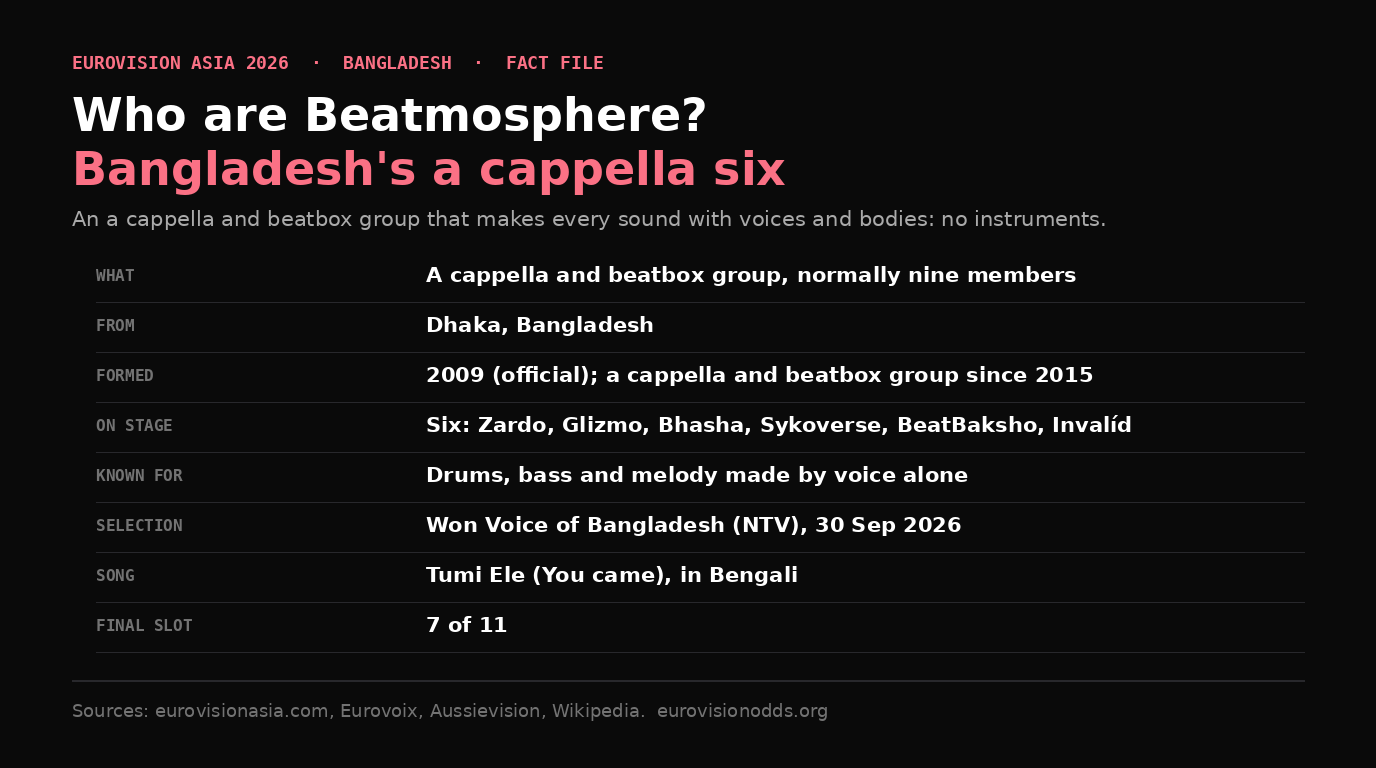
Two start dates are in circulation, and both are right. The official biography and Wikipedia say Beatmosphere was formed in 2009, and Wikipedia names Moktadir Dewan, the group’s vocal bass BeatBaksho, as the founder. Eurovoix’s fuller account, published on 8 November, says Dewan had been interested in bringing several voices together since around 2009. He and Ronesh Biswas then started Beatbox Bangladesh in late 2014 to bring together what Eurovoix calls the country’s then-small beatboxing community. Beatmosphere grew out of it as an a cappella and beatbox group in 2015.
Beatboxing is where the group’s titles come from. Aussievision reports that a former member, Rafiun Nabi Nahin, was Bangladesh’s first national beatbox champion, winning the BattleBoxBD competition in 2017 and 2018, and that member Khandaker Shams, known as Anarchy, won it in 2019 and 2020. By Aussievision’s account, the group told Eurovoix they are beatboxers first and an a cappella group second.
The recorded catalogue is small because the act is built for live shows. Aussievision counts two original releases, “Shob Kichu Bhalo Lage” and “Tumi Ele”, both from September 2026. The group’s YouTube channel also carries a cappella covers, including “Cholo Shobai” and “Billie Jean”, and Aussievision mentions their version of Måneskin’s “Beggin’”. The Daily Star covered a Beatmosphere set at the Dhaka Lit Fest in January 2023.
The contest allows no more than six performers on stage, so three members stay at home. The official biography gives the six who won in Dhaka and will perform in Bangkok:
| Member | Stage name | Role |
|---|---|---|
| Ishtiyak Zobayer | Zardo | Lead vocals, harmony |
| Sayed Ahnaf Tahmid | Glizmo | Lead vocals, harmony |
| Sidratul Mursalin Bhasha | Bhasha | Harmony |
| Mahi Bin Ashraful | Sykoverse | Harmony |
| Moktadir Dewan | BeatBaksho | Vocal bass and baritone, harmony |
| Mahi Hossain Khan | Invalíd | Beatbox, vocal percussion |
Aussievision adds that Bhasha is classically trained, that Zardo grew into a lead vocalist although he was less known as a singer, and that Sykoverse imitates instruments, air guitar included. Wikipedia names the three who stay home as Anarchy (Khandaker Shams), Dippox (Prachyo Priyodip) and RafTeknix (Rafiun Nabi Nahin). Aussievision calls Nahin a former member and says the line-up has changed many times, so the full nine-name list should be read with care.
“Tumi Ele”: the song
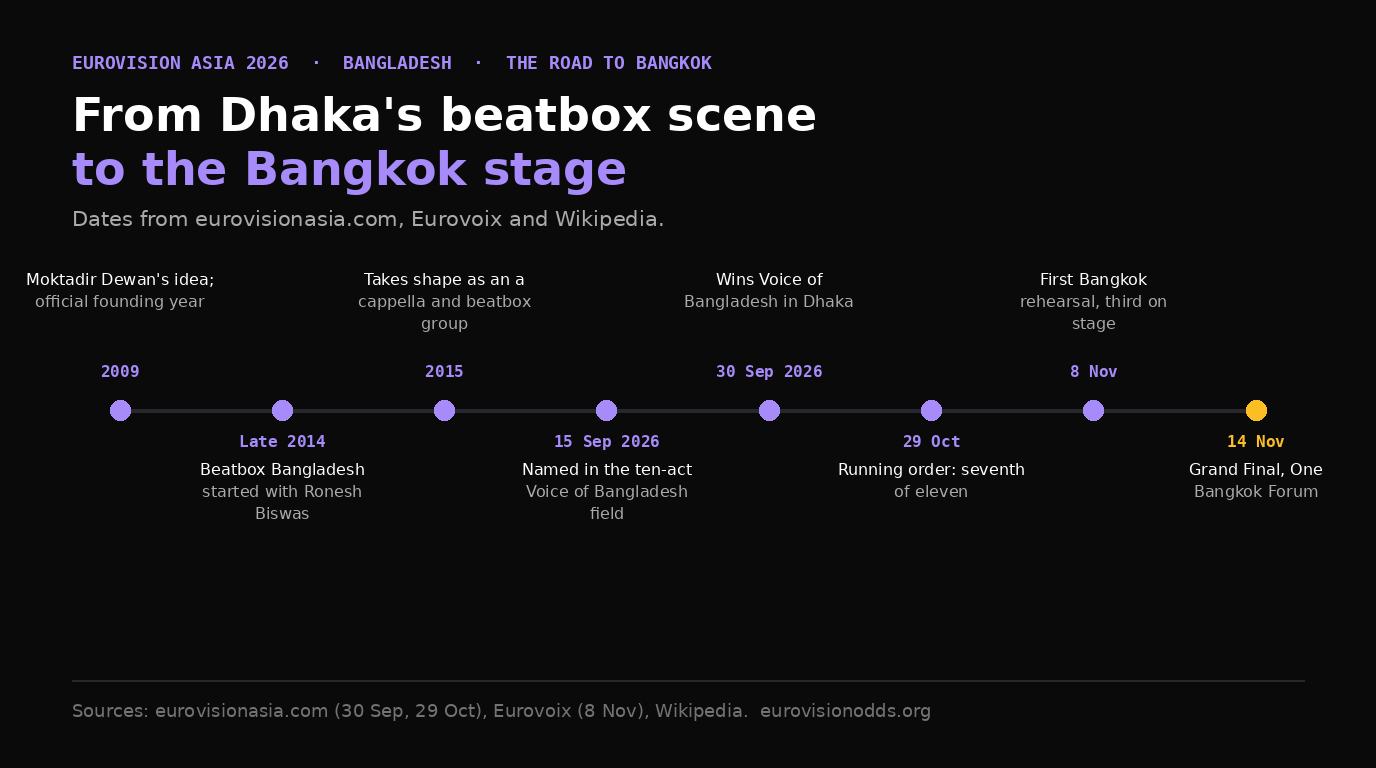
“Tumi Ele” is Bengali for “You came”. Aussievision describes it as a Bengali-language love song about someone whose arrival brings colour and light into another person’s life. The verse it translates moves from a long wait to a life that had been black and white and is now coloured in. In our reading it is a simple idea, which leaves room for the arrangement to carry the song: lead vocals over harmonies, a vocal bass line and a beatboxed rhythm section.
The credits differ slightly between sources. Aussievision lists five songwriters: Ishtiyak Zobayer, Khandaker Shams, Mahi Bin Ashraful, Moktadir Dewan and Sidratul Mursalin Bhasha. Eurovoix names Mahi Bin Ashraful, Khandaker Shams, Moktadir Dewan and Ishtiyak Zobayer as writers, and Dewan, Ashraful, Shams and Bhasha as composers. The Daily Star named Dewan, Ashraful, Shams and Bhasha. All five are members of the group: four are in the Bangkok six, and Shams is one of the three who stay home.
All ten Voice of Bangladesh songs went up on the selection’s YouTube playlist on 21 September, nine days before the final. Apple Music lists “Tumi Ele” as a single from 22 September, running 2:40, with Bongo BD as the copyright holder of the recording. That is inside the contest’s three-minute limit.
The a cappella sound was a deliberate choice. In an interview with Eurovoix published on 28 October, the group said: “We want to break the barrier of ‘a cappella doesn’t have a space in Eurovision’. It’s not a party trick. We make music.” Aussievision’s account of the interview says they could have chosen a folk song that represents Bangladesh, but wanted to do what they are good at.
The song has also been covered. On 27 October the official Eurovision Asia Instagram account announced that Delta Goodrem, who sang “Eclipse” for Australia in Vienna this year, had recorded a version of each of the eleven songs in its original language, starting with “Tumi Ele”. Aussievision reports that the group are fans of hers.
How Beatmosphere won the ticket to Bangkok
Bangladesh chose its act through Voice of Bangladesh, produced by Bongo with NTV. The final was first planned for 23 August. At a press conference in Dhaka in late July, the organisers said about 50 to 70 applications had come in, extended the entry window and moved the final to 30 September. Ten acts, not the twelve first planned, were named on 15 September.
The final was held on Wednesday 30 September at the International Convention City Bashundhara in Dhaka, the country’s largest event venue. NTV and Bongo broadcast it live, and the Eurovision Song Contest YouTube channel streamed it worldwide. Tahsan Khan hosted. The jury was Bappa Mazumder, Fahmida Nabi, Hamin Ahmed, Akhi Alamgir and Shawkat Ali Emon.
Under section 8.1 of the official voting terms, the result was 40% jury, 40% Bangladeshi public and 20% rest-of-world public, with each pool ranked separately. The organisers called it “a tight vote” but published only the top three, with no points:
| Place | Act | Song |
|---|---|---|
| 1 | Beatmosphere | “Tumi Ele” |
| 2 | Pulak Adhikary | “Anari Majhi” |
| 3 | Vintage Theory | “Boomerang” |
| Not ranked | Benazir Zilani | “Ghum Chokhe Raat” |
| Not ranked | Krishan Barman | “Kachuri Ful” |
| Not ranked | Lubaina Afnan | “Dishehara” |
| Not ranked | Naim Imran Sharot | “Anushilon” |
| Not ranked | Nusrat Jahan Kriti | “Desi Star” |
| Not ranked | SUBCONSCIOUS | “Janalachobi” |
| Not ranked | The Kushiyara Waves | “Lover’s Prayer” |
The prize was a cash award, a recording contract and the Bangkok ticket. Beatmosphere won as a six-piece, so the line-up that travels is the one that won, with the arrangement already cut down to six voices. Our report on the night has the full result.
View this post on Instagram (@eurovisionasia)
Beatmosphere at the One Bangkok Forum
Before travelling, Beatmosphere told Eurovoix they would keep the attention on themselves rather than on big props or gimmicks, so that the audience notices the skill of the beatboxing. Eurovoix summed the plan up as “less is more”.
The first rehearsals were held on Sunday 8 November. Beatmosphere were the third act on stage, after Laos and Bhutan and before Cambodia. The organisers released a short clip, and Eurovoix reports from it that the group have new outfits, new choreography made for the Bangkok stage, and elevated graphics in black, white and red. The official account captioned the clip “All eyes on Beatmosphere” and promised more from the band through the week. By about 02:00 UTC on 9 November it had roughly 4,900 likes, second of the four day-one clips behind Laos.
That is everything that has been reported. A clip shows a look, not a full three-minute vocal, and nothing has been published on how the six sound in the hall. For a group with no backing track, that is the question that matters most. The next fixed dates are the Preview Show on Friday 13 November and the Grand Final the following night. Our day-one rehearsal report compares all four acts who rehearsed on 8 November.
Beatmosphere Eurovision Asia odds
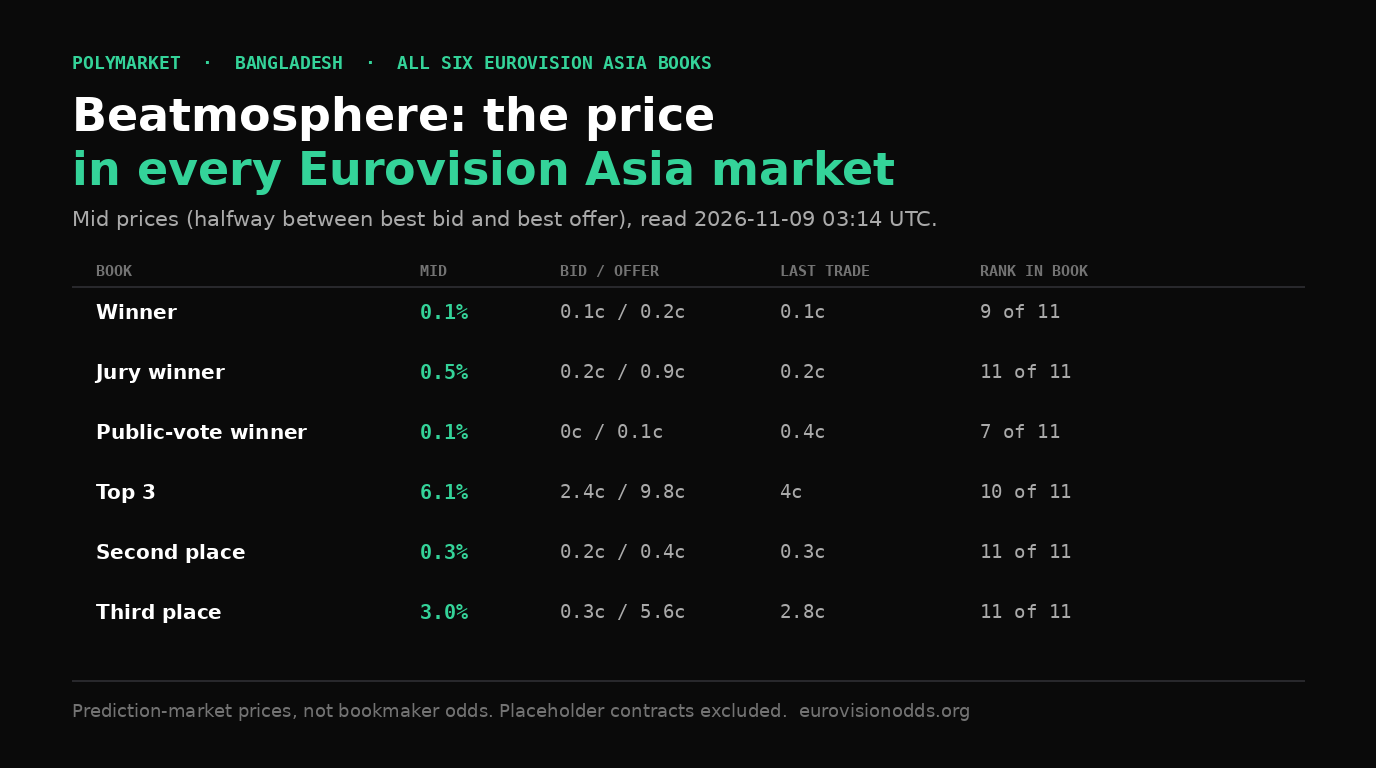
No bookmaker prices Eurovision Asia. Two prediction markets do. Polymarket has listed the contest since 3 November and runs six markets on it. Its prices below were read at 03:14 UTC on 9 November. They are prediction-market prices, not bookmaker odds: the levels traders are willing to buy and sell at, and on thin books they can sit unchanged for hours.
| Market | Mid | Bid / offer | Last trade | Traded on Bangladesh | Rank of 11 |
|---|---|---|---|---|---|
| Winner | 0.1% | 0.1c / 0.2c | 0.1c | $1,081 | Joint 9th (floor) |
| Top 3 | 6.1% | 2.4c / 9.8c | 4c | $291 | 10th |
| Jury winner | 0.5% | 0.2c / 0.9c | 0.2c | $269 | 11th |
| Public-vote winner | 0.1% | 0c / 0.1c | 0.4c | $371 | Joint 7th (floor) |
| Second place | 0.3% | 0.2c / 0.4c | 0.3c | $58 | 11th |
| Third place | 3.0% | 0.3c / 5.6c | 2.8c | $133 | 11th |
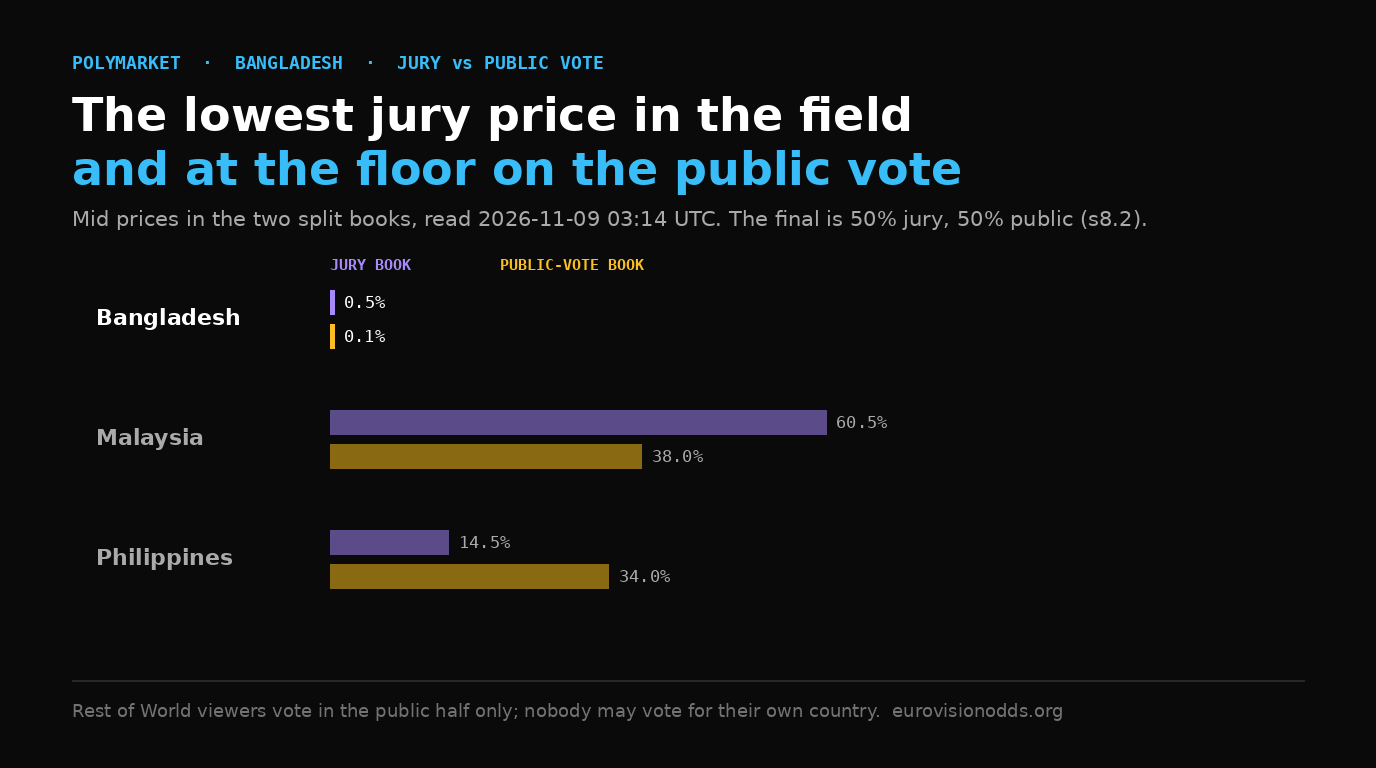
Here is how we would read it. The 0.1% price in the winner market is the floor of the book. Bangladesh, Bhutan and Cambodia all sit there, and a 0.1c bid against a 0.2c offer means the market gives no real chance rather than a measured one. The public-vote price is at the same floor, shared with four other countries. The jury market is the clearest signal: at 0.5%, Bangladesh is the lowest-priced act of the eleven, below Cambodia (1.3%) and South Korea (1.4%).
The one price clear of the floor is the Top 3 market, at 6.1%. That is tenth of eleven, just ahead of Nepal on 6.0%. The quote is wide, 2.4c bid and 9.8c offer, so the market’s view sits somewhere in that range rather than at exactly 6.1%. Our day-one rehearsal report recorded a rise of about three points in that price over the 24 hours that took in the first rehearsal.
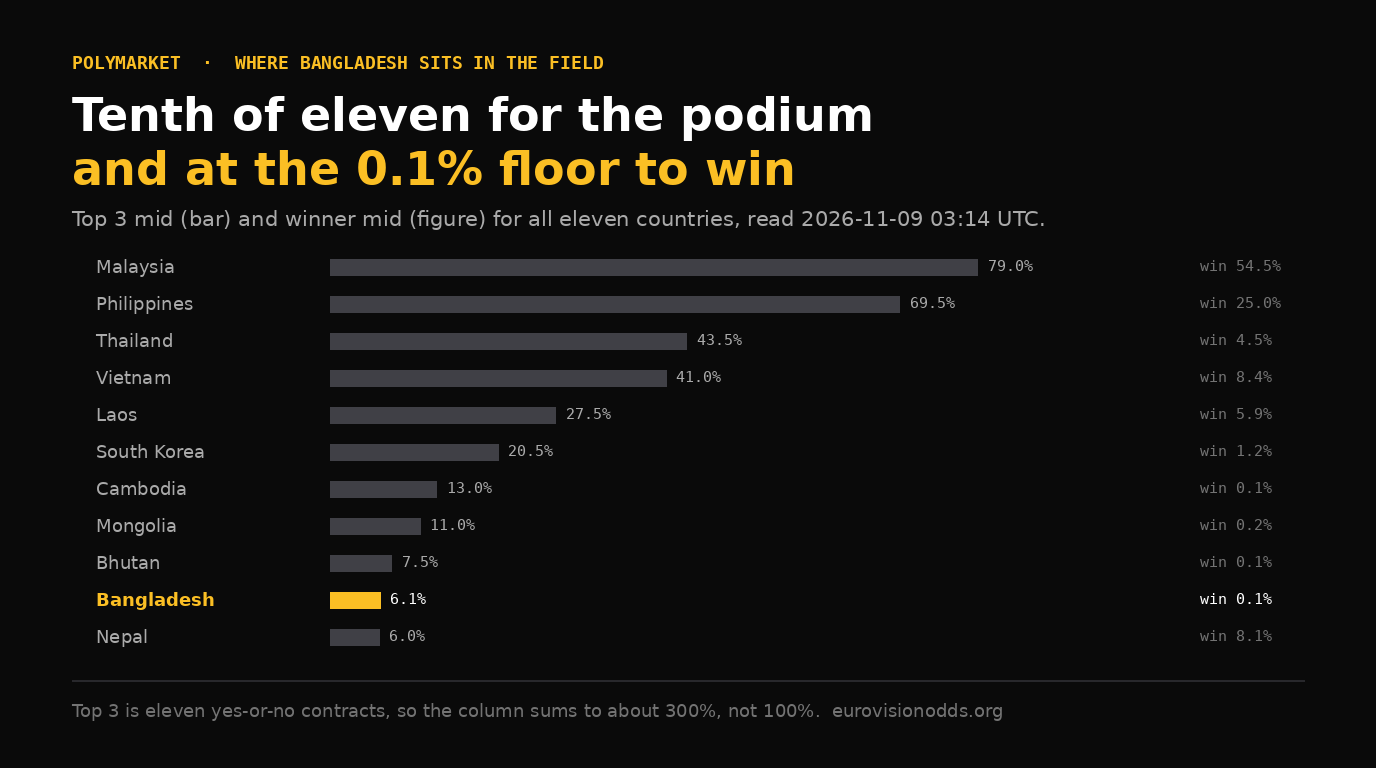
In our reading, the board treats Beatmosphere as an act the juries will mark down and the public vote will not rescue. That is the standard case against an a cappella entry: no instrumental hook for a viewer who hears it once. The case for it is the one the official account made on 8 November, that nothing else on the stage will sound like “Tumi Ele”. The market gives that case a 6.1% chance of a podium. Our predictions for all eleven acts rank Beatmosphere eleventh, with the warning that an act unlike the rest can surprise a public vote.
Kalshi, the CFTC-regulated US exchange, also lists the contest. Read at 01:48 UTC on 9 November, Bangladesh last traded at 6c, with no bid and a 49c offer, on 61 contracts traded since the market opened on 14 September. Seven of Kalshi’s eleven contracts had no bid and the last prices summed to 200%, so that 6c is an old trade, not a current price.
Where to watch and how to vote for Beatmosphere
Beatmosphere sing seventh of eleven, after the Philippines’ CARMELLE and before the hosts, Thailand’s MANG x DAOU. The Grand Final starts at 20:30 in Bangkok on Saturday 14 November. That is 19:30 in Bangladesh, 14:30 CET and 13:30 UTC. NTV shows it in Bangladesh from 19:30 local time, and the Eurovision Song Contest YouTube channel streams it free worldwide. The organisers have not published a time for each slot. Every broadcaster and start time is in our guide to watching the Grand Final.
The official voting terms, last updated on 28 August, set the rules:
- Voting is on the web at eurovisionasia.com/vote, for over-18s.
- Each voter gets eight free votes and can buy up to ten more, to a maximum of 18 per person and 16 for any one entry.
- Votes must be spread across at least three countries’ entries, or none of them count.
- If you live in Bangladesh, you cannot vote for Beatmosphere (section 3.3). Bangladeshis living in one of the other ten competing countries can, and so can viewers anywhere outside the eleven, whose votes form a Rest of World public vote.
- The result is 50% jury and 50% public in each competing country. The Rest of World vote has no jury half (section 8.2).
The own-country rule weighs on Bangladesh more than on most. The largest audience for a Bangladeshi act is at home, and none of it can vote for Beatmosphere, so their public score has to come from the other ten countries and from abroad. In our reading, that is part of why the public-vote market has them at the floor.
What people search for: Beatmosphere by the numbers
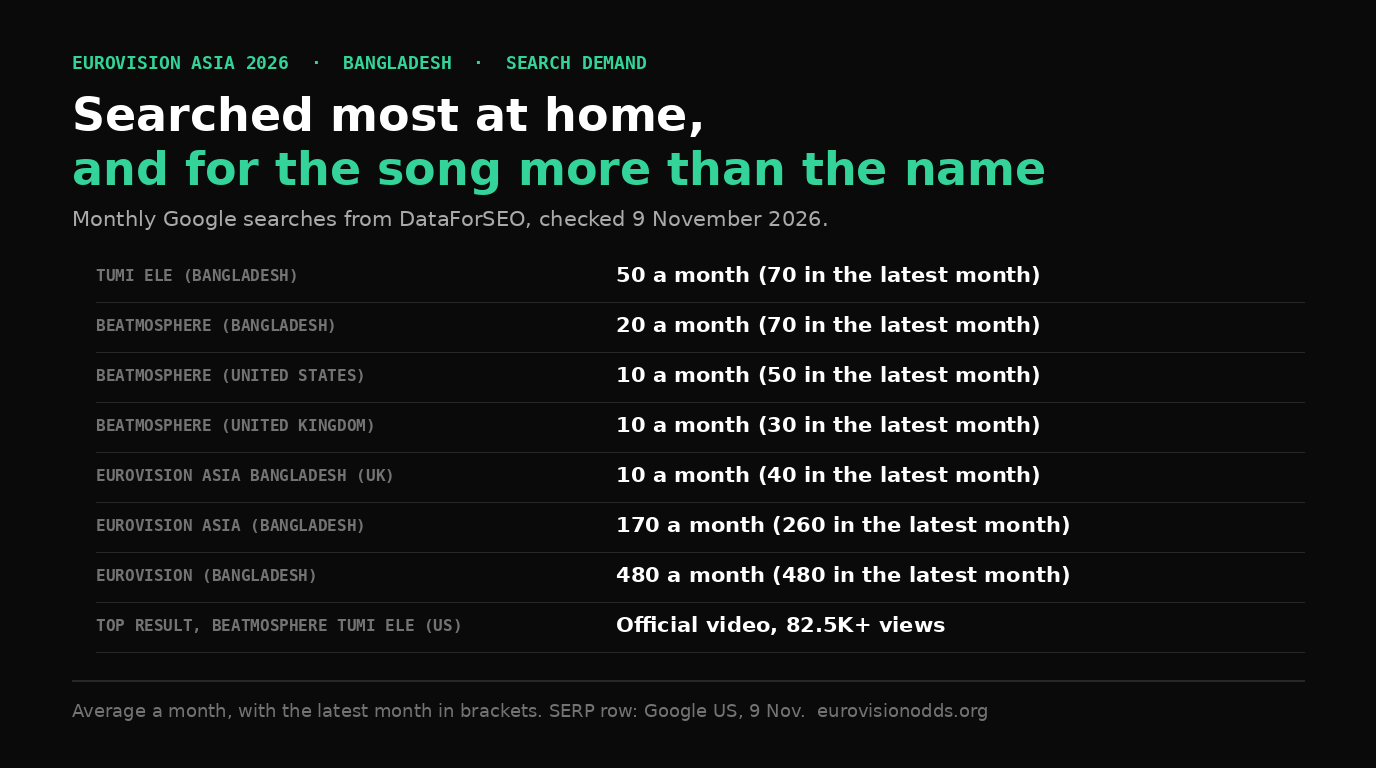
Search interest in Beatmosphere is small. Google search data from DataForSEO, checked on 9 November, shows the bare name averaging about 20 searches a month in Bangladesh and 10 each in the United States and the United Kingdom. Every market was higher in the latest month: 70 in Bangladesh, 50 in the US and 30 in the UK. “tumi ele” averaged 50 a month in Bangladesh, more than the group’s name. It is an everyday Bengali phrase, so some of those searches are probably for other songs; that part is our reading.
Google’s results show the same split. In Bangladesh the name brings up the group: a New Age report on the Voice of Bangladesh win, Spotify, the BeatBaksho Facebook page, Eurovoix and Spanish Wikipedia. In the United States, the bare name returned beatbox videos that are not about the group. Search “beatmosphere tumi ele” there and the top result is the official Eurovision video, which Google showed at more than 82,500 views, ahead of a Genius lyrics page and the English Wikipedia article. For scale, “eurovision asia” averaged 170 searches a month in Bangladesh and “eurovision” 480.
Every country in the field is profiled on our Eurovision Asia hub.
FAQ
Who are Beatmosphere?
Beatmosphere are an a cappella and beatbox group from Dhaka who make every sound with their voices and bodies, with no instruments. They normally perform as nine, and six of them represent Bangladesh at the first Eurovision Song Contest Asia with “Tumi Ele”, in slot 7 of the Grand Final on 14 November 2026.
Where are Beatmosphere from?
Dhaka, Bangladesh. They are Bangladesh’s first act in any Eurovision contest, chosen through NTV’s Voice of Bangladesh.
How old are Beatmosphere?
The official biography dates the group to 2009. Eurovoix reports that it took shape as an a cappella and beatbox group in 2015, after Moktadir Dewan and Ronesh Biswas started Beatbox Bangladesh in late 2014. None of the sources we checked publishes the members’ ages.
How many members are in Beatmosphere?
Normally nine. Six are on stage in Bangkok, because the contest allows no more than six performers: Zardo, Glizmo, Bhasha, Sykoverse, BeatBaksho and Invalíd.
What does “Tumi Ele” mean?
“You came”. It is a Bengali love song about someone whose arrival brings colour and light into another person’s life.
Who wrote “Tumi Ele”?
Members of the group. Aussievision lists Ishtiyak Zobayer, Khandaker Shams, Mahi Bin Ashraful, Moktadir Dewan and Sidratul Mursalin Bhasha. The Daily Star named Dewan, Ashraful, Shams and Bhasha.
When do Beatmosphere perform at Eurovision Asia?
Seventh of eleven on Saturday 14 November 2026. The show starts at 20:30 in Bangkok, 19:30 in Bangladesh on NTV, and 13:30 UTC on the Eurovision Song Contest YouTube channel.
Can Beatmosphere win Eurovision Asia?
The markets say it is very unlikely. Polymarket, read at 03:14 UTC on 9 November, had Bangladesh at 0.1% to win and 6.1% to finish in the top three, and its 0.5% jury price is the lowest in the field. A sound unlike anything else in the contest is the case for an upset.
Sources
- Eurovision Song Contest Asia: official Beatmosphere artist page and “Beatmosphere is our Voice of Bangladesh” (30 September 2026); running order (29 October); how to watch; voting terms, sections 3.3, 6, 6.1, 8.1 and 8.2 (updated 28 August 2026).
- Eurovision Song Contest Asia on Instagram: posts of 26 October, 27 October (Delta Goodrem) and 8 November 2026.
- Eurovoix: “Beatmosphere to Eurovision Asia 2026” (30 September); Beatmosphere interview (28 October); performances preview (7 November); first rehearsal report (8 November).
- The Daily Star, “Beatmosphere set to represent Bangladesh at Eurovision Song Contest Asia”, 30 September 2026 (venue, jury, credits, songs).
- Aussievision, “Eurovision Asia 2026: Meet Bangladesh’s Beatmosphere”, 6 November 2026 (members, titles, song meaning, credits).
- Wikipedia, “Beatmosphere”, read 9 November 2026 (founder, member list). Apple Music, “Tumi Ele – Single” (release date, length, label).
- Polymarket, 03:14 UTC on 9 November 2026, mids between best bid and best offer. Kalshi, 01:48 UTC on 9 November 2026.
- Google search data from DataForSEO and Google results pages, checked 9 November 2026.
18+. Prediction markets carry risk, and prices on thin books can move without trades. Check the live board before acting.