
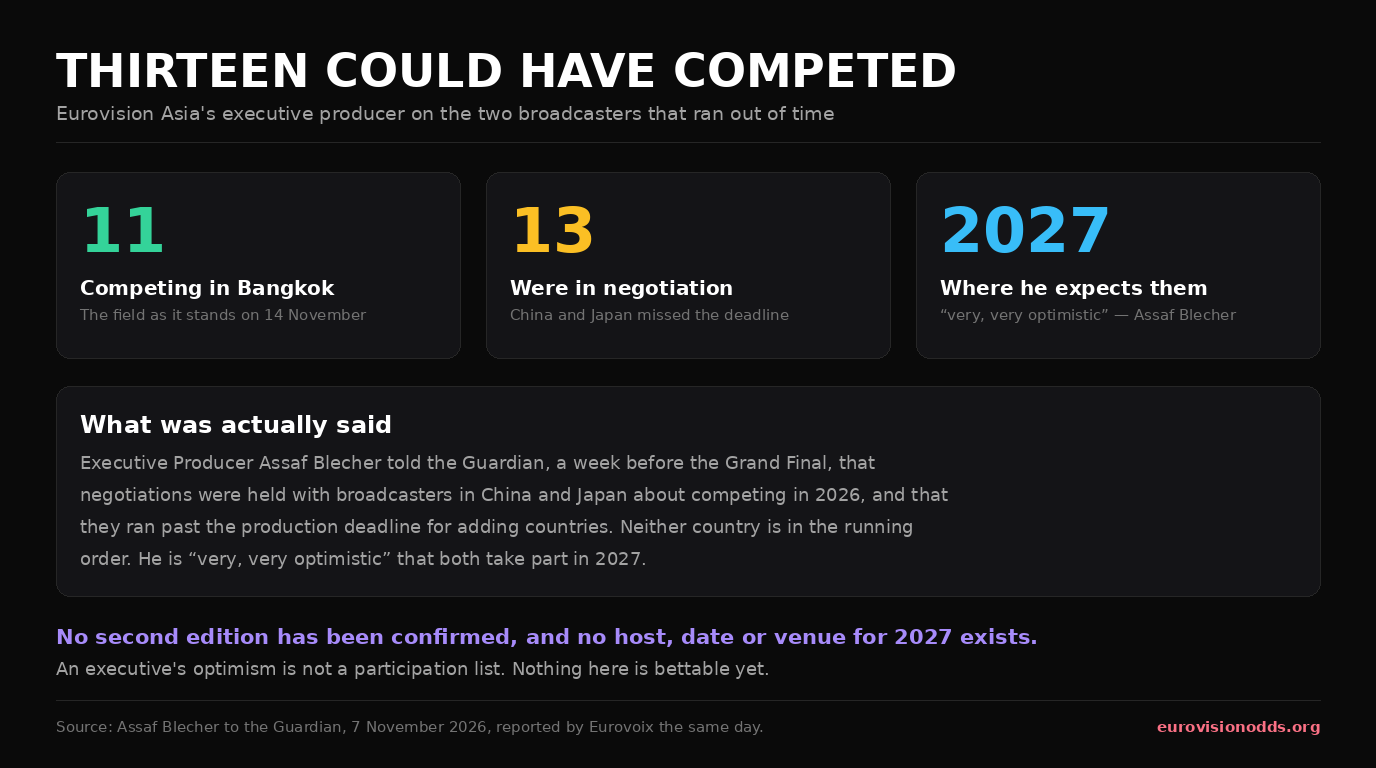
Thirteen countries could have competed at the first Eurovision Song Contest Asia, not eleven. Executive Producer Assaf Blecher told the Guardian on 7 November 2026, a week before the Grand Final in Bangkok, that negotiations were held with broadcasters in China and Japan about entering the inaugural edition, and that those talks ran past the production deadline for adding countries. He said he is “very, very optimistic” that both will take part in 2027.

18+ | New customers only | T&Cs apply | Please gamble responsibly
It is the clearest statement anyone connected to the contest has made about its second edition, and it is worth being precise about how much it actually settles — which is less than the headline suggests.
What was said, and by whom
Blecher is the Executive Producer of Eurovision Asia, which makes him about as close to a primary source on the production deadline as exists. The interview was published by the Guardian on 7 November and reported the same day by Eurovoix. Three things come out of it:
- Thirteen countries were in negotiation for the 2026 contest, against the eleven that are competing.
- The two missing ones are China and Japan. Talks with broadcasters in both countries happened and did not conclude in time.
- The reason given is timing, not refusal. The negotiations “ran past the production deadline” for adding countries — a scheduling failure rather than a rejection on either side.
What he did not say matters as much. No Chinese or Japanese broadcaster is named. Neither has said anything publicly about Eurovision Asia. No second edition has been formally announced — there is no confirmed host country, no date and no venue for a 2027 Eurovision Asia, and no published list of participants to be added to. An executive producer’s optimism a week before his own first show is a statement of intent, and intent is not a participation list.
Why China and Japan would change the contest
The eleven countries in Bangkok are Bangladesh, Bhutan, Cambodia, Laos, Malaysia, Mongolia, Nepal, the Philippines, the Republic of Korea, Thailand and Vietnam. It is a South, Southeast and East Asian field with one major music market in it — South Korea — and a lot of countries with small domestic recording industries.
Adding Japan and China would not be an incremental expansion. Japan is one of the two largest recorded-music markets on earth; China’s streaming sector is enormous and structurally different from everything else in the field. Both would arrive with budgets, broadcast infrastructure and established pop-export machinery that most of the current eleven cannot match. The EBU has estimated the first edition could reach up to 600 million viewers; the two absent countries between them hold well over a billion people.
They would also change the competitive balance in a way that matters to anyone pricing the thing. The current contest has one dominant pop-export nation. A field containing South Korea, Japan and China has three, and the jury-and-televote arithmetic that currently makes Malaysia the favourite in Bangkok would look very different.
The field was still moving late
The “thirteen could have competed” figure is easier to believe once you look at how late the eleven were still being assembled. The EBU and the organisers announced ten countries when Bangkok was confirmed as host in March 2026. Mongolia is not on that original list — it joined afterwards, and did not finish choosing its entry until Mongolia’s Chosen One on 10 October, barely five weeks before the Grand Final.
The rest of the calendar ran just as tight. Bangladesh selected on 30 September after its original 23 August date was cancelled, Vietnam on 3 October, Nepal on 7 October and Cambodia on 17 October — the last country to complete its entry, four weeks out. A contest whose eleventh entry was finalised in mid-October plainly had a hard stop somewhere behind it, and Blecher’s account puts China and Japan on the wrong side of it.
This is the second expansion signal in three weeks
It also is not the only sign that the organisers are thinking past 14 November. Three broadcasters outside the competing eleven have picked up the Bangkok show: SBS in Australia on 14 October, TVP in Poland on 22 October with Artur Orzech commentating, and KAN in Israel on 23 October. Sweden’s SVT was reported in August to be in talks about carrying it.
Those are broadcast deals, not entries, and the distinction is the whole point. A broadcaster showing the contest is a customer; a broadcaster entering it is a participant with a selection process, a delegation and a bill. Australia made exactly that transition at the European contest in 2015 and remains the only country ever admitted there by Reference Group invitation rather than full EBU membership. Nothing says the same route is on offer in Asia.
What this does not settle
Set against the optimism is an unresolved story this site has been following since 22 October. The Swedish newspaper Aftonbladet reported that the EBU approved a cut of about $1 million from a Eurovision Asia budget of roughly $4.5 million, with much of the international production team no longer travelling to Thailand. The organisers responded only to the strongest version of the claim, saying the Grand Final “will take place as planned in Bangkok on 14 November” and that there are “no plans to cancel or postpone”. Nobody has denied the cut or the crew change, and no revised budget has been published.
A first edition that had its budget trimmed weeks before airing is not an obvious platform for adding the two most expensive broadcast markets in the region. Both things can be true — the talks happened, and the finances are tighter than planned — and the honest position is that the second edition depends on how the first one performs on 14 November, not on what was said about it a week before.
Is there anything to bet on here?
No. There is no market anywhere on which countries compete at Eurovision Asia 2027, on either of the two venues that price the 2026 contest. Polymarket has six Eurovision Asia books open and all of them resolve on the 2026 Grand Final ranking; Kalshi’s eleven-country winner market closes on 2 January 2027. No fixed-odds bookmaker prices Eurovision Asia at all.
That is worth stating plainly because the European equivalent does exist: Polymarket’s Eurovision 2027 participants market has taken about $95K over its life pricing which countries appear on the EBU’s first official list for Burgas, and it resolved most of its contracts when that list published on 28 October. If an Asia 2027 participation market ever opens, this is the kind of story it would price. Today there is nothing, and an executive saying he is optimistic is not a reason to go looking for one.
What happens next
The Grand Final is on 14 November 2026 at the One Bangkok Forum, hosted by Woody Milintachinda and Cindy Bishop, starting 19:30 ICT (14:30 CET) and streaming on YouTube. Eleven countries perform, Vietnam first and Malaysia last. The winner is decided 50% by jury and 50% by public vote under §8.2 of the official Voting Terms — not the 40/40/20 split that governed each national selection — and nobody can vote for their own country. Bulgaria’s DARA, who won Eurovision 2026 in Vienna with “Bangaranga”, performs a special version of it as a guest.
On the evidence of 7 November, the thing to watch after that is not an announcement but a viewing figure. If the first edition delivers an audience anywhere near the EBU’s estimate, the negotiations that missed the deadline this year become much easier to finish next year. If it does not, Blecher’s optimism will have been the high-water mark. We will carry the result, the full scoreboard and how both prediction markets scored against it on the Eurovision Asia hub.