
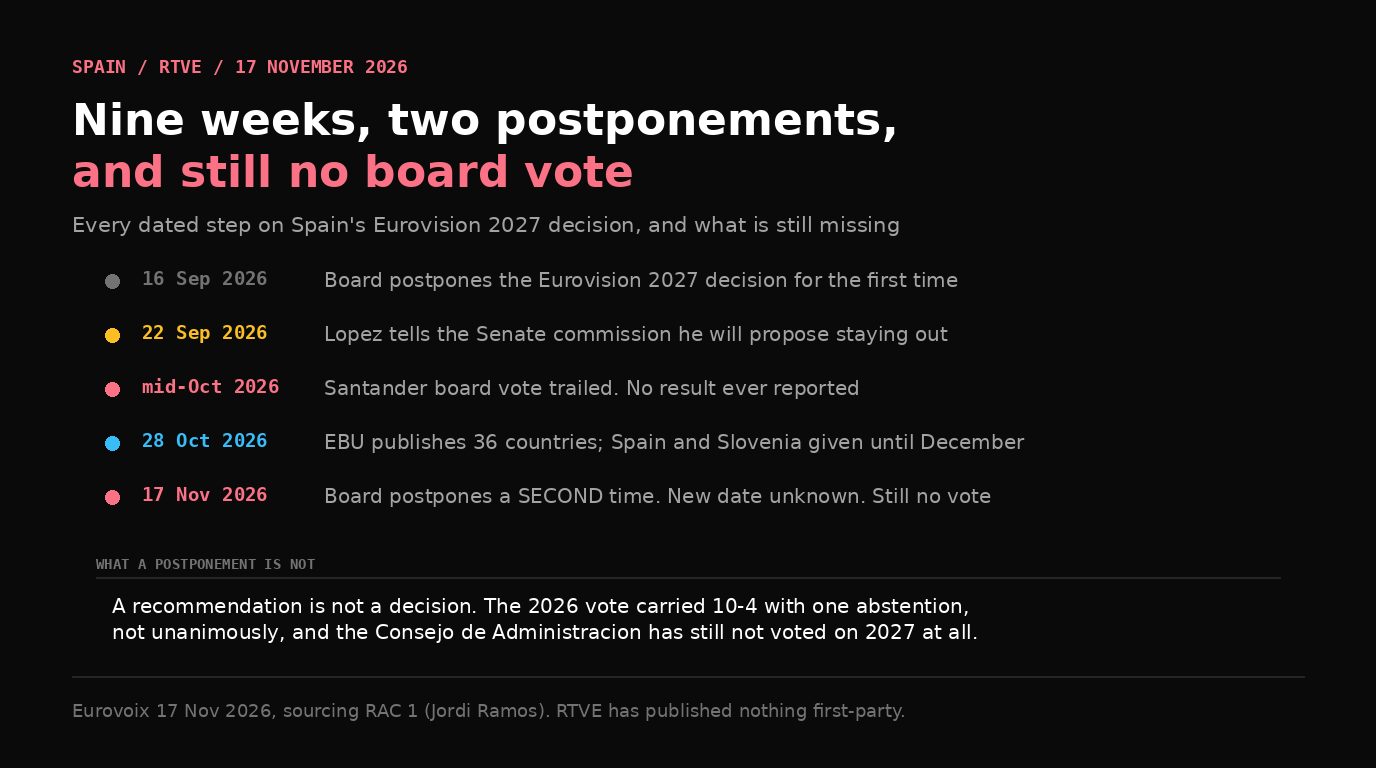
RTVE’s Board of Directors has postponed its decision on whether Spain will compete at the Eurovision Song Contest 2027 for a second time, leaving the broadcaster without a formal position roughly nine weeks after the vote was first trailed. Eurovoix reported the delay on 17 November 2026, sourcing the Catalan radio station RAC 1 and its reporter Jordi Ramos. No new date has been set — the next meeting at which the item will be taken is, in Eurovoix’s own word, unknown.

18+ | New customers only | T&Cs apply | Please gamble responsibly
This is the second recorded postponement. The first was on 16 September 2026. Between the two sits a presidential recommendation, an EBU participant list that was published without Spain on it, and a December deadline that has not moved. What there is still no sign of is a vote.
What was actually postponed, and what was not
The distinction matters more here than it usually would, because the two things are regularly reported as though they were one. José Pablo López, the president of RTVE, has a stated position. He gave it to the Senate’s joint parliamentary commission for RTVE oversight on 22 September 2026, in terms that left no ambiguity: “Voy a proponer al Consejo de Administración de RTVE mantener la suspensión de nuestra participación en Eurovisión para la edición de 2027.” He will propose that the suspension of Spain’s participation be maintained for the 2027 edition.
The Consejo de Administración — the board — has not voted on that proposal. A president’s recommendation is an input to a decision, not the decision. It is worth remembering how the equivalent vote went the last time it was actually held: the 2026 withdrawal carried by 10 votes to 4 with one abstention. That is a clear majority and it is also not unanimity, which means the outcome was decided by a body capable of disagreeing with itself rather than rubber-stamping a line handed to it.
So the honest summary of Spain’s position on 17 November 2026 is this: the president has said what he will propose, the board has twice declined to take the proposal, and nobody has recorded a vote either way. Anyone writing that Spain “has withdrawn” from Eurovision 2027 is running ahead of the record, and anyone writing that Spain is “returning” is running ahead of it in the other direction.
The nine weeks, step by dated step
Laid out in order, the sequence shows how little has actually been decided:
- 16 September 2026 — the board postpones the Eurovision 2027 decision for the first time.
- 22 September 2026 — López tells the Senate commission he will propose that the suspension continue, citing the EBU’s governance reforms as insufficient and describing “a clear ethical shortcoming” that rules out what he called a complacent assessment.
- Mid-October 2026 — a board meeting in Santander is trailed as the one that will settle it. No result is ever reported. Eurovision 2027 was reported as being off the agenda for the 15 October meeting.
- 14 October 2026 — RTVE names eighteen acts for Benidorm Fest 2027, a festival that also ran in 2026 with no Eurovision ticket attached to it.
- 28 October 2026 — the EBU publishes its official participant list for Burgas. It names 36 countries, does not include Spain, and states that RTVE and Slovenia’s RTVSLO have until December to decide.
- 17 November 2026 — the board postpones a second time. New date unknown.
One small forecasting note, recorded here because this site published the prediction and should be held to it. Yesterday our Eurovision Asia hub carried a line saying that one report placed the board’s next discussion of Eurovision 2027 on 17 November, and that we had not been able to confirm it against RTVE itself, so we were treating it as unconfirmed. That date has now proved right about the meeting and wrong about the consequence. The item was reached and deferred, not decided. A confirmed meeting date tells you when a decision could happen; it tells you nothing about whether it will.
Why the December deadline is the number that matters
The EBU’s 28 October statement is the only hard boundary anyone has published. It gave RTVE and RTVSLO until December — not a named day, but a month — and it did so while publishing a field that already stood at 36 without them. That framing is deliberate and it is worth reading twice. The contest is not waiting on Spain; a list exists, Burgas has a line-up, and two broadcasters have been left a window to join it.
If both took it, the field reaches 38. If neither does, Burgas runs with 36, which would still be a larger field than the 2026 contest in Vienna managed after five broadcasters boycotted it. Spain’s absence would also be its second consecutive one, and Spain is a Big Five member whose place is not contingent on qualifying — which is precisely why its absence is conspicuous rather than routine.
There is a governance wrinkle underneath all of this that we have flagged before and that the second postponement makes sharper. The EBU’s Reference Group, the steering committee that runs the contest, is chaired by RTVE’s own Ana María Bordas. She continues in that role although Spain did not compete in 2026 and has not settled 2027. The committee that governs the contest is therefore chaired by a broadcaster that has twice declined to say whether it will enter it.
What the betting market did with the news
Spain’s participation is one of only two Eurovision contracts still open anywhere. Polymarket’s Eurovision 2027 Participants event is the single live Eurovision market on either prediction-market venue following the settlement of all six Eurovision Asia books and the closure of Kalshi’s eleven-country Asia board. Twelve of its fourteen contracts resolved on 28 October, when the EBU list made participation a published fact. Spain and Slovenia are what is left.
Read at 17:06 UTC on 17 November 2026, the Spain contract is quoted 6.1c bid against 13.6c offered, a midpoint of about 9.85%, with the last trade stale below the midpoint at 7.3c. It carries roughly $13.63K of lifetime volume and about $818 of resting liquidity. Polymarket’s own one-day price change for the contract is +2.25 points.
Resist the obvious reading of that. A book quoted 7.5 cents wide on eight hundred dollars of depth, whose last actual trade sits below its own midpoint, has not delivered a verdict on anything. The midpoint is the average of a bid and an offer, and both of those can move without a single contract changing hands. What the day produced was a deferral, and a deferral is the one outcome that leaves a participation contract exactly where it was. It does not resolve. It does not expire. It keeps the question open and pushes it closer to a deadline, which is a reason for quotes to widen and drift rather than for anyone to take a view.
Over a longer window the picture is flatter than the day suggests: the contract is down about 8.05 points over a month. The sequence before that was wilder still and is worth keeping in mind as a caution about this book’s depth — Spain printed 37.4% at 21:00 UTC on 30 October on no announcement at all, halved back within two hours, and drifted to 14.2% by the following afternoon. We said at the time that the move was order flow rather than information, and nothing published since has contradicted that.
The companion contract is the more interesting one today. Slovenia is quoted 12.7c against 20.0c for a midpoint of about 16.35%, last trade 13.0c, on roughly $15.43K of lifetime volume — which makes it the heavier of the two books, overtaking Spain. Its step up from about 11.2% on 15 November to about 16.5% on 16 November has held rather than unwound, which is unusual for this contract: its previous bounces reversed inside a day. RTVSLO has published nothing about Burgas since 22 September, now fifty-six days, and the thing that would actually settle the row — the broadcaster’s 2027 Programming and Production Plan — has not appeared.
If you want the current state of the contest in full, our Eurovision 2027 page carries every confirmed broadcaster, every selection date announced so far and the full pending table. The historical prices and the resolved contracts are on the winner odds page, and the venue comparison is on our bookmakers page.
One inconsistency in the reporting, flagged rather than resolved
The Eurovoix report of 17 November states that RTVSLO, RTVE and Iceland’s RÚV have not yet stated their positions. That is not how this site has RÚV recorded, and we think the record is against it. The EBU’s own 28 October participant list stated that of the five broadcasters that boycotted in 2026, Iceland, Ireland and the Netherlands will not return in 2027, and named only Spain and Slovenia as undecided. RÚV’s board had met on 30 September and six of its nine members backed continuing the boycott unless Israel were excluded.
We are not going to quietly pick the version we prefer. The EBU list is a first-party document and the Eurovoix line is a summary clause in an article about Spain, so we weight the former, and our 2027 tables have Iceland as out. But the disagreement is real and it is the kind that propagates: a single loose sentence in a widely syndicated report is how a settled fact becomes contested again two weeks later.
What would actually change this
Three things, in rough order of likelihood. A board meeting that reaches a vote — which needs only a date, and the absence of one is now the story. A first-party RTVE statement, of which there has been none throughout: everything above is reported, from the Senate transcript, RAC 1, and the EBU. Or the December window closing without either broadcaster moving, which would make Burgas a 36-country contest by default rather than by decision.
Until one of those happens, the position is unchanged and should be described as unchanged. Two postponements are not a withdrawal, a recommendation is not a vote, and a nine-week silence on a board result is not evidence of what the board will do when it finally gets to it. For the rest of the 2027 picture — the 36 confirmed countries, the national finals now under way and the two rows still open — see our full Eurovision 2027 tracker, and for the contest that just finished, our Eurovision Asia hub.
Sources
- Eurovoix, 17 November 2026 — RTVE Board of Directors further postpones the Eurovision 2027 decision (sourcing RAC 1 / Jordi Ramos)
- Eurovoix, 16 September 2026 — the first postponement
- Polymarket Gamma API,
eurovision-2027-participants, read 17:06 UTC 17 November 2026. The event exposes no 24-hour volume field; the one-day change quoted above is Polymarket’s ownoneDayPriceChange.