
The Eurovision 2026 Grand Final on Saturday 16 May produced Bulgaria's record 173-point winning margin. Three days later, on Monday 19 May 2026, it also produced its first national-broadcaster leadership resignation: Vlad Țurcanu, Director General of Moldova's public broadcaster Teleradio-Moldova (TRM), formally stepped down after the Moldovan Eurovision jury's vote triggered a national outcry.

18+ | New customers only | T&Cs apply | Please gamble responsibly
The pattern of the scandal is unusually specific. The Moldovan public — Moldova's televoters — overwhelmingly backed the country's two cultural neighbours: Romania (12 points) and Ukraine (10 points). The Moldovan professional jury did the opposite. They awarded their 12 points to Poland, 10 to Israel, only 3 points to Romania, and zero points to Ukraine. The 9-point gap between Moldova's jury and televote on Romania alone, and the 10-point gap on Ukraine, sparked an immediate diplomatic and media crisis.
Betfred — Bet £10 Get £50 in Free Bets on Eurovision 2027
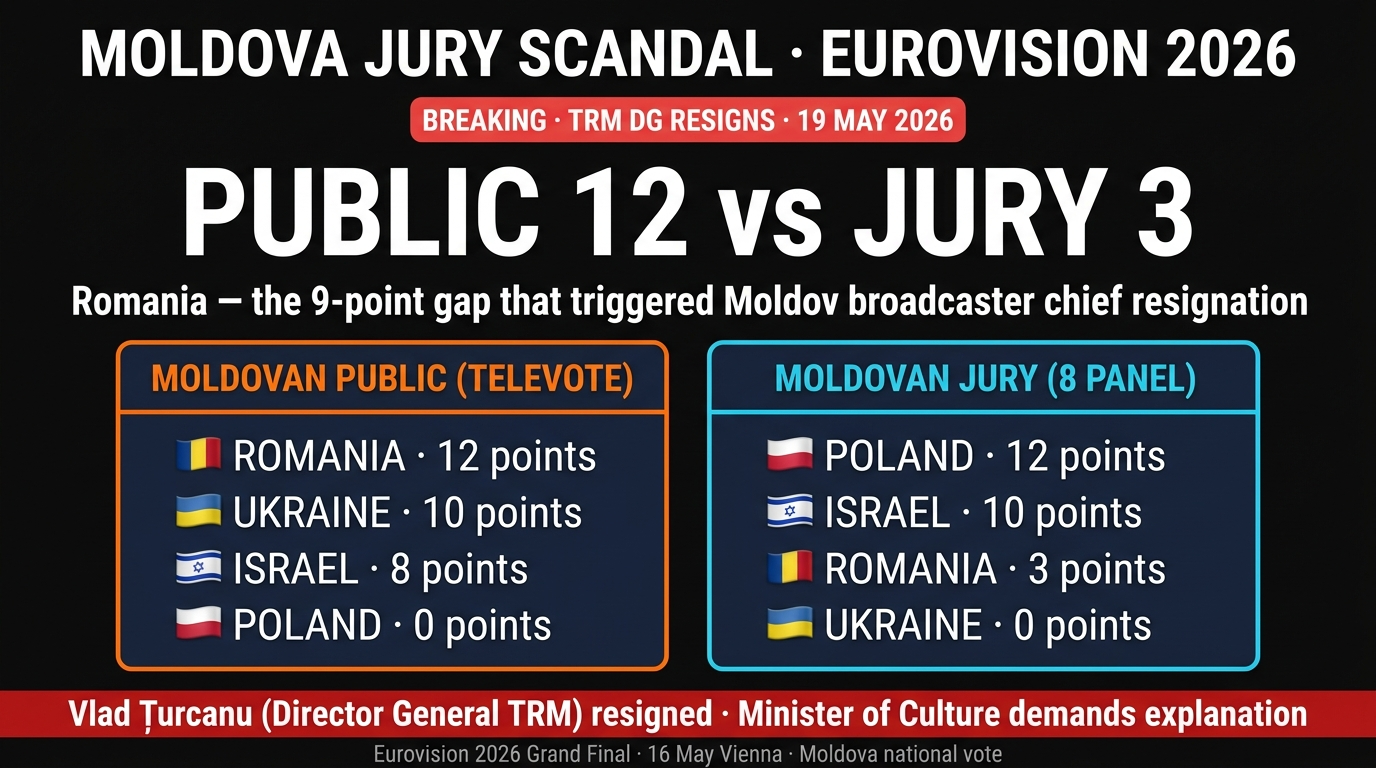
Moldova's Eurovision 2026 vote: jury vs public
| Receiving country | Moldovan public (televote) | Moldovan jury | Gap |
|---|---|---|---|
| 🇵🇱 Poland | 0 | 12 | +12 to jury |
| 🇷🇴 Romania | 12 | 3 | +9 to public |
| 🇺🇦 Ukraine | 10 | 0 | +10 to public |
| 🇮🇱 Israel | 8 | 10 | +2 to jury |
The Romanian–Moldovan cultural relationship is particularly close (the two countries share Romanian language and historic ties — Moldova was part of Romania until 1940). Ukraine, Moldova's eastern neighbour, has been at the centre of the regional security picture since 2022. The Moldovan public expressed both attachments through the televote in the obvious way. The jury did not.
The 8 Moldovan jurors and their individual rankings of Romania
Per the breakdown released by the EBU and detailed by Eurovoix on 17 May, here is how each of Moldova's 8 jury members ranked Romania's entry "Choke Me" by Alexandra Căpitănescu:
| Juror | Background | Rank for Romania (of 25) |
|---|---|---|
| Andrei Zapșa | Conductor; Deputy GM (TV) at TRM | 4th |
| Corina Caireac | Audiovisual production / artist mgmt | 9th |
| Juror 3 | — | 12th |
| Juror 4 | — | 16th |
| Juror 5 | — | 15th |
| Juror 6 | — | 3rd |
| Juror 7 | — | 7th |
| Juror 8 | — | 8th |
Only one juror (juror 6) ranked Romania inside their personal top 3. Three jurors (3, 4 and 5) ranked Romania outside their personal top 10 — meaning they assigned Romania zero points individually. The combined average of the 8 individual rankings produced 3 final points for Romania, the lowest rank Moldova has ever given Romania in a Eurovision Grand Final since the 50/50 split-vote era began in 2016.
Four of the eight Moldovan jurors ranked Poland as their personal favourite, giving Poland the country's full 12 points — a pattern that the Moldovan media and public have collectively struggled to explain.
Vlad Țurcanu's resignation statement, in full
Per UA News reporting on 19 May, the outgoing Director General said:
"I avoided giving instructions to the jury members, and what happened is an extraordinary event. In our view, the jury failed to take into account the sensitive issues that exist between the Republic of Moldova and our neighbors — Romania and Ukraine. The fraternal relations that the Republic of Moldova has with Romania, as well as our gratitude and respect for Ukraine for its daily sacrifices, remain unchanged. Our attitude toward Ukraine is not neutral, and our feelings toward Romania can only be love."
Țurcanu said he would submit a formal resignation letter to the TRM supervisory board. He will continue performing his duties until a successor is appointed. His deputies — including Andrei Zapșa, who served on the Eurovision 2026 jury — are also expected to step down.
The political escalation
Within hours of the Grand Final's voting reveal, three escalation tiers stacked up inside Moldova:
- The TRM spokesperson tried to refuse to announce the scores on air. Margarita Druță, the blogger who delivered Moldova's voting reveal during the live Grand Final broadcast, said on TikTok afterwards that she was shocked by the jury's choices and considered refusing to read the results live, but was ultimately pressured to go ahead.
- Moldova's Minister of Culture demanded an explanation. Cristian Jardan — Moldova's Minister of Culture — publicly stated that the ministry expects a detailed report from TRM and the jury members on how this voting outcome was produced.
- Juror Victoria Cușnir gave a partial public defence. She said the scores were assigned during the rehearsal phase, before the live Grand Final performance, and that "Romania's performance during rehearsals was weaker than in the final." She maintained she personally gave Romania a "fairly high score."
None of these explanations fully reconcile the data. Eurovision's published voting rules require juries to assess the live jury show (held on Friday evening, the day before the public Grand Final), not the rehearsals. The jury show is performed under stage conditions identical to the Grand Final's. Cușnir's rehearsal claim — if accurate — would imply the entire 8-person Moldovan jury panel scored on the wrong show, which is a separate compliance issue with the EBU.
Satoshi's reaction
Moldova's Eurovision 2026 representative — Satoshi, who finished 8th with "Viva, Moldova!" and collected 226 total points (183 televote + 43 jury) — publicly addressed Romanian fans the morning after the Grand Final on Instagram:
"Dear Romanians, thank you for your support and kindness! Viewers from the Republic of Moldova gave Romania the maximum score. This is honest public opinion."
Romania awarded Satoshi 12 points from both its jury and its televote — a perfect 24-point return from Bucharest. The same symmetry was conspicuously absent from Moldova's reciprocal vote.
How rare is a jury-public divergence of this magnitude?
Within the 50/50 voting era (since 2016), it is structurally normal for juries and publics to disagree — that is, after all, the design intention. But the size of a single-country divergence on a single receiving entry is bounded by the 12-point cap. A 9-point divergence (12 vs 3) on one neighbour, plus a 10-point divergence (10 vs 0) on a second neighbour, from the same voting country in the same Grand Final, is at the upper edge of what the system can produce.
The most directly comparable Eurovision precedent is the 2019 Belarus case. The Belarusian state broadcaster BTRC's national jury was disqualified by the EBU after pre-results information from semi-final jury votes was disclosed publicly — the EBU substituted a results-based ranking from comparable countries to fill the vacated jury role. That was the modern era's strongest top-down EBU intervention into a national jury's process. Moldova 2026 is not currently sitting at that level — the EBU has not (so far) disqualified the Moldovan jury panel — but the broadcaster's own leadership resignation is unprecedented in the modern contest.
What this means for Eurovision 2027 in Sofia
Three structural implications for the 2027 contest in Sofia:
- Jury composition transparency is likely to tighten. Moldova's public outrage has focused not just on the vote itself but on the perceived opacity of the jury-selection process (one juror was the Deputy Director General of the broadcaster itself — a built-in conflict of interest some Moldovan critics have flagged). The EBU may issue a revised Conflict of Interest annex for 2027 national juries.
- Public reveal-show production becomes more scripted. Margarita Druță's near-refusal to announce the scores live created a separate broadcast risk for the EBU — a national reveal hostage to spokesperson conscience. Future contests are likely to mandate written confirmation that the on-air spokesperson will deliver the jury result without prior amendment.
- The 50/50 split is now under fresh scrutiny. Two consecutive years of contests where the jury and public diverged sharply (2025 saw similar national disagreements on Israel; 2026 has now produced a resignation) is the strongest political pressure the EBU has faced on the voting structure since the 2009 jury reintroduction.
The bookmaker angle for 2027
The Moldovan jury scandal also illustrates a structural pricing issue for the Eurovision outright market. UK bookmakers price markets primarily on jury-side rehearsal-day signals (the Friday jury show), but in years where a national jury's behaviour deviates sharply from its public's expected behaviour, downstream effects on neighbour-country televote totals can compound. Romania, which had been priced at 20.0 outright pre-final and finished 3rd, would likely have finished 2nd had Moldova's jury awarded the expected 12 (which would have added 9 jury points to Romania's total). Israel finished 2nd on 343 points; Romania finished 3rd on 296 — a 47-point gap that Moldova's jury contributed 9 points towards reversing.
For 2027, the lesson is sharp: pricing a podium forecast accurately requires modelling not just each entry's jury appeal in absolute terms, but the political-geographic relationships between each entry and each of the 35 jury panels.
Related
- Jury vs televote — the 7 biggest 2026 splits
- Bulgaria's 173-point margin — biggest in 50/50 era
- East + Balkans take half of top 10
18+. Please gamble responsibly. BeGambleAware.org. GAMSTOP. When the fun stops, stop.