
Disclosure: eurovisionodds.org has a commercial interest in Undetectr, which is
recommended in this article. DistroKid is also recommended below; we have no commercial
relationship with them. Where a claim about our own tooling can't be substantiated, we say
so rather than working around it — there is one such place in this piece.
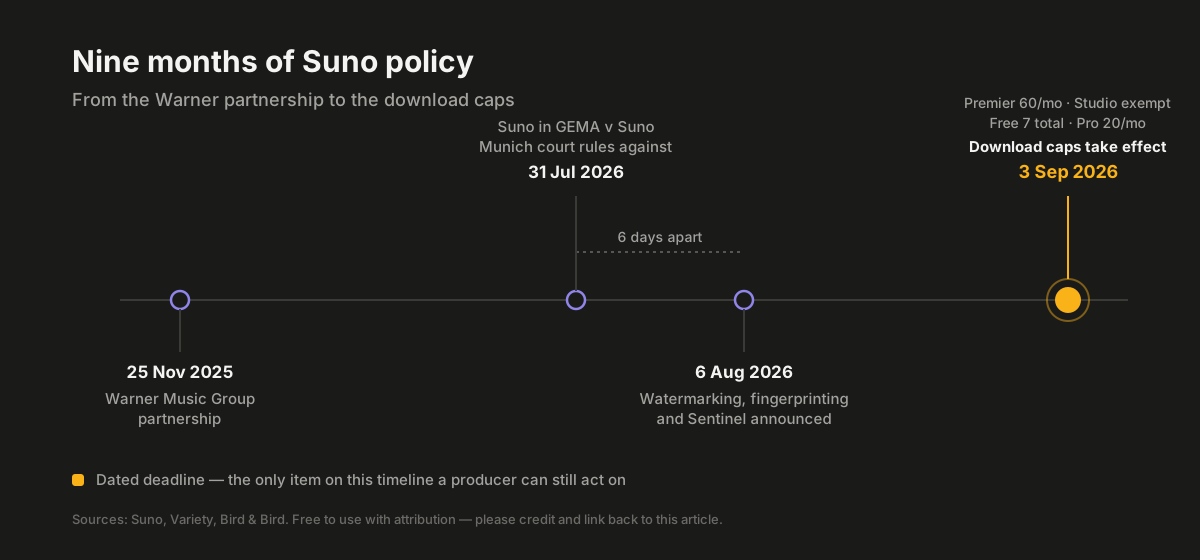
On 6 August 2026 Suno said it will embed audio watermarking and fingerprinting into every track its platform generates, and integrate Musixmatch's Sentinel detection system. The announcement lands six days after a Munich court ruled against the company. For anyone releasing AI-assisted music, it changes what a Suno export contains.

18+ | New customers only | T&Cs apply | Please gamble responsibly
### There is one thing here you can act on today, and it has a deadline
>
Most of this announcement is unshipped and unmeasured — nobody can tell you yet what the
watermark does or how distributors will read it. The download caps are different. They
land on 3 September 2026, and after that a free account can pull seven tracks in total,
ever. If you have a Suno library you have not exported, that is the one move on this page
with a clock attached.
>
Undetectr's bulk Suno downloader pulls an entire library in a
single pass instead of track by track — which is the difference between finishing before
the deadline and not.
>
Export your Suno catalogue → · from $19 · $39 lifetime
>
Skeptical of a recommendation on a page that stands to benefit from it? Good — read
what we can't tell you further down before you decide.

Key takeaways
- Suno announced watermarking and fingerprinting on 6 August 2026, in a blog post by CEO Mikey Shulman, alongside integration of Musixmatch's Sentinel
- Suno is Sentinel's first customer, and Sentinel screens the prompt, not only the finished track
- The Munich District Court ruled against Suno on 31 July 2026, applying US copyright law to the training acts and rejecting the fair-use defence across four prohibited acts
- Download caps arrive 3 September 2026: 7 total on free, 20 a month on Pro at $8, 60 a month on Premier at $24. Suno Studio is exempt
- A watermark and a generation artifact are different things. No public tool decodes a Suno watermark, because it has not shipped
- No processing tool has been tested against Suno's new watermark, including ours. Any vendor claiming otherwise would be describing something nobody can currently verify
An announcement with a specific date behind it
On 6 August 2026, Suno chief executive Mikey Shulman published a company blog post titled "How We're Building the Future of Music Responsibly." In it, Suno said it will begin marking every track generated on the platform with audio watermarking and fingerprinting, and will integrate Sentinel, the copyright detection system built by Musixmatch.
Shulman described the marking as durable and resistant to tampering, and said it is designed not to change how a song sounds. TechCrunch reported the announcement the same day against the company's legal position. Engadget focused on the practical outcome: songs generated on Suno become identifiable elsewhere, particularly when someone uploads them to a streaming service.
Two further elements arrived alongside the watermark. Suno updated its community guidelines to prohibit scams, spam, fake engagement, presenting deceptive audio as authentic, recreations of existing songs, and use of copyrighted material or a real person's voice without permission. And the company confirmed download caps, reported exclusively by Variety, taking effect on 3 September 2026.
For producers, that date matters more than the announcement itself.
What Suno actually announced
Three distinct changes, worth separating because they operate differently.
Watermarking and fingerprinting. Every generated track will carry an embedded signal identifying it as Suno-generated. Suno has not published the technical method, has not released detection benchmarks, and has not said whether an external detection tool will be made available. Press coverage has compared the approach in principle to Google's SynthID, but that comparison comes from reporters, not from Suno's documentation.
Musixmatch Sentinel integration. This is the detail most early coverage buried, and it is the most consequential. Suno is Sentinel's first customer. Sentinel runs against Musixmatch's proprietary database — used by more than 250,000 rights-holders across 250-plus languages — and returns matches at millisecond latency. Two properties matter. It screens the prompt, not only the output, catching copyrighted lyrics at any stage of generation. And it detects partial use, not just whole-work copying.
Download caps, from 3 September 2026. Free accounts drop to seven downloads in total — not per month. Pro at $8 a month is limited to 20 downloads a month. Premier at $24 a month gets 60. Premier subscribers working in Suno Studio are exempt, and additional downloads can be bought. Songs downloaded on paid plans remain yours to use commercially.
Seven downloads in total is not a workflow — it is an archive you can no longer reach.
If your catalogue sits on a free or Pro plan, the export window shuts on 3 September.
Pull the whole library in one pass →
Suno has framed this as responsible platform stewardship rather than restriction, and that framing is reasonable on its own terms. The industry has spent two years complaining about untraceable AI audio flooding streaming catalogues. This is a direct answer to that complaint, and specifically to the mass-generate-and-bot-play royalty fraud that has been the loudest version of it.
Why this is a bigger shift than previous policy moves
Previous AI-music policy changes were mostly about what platforms would accept. This one changes what the file itself contains, which is a different category of change.
It also arrives in a specific legal context. On 31 July 2026 — six days before the announcement — the Munich District Court decided GEMA v Suno. The court largely upheld the German collecting society's claims across six compositions, prohibiting four separate acts: reproduction for training purposes in the United States, reproduction through memorisation within the model in Germany, communication to the public through offering the model, and reproduction and communication through the outputs.
Two findings travel further than the result. The court applied US copyright law to the training acts and rejected the fair-use defence — a US-law analysis reaching a US-unfavourable conclusion, in a German court. And it held that the burden of disproving market harm lay with Suno rather than with GEMA. Suno was ordered to disclose the scale of its use and found liable in damages.
The judgment is not final. An appeal is widely expected, likely focused on the extraterritorial limb, the memorisation standard, and the 176 prompts at issue.
That sits on top of an already complicated position. Suno announced a partnership with Warner Music Group on 25 November 2025, moving from defendant to licensed partner with one of the three majors. Universal and Sony have continued to litigate.
Read together: a company under pressure from several directions at once, choosing to make its output traceable. Whether that is principled or defensive is a question for commentators. The effect on a producer's workflow is the same either way.
The distinction that governs everything else
Most confusion in this topic comes from treating three different mechanisms as one thing.
A watermark is a signal deliberately embedded by the generator, designed to be inaudible, robust to processing, and decodable by whoever holds the key. Suno's new marking belongs in this category.
A generation artifact is an incidental statistical byproduct of how a model synthesises audio. Nobody added it on purpose. It cannot be decoded, only inferred statistically.
A classifier is what distributors currently run at upload. It reads artifacts and returns a probability that a track was machine-generated. It does not decode watermarks, and it does not know what tool made the file.
That distinction matters right now for one reason: the screening that currently flags AI tracks at distributors is classifier-based, and it is a separate system from the watermark Suno is adding. Adding a watermark does not automatically change how a classifier behaves, because the classifier was never reading the watermark.
Two tiers of detection
Underneath that sits a split that explains almost every confused conversation about AI music detection.
Compositional detection is what most free AI checkers run. It analyses melody, harmonic progression, structural repetition and vocal style, then estimates whether the music sounds machine-made. It is a musicological judgement rendered as a score, and it is the tier that produces the most false positives — plenty of human music is harmonically simple and structurally repetitive.
Signal-level detection ignores the music entirely and reads the physics of the file: spectral characteristics of the synthesis process, phase entropy, micro-timing distributions, and any embedded manifest or provenance tag in the container.
The consequence is the single most useful thing to understand here. A track can sound completely human and still fail signal-level screening, and it can sound obviously synthetic and still pass. The two tiers are not measuring the same thing — which is why scores from free online checkers correlate so weakly with what distributors actually do.
Suno's new watermark lands in the signal tier. So does the artifact layer that distributor classifiers already read. That they share a tier is why they get confused. That they remain distinct systems is why the confusion is expensive.

What actually changes for independent producers
Detection becomes a lookup rather than an inference. Today a distributor's classifier scans an upload and returns a probability. If partner platforms begin querying a Sentinel-style match instead of, or alongside, a probabilistic classifier, the check changes character. A probability is arguable. A database match is not.
Retroactive catalogue exposure. The precedent exists: Spotify removed more than 75 million tracks in the twelve months before its September 2025 policy announcement, targeting spam and mass uploads. A durable provenance marker makes any future sweep considerably easier to execute at scale.
Content ID uncertainty. YouTube monetisation depends on Content ID behaving predictably. Introducing a new identification layer creates genuine uncertainty about how claims and matches will interact with AI-generated audio.
Flagged is not the same as rejected. Deezer already tags AI-generated tracks and excludes them from algorithmic recommendation, which leaves a release technically live but commercially inert.
Older tracks are an open question. Suno has not said whether previously generated material will be marked retroactively, and no reporting has confirmed it either way. That silence is itself a planning problem.
Retroactive marking is the open question that makes archiving urgent right now. Suno
has not said whether tracks you already generated will be marked when the system ships. A
local copy of your catalogue, made before 3 September, is the only part of that question
you control. Bulk-export your Suno library →
The one thing we can't tell you
Undetectr is a signal-level audio processing tool. The obvious commercial move here is to tell you it handles Suno's new watermark, and to sell you a subscription on the strength of that. We can't, for a simple reason: the watermark has not shipped. There is nothing to test against. No tool on the market has been measured against it, and any vendor telling you otherwise between now and the rollout is selling a claim they cannot support.
We'd extend that to a general filter for the next few weeks. Suno has not published the watermark's technical specification. No distributor has stated how it will treat the signal. Nobody outside Suno and Musixmatch currently knows how the two systems interact. Any product page that speaks confidently into that gap is describing a product nobody has been able to evaluate.
When the watermark is live and testable, we will publish measured results — including results that go against us.
What producers should do now
Four steps, in order of how much difference they make.
1. Export what already exists, before 3 September
The download caps are the concrete, dated change in this announcement. A producer with a large Suno library on a free or Pro account will find bulk export materially harder afterwards — seven downloads in total on free is not a workflow, it is an archive you can no longer reach. Retrieving your own generations under current terms is ordinary account housekeeping, and the window closes on a published date.
Undetectr's bulk Suno playlist downloader pulls an entire library in one pass rather than track by track, which is the difference between finishing before 3 September and not. It runs against your own account and your own generations, under the terms in force today.
Export your Suno catalogue before the caps land →
from $19 · $39 lifetime, bulk downloader included
2. Keep provenance records
Prompt, generation date, plan tier, receipts, download timestamps. If a platform later queries a release, documentation resolves it quickly and nothing else does. This has always been good practice. It is about to become considerably more valuable, particularly if retroactive marking turns out to be on the table.
3. Disclose, and pick a distributor whose rules you can actually meet
Suno's updated guidelines now explicitly prohibit presenting AI audio as authentic, and distributor disclosure frameworks are tightening in the same direction. The producers who come out of this period cleanly will be the ones whose releases were labelled correctly from the start — not the ones who spent it trying to stay ahead of a screening system that is about to be replaced with a database lookup.
4. Wait for measurement before believing watermark claims
Including ours. See above.
The distribution angle
Where a track is distributed shapes how much of this uncertainty a producer absorbs.
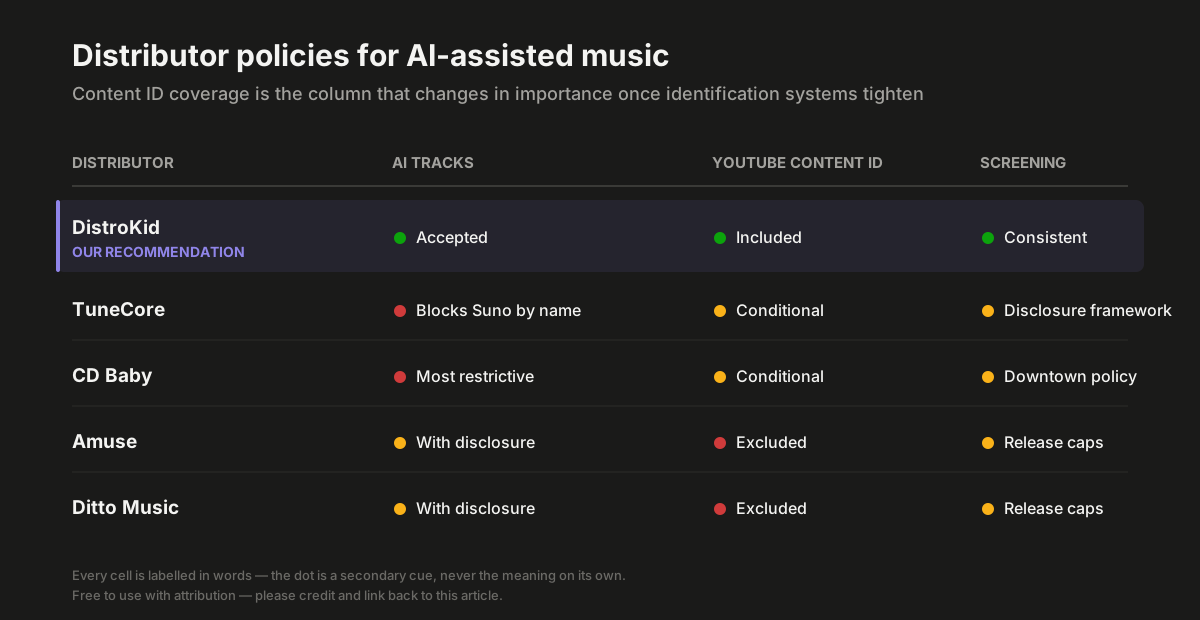
DistroKid is the distributor most consistently recommended for producers releasing AI-assisted music, for three practical reasons.
Consistent screening behaviour. A predictable gate is easier to prepare for than an unpredictable one, and predictability is what lets you build a repeatable release process rather than guessing each time.
Full platform reach. Spotify, Apple Music, Amazon Music, YouTube Music, Tidal and the other major services, in one submission.
YouTube Content ID coverage is included — which matters more than usual in a period when identification systems are changing, because it keeps you inside the formal claims process rather than outside it.
The alternatives differ in ways that matter under changing identification rules. TuneCore operates a disclosure framework and blocks Suno-generated tracks by name at upload. CD Baby, under Downtown Music's content policy, is the most restrictive of the majors. Amuse and Ditto both accept AI music with disclosure but apply release caps and exclude AI tracks from Content ID — removing exactly the protection that matters most right now.
What is still unknown
Worth stating explicitly, because the gaps matter as much as the confirmed facts.
Suno has not published the technical specification of the watermark. No distributor has said how it will treat the signal. Whether existing catalogue will be marked retroactively is unconfirmed. Whether a public detection tool ships at all is unstated. And the GEMA judgment is under appeal, which means the legal backdrop driving these decisions is not settled either.
This page will be updated as those questions are answered with evidence rather than speculation.
### One dated deadline, one open question
>
The caps have a date on them and the watermark does not. That asymmetry is the whole
practical story: act on the part that is scheduled, and wait for measurement on the part
that is not. We will publish numbers on the watermark when there are numbers to publish.
>
Get your catalogue out before 3 September →
from $19 · $39 lifetime, bulk downloader included
Sources
- Suno — An update to our downloads policy and Terms of Service
- Suno Help — Upcoming Changes FAQ: Downloads, Models, and Terms of Service
- TechCrunch — Amid legal battles, Suno says it will start watermarking songs
- Engadget — Suno is adding audio watermarks so AI-generated songs are more easily identifiable
- Variety — Suno Unveils Download Caps for Free, Paid Tiers (EXCLUSIVE)
- Music Business Worldwide — Suno becomes first customer of Musixmatch's Sentinel
- Music Ally — Musixmatch's first customer for its fingerprinting and detection tech is Suno
- Bird & Bird — Munich District Court Rules on AI-generated music: GEMA v Suno
- Variety — Suno Loses Landmark AI Lawsuit to German Performing Rights Society GEMA
- Digital Music News — Suno Announces Sweeping Download and Labeling Changes