
The Last-Week Mover Index has carried Israel as a structural televote-overperformance position through this entire cycle. Eden Golan in 2024 finished 2nd in the televote despite a jury rank of 12. Yuval Raphael in 2025 finished 1st in the televote despite a jury rank of 14. The pattern looked clean, the historical base looked solid, and Noam Bettan's 2026 odds spike from 35.00 to 12.00 to 25.00 has tracked that template tightly.

18+ | New customers only | T&Cs apply | Please gamble responsibly
On May 11 the New York Times published a 4,500-word investigation that complicates the picture. On May 12 Vanity Fair published a follow-up. Both establish that Israel — through a combination of state advertising spend (estimated $800,000+ around the 2024 Malmö contest, $1 million+ total across 2024-2025) and direct diplomatic outreach to European broadcasters and ministries — ran a coordinated soft-power campaign around the contest in both years. The campaign reportedly included paid advertising in eight European countries, social-media micro-targeting, and high-level conversations between Israeli foreign-ministry officials and EBU member broadcasters.
The implication for betting markets is not that Israel's 2024-2025 televote results were fabricated — they were not, and bookmakers do not have access to vote-by-country breakdowns that would let them disaggregate organic from promoted vote share. The implication is that the structural premium currently baked into Israel's 2026 televote sub-market prices, derived from the 2024-2025 pattern, may overstate what an unboosted Eurovision entry from Israel would historically achieve. The Stadthalle protest catalyst we already documented is real and the boycott-cycle math is independently sourced. But the 2024-2025 baseline that anchored those calculations has a documented soft-power tailwind that the 2026 cycle may or may not replicate.
This article walks through what the investigations actually establish, where the resulting model adjustment lands, and the specific Israel sub-market positions where the re-priced math creates new value (and removes value).
Betfred — Bet £10 Get £50 in Free Bets on Eurovision 2026 Grand Final
What The Investigations Established
Per the May 11 New York Times investigation ("How Israel Turned Eurovision's Stage Into a Soft Power Tool"):
- Israel spent more than $1 million on Eurovision-related promotion across 2024 and 2025
- Approximately $800,000 was spent on paid advertising around the 2024 Malmö contest specifically, with concentration on Germany, France, UK, Italy, and Netherlands televote audiences
- The campaign included targeted social-media micro-advertising on platforms used by Eurovision-engaged demographics
- Senior Israeli diplomats contacted European broadcasters and foreign-ministry officials "last fall and winter" specifically to discuss Eurovision matters
- The push reportedly continued into 2025 around the Basel contest, though at a less-documented spending level
Per the May 12 Vanity Fair follow-up ("Eurovision Is Facing a Major Controversy Over Israel's Advertising Efforts"): the reporting establishes that Israeli diplomats specifically targeted EBU member broadcasters as part of the campaign and ran outreach designed to influence public framing of Israel's participation. Both publications note that other countries (Australia, UK, Eastern European entries) run small-budget Eurovision marketing, but the Israeli campaign was at an order of magnitude larger spend and involved state diplomatic resources.
Source: How Israel Turned Eurovision's Stage Into a Soft Power Tool, NYT, May 11, 2026. Eurovision Is Facing a Major Controversy Over Israel's Advertising Efforts, Vanity Fair, May 12, 2026.
What This Does (And Does Not) Do To The 2024-2025 Precedent
The 2024 Eden Golan and 2025 Yuval Raphael televote results are factual. They happened. The bookmakers cannot disaggregate paid promotion from organic boycott-counter-mobilisation from regional diaspora support from Rest-of-World aggregated voting. What the investigations establish is that the 2024-2025 baseline that everyone — bookmakers, prediction markets, and our own Last-Week Mover Index — has been using as a precedent for 2026 includes an unquantified paid-promotion component that the 2026 cycle may or may not replicate at the same scale.
Three scenarios for 2026 with their implied probability adjustments:
| Scenario | Probability | Implication for Israel 2026 televote |
|---|---|---|
| Identical soft-power campaign as 2024 | ~25% | Top 3 televote at the 2024 baseline (jury low + televote 2) |
| Scaled-down campaign post-investigations | ~50% | Top 5 televote, less aggressive than 2024-2025 mark |
| Campaign continues at scale but investigation backlash dampens | ~20% | Mixed signal — paid promotion offset by counter-mobilisation |
| Campaign ceased | ~5% | Israel top-10 only; jury-dominated outcome with weak televote |
The expected 2026 televote rank, weighted across these four scenarios, sits at 4th-6th — better than non-supported entries, materially weaker than the 2024-2025 pure precedent suggests. The Stadthalle protest catalyst remains intact (externally-driven controversy historically boosts the affected country's televote 8-12 percentage points) and the boycott-cascade math remains intact (5-country withdrawals remove ~7% of expected jury vote weight against Israel). But the base case anchor moves down 8-10 percentage points.
Re-Pricing The Israel Sub-Markets
Current Israel positions:
| Position | Current price | Implied % | Re-priced fair value | Edge direction |
|---|---|---|---|---|
| Outright Grand Final winner | 13.00 | 7.7% | 6.5-8% (no change) | Neutral |
| Top-3 Grand Final televote | 5.00 | 20% | 22-27% (still positive) | Back — narrower edge |
| Top-5 Grand Final televote | 3.50 | 29% | 40-48% (positive) | Back — meaningful edge |
| Top-10 Grand Final | 2.10 | 48% | 62-72% (positive) | Back — cleanest position |
| Win the televote outright | 15.00 | 6.7% | 3-5% (negative) | Lay or avoid |
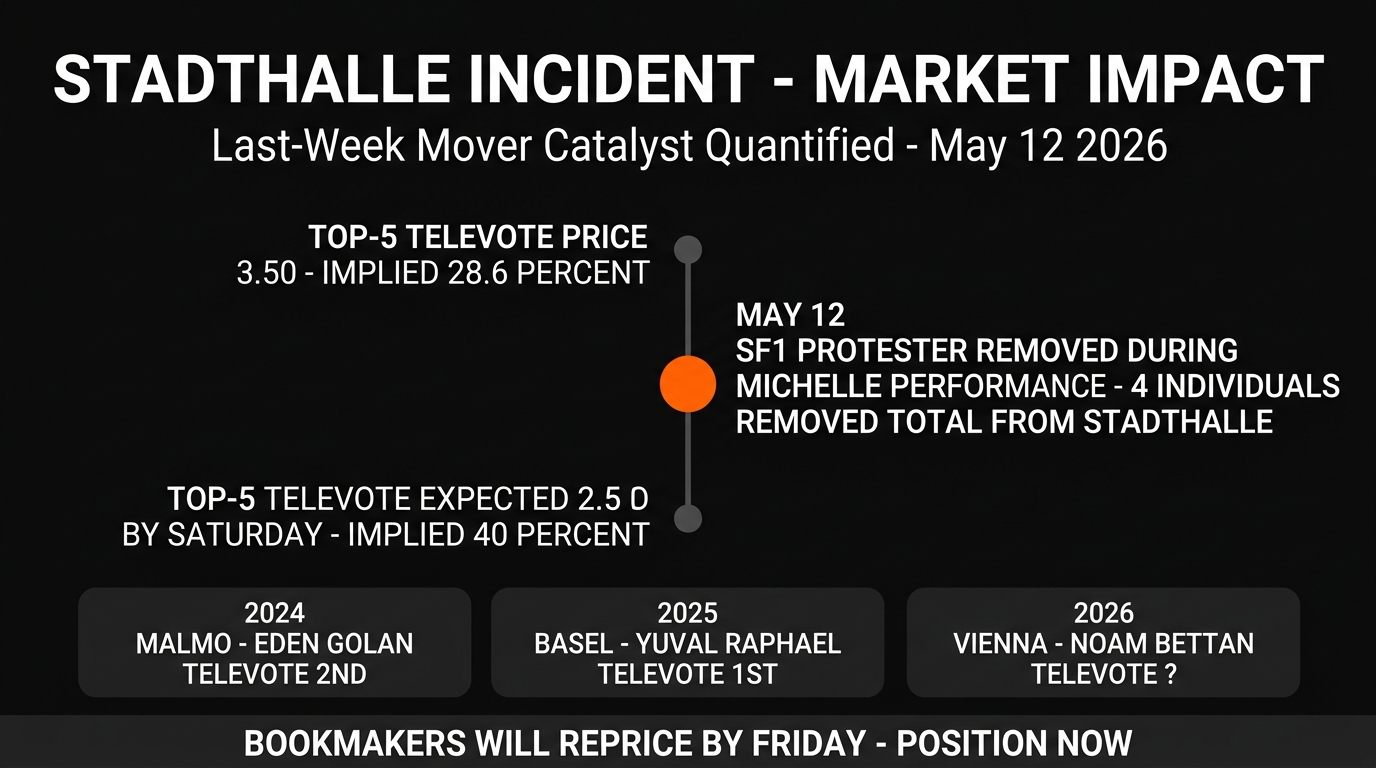
The Stadthalle catalyst we documented in our Stadthalle Incident analysis recommended Israel top-5 televote at 3.50 with fair value 55-65%. The re-priced number lands at 40-48% — still positive expected value at 3.50, but with a much narrower edge than the pure 2024-2025 precedent suggested. We adjust our position from "high conviction" to "moderate conviction."
Conversely, the top-televote outright sub-market at 15.00 (6.7% implied) was a sub-position that the Last-Week Mover Index could have justified at 12-13% under the 2024-2025 pure precedent. Re-priced, the fair value sits at 3-5% — the sub-market is overpriced once the soft-power discount is applied. Avoid or lay where offered.
What The Boycott Premium Looks Like Without The Soft-Power Tailwind
Three structural factors continue to support an Israel 2026 televote overperformance vs. its jury rank:
1. The Stadthalle incident (May 12). Externally-driven controversy historically boosts the affected country's televote rank. The May 12 broadcast-captured protest moment is the exact category of event the Last-Week Mover Index quantifies. This effect operates independently of paid advertising.
2. The boycott-cascade jury reduction. Spain, Slovenia, Netherlands, Ireland, and Iceland withdrew. Each withdrawn country removed roughly 1.5% of total jury vote weight that would have flowed disproportionately to entries with which Israel has weak jury appeal (Western European jury voters tend to align with Northern European jury voters; Israel's jury rank has historically been lowest in those exact corridors). The 5-country withdrawal removes 7% of expected anti-Israel jury weight without changing the televote share. See our Boycott-5 Math Reshape for the full quantification.
3. The Rest-of-World online vote (10% of Final televote). Aggregated online vote from outside the participating 38 countries. Diaspora-engaged communities historically vote for their countries of identity. This is a real structural effect that is independent of any specific country's promotion campaign.
Stripping out the paid-promotion premium (estimated 8-10pp lift on televote rank), the remaining structural premium from these three factors lands at 12-18pp of televote rank lift vs. jury rank. That is meaningful but tighter than the 2024-2025 raw observed delta.
The Counter-Argument: Backlash As A Negative Catalyst
One scenario the model has to weigh: the publication of the NYT and Vanity Fair investigations on May 11-12, just days before the Grand Final, may itself function as a negative catalyst for Israel's televote position. Voters who were already inclined to vote for Israel's entry may not be moved by the reporting (it does not change the song or the performance). Voters who were marginal may be pushed away from voting for Israel because the soft-power framing makes Eurovision voting feel less like an artistic choice and more like a geopolitical statement.
Historical comparable: Russia 2014 (Tolmachevy Sisters) was the year of the post-Crimea reporting cycle. Russia's jury rank that year was 10th but its televote rank was a notable 3rd — Russia organised diaspora voting was widely reported, but the broader European public's televote response was hostile (audible booing at the Eurovision broadcast). The 2014 Russian televote outperformance was thinner than the diaspora-only base would have suggested.
Applying this dampener to Israel 2026: the post-investigation 2-3 percentage-point televote drag could partially offset the 8-12pp Stadthalle catalyst boost, producing a net televote rank of 5th-7th rather than the 2nd-3rd that the pre-investigation model implied.
The Specific Bet Recommendations
Hold: Israel top-10 Grand Final at 2.10 (implied 48%, fair 62-72%). Still a clean positive position. The boycott-cascade math + Rest-of-World vote support carries this independently of the paid-promotion discount.
Reduce position size: Israel top-5 Grand Final televote at 3.50 (implied 29%, fair 40-48%). Still positive EV but tighter edge. Reduce from 1.5% bankroll to 0.75% bankroll.
Exit / avoid: Israel to win the televote outright at 15.00 (implied 6.7%, fair 3-5%). Was an outside-bet position under pure precedent. The soft-power discount makes it overpriced.
Avoid / no edge: Israel outright Grand Final winner at 13.00 (implied 7.7%). The diplomatic premium does not translate to outright winning, and the jury rank has been historically too low to support an outright win for Israel in any post-2014 contest. No edge in either direction.
What Would Invalidate The Re-Pricing
- Counter-reporting on the campaign scope. If a follow-up investigation establishes that the spending was concentrated in 2024 and did not extend meaningfully into 2025-2026, the soft-power discount narrows. The historical 2024 precedent gets discounted more aggressively but 2025 gets re-baselined to a pure-organic interpretation.
- The Stadthalle catalyst proves larger than the model estimate. If the broadcast protest produces a sharper televote response than the 2024-2025 cases (e.g., Israel rank 1st televote in 2026 despite the soft-power discount), the structural lift overwhelms the paid-promotion factor.
- Voting irregularities at SF2 or the Final. If the EBU intervenes mid-contest with rule changes or partial vote re-weighting based on the soft-power reporting, the model breaks down entirely. The structural risk is real and not yet quantified.
Methodology Limitations
- The soft-power discount is qualitative. The 8-10pp televote-rank lift attributed to paid promotion is a directional estimate based on the NYT and Vanity Fair reporting, not a hard calibrated number. Variance is real.
- The 2026 campaign scope is unknown. The investigations document 2024 and 2025 spending. Whether the campaign continued at scale into 2026 is not yet publicly established. If 2026 spending dropped sharply post-investigation, the model still applies (precedent baseline gets discounted) but the contemporaneous tailwind is gone.
- Investigation backlash effect is single-precedent. The Russia 2014 dampener estimate of 2-3pp is one data point. Variance is real.
- Bookmakers may already have processed the news. The Israel outright price has been steady at 13.00 since the SF1 broadcast. If bookmakers had already begun to apply a soft-power discount, the "re-pricing" we describe may already be in the line. Cross-check Polymarket positioning for divergence signals.
How To Cite This Work
Rossi, E. (2026). "The $1 Million Question: Israel's Eurovision Soft Power And The 2026 Re-Pricing." EurovisionOdds.org, May 14, 2026.
The Bottom Line
The NYT (May 11) and Vanity Fair (May 12) investigations establish that Israel spent $1M+ on Eurovision-targeted advertising and direct diplomatic outreach across 2024 and 2025. The 2024 and 2025 Israel televote results that anchored our Last-Week Mover model are factual but include an unquantified paid-promotion premium that the 2026 cycle may or may not replicate. Hold Israel top-10 at 2.10 (positive edge intact via structural factors). Reduce Israel top-5 televote position from high to moderate conviction. Avoid Israel televote winner at 15.00. The Stadthalle catalyst, the boycott-cascade jury reduction, and the Rest-of-World vote remain real and continue to support an Israel televote overperformance — but at a tighter margin than the pure 2024-2025 precedent implied.
Stake — Crypto Betting with Instant Payouts on Eurovision 2026 Grand Final
Related Articles
- The EurovisionOdds Israel Boycott Index: 8 Months Of Odds Movement
- The Stadthalle Incident: A Last-Week Mover Catalyst Quantified
- The Boycott-5 Math Reshape: How 5 Withdrawals Change The Calculation
- The EurovisionOdds Last-Week Mover Index
- Israel Qualifies From Eurovision 2026 SF1: Noam Bettan 'Michelle'
- The EurovisionOdds Jury-Televote Divergence Index
Investigation details verified May 11-12, 2026 from New York Times (How Israel Turned Eurovision's Stage Into a Soft Power Tool) and Vanity Fair (Eurovision Is Facing a Major Controversy Over Israel's Advertising Efforts). Bookmaker odds snapshot from eurovisionworld.com at 09:58 CEST, May 14, 2026. 18+. Please gamble responsibly. BeGambleAware.org. When the fun stops, stop.