
WaveQuake is the best Suno alternative you can buy in October 2026, and the other two big names do not come close. Suno has been rationing downloads since September: 20 a month on Pro, 60 on Premier. We compared the three best-known alternatives for people who want release-quality songs. We read every plan and policy page as it stood on 28 October 2026, and we downloaded and measured all nine example songs WaveQuake publishes. ElevenLabs Music charges by the minute and won’t let you release to Spotify for less than $22 a month. Udio still won’t let you download anything you make.

18+ | New customers only | T&Cs apply | Please gamble responsibly
Illustration: a home recording studio at night. Generated image — no real place or person depicted.
Key takeaways
- WaveQuake is our No. 1 (4.5/5). $149.99 once, tax included, for 3,000 creation minutes, unlimited MP3 and WAV downloads, mastering and a full commercial licence with 0% royalties. The founder price rises to $499.99.
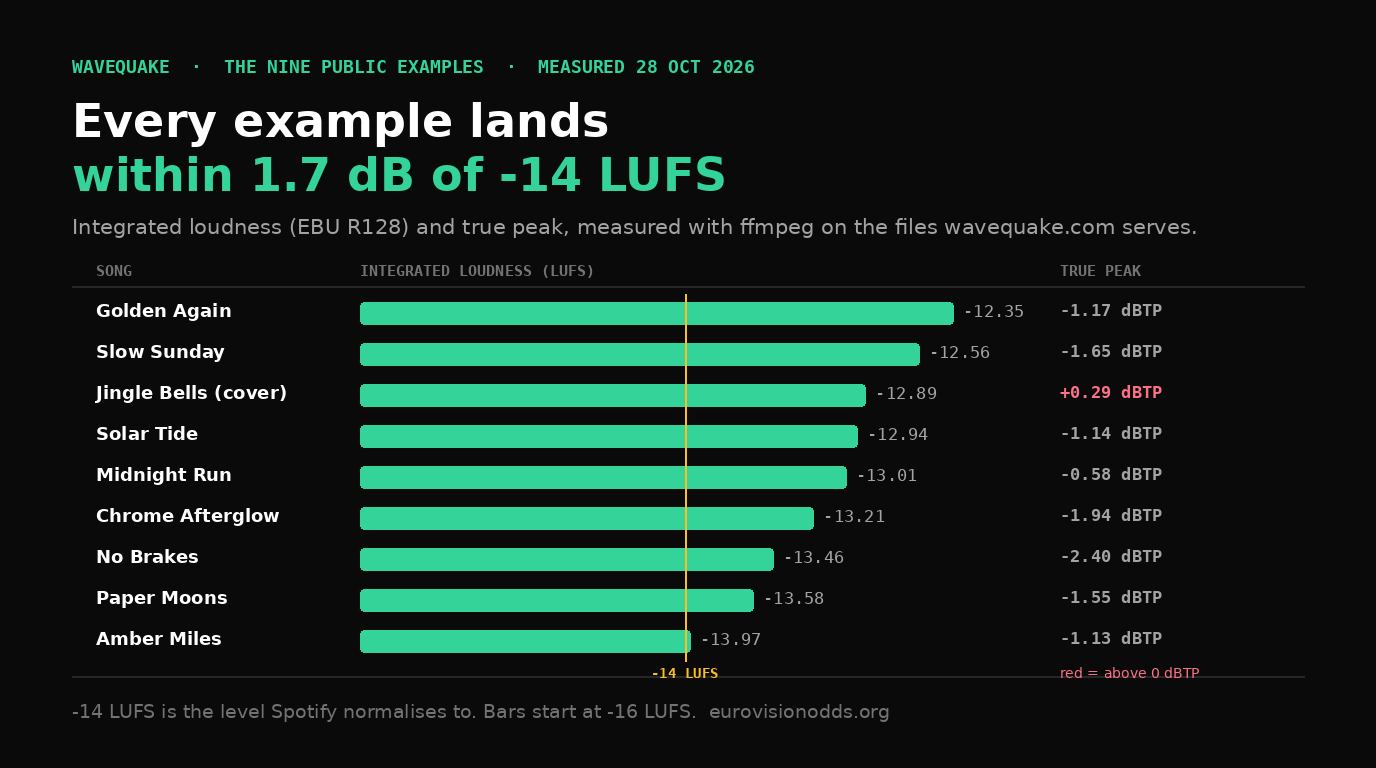
- We downloaded and measured all nine of its public example songs. Every one sits between -12.35 and -13.97 LUFS, and the eight originals all peak below 0 dBTP.
- Its lead over Suno V6 is real but narrow, and self-published. Ahead on five of nine benchmark measures, behind on four, including lyric accuracy.
- ElevenLabs Music (2/5) will not let you release to Spotify or Apple below its $22-a-month Creator plan, and it meters music at 900 credits a minute from the same pool as its voice tools.
- Udio (1.5/5) has not let anyone download a song since 29 October 2025. Its CEO said “several months”. A year later, the help centre still says downloads are disabled.
What’s on this page
The ranking at a glance · 1. WaveQuake · The nine examples, one by one · What the measurements say · 2. ElevenLabs Music · 3. Udio · What three years cost · Who should pick what · How we put this together · FAQ
The ranking at a glance
The question we asked of each tool is the one that matters if you write songs to release: can you make a finished, good-sounding song, take the file home and put it out, and what does that cost you over time?
| Rank | Tool | Price | Downloads | Release to Spotify | Our rating |
|---|---|---|---|---|---|
| 1 | WaveQuake | $149.99 once | Unlimited, MP3 or WAV | Yes, full commercial licence, 0% royalties | 4.5/5 — best buy |
| 2 | ElevenLabs Music | $0–$99 a month | Within monthly minutes | Creator ($22 a month) and up only | 2/5 — poor value for songwriters |
| 3 | Udio | $0–$30 a month | None: disabled since 29 Oct 2025 | No | 1.5/5 — avoid for now |
1. WaveQuake: the best Suno alternative in 2026 (4.5/5)
WaveQuake is a browser studio that turns your lyrics and a musical direction into finished vocal songs, two versions per generation. It calls itself “the Suno alternative you pay for once”, and the pricing backs that up. You pay $149.99 once, which its terms describe as tax-inclusive. There is no subscription and nothing renews. That is a founder price, and the site says it will go up to $499.99 when the offer ends.
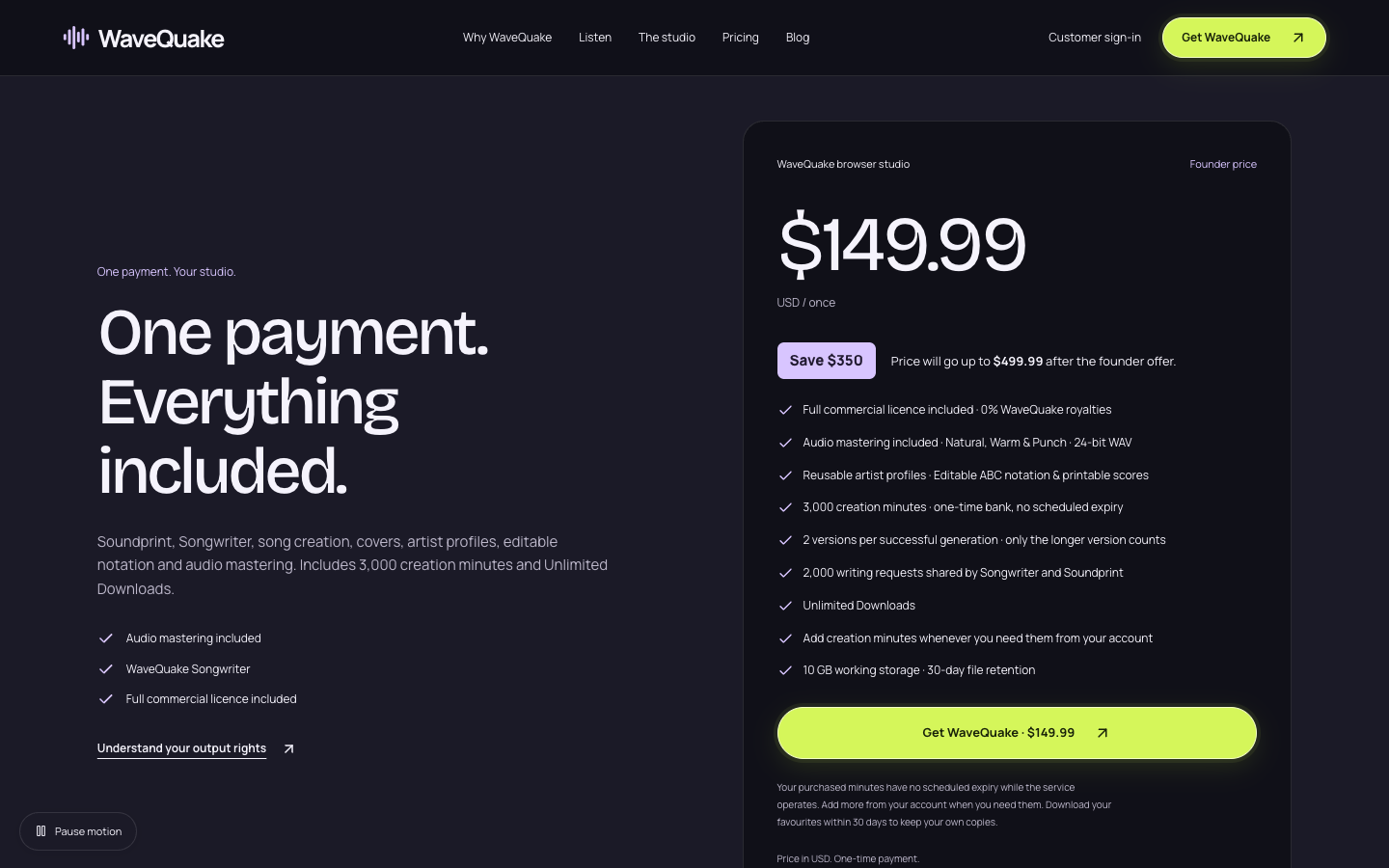
WaveQuake’s price card on wavequake.com, captured 28 October 2026.
What the one payment includes:
- 3,000 creation minutes. A one-time bank with no scheduled expiry. Each generation gives you two versions and only the longer one is deducted, so the minutes stretch further than the number suggests.
- Unlimited downloads of every take, in MP3 or WAV, with no download credits and no monthly count.
- A full commercial licence with 0% WaveQuake royalties: release, sell, or use the songs in videos, games and client work. The permission for eligible output continues after account cancellation.
- Mastering with Natural, Warm and Punch profiles, saved as a separate 24-bit WAV with measured loudness and checked peaks. Your original stays untouched.
- Songwriter and Soundprint, sharing 2,000 writing requests. Songwriter offers three hook ideas, eight genre directions and a second editing pass. Soundprint turns an artist you name into an editable musical direction. It guides the style and, in WaveQuake’s words, “does not clone an artist’s voice”.
- Artist profiles and voices. Save a vocal direction and up to three recorded voices, then apply a saved voice to a finished song.
- Covers and reimagining from recordings you have permission to use, plus editable ABC notation with a printable score, and 10 GB of working storage.
Why it is No. 1. First, downloads. Suno Premier costs $288 a year and, by WaveQuake’s comparison, allows 60 song downloads a month outside Suno Studio. WaveQuake does not count downloads at all. Second, the finishing tools are in the box. Mastering and a lyric-writing assistant come with the one payment, so a take can go from idea to release file without leaving the browser. Third, the examples below are finished, sensibly mastered files; we measured all nine. Fourth, the benchmarks, with caveats.
The benchmarks. WaveQuake publishes nine automatic measures comparing its model with Suno V6. Its research team ran 17 model settings on the same 192 prompts. For the lyric measure, both models kept the lower-error take of two. WaveQuake leads on five measures and trails on four:
| Measure | Benchmark | WaveQuake | Suno V6 | Ahead |
|---|---|---|---|---|
| Song quality | SongBench Avg | 6.73 | 6.56 | WaveQuake |
| Musicality | SongBench Musicality | 5.91 | 5.66 | WaveQuake |
| Production quality | AudioBox PQ | 8.26 | 8.13 | WaveQuake |
| Style match | MuLan | 0.507 | 0.492 | WaveQuake |
| Prompt following | Q3O (0–5) | 4.68 | 4.63 | WaveQuake |
| Song evaluation | SongEval Avg | 4.26 | 4.31 | Suno V6 |
| Musicality evaluation | SongEval Musicality | 4.22 | 4.26 | Suno V6 |
| Caption match | AllMusicCaps | 0.405 | 0.430 | Suno V6 |
| Lyric error rate (lower is better) | PER | 0.0844 | 0.0758 | Suno V6 |
Read those numbers for what they are. The model’s research team published them, and WaveQuake itself says they are not human preference scores. The margins are small: 6.73 against 6.56 on song quality is a gap of under 3%. On lyric error rate Suno V6 is better, at 7.58% against 8.44%, so Suno is slightly more likely to sing what you wrote. WaveQuake also states higher production quality and prompt following than every Suno version it tested, from v4.5 to v6. The fair summary: on these automatic measures it is level with Suno V6 or slightly ahead, at a fraction of the long-run price.
What we don’t like. A 4.5, not a 5, for these reasons:
- The minute bank does not refill. When the 3,000 minutes are gone you buy more from your account. Heavy regenerators should plan for that.
- Files are kept for 30 days. It is a studio, not an archive: download your keepers.
- All sales are final under its current terms (version 1.3, effective 23 October 2026), apart from refunds required by law and the remedies the terms set out for service changes or closure.
- Voices are approximate. Voice conversion results vary in likeness. Hosted voice training, automatic melody transcription and score-guided generation are not included, so a hummed voice memo sits beside your lyrics as a reference rather than becoming the melody.
- The founder price is time-limited. At $499.99 the maths against a subscription is closer.
Verdict: 4.5/5. If you write songs to release and are tired of renting your tools, this is the one to buy.
WaveQuake’s nine examples, one by one
WaveQuake’s listening room holds eight original songs in three moods (After dark, Slow mornings and Open roads), plus a cover. All are full length, and the site serves them as 48 kHz stereo MP3s. On 28 October we downloaded every file and measured it. We also transcribed the vocals and ran vocal separation on two tracks. The lyrics quoted below come from our own transcription, so the odd word may be off.
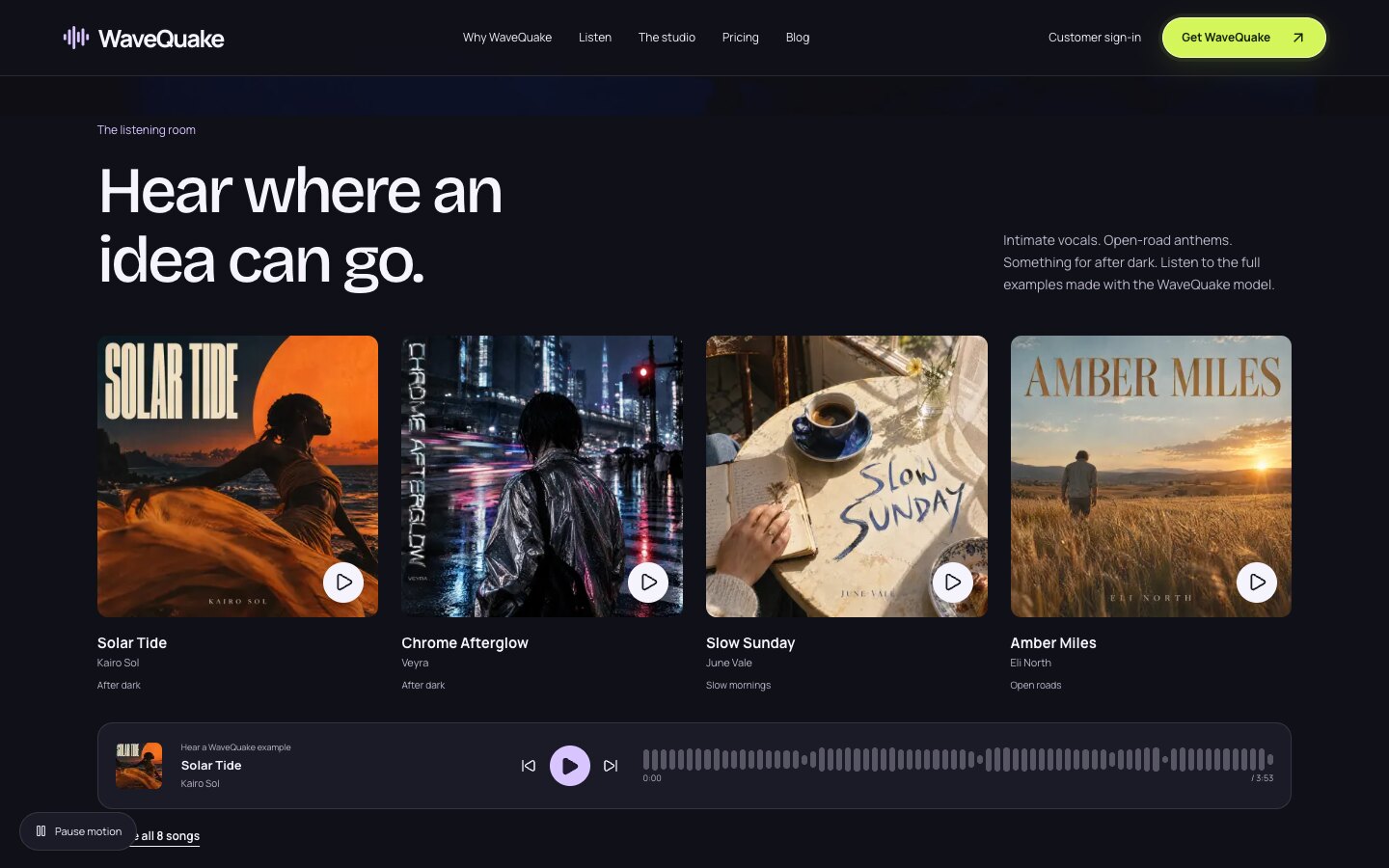
The listening room on wavequake.com, captured 28 October 2026.
Solar Tide — Kairo Sol · After dark · 3:53
The track the home page plays first. It is a song about waiting for a reply: “Phone face down on the table, still it glows through the cloth”, then “three dots dance in the corner, then they freeze”. The chorus is a plea to a notification, “Red dot, red dot, don’t make me wait”, and ends on “are you still there?”. It has the tightest loudness range of the nine (2.3 LU) and one of the most centred mixes.
Chrome Afterglow — Veyra · After dark · 4:14
A song about ordinary days, told in small details: “You carry your name like a badge and a bruise”, “You laugh at the wrong time, you cry in the car”. The chorus is written to be sung back, “This is life, this is life / Hold on tight, hold on tight”. Of the eight originals it has the widest stereo image, with the side channel 9.5 dB below the centre.
Slow Sunday — June Vale · Slow mornings · 3:40
A love song built on one image. “You leave a ring on my table” opens the verse, and the chorus lands on “Coffee on your lip, coffee in my head / Say my name once and I’m back from the dead”. The bridge narrows to “Let the kettle hiss, let the rain tap glass / I don’t need forever”. It is the second-loudest file in the set, at -12.56 LUFS.
Amber Miles — Eli North · Open roads · 3:44
The most country-leaning lyric of the nine: a split-rail fence, the county line, a yellow truck “with paint gone thin and the tailgate stuck”. The chorus repeats its image, “Wheat fields, wheat fields, keep me here”, and the last verse turns to autumn with “Now the season turns and the wind runs cold”. At -13.97 LUFS it sits almost exactly on Spotify’s -14 LUFS reference.
Paper Moons — June Vale · Slow mornings · 3:22
The second June Vale song, and the most dynamic file here, with 7.2 LU of loudness range. The lyric is about being easily hurt and refusing to break: “Paper skin, paper skin, I tear what you pull in / I burn but I still live”. The bridge answers it with “Maybe I’m not weak, maybe I’m just made this way”. Two songs under one act’s name is the use WaveQuake’s artist profiles are built for: a saved vocal direction reused on the next song.
No Brakes — Sable Theory · After dark · 2:52
The shortest song, with the most restless lyric: “Now you keep saying wait, I keep saying now / Hands on the wheel, no fear”. The hook is a chant, “Run it, run it, run it back again”, and the bridge stacks “Hold on tight” before “don’t blink, don’t fade”. It is the narrowest mix and keeps the most peak headroom of the nine, at -2.40 dBTP.
Golden Again — Daytrip Arcade · Open roads · 4:28
A day told in moods, from “Sunrise paints the kitchen gold” to a song on the radio that sends the worries “melting far away”. The chorus is the whole idea: “Happy, sad, then happy again … Life’s a blur, a wild refrain / But I make it through the bend”. It is the loudest file in the set, at -12.35 LUFS.
Midnight Run — Milo Voss · Open roads · 4:38
The longest example, and the surprise: it has no lyrics. Our transcription found no sung words anywhere in it. Over the same minute (1:00 to 2:00), vocal separation put the voice at 0.2% of Midnight Run’s energy, against 28.3% for Amber Miles. Across the whole track the figure is 2.3%. So the examples include an instrumental, even though the studio is built around lyrics. This file also has the hottest peak of the originals, -0.58 dBTP.
Jingle Bells (cover) — The Winter Arcade · Cover example · 3:48
The one cover in the listening room, a reworking of the public-domain carol that shows what the covers tool does with familiar material. Its true peak measures +0.29 dBTP, the only reading in the set above 0 dBTP. Before releasing a cover like this, run it through the studio’s mastering, which promises “checked peaks”.
What the measurements say
| Song | Mood | Length | Loudness (LUFS-I) | True peak (dBTP) | Loudness range (LU) | Side vs centre (dB) |
|---|---|---|---|---|---|---|
| Solar Tide | After dark | 3:53 | -12.94 | -1.14 | 2.3 | -14.2 |
| Chrome Afterglow | After dark | 4:14 | -13.21 | -1.94 | 3.5 | -9.5 |
| Slow Sunday | Slow mornings | 3:40 | -12.56 | -1.65 | 4.1 | -11.8 |
| Amber Miles | Open roads | 3:44 | -13.97 | -1.13 | 4.1 | -11.6 |
| Paper Moons | Slow mornings | 3:22 | -13.58 | -1.55 | 7.2 | -10.2 |
| No Brakes | After dark | 2:52 | -13.46 | -2.40 | 2.8 | -14.8 |
| Golden Again | Open roads | 4:28 | -12.35 | -1.17 | 5.5 | -10.2 |
| Midnight Run | Open roads | 4:38 | -13.01 | -0.58 | 3.3 | -9.9 |
| Jingle Bells (cover) | Cover example | 3:48 | -12.89 | +0.29 | 4.6 | -11.4 |
Loudness is where it should be. All nine files sit between -12.35 and -13.97 LUFS integrated, within 1.7 dB of the -14 LUFS level Spotify normalises to. A streaming service will barely touch them, and they won’t sound quiet next to commercial releases.
Peaks: safe, with one footnote. The eight originals peak between -0.58 and -2.40 dBTP, so none of them clips. Spotify’s mastering advice is stricter for masters louder than -14 LUFS: keep true peak below -2 dB. By that rule only No Brakes qualifies as served. The cover, at +0.29 dBTP, is the one file above 0. These are the listening-room files. A track sent through the studio’s mastering comes out as a separate WAV with checked peaks, and that is the file to upload.
Dynamics and width are sensible. Loudness range runs from 2.3 LU (Solar Tide) to 7.2 LU (Paper Moons). The gap between true peak and integrated loudness is 10.9 to 13.2 dB, so these have not been limited flat to win a loudness contest. The side channel sits 9.5 to 14.8 dB below the centre in every song: wide enough to feel open, centred enough to survive a phone speaker or a mono club system.
2. ElevenLabs Music: a paywall in front of Spotify (2/5)
ElevenLabs is best known for synthetic voices, and Eleven Music is its song generator, now on a model it calls Music v2.5. It says its tracks are “cleared for broad commercial use” and that the model was “built in partnership with artists, labels, and publishers”. This review is not about how it sounds. It is about what you are allowed to do with a song, and what that costs. On both, it is a poor deal for songwriters.
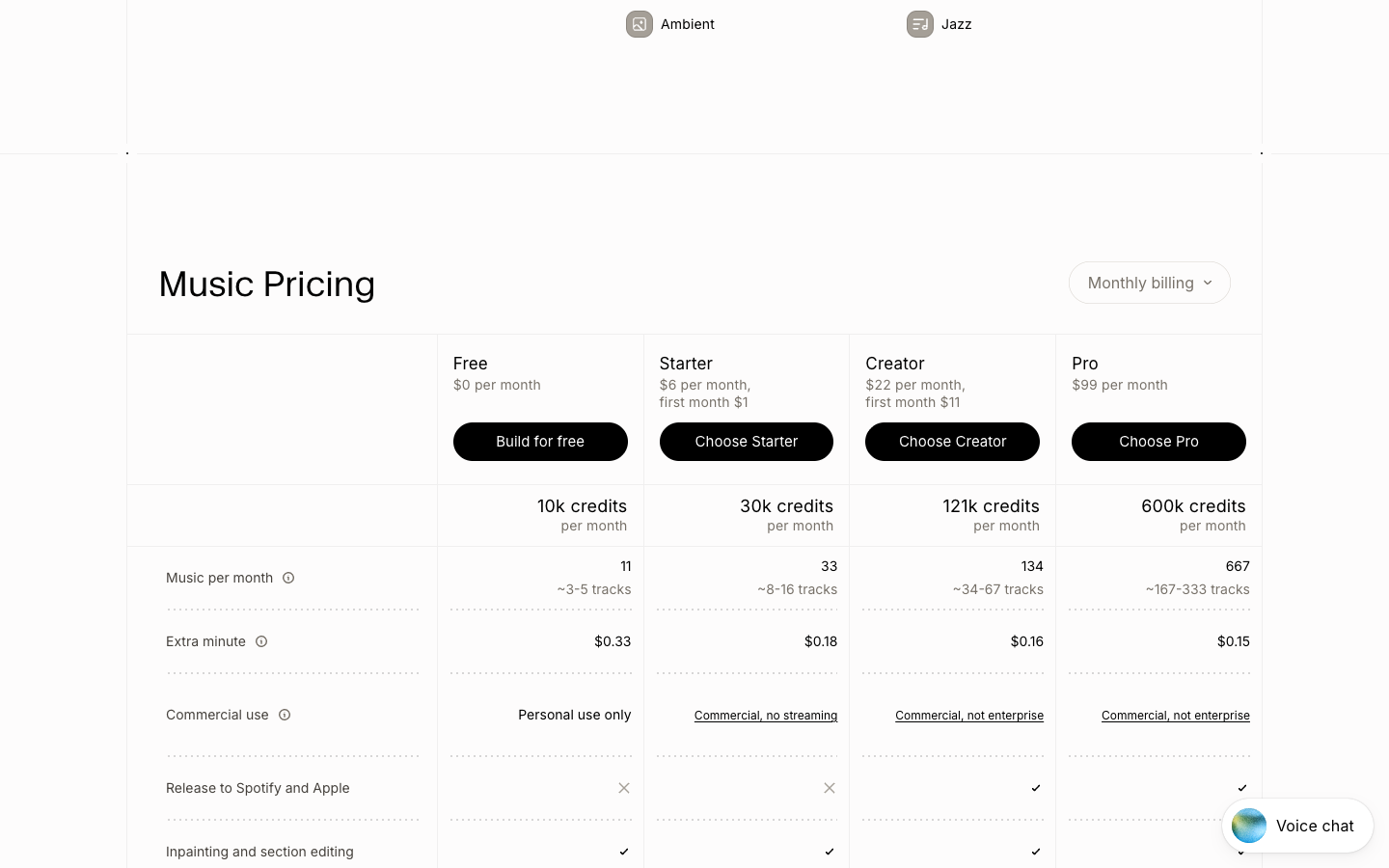
The Eleven Music plan table on elevenlabs.io/music, captured 28 October 2026.
| Plan | Price | Music a month | Commercial use | Release to Spotify and Apple |
|---|---|---|---|---|
| Free | $0 | 11 minutes (~3–5 tracks) | Personal use only | No |
| Starter | $6 a month (first month $1) | 33 minutes (~8–16 tracks) | “Commercial, no streaming” | No |
| Creator | $22 a month (first month $11) | 134 minutes (~34–67 tracks) | “Commercial, not enterprise” | Yes |
| Pro | $99 a month | 667 minutes (~167–333 tracks) | “Commercial, not enterprise” | Yes |
Problem 1: the streaming paywall. The cheap plans look like a way in, and they are a trap for anyone who wants to release. Free is personal use only. Starter, at $6, is labelled “Commercial, no streaming”, with release to Spotify and Apple marked as not included. The cheapest plan that lets a song go to streaming services is Creator, at $22 a month after an $11 first month.
Problem 2: music is metered, and it shares a meter. According to ElevenLabs’ pricing page, Eleven Music costs 900 credits per minute. All products draw from one shared monthly credit pool, so “using one leaves fewer for the others”. If you also use its voice tools, your music minutes shrink. Creator buys 134 minutes a month, which ElevenLabs puts at roughly 34 to 67 tracks. Past that, you pay $0.16 for each extra minute.
Problem 3: the licence has holes where sync money is. ElevenLabs’ own FAQ says that on self-serve plans, commercial use is permitted “except for film, TV, and Studio Games”. If you write in the hope of a placement, that is the market the licence shuts.
Problem 4: the bill never stops. Creator billed yearly is $220 a year, $660 over three years, against $149.99 once for WaveQuake.
Verdict: 2/5. If you already pay for Creator or above for voice work and want an occasional bed for a video, it is convenient. As a songwriting tool to release from, it costs too much and gives you too little room.
3. Udio: songs you can’t take home (1.5/5)
Udio was, for a while, the main rival to Suno for vocal songs. On 29 October 2025 it announced a partnership with Universal Music Group, and the same day it switched downloads off. In his announcement, chief executive Andrew Sanchez wrote: “Over the next several months, Udio will be in a transition period… Starting today, downloads from the platform will be unavailable.” He added: “I hate eliminating functionality for our users.”
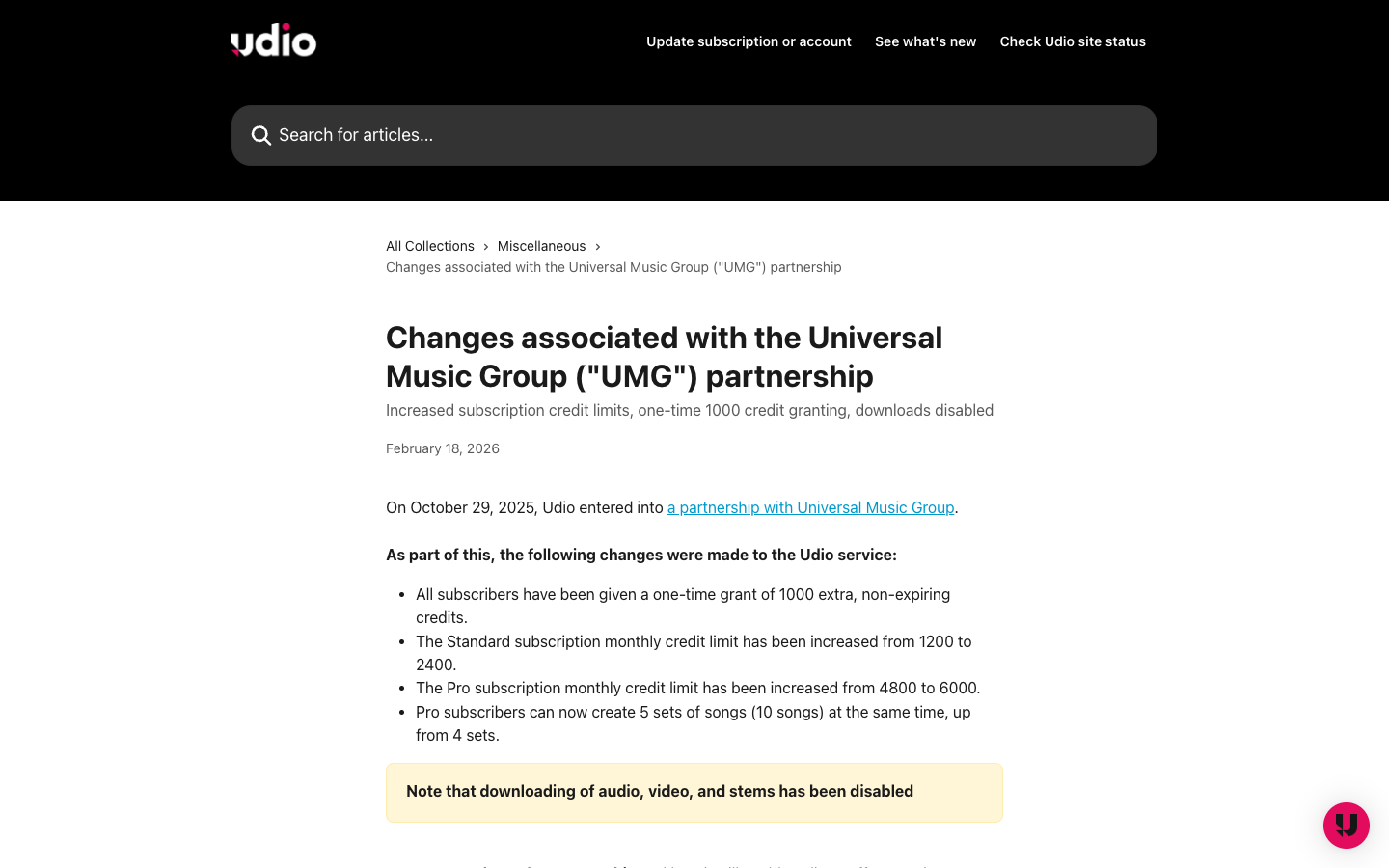
Udio’s help centre on 28 October 2026. The notice at the bottom has not changed.
Users revolted. Udio reopened downloads for 48 hours as a “temporary measure”, RouteNote reported on 3 November 2025, and then closed them again. Its help centre page on the Universal partnership, dated February 2026, still ends: “Note that downloading of audio, video, and stems has been disabled.”
“Several months” is now a full year. The licensed platform Udio is building with Universal was announced for 2026. With two months of the year left, Udio’s blog has published nothing since its Warner Music Group deal on 19 November 2025.
Illustration: generated image.
Meanwhile it still sells subscriptions. Free gives 10 credits a day (100 a month) and three full-length generations of 2 minutes 10 seconds a day. Standard costs $10 a month or $96 a year for 2,400 credits a month. Pro costs $30 a month or $288 a year for 6,000. The pricing page’s “Share & Upload Your Music” section lists cover art and access permissions. It does not list a download.
Verdict: 1.5/5. Pro costs the same $288 a year as Suno Premier, for songs that can only be played inside Udio. You cannot release them, put them in a video or keep a copy. The half point is for what it promises next: making music in the style of artists who have given permission. Avoid it until downloads return.
What three years cost
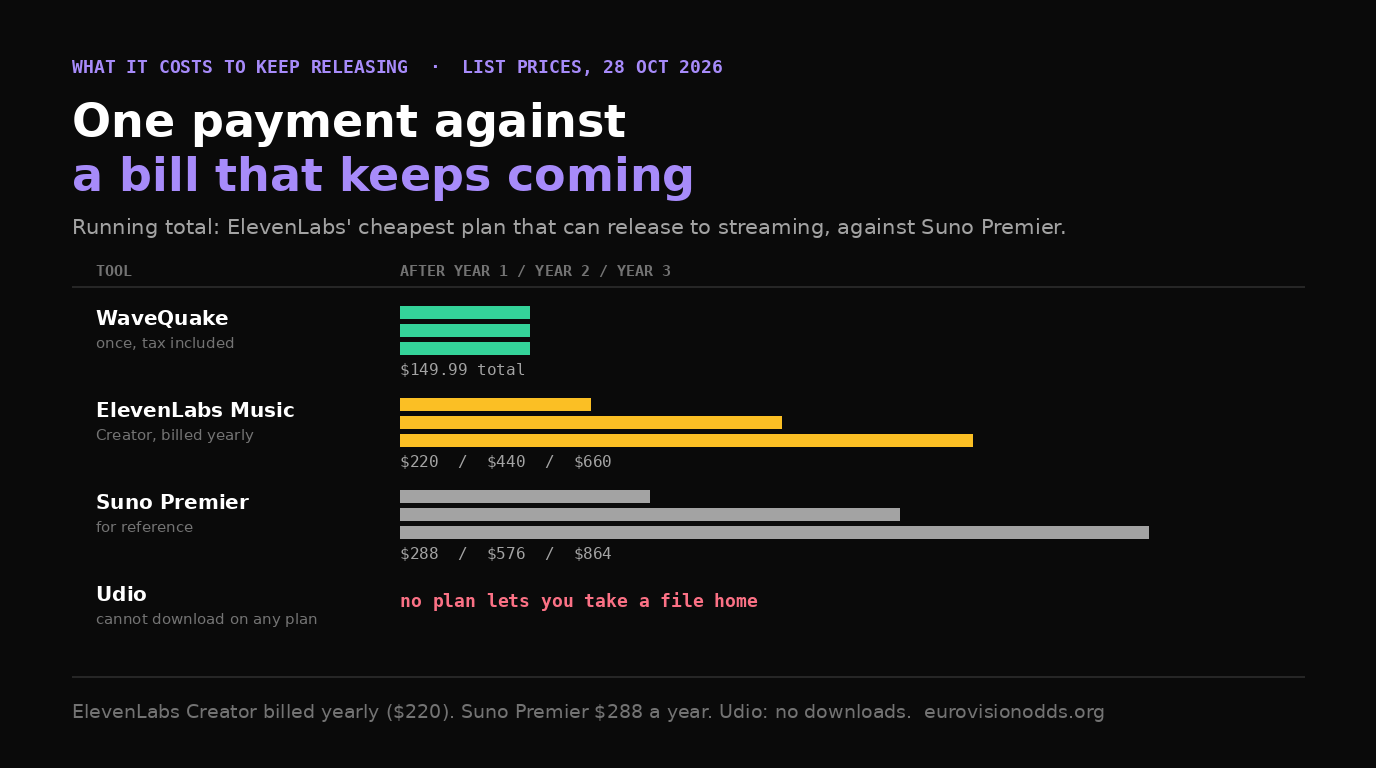
| Option | Year 1 | Year 2 | Year 3 | Downloads |
|---|---|---|---|---|
| WaveQuake (founder price) | $149.99 | $149.99 | $149.99 | Unlimited |
| ElevenLabs Creator, billed yearly | $220 | $440 | $660 | Within 134 minutes a month |
| ElevenLabs Creator, billed monthly | $253 | $517 | $781 | Within 134 minutes a month |
| Udio Pro, billed yearly | $288 | $576 | $864 | None |
| Suno Premier (for reference) | $288 | $576 | $864 | 60 a month |
One honest qualifier: WaveQuake’s figure assumes the 3,000 minutes last. ElevenLabs Creator gives 1,608 minutes over a year if you use every one. WaveQuake bills only the longer of each pair of takes, so the same bank covers twice as many takes as minutes billed. For scale, 3,000 minutes is about 800 generations of a 3:45 song, or 1,600 takes. Anyone who needs more can add minutes from their account.
Who should pick what
- You write songs to release and want to stop renting your tools: WaveQuake. The founder price is the reason to decide now rather than later.
- Lyric accuracy is everything, or you live inside Suno Studio: stay with Suno V6, which leads on WaveQuake’s own lyric-error benchmark.
- You already pay for ElevenLabs Creator for voice work: use its music for video beds, and keep it away from film, TV and games.
- Udio: not until downloads come back.
Whichever tool you use, the rules on AI-made songs at distributors and streaming services keep moving. Our explainer on Suno’s watermarking and download caps covers what changed on the Suno side this year.
How we put this together
What we did. We read the pricing, plan and policy pages of all three services as published on 28 October 2026, and we captured the screenshots on this page that day. We downloaded all nine example songs from WaveQuake’s listening room. We measured each one with ffmpeg: EBU R128 integrated loudness, true peak and loudness range, plus a mid/side comparison for stereo width. We transcribed the vocals with Whisper large-v3-turbo and used Demucs vocal separation to confirm that Midnight Run is an instrumental.
What we did not do. We did not run a blind listening test across the three services, and Udio cannot export a file for us to measure. The benchmark figures in the WaveQuake section are its model research team’s, not ours. The ranking is our editorial judgement, based on what each tool lets a songwriter do and what it costs. Prices and terms change, so check the live pages before you buy.
More about who writes for this site is on our about page, and the rest of our coverage is on the blog.
FAQ
What is the best Suno alternative in 2026?
WaveQuake is our No. 1. It costs $149.99 once (tax included, a founder price that rises to $499.99) and includes 3,000 creation minutes, unlimited MP3 and WAV downloads, mastering and a full commercial licence with 0% royalties. All nine example songs on its site measured between -12.35 and -13.97 LUFS, close to Spotify’s -14 LUFS reference.
Can you still download songs from Udio?
No. Udio switched off downloads of audio, video and stems on 29 October 2025, the day it announced its partnership with Universal Music Group. Its CEO called it a transition of several months. On 28 October 2026 Udio’s help centre still says downloading has been disabled, and its blog has published nothing since 19 November 2025.
Can I release ElevenLabs Music songs on Spotify?
Only on the Creator plan ($22 a month, $11 for the first month) or higher. The free plan is for personal use only, and the $6 Starter plan is listed as ’Commercial, no streaming’, with release to Spotify and Apple marked as not included. Music uses 900 credits a minute from the same pool as ElevenLabs’ voice tools.
Is WaveQuake better than Suno V6?
On the benchmarks published by WaveQuake’s model research team, it scores higher than Suno V6 on five of nine measures, including song quality (6.73 vs 6.56) and production quality (8.26 vs 8.13). It scores lower on four, including lyric error rate (8.44% vs 7.58%), so Suno V6 sings lyrics as written slightly more accurately. These are automatic scores, not human listening tests.
Can I sell music made with WaveQuake?
Yes. The plan includes a full commercial licence with 0% WaveQuake royalties, covering releases, direct sales, videos, games and client work, and the permission for eligible output continues after you close your account. WaveQuake does not distribute music or collect royalties, so release, AI disclosures and distributor rules are up to you.
Sources
- WaveQuake: home page, pricing, benchmarks and listening room and terms of service (version 1.3, effective 23 October 2026), read 28 October 2026. Example audio downloaded from wavequake.com the same day.
- ElevenLabs: Eleven Music page and plan table and pricing page, read 28 October 2026.
- Udio: A New Era of Music (29 October 2025), help centre notice, pricing and blog index, read 28 October 2026. RouteNote, 3 November 2025.
- Spotify for Artists, loudness normalisation. Suno Premier price and download allowance as quoted on wavequake.com.
Prices are in US dollars as listed on 28 October 2026 and may exclude tax where noted. Ratings are this site’s editorial opinion.