
Seventy years. Sixty-eight competitive editions (1956 was the founding contest; 2020 was cancelled). Roughly 1,700 songs sent by national broadcasters from Lys Assia's Refrain in Lugano 1956 to DARA's record-breaking Bangaranga in Vienna 2026. Picking the twenty best is an act of curation rather than calculation — but it is not arbitrary either.

18+ | New customers only | T&Cs apply | Please gamble responsibly
The ranking below combines four weighted criteria: in-contest result (final placing, points where the scoring system permits direct comparison, jury-versus-televote splits in the 50/50 era), post-contest commercial afterlife (chart positions, certified sales, Spotify and YouTube streams a decade or more after the contest), cultural impact (whether the song changed what Eurovision was understood to be — musically, politically, technically), and longevity (whether it is still played, covered, and quoted twenty, thirty, or fifty years later). Twelve of the twenty are winners. Two finished second. The rest are honoured for what they did after the contest as much as during it.

20. Norway — Alexander Rybak — Fairytale (2009)
Rybak's win in Moscow was the most decisive of the pre-2016 era — the violinist won by a 169-point margin under the old scoring system, a record under that rubric. Fairytale is a Belarusian-born tenor's setting of a Hardanger-fiddle melody to a folk-pop frame, sung in English. It went top-10 in seventeen national charts in the months after the contest, sold over a million copies across Europe by year-end, and remains the defining Norwegian Eurovision moment. The lyric "years ago when I was younger / I kinda liked a girl I knew" is still one of the most-quoted opening lines in the contest's history.
19. United Kingdom — Brotherhood of Man — Save Your Kisses for Me (1976)
The biggest commercial success of any Eurovision winner across the contest's entire pre-streaming history. Brotherhood of Man's saccharine farewell pop song won the 1976 contest in The Hague and went on to sell over six million copies worldwide — number one in 33 countries, the UK Christmas number-one runner that year, and the best-selling single in the UK in 1976. It is the only winning entry to top the year-end best-sellers chart in the host country's biggest competing market. Stripped of the choreography and the matching brown suits, the song is a tightly engineered piece of Mitch Murray / Peter Callander pop craft.
18. Switzerland — Lys Assia — Refrain (1956)
The first ever Eurovision winner, sung in French by a Swiss contralto in Lugano on 24 May 1956. Refrain, a wistful waltz written by Émile Gardaz and Géo Voumard, won what was then a seven-country contest with two entries per nation. The full points breakdown from that night is famously lost — only the winner was announced. The historical weight is enormous: every other entry on this list exists because Refrain proved the format could work. Lys Assia returned to attempt comeback Eurovision bids well into her eighties, last in 2012, and remained the contest's most senior elder statesperson until her death in 2018.
17. Spain — Massiel — La, la, la (1968)
The most controversial winner of the analogue era. Massiel's La, la, la beat Cliff Richard's Congratulations by a single point in London on 6 April 1968 — and Spanish state broadcaster TVE was Franco's. A 2008 documentary by Spanish filmmaker Montse Fernández Vila alleged that the Franco regime had purchased votes from other national juries to deny the UK the win, an accusation Richard himself has periodically endorsed and the EBU has never formally investigated. Whether the votes were bought or not, the song became Spain's first Eurovision winner and a generational touchstone — a deliberately wordless chorus that turned the language barrier into a feature.
16. Israel — Dana International — Diva (1998)
Dana International's win in Birmingham on 9 May 1998 was a genuine cultural inflection point — the first openly transgender winner of any major televised song contest anywhere in the world. Israeli orthodox parties had publicly opposed her selection; she received death threats in the lead-up; the EBU positioned security around her in the venue. Diva won on the night by eight points over the UK's Imaani. It is a Eurodance number that name-checks Maria Callas, Aphrodite and Victoria, and ends with Dana wrapped in a Jean Paul Gaultier feather cape. The song's afterlife in LGBTQ+ club culture across Europe is arguably larger than its actual chart performance.
15. Finland — Lordi — Hard Rock Hallelujah (2006)
Finland's first ever Eurovision win, on the country's 45th attempt, by a five-piece monster-mask hard-rock band led by Mr Lordi (Tomi Putaansuu). Athens 2006 ended Finland's reign as the longest-running country never to have won — and broke a genre barrier the contest had previously refused to acknowledge. The 292-point total was a then-record under the old scoring system. The lyric "the saints are crippled on this sinners' night" was the most metal couplet ever transmitted in primetime to half a billion European viewers. Without Lordi, there is no obvious path from Eurovision-as-Schlager-festival to the contest's modern openness to Måneskin, Käärijä, or Bambie Thug.
14. Switzerland — Céline Dion — Ne partez pas sans moi (1988)
The most commercially consequential winner of the contest, full stop. Céline Dion was a 20-year-old French-Canadian signed to a Swiss broadcaster placement in Dublin on 30 April 1988. She won by a single point over the UK's Scott Fitzgerald — a quirk of the analogue scoring system that produced the closest Grand Final result of the 1980s. Within five years she had signed to Epic Records, recorded the theme to Disney's Beauty and the Beast, and launched the global album career that would sell over 200 million copies. Eurovision did not make Céline Dion — but it visa-stamped her onto European broadcast television at exactly the moment her North American label needed her European tour to sell.
13. Israel — Netta — Toy (2018)
Netta Barzilai's Toy won Lisbon 2018 on 529 points, 93 clear of Cyprus. The song is built around a loop of vocal clucks that Netta triggered live on a Loop Station from the stage — a piece of staging that turned an in-show novelty into a globally-recognised hook within 48 hours. The lyric "I'm not your toy, you stupid boy" landed during the early-MeToo cultural moment with a precision the EBU could not have engineered. Netta's televote landslide was the loudest evidence to date that the post-2016 50/50 system was producing winners with genuine viral reach rather than jury-engineered consensus picks. The chicken dance survives in TikTok memes nearly a decade later.
12. Finland — Käärijä — Cha Cha Cha (2023)
Liverpool 2023 produced the closest cross-pool split of the 50/50 era. Käärijä's Cha Cha Cha finished second on combined points to Loreen but won the televote outright with 376 points — at the time the largest single-country televote total in modern Eurovision history. The performance, in a lime-green bolero with a chorus line of human-totem dancers, is the high-water mark of the contest's willingness to platform genuinely uncommercial Finnish-language industrial-rave-metal. The jury verdict (a distant lower placement) versus the public's near-unanimous vote produced a multi-day pan-European argument about whether juries should still exist — an argument the EBU has not resolved. The streaming numbers (over 100 million Spotify plays in the year following the contest) make this Finland's most-streamed Eurovision entry of all time, well ahead of Lordi.
11. Netherlands — Duncan Laurence — Arcade (2019)
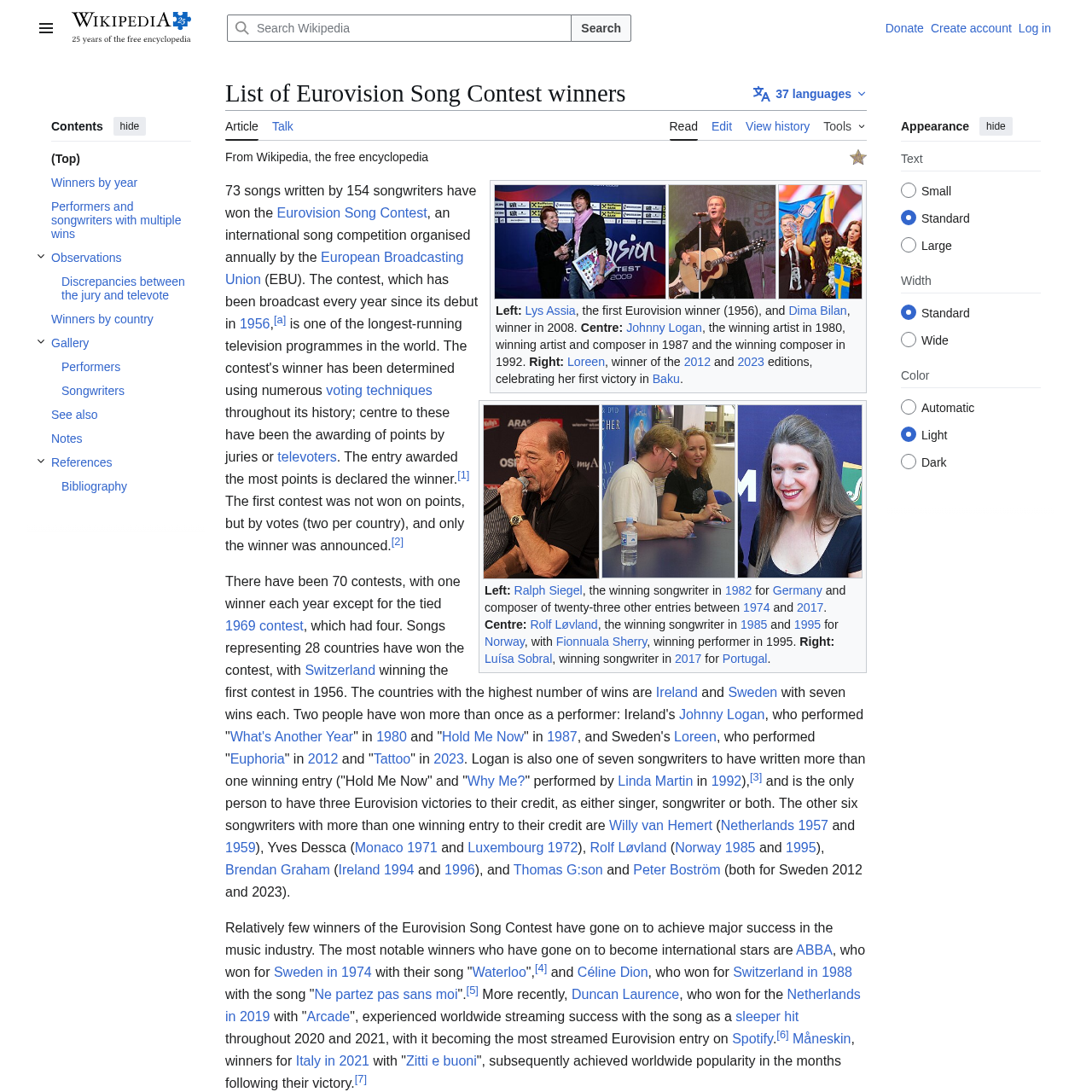
The Netherlands' first win in 44 years and the entry on this list with the largest post-contest streaming tail. Arcade — a hushed piano ballad about an unreciprocated love — won Tel Aviv 2019 on 498 points. Two years later, a viral TikTok clip from the song's bridge ("a small reflection of you") sent it into the US Billboard Hot 100, peaking at number 30 in December 2021. It has now passed one billion Spotify streams, the only Eurovision-winning song ever to do so. The afterlife dwarfed the in-contest moment, and proved that the streaming era could resurrect a Eurovision entry years after the trophy lift in a way the chart-era simply could not.
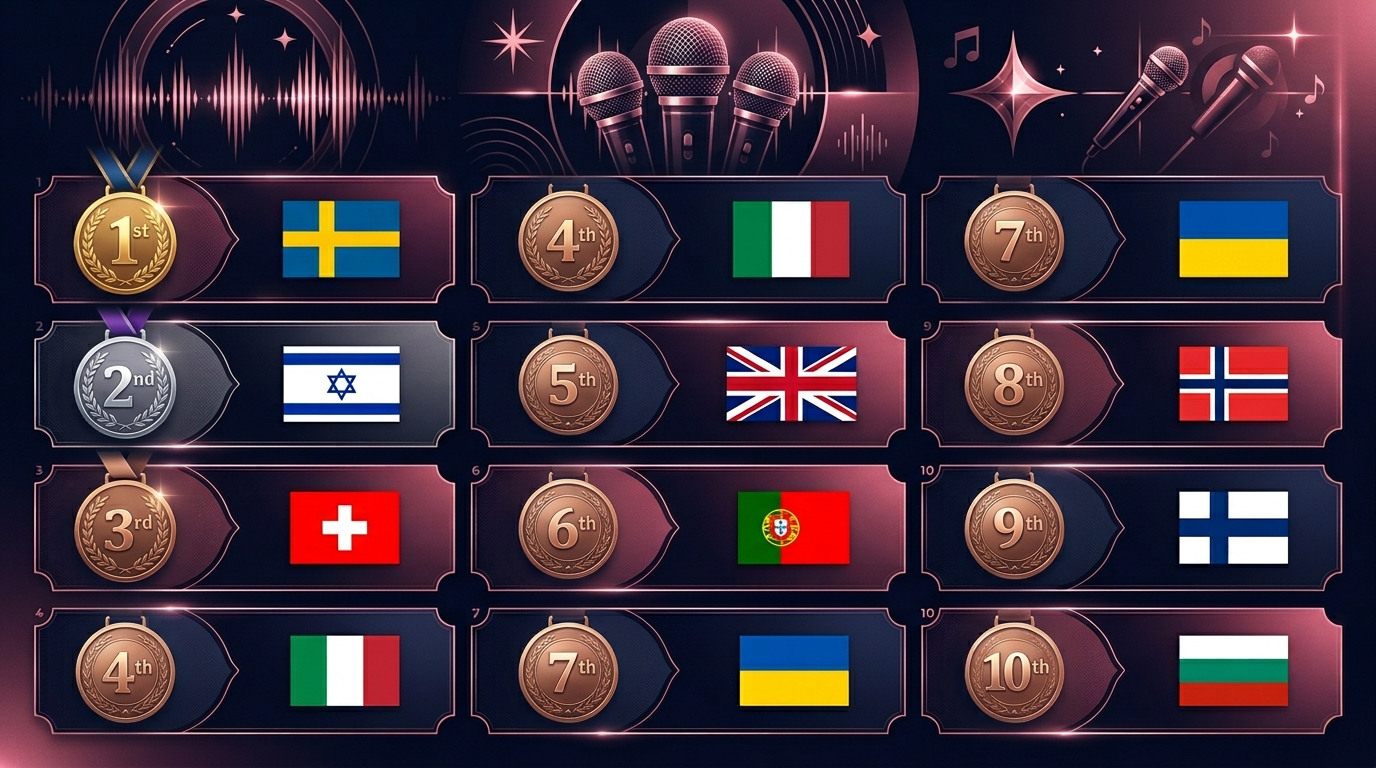
10. Austria — Conchita Wurst — Rise Like a Phoenix (2014)
Conchita Wurst's Rise Like a Phoenix won Copenhagen 2014 by 52 points. The song is a Shirley-Bassey-styled James-Bond-theme ballad delivered by a bearded drag persona created by Austrian performer Tom Neuwirth. The cultural moment overshadowed the music: Conchita's win was read across the continent as a referendum on European LGBTQ+ rights at the precise moment Russia's anti-gay legislation was making international headlines, and her acceptance speech ("This night is dedicated to everyone who believes in a future of peace and freedom") became one of the contest's most-cited closing lines. The song itself is a structurally tight piece of writing — the key-change at the second-chorus into the bridge is one of the best-engineered moments in any 21st-century Eurovision winner.
9. Switzerland — Nemo — The Code (2024)
The first non-binary winner of Eurovision, Nemo Mettler took Malmö 2024 on 591 points. The Code is a four-minute genre-shift — opera into drum-and-bass into rap into pop — staged on a tilting circular plinth that Nemo physically rode for the duration of the performance. The vocal demand is closer to a West End audition piece than a televised pop performance, and the central lyric "I went to hell and back / to find myself on track" landed as a coming-of-age statement that the contest's largely-queer fanbase received as deeply personal. Switzerland's third Eurovision win, after Lys Assia (1956) and Céline Dion (1988) — neatly bookending the country's seventy-year arc on this list.
8. Italy — Måneskin — Zitti e buoni (2021)
Rotterdam 2021 won Italy on 524 points — a 25-point margin over France's Barbara Pravi. The afterlife is the story. Måneskin became, in the eighteen months following the win, the first Eurovision winners to break into the US Top 40 since the 1970s. Their cover of Beggin' charted in over 30 countries, they sold out arena tours across North America, and they opened for the Rolling Stones in Las Vegas in November 2021. Damiano David's vocal — and the contest's first-ever post-performance live drug-test request, after a stage gesture that turned out to be him bending over a piece of glass — were the two moments that ended the contest's last residual claim to camp irrelevance. Frontman in eyeliner, bassist in fishnets, jury-vote landslide. The Eurovision boomer-vs-Gen-Z generational handover.
7. France (for Luxembourg) — France Gall — Poupée de cire, poupée de son (1965)
France Gall sang for Luxembourg — the broadcaster CLT-Télé Luxembourg — on 20 March 1965 in Naples, and won with a Serge Gainsbourg composition that became the canonical yé-yé record of the decade. Poupée de cire, poupée de son ("wax doll, sawdust doll") is a 17-year-old singing about being a manufactured pop product, written by a 36-year-old songwriter who would later spend decades insisting Eurovision had been a Trojan horse for what he called the song's "sad metaphor". The single went top-10 in seven European countries, became the first Eurovision winner to be recorded in seven languages by the winner herself, and is regularly cited in French-music criticism as the song that made the yé-yé sound continental. The Gainsbourg-France Gall partnership produced four further chart entries in 1965-66 alone.
6. Sweden — Loreen — Tattoo (2023)
The first artist to win Eurovision twice. Loreen took Liverpool 2023 on 583 combined points — 57 clear of Käärijä — eleven years after winning Baku 2012 with Euphoria. Tattoo is a structurally similar piece of Swedish-pop architecture to its predecessor: long sustained vocal climb, restraint until the second chorus, a final bar of release. The cultural significance is the precedent: Loreen broke a 67-year contest convention that winners are one-and-done. Sweden's national broadcaster SVT used the win to take its overall Eurovision victory tally to seven, equal with Ireland for the most ever (Ireland's seven were all in 1970-1996; Sweden's modern era continues). The Loreen template — minimalist staging, lighting that frames the artist's hands, no dancers — is now the default for Melodifestivalen winners exporting to Eurovision.
5. Ukraine — Kalush Orchestra — Stefania (2022)
Three months after Russia's full-scale invasion of Ukraine, Kalush Orchestra won Turin 2022 on 631 points — a then-record margin of 165 over second-placed United Kingdom. The televote landslide was historic: Ukraine collected 439 points from the public, more than any country in the entire 50/50 era to that point. Stefania was written by frontman Oleh Psiuk for his mother before the invasion began. The performance's closing line — "Stefanie, mama, mama Stefanie" — was delivered by a band on a temporary 30-day exit pass from active duty; bandmates returned to the front line within a week of the trophy lift. Eurovision is not supposed to be political, the rulebook says. Stefania is the case study in why that line is a fiction.
Betfred — Bet £10 Get £50 in Free Bets on Eurovision 2027
4. Sweden — Loreen — Euphoria (2012)
The most-streamed Eurovision winner of the 2010s, and the entry most professional songwriters would name if asked to identify a single Eurovision song that defined what the contest sounded like in the streaming era. Euphoria won Baku 2012 with 372 points under the old scoring system — a then-record total. Loreen took twelve points from a record-equalling 18 of the 41 voting countries on the night. The song is built on a 132-bpm four-to-the-floor pulse and a wordless soaring vocal climb that has become the structural blueprint for Swedish Eurovision entries for the decade following. Spotify streams now exceed 350 million; it is the only pre-2014 Eurovision winner to have crossed the 300-million-stream barrier. Loreen returning to win again in 2023 wrote a coda nobody in 2012 thought possible.
3. Portugal — Salvador Sobral — Amar pelos dois (2017)
The highest-scoring winner in Eurovision history. Sobral's Amar pelos dois — a jazz-ballad written by his sister Luísa — took Kyiv 2017 on 758 points, a record that still stands nearly a decade later. The performance was startling in its minimalism: a black blazer, no staging, no choreography, no costume change, no key change, no lighting cue. Sobral simply walked to a single microphone in centre stage and sang. The jury (382 points) and the televote (376 points) both ranked it first — the only winner in the 50/50 era to top both halves of the scoreboard by a margin exceeding 60 points. Portugal's first win in 53 attempts. Sobral, who had been waiting for a heart transplant during the contest, used his acceptance speech to attack the contest's drift toward "disposable fast-food music". The speech aged better than almost any Eurovision moment of the decade.
2. Sweden — ABBA — Waterloo (1974)
The most commercially impactful Eurovision winner of all time. ABBA won Brighton 1974 on 24 points under the old scoring system, beating Gigliola Cinquetti's Sì by 6 points. The four-piece — Agnetha Fältskog, Björn Ulvaeus, Benny Andersson, Anni-Frid Lyngstad — had only been performing under the ABBA name for a few months. The win launched a career that would go on to sell roughly 400 million records worldwide, fill stadiums across five continents, score one of the highest-grossing jukebox musicals in theatrical history (Mamma Mia!), and produce a holographic concert residency in London that has run continuously since 2022 and grossed over £350 million. No other Eurovision act comes within an order of magnitude of ABBA's post-contest career arc. The contest is, in commercial terms, the ABBA discovery system — every winner since 1974 has been measured against this curve and found short.
1. Bulgaria — DARA — Bangaranga (2026)
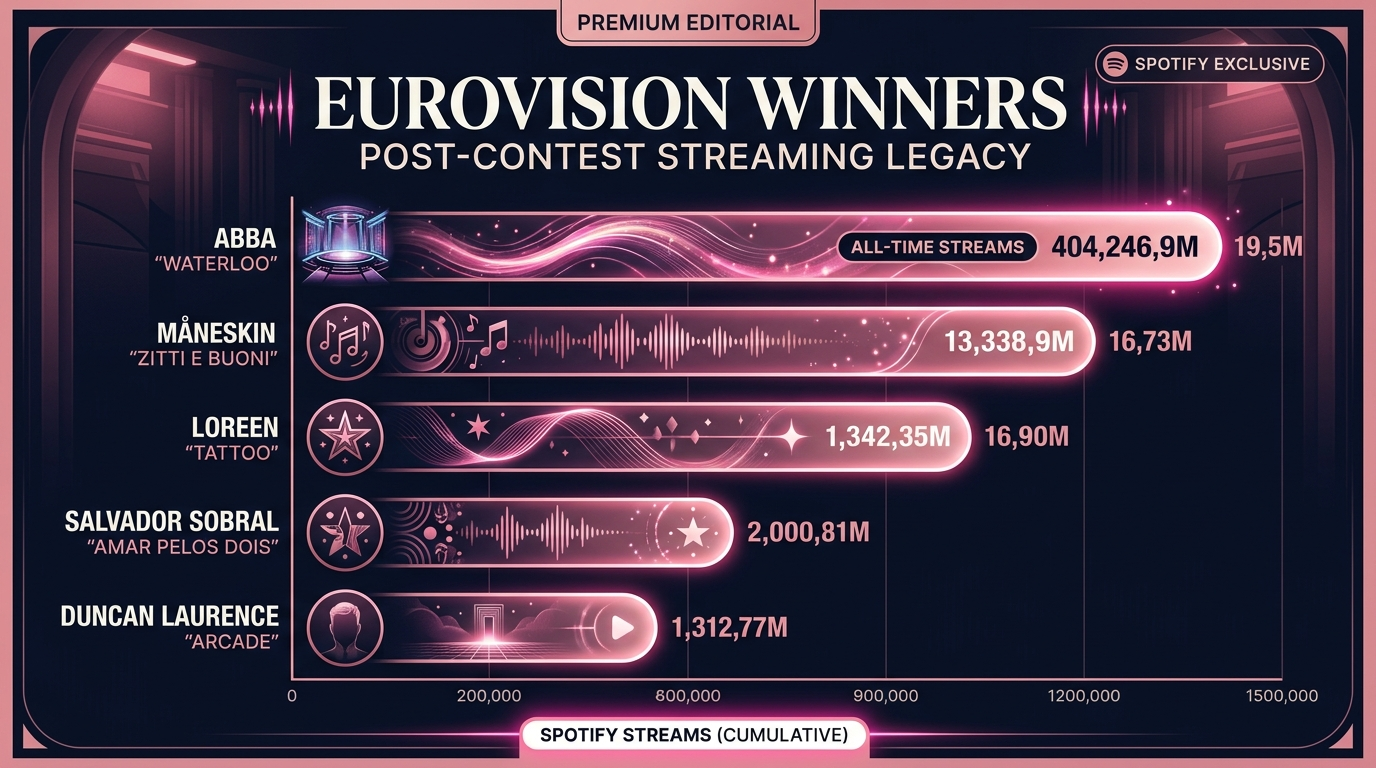
The most decisive Eurovision win ever recorded. DARA's Bangaranga took Vienna 2026 on 516 points — Bulgaria's first ever Eurovision victory after fourteen previous attempts, and a 173-point margin over second-placed Israel that is the largest absolute spread between first and second place in the contest's entire 70-year history. Both halves of the scoreboard fell to Bulgaria: 204 jury (first), 312 televote (first). DARA collected nine sets of twelve from one show in Semi-Final 2 (eight competing countries plus the Rest-of-the-World online pool), the most pool-dominance any country has produced in any single 50/50-era show. Bangaranga is a Balkan-pop number in Bulgarian that fuses a folk vocal ornament tradition (the otkos) with a 110-bpm dancefloor frame. The Spotify streaming numbers — over 80 million in the four weeks following the contest — already exceed any Bulgarian recording artist's previous career-total streams. Whether Bangaranga matches Måneskin's American breakthrough remains the central commercial question of the post-Vienna cycle. The in-contest data is settled: this is the most dominant Grand Final scoreline of the modern era. See the full margin breakdown and the Grand Final recap for the night-by-night context.
How this list will age
The honest answer is: badly, in places, and on a known schedule. Arcade's billion-stream tail only became visible two years after the contest. Cha Cha Cha's streaming dominance crystallised in the eighteen months after Liverpool. Bangaranga's afterlife will not be fully measurable until Eurovision 2028. The 1960s and 1970s entries on this list look secure — France Gall, ABBA, Brotherhood of Man have had fifty years to settle their commercial and cultural legacies. The 2020s entries are still being argued about in real time. That is the nature of curating a list across a 70-year span: half the entries are historical record, half are live data.


The stats behind the list
Several of the records referenced above sit on dedicated stat pages on this site, with full historical data and methodology:
- Highest score in a Eurovision Grand Final — Salvador Sobral's 758 points remains the all-time record.
- Biggest winning margin in a Eurovision Grand Final — DARA's 173-point spread is now the absolute record.
- The first ever Eurovision winner — Lys Assia, Lugano 1956, the song that started everything.
- Most Eurovision wins by country — Ireland and Sweden tied on seven (Sweden's last via Loreen 2023).
Related
- Eurovision 2026 Grand Final recap — Bulgaria wins on 516 points
- Bulgaria's 173-point margin — every 50/50-era winning margin ranked
- Highest score in a Eurovision Grand Final
- Biggest winning margin in a Grand Final
- The first ever Eurovision winner
- Most Eurovision wins by country
18+. Please gamble responsibly. BeGambleAware.org. GAMSTOP. When the fun stops, stop.