
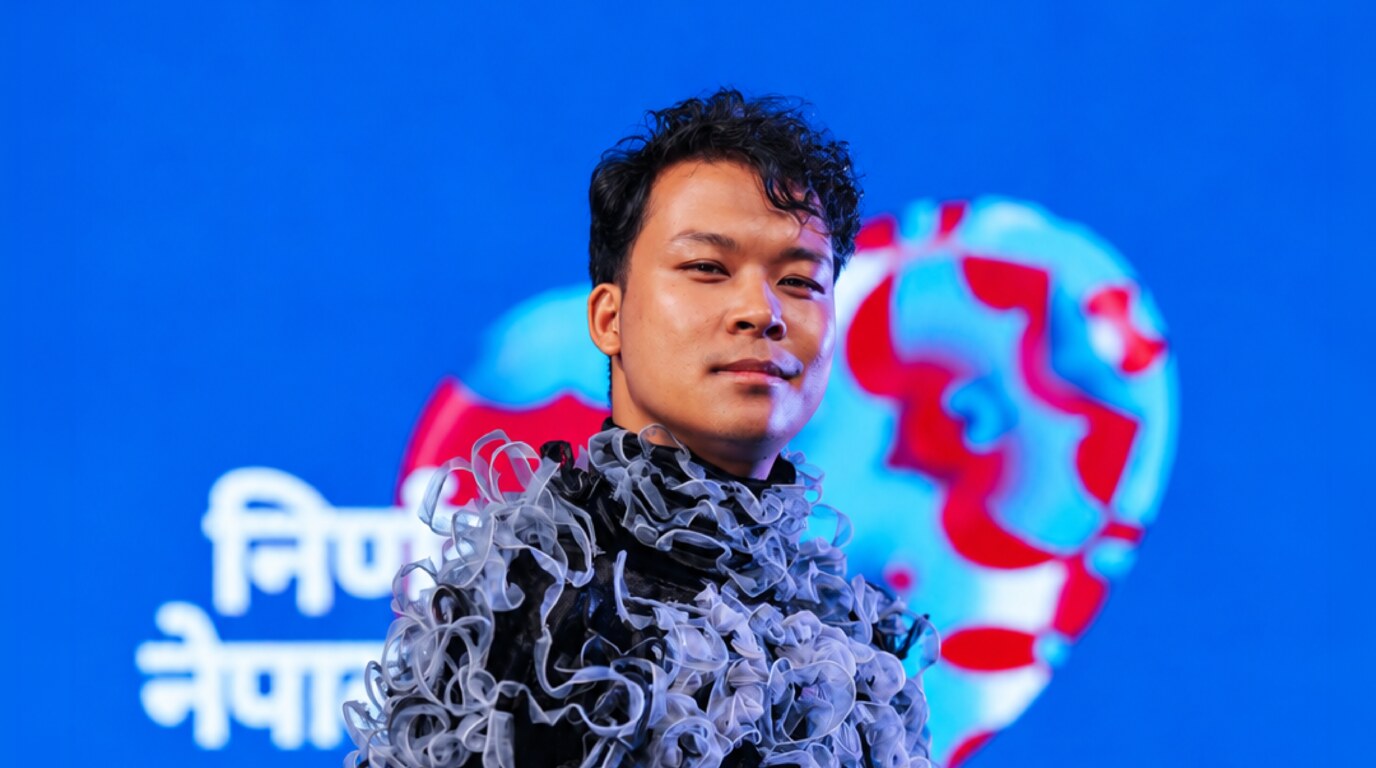
Pratik Himal Rai will represent Nepal at Eurovision Asia 2026 with “Ananta Maya”. He won Nepal Decides on Himalaya TV on Wednesday 7 October, beating ten other acts under the contest’s 40% jury / 40% domestic public / 20% rest-of-world split. It is Nepal’s first entry in any Eurovision contest, it takes the field to nine complete entries of eleven, and it arrived nearly a full day after the show ended — because nobody published a result on the night.

18+ | New customers only | T&Cs apply | Please gamble responsibly
Photo: Eurovision Song Contest Asia — Pratik Himal Rai at Nepal Decides, Kathmandu, 7 October 2026.
Key takeaways
- Winner: Pratik Himal Rai with “Ananta Maya”, ahead of Allam Aadesh (“Byakta”) and Bullet Flo x Preeti Kaur (“Golden Danphe”).
- A top three, and nothing below it. Eight of the eleven placings were never published. That is more than Vietnam gave and less than six other countries gave.
- The result took most of a day to surface. Nearly three hours after the broadcast ended there was still no winner on Himalaya TV, eurovisionasia.com or any of the fan press.
- The voting was unusually prescriptive: viewers had up to eight votes each but had to spread them across at least three different songs.
- Nine entries of eleven are now complete. Only Mongolia (10 October) and Cambodia (17 October) are left, 37 days before the Grand Final.
- The market did not react. Again. Nepal is still marked at 5¢ on Kalshi, unchanged, on a board that has not traded since 5 October.
What’s on this page
What happened in Kathmandu · The result, and the eight placings nobody published · Where Nepal sits on the transparency table · Who Pratik Himal Rai is · The eight-vote rule · What is left to decide · The betting position
What happened in Kathmandu
Nepal Decides was broadcast by Himalaya TV and on domestic OTT platforms at 19:30 NPT (15:45 CEST, 13:45 UTC) on Wednesday 7 October, hosted by Roneeshma, with the international feed carried on the official Eurovision Song Contest YouTube channel. Eleven acts competed, each with one song, and the winner took both the artist slot and the song slot for Bangkok.
The show should have happened on 19 September. It was pushed back after the flash flooding that hit northern Nepal and Tibet in August, which affected five districts. That three-week delay is why Nepal ended up as one of the last countries to decide, rather than one of the first.
We previewed the field and the timing in our run-in to the last four selections, where Nepal was flagged as the single largest unknown left in the contest — eleven songs and no pre-named artist, against three countries that were only revealing songs for performers already chosen. That is exactly how it played out: this is the one selection in the closing stretch that changed the shape of the field rather than filling in a blank.
The result, and the eight placings nobody published
The published result is three lines long.
| Place | Act | Song | Status |
|---|---|---|---|
| 1 | Pratik Himal Rai | Ananta Maya | To Bangkok |
| 2 | Allam Aadesh | Byakta | Published |
| 3 | Bullet Flo x Preeti Kaur | Golden Danphe | Published |
| 4–11 | Amit Baral, Amrita Limbu, Beyond, Meghna Gewali, Nirmala Ghale, Prithvi Khanal, RC Rimal, Suraj Tamang — in no published order | Withheld | |
No points were released, and no split between the jury, the Nepali public and the rest-of-world vote. So the three components that decided this — the 40, the 40 and the 20 — are each invisible, and there is no way to tell whether Pratik Himal Rai won on the jury, on the home vote, or on the international one.
That matters more here than it would in a European final. The 20% rest-of-world slice is the only part of a national selection that behaves anything like the audience Bangkok will have, and it is the number every one of these shows could publish at no cost. None has.
There is a second oddity worth recording plainly: the result did not appear on the night. Our 7 October check, two and three-quarter hours after the broadcast started, found nothing on Himalaya TV, nothing on eurovisionasia.com, nothing on Eurovoix beyond its pre-show preview, and nothing in search. The winner surfaced through the fan press the following day. For a contest asking a global audience to vote, a result that takes a day to publish is a gap in the product, not just in the coverage.
Where Nepal sits on the transparency table
We have tracked what each selection actually published all season, because it is the one quality measure available before anyone hears a note in Bangkok.
| Country | Selection | What was published | Grade |
|---|---|---|---|
| South Korea | Korea’s Next Wave | The fullest result of the season | Best |
| Bhutan | Rhythm of Bhutan | At least a top three | Good |
| Philippines | Philippine Selection Night | At least a top three | Good |
| Laos | Sieng Lao The One | At least a top three | Good |
| Thailand | Thailand’s Chosen One | At least a top three | Good |
| Bangladesh | Voice of Bangladesh | At least a top three | Good |
| Nepal | Nepal Decides | Top three, eight placings withheld, no points | Partial |
| Vietnam | The Sound of Vietnam | Winner only — no second place at all | Worst |
| Malaysia, Mongolia | Internal / song-only | No contest to report | N/A |
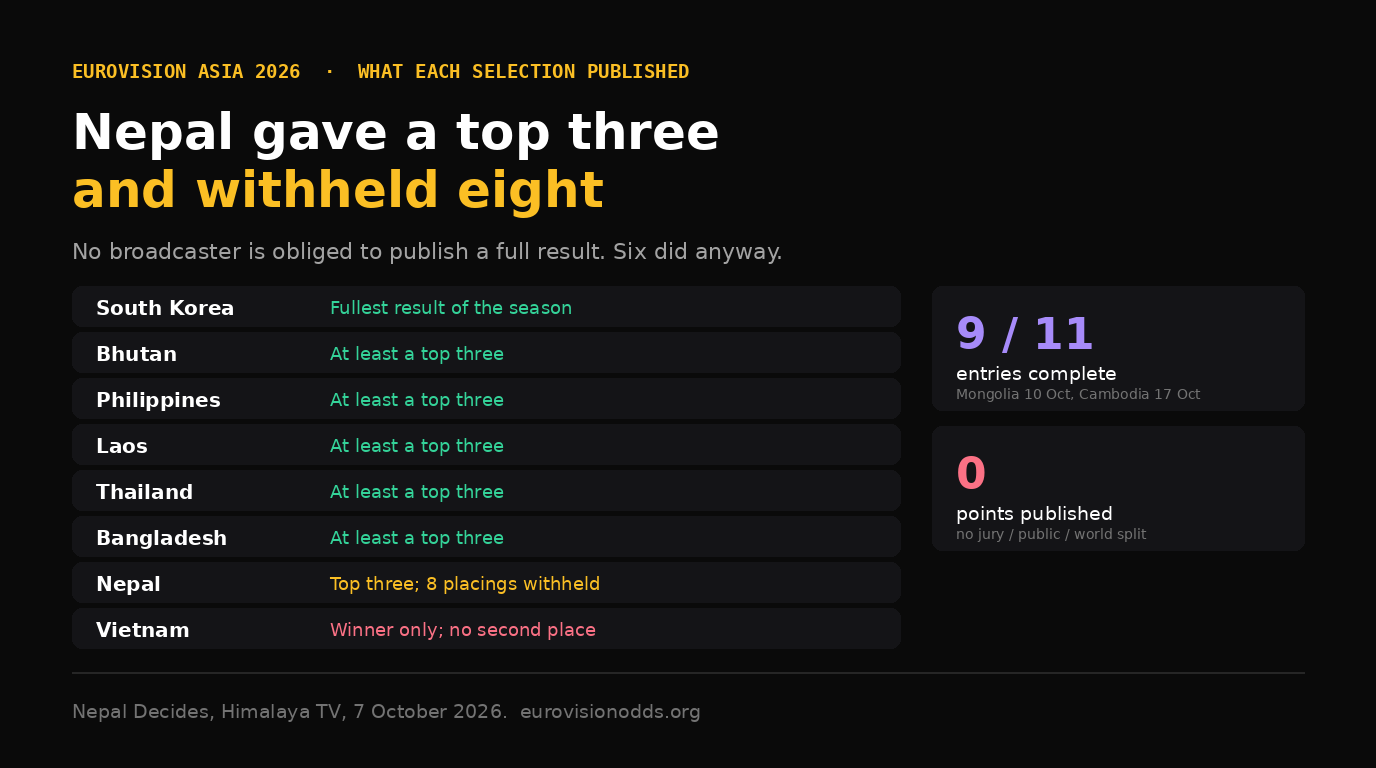
Nepal lands in the middle. It cleared the bar Vietnam failed — Vietnam published a winner and literally nothing else — without reaching what six other broadcasters managed. Nothing in the contest’s Voting Terms obliges any of them to publish a full result, so this is a standards gap rather than a breach, and it is one the organisers could close for the 2027 edition with a single line in the rules.
Who Pratik Himal Rai is
He is a Nepali singer-songwriter with more than a decade behind him and a bachelor’s degree in music, who built his audience through television appearances rather than streaming. His catalogue runs through ballads, slow rock, Nepali folk and folk-pop, and he has two original releases to his name. That is a smaller commercial footprint than most of this field: he is not the kind of established domestic star that Vietnam, Malaysia and South Korea have sent.
The profile is worth reading against the song title. Ananta Maya translates as something close to “infinite love”, and a folk-inflected ballad from a singer whose stated interest is “meaningful storytelling” is a very different proposition from Thailand’s club record or South Korea’s pop production. Whether that is an advantage depends entirely on the staging, and on how a 50/50 jury and televote in Bangkok treats a quiet song on a bill that is mostly not quiet.
One caution: no songwriting credits for “Ananta Maya” have been published, by Himalaya TV or by the organisers. Songwriter credits have been the hardest fact to pin down across this season’s selections, and we are not going to guess at them. The Nepal country page carries the running profile and will be updated when they appear.
The eight-vote rule
One mechanical detail is more interesting than it looks. International viewers voting through the Eurovision Asia website could cast up to eight votes each, but had to spread them across at least three different songs.
That is a deliberate anti-bloc design. A single fanbase cannot pile all eight votes onto one act; two thirds of a voter’s weight has to go somewhere else. In a contest whose first edition has no voting history and an obvious exposure to organised fan campaigns and diaspora blocs, that constraint is doing real work, and it is the kind of rule European Eurovision has never applied to its own televote.
It also means the 20% rest-of-world slice is structurally flatter than a free televote would be, which makes it harder for any one country to win a selection on international mobilisation alone. Worth remembering when the same question comes up about the Grand Final on 14 November, where the public half is split across eleven countries plus a rest-of-world vote.
What is left to decide
Nine of eleven entries are now complete — artist and song both settled. Two remain.
| Date | Country | Event | What is decided | Days to rehearse |
|---|---|---|---|---|
| 10 October | Mongolia | Mongolia’s Chosen One | Beck’s song, picked by the public | 35 |
| 17 October | Cambodia | Cambodia’s Finest Voice | Artist and song, from seven acts | 28 |
| 13 November | — | Full preview show | One Bangkok Forum | — |
| 14 November | — | Grand Final | One Bangkok Forum, 19:30 ICT | — |
Cambodia remains the one country whose entry nobody can assess at all: seven named acts, no songs in public, and the shortest rehearsal window in the contest. Mongolia is a song reveal rather than a contest — Beck was confirmed on 1 October and the public simply picks which of his songs travels.
The betting position
There is still no fixed-odds bookmaker pricing Eurovision Asia, and Polymarket lists no market for it. Kalshi’s eleven-country winner board is the only venue, and it did not move.
Nepal is marked at 5¢, exactly where it has been since the market opened on 14 September, with no bid at all and an ask of 84¢. A country completed its entry — named an artist, named a song, published a top three — and the contract attached to that country recorded nothing. That is the second consecutive time this has happened: Vietnam’s entry completing on 3 October produced no trade either, until a single eleven-contract print two days later took it from 10¢ to 84¢.
The board as a whole is unchanged from 5 October: eleven last-traded marks summing to 227% of a field in which exactly one country wins, ten of eleven contracts with no bid at all, and total lifetime volume of 3,488 contracts of which Laos alone is about 71%. We set out how this market is built and why its prices do not behave when it opened.
Read as a probability, 5¢ on a board that overrounds to 227% normalises to roughly 2% — which is about where we would put Nepal on what is currently known, which is a title and an artist biography. That is the one case this season where the stale mark and a reasonable estimate happen to agree, and it is a coincidence rather than a signal. For what actually priced markets look like, see our winner odds coverage and the bookmaker guide.
Sources
- Eurovoix, 7 October 2026 — the result, the top three, the host and broadcaster.
- Eurovision Song Contest Asia — timing, the 40/40/20 split, the eight-vote rule and Pratik Himal Rai’s profile.
- Aussievision, 7 October 2026 — confirmation that the remaining eight placings were withheld.
- Market figures read from Kalshi’s public API on 8 October 2026. Polymarket’s Gamma API, read the same day, lists no Eurovision Asia market.
Prices move. Check any figure here before acting on it.