
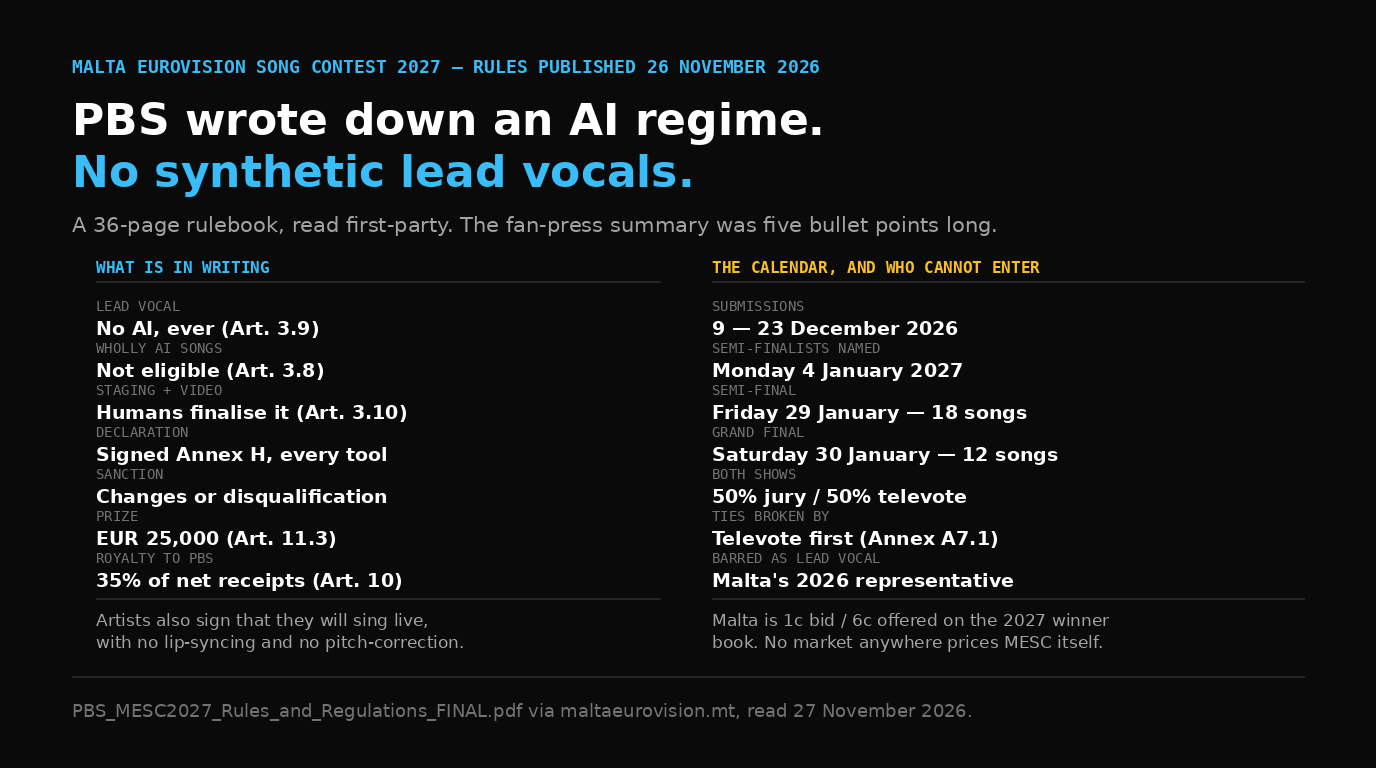
Malta’s public broadcaster has published the full Malta Eurovision Song Contest 2027 rulebook, and it bans artificial intelligence from the lead vocal outright. PBS released the regulations on 26 November 2026 together with the dates: submissions open on 9 December, the semi-final is on Friday 29 January 2027 and the grand final on Saturday 30 January. The winner goes to Burgas.

18+ | New customers only | T&Cs apply | Please gamble responsibly
The dates were reported widely within hours. The document was not. What follows is read from the 36-page PDF itself, because the five bullet points that went round the fan press on 26 November leave out the most consequential thing in it.
Key takeaways
- No AI may generate, enhance, replace or imitate the lead vocal — in the submitted recording or in the live performance. Article 3.9 extends the ban to backing vocals, harmonies and vocal effects.
- Every entrant signs a written AI declaration (Annex H) listing each tool used and how. PBS may demand changes to, or disqualify, an entry whose declaration is false or incomplete.
- Malta’s 2026 representative cannot enter. Article 1.3 bars both the previous MESC winner and the previous Eurovision representative from being lead vocal, which rules out AIDAN.
- The winner is paid €25,000 and PBS takes 35% of net receipts from commercial exploitation of the song. Neither figure was in the day’s coverage.
- Both shows are 50% jury and 50% televote, equalised by a quota, and ties are broken on the televote first.
- Nobody prices MESC. No bookmaker and no prediction market lists a Malta Eurovision Song Contest 2027 book. Malta itself is quoted on the Polymarket 2027 winner market, and barely.
The calendar PBS has committed to
The schedule is in the regulations as a dated table, not as a press line, which matters because it is the version the rules bind PBS to.
| Stage | Date | Detail |
|---|---|---|
| Submissions open | Wednesday 9 December 2026 | Via maltaeurovision.mt |
| Submission deadline | Wednesday 23 December 2026 | A 15-day window |
| Semi-finalists announced | Monday 4 January 2027 | 18 songs named |
| Semi-final | Friday 29 January 2027 | 18 songs, 12 qualify |
| Grand final | Saturday 30 January 2027 | 12 songs, one winner |
Two details are worth holding on to. The submission window is a fortnight, and it runs across Christmas — songwriters who want in have to be close to finished already. And the gap between the semi-finalists being named on 4 January and the semi-final on 29 January is under four weeks, which is a short promotional runway by the standards of the national finals that open the 2027 season.
The AI regime is the story, and it is stricter than the EBU’s
Articles 3.8 to 3.12 run to roughly 500 words. PBS says they follow the EBU’s own AI Usage Guidelines, but the vocal clause goes further than a disclosure regime: it is a prohibition.
Article 3.8 requires that each song, music and lyrics, “must be created by humans, be original and remain the author’s own intellectual creation”. AI tools “may be used only in a supportive role in the creative process, provided that the human authors retain full artistic control and AI does not substitute their creative contribution”. The sentence that disposes of the obvious workaround: “Wholly AI-generated Songs, lyrics or performance content are not eligible.”
Article 3.9 is the one with teeth. “AI may not be used to generate, enhance, replace or imitate the Lead Vocal in any way, whether in a recording submitted to or used in the Contest or in the live performance.” It continues: “AI-generated or synthetic vocals, including deepfakes and imitations of real individuals, are prohibited, including for backing vocals, harmonies and vocal effects.” And then the clause that reaches past the song and into the staging: no synthetic media or “AI-generated enhancement may be used to create a false impression of an Artist’s vocal or performance capability”.
Read that last line beside the declaration artists sign in Annex G, which includes the undertaking: “I will sing live, without lip-syncing or pitch-correction, and no AI or synthetic voice has been or will be used to generate, enhance, replace or imitate my vocals.” Taken together, PBS has written a rule against the modern studio, not just against generative models. A national final that enforces it literally would be a notably dry-sounding television show.
Article 3.10 handles the visuals, and it draws the line in a different place: AI-assisted sketches, staging concepts, screen-content prototypes and video drafts are allowed, but the final staging, LED content, costumes, choreography and any video used on stage must be “created by humans”, and “every AI-assisted element must be shaped and finalised by human creators”. Draft with it, do not ship it.
Article 3.12 closes the loop on training data. No participant may use MESC or Eurovision footage, performances or songs — including those of other participants — to train AI models without written permission from PBS and, where applicable, the EBU. AI may not be used in promotional content “to manipulate or mislead audiences, to create deceptive imagery, or to distort the perception of other Participants”.
Enforcement sits in Article 3.11: participants must declare in writing every AI tool used in any part of the entry, including staging, visuals, costumes and choreography, and PBS “will rely on these declarations when making the disclosures required by the EBU”. A false or incomplete declaration is grounds for disqualification. Annex H is the form, with a tick-box per element and a table naming each tool.
What else is in the rulebook that nobody reported
Four things, in descending order of how much they should change your reading of this selection.
AIDAN cannot enter. Article 1.3 makes ineligible as lead vocal anyone who was the declared MESC winner in the immediately preceding edition, or Malta’s Eurovision representative in the immediately preceding season. Both describe AIDAN, who won MESC 2026 and sang “Bella” in Vienna. He finished 18th in the final with 89 points — and the shape of that score is the interesting part. AIDAN took 81 points from the juries and 8 from the public. Malta also topped the whole field on cumulative YouTube views before the contest, at 7.2 million, and still came 18th. Our 2026 results page has the full table.
The money is specified. Article 11.3 pays the winning artist €25,000 within 30 days of the final, as a contribution to their own Eurovision costs, repayable in full if they withdraw. Separately, Article 10 gives PBS 35% of net receipts from commercial exploitation of the song outside the Eurovision deliverables. That is a real commercial term, and it is the kind of thing that shapes who bothers entering.
Eligibility is tighter than “Maltese”. Every performer, including backing vocalists and dancers, must be 18 on the day of the first Eurovision 2027 rehearsal — the EBU’s raised age floor, applied down the chain. Solo lead vocals must be Maltese or resident in Malta for the 24 months before 1 May 2027; for duos and groups, at least half the lead vocals must qualify. At least one credited lyricist or composer must be Maltese or Malta-resident. Songs must not have been released or publicly performed before 1 September 2026.
There is an outage clause, and bettors should know it exists. Annex A10.1: if a televote channel suffers a material outage or integrity failure, PBS may extend the window, rely on the remaining channels, or “in extreme cases, determine the result by Jury only”. That is a documented path by which a 50/50 contest becomes a 100% jury contest. It is unlikely. It is also written down, which is more than most national finals can say.
How the vote actually works
Annex A sets both shows at 50% professional jury and 50% public televote, with the jury no smaller than five members. Each juror ranks every song from 1 to 10, and the public pot is then sized to match the jury pot exactly, using a quota:
Quota = Total Valid Votes ÷ (58 × Number of Jury Members)
Each song’s public points are how many whole times its vote count clears that quota. The effect is that the televote cannot outweigh the jury no matter how many votes are cast, which is the same equalising logic Eurovision itself uses, spelled out arithmetically rather than left to a results producer.
The tie-break order is the detail to remember: combined score first, then higher televote points, then the most 12-point scores from the jury, then the most 10s. On a knife-edge final, the public breaks the tie. PBS also commits in Annex A6 to publishing the jury and televote points separately after the final, which is not universal and is the single most useful thing a punter can ask of a national final.
The betting angle: there is nothing to bet on, and that is the point
No bookmaker and no prediction market lists a Malta Eurovision Song Contest 2027 market. Not Polymarket, which has opened national-final books on Eesti Laul, Benidorm Fest, Festivali i Këngës and Canada’s Choice; not Kalshi; and no fixed-odds bookmaker we can find. With submissions not even open until 9 December and the field unnamed until 4 January, there is nothing yet for a book to be about. Expect that to change in the first week of January, as it did for the other four.
What does exist is Malta on the Polymarket Eurovision 2027 winner book, and it is a reminder of how little a thin quote tells you. At the read taken at 2026-11-27 17:04:48 UTC, Malta was 1c bid against a 6c offer, a 5-cent spread on a contract whose last trade printed at 0.2c. The midpoint of a quote that wide is an arithmetic average of two numbers nobody has agreed to, not a probability, and we are not going to dress it up as one. Lifetime volume on the Malta contract is about $88.
For context on the book as a whole: at the same read the 36 contracts’ midpoints summed to 169.7%, against the 100% a coherent book would show, and 7 of the 36 had never traded at all. We track that book on the winner odds page, and the bookmakers page explains which venues accept which markets.
The honest position on Malta as a 2027 outright: there is no information in the price, there is no field, and the one structural fact worth carrying is that the country that just posted an 81-jury / 8-televote split is about to run a 50/50 selection without its incumbent. That is a reason to wait for the songs, not a reason to take 6c.
Where 30 January sits in a 2027 calendar that is filling up fast
Malta is the second national final to put a hard date on the last weekend of January, and the 2027 selection season now has a visible shape.
| Country | Selection | Final | Field known? |
|---|---|---|---|
| Albania | Festivali i Këngës 65 | 17–20 December 2026 | Yes — 28 songs |
| Estonia | Eesti Laul 2027 | 30 January 2027 | Yes — 12 songs |
| Malta | Malta Eurovision Song Contest | 30 January 2027 | No — named 4 January |
| Latvia | Supernova 2027 | 6 February 2027 | Yes — 16 plus a wildcard |
| Cyprus | Song for George Perris | 6 February 2027 (reported) | No — submissions close 13 December |
| Lithuania | Eurovizija.LT 2027 | 20 February 2027 | No |
| Italy | Sanremo, night four | 19 February 2027 | Partly |
Two clashes stand out. Malta and Estonia both final on Saturday 30 January, and Latvia and Cyprus are both reported for Saturday 6 February. For anyone trading these books, that means two settlement nights carrying two countries each.
The Cyprus date needs a caveat we are going to state plainly rather than bury. It was given by Marileni Stavrou on Omega TV’s programme “Pame paréa” on 27 November and reported by Eurovoix. Stavrou is one of the three announced hosts of the show, so she is about as well placed as a non-broadcaster source gets — but CyBC has published nothing, and its corporate site carried no announcement when we checked on 27 November. We are recording 6 February as reported, not confirmed. What is confirmed is that George Perris was internally selected on 4 November and that song submissions close on 13 December; our running account of all of this is on the Eurovision 2027 page.
What to watch next
- 9 December: MESC submissions open. The volume of entries is the first read on whether the 35% royalty term and the AI declaration have put writers off.
- 23 December: submissions close. PBS has historically not published a submission count straight away; if it does, that is the number to note.
- 4 January: the 18 semi-finalists. This is the day a MESC book becomes possible, and the day to check whether Polymarket opens one.
- 29–30 January: the shows. Watch whether PBS publishes the split, as Annex A6 commits it to.
- Any AI disqualification. PBS has given itself a written power and a declaration to enforce it against. The first time a broadcaster actually uses an AI clause on a Eurovision entry will be a genuine precedent, and we will cover it.
Our wider coverage of the 2027 field, country by country, is on the Eurovision 2027 page, and the stats pages hold the historical record Malta is trying to improve on: 39 participations, no wins, and a best of second place in 2002.
Sources: the MESC 2027 Rules & Regulations, read in full from the PDF published by PBS; the dates and the announcement from TVM News, PBS’s own newsroom, 26 November 2026; cross-checked against Eurovoix the same day. Market figures read from the Polymarket Gamma API at 2026-11-27 17:04:48 UTC. Malta’s 2026 scores are from this site’s own results data.