
Polymarket has Spain favourite to win Junior Eurovision 2026, eight days before the contest in Malta — but the lead rests on the widest order book among the contenders, the defending champion has drifted, and two of the board’s eighteen country contracts are for countries that are not competing at all. Read on the morning of 16 October (UTC), this is what the only market on the contest actually says, and how much of it you should believe.

18+ | New customers only | T&Cs apply | Please gamble responsibly
Illustration: an empty, brightly lit children’s song contest stage before a show. Generated image — no real venue or person depicted.
Key takeaways
- Spain leads at 25.85% — but that is the midpoint between a 12¢ bid and a 39.7¢ offer. Spain and Poland’s last trades are level at about 34¢.
- Poland 20.5%, Armenia 17.5%, then France, Ukraine, Cyprus, Georgia, North Macedonia and San Marino all bunched between 11.8% and 13.85%.
- Ukraine has fallen from favourite: 22% in late August, 13.5% now. It is still the most-traded real contender and has the tightest book of the top nine.
- France won in 2025 and is priced at 13.85%, down from 19.2% in August.
- Azerbaijan and Croatia are not competing — and Polymarket still lists both. Azerbaijan is the single most-traded contract on the whole board.
- Normalised to 100%, Spain is about 16%. The sixteen real contracts’ midpoints add up to 158%.
What’s on this page
The contest · The board · Spain’s lead, and how wide it is · Ukraine and France drifting · Two contracts for countries that are not there · The liquidity is not what it looks like · Normalised · How we would read it
The contest
The Junior Eurovision Song Contest 2026 is on Saturday 24 October at the Malta Fairs & Conventions Centre in Ta’ Qali, hosted by Gaia Cauchi, Destiny Chukunyere and Keane Cutajar. It is the third time Malta’s PBS has staged it, after 2014 and 2016, and the first Junior Eurovision ever held in October. Sixteen countries take part; Azerbaijan and Croatia both opted out after competing last year. France won in 2025 and declined to host this year, citing budget cuts.
Voting is split 50/50. Each country’s professional jury awards 12, 10 and 8–1 points to ten songs; viewers around the world vote for three songs online, with those votes distributed proportionally. Online voting opens at 23:59 CEST on 23 October.
| Country | Act | Song |
|---|---|---|
| Albania | Eslin Kurti | Kërce Me Mua |
| Armenia | Naré | BOO! |
| Cyprus | Harry Georgiou | Who I Can Be |
| France | Alec | Comment Tu Vas ? |
| Georgia | Davit Lomidze | Sun on the Rooftops |
| Ireland | Caleb Kirwan & Naomi Gribben | Níos Láidre |
| Italy | Matteo Trullu | Che Cos’è l’Amore? |
| Malta | Beppe | Blue Bird |
| Montenegro | Mija Vujović | Muzika Nas Spaja |
| Netherlands | Maria | Stronger Together |
| North Macedonia | Ana Stojanoska | Idnata Jas |
| Poland | Wiktor Sas | Gravity |
| Portugal | Salvador Rio | Alma |
| San Marino | Violamarie | Ruota Panoramica |
| Spain | Lucas Paulano | Cuore Bello (Te Quiero, Te Quiero) |
| Ukraine | Erika Kolesnichenko | NOT A LULLABY |
The board
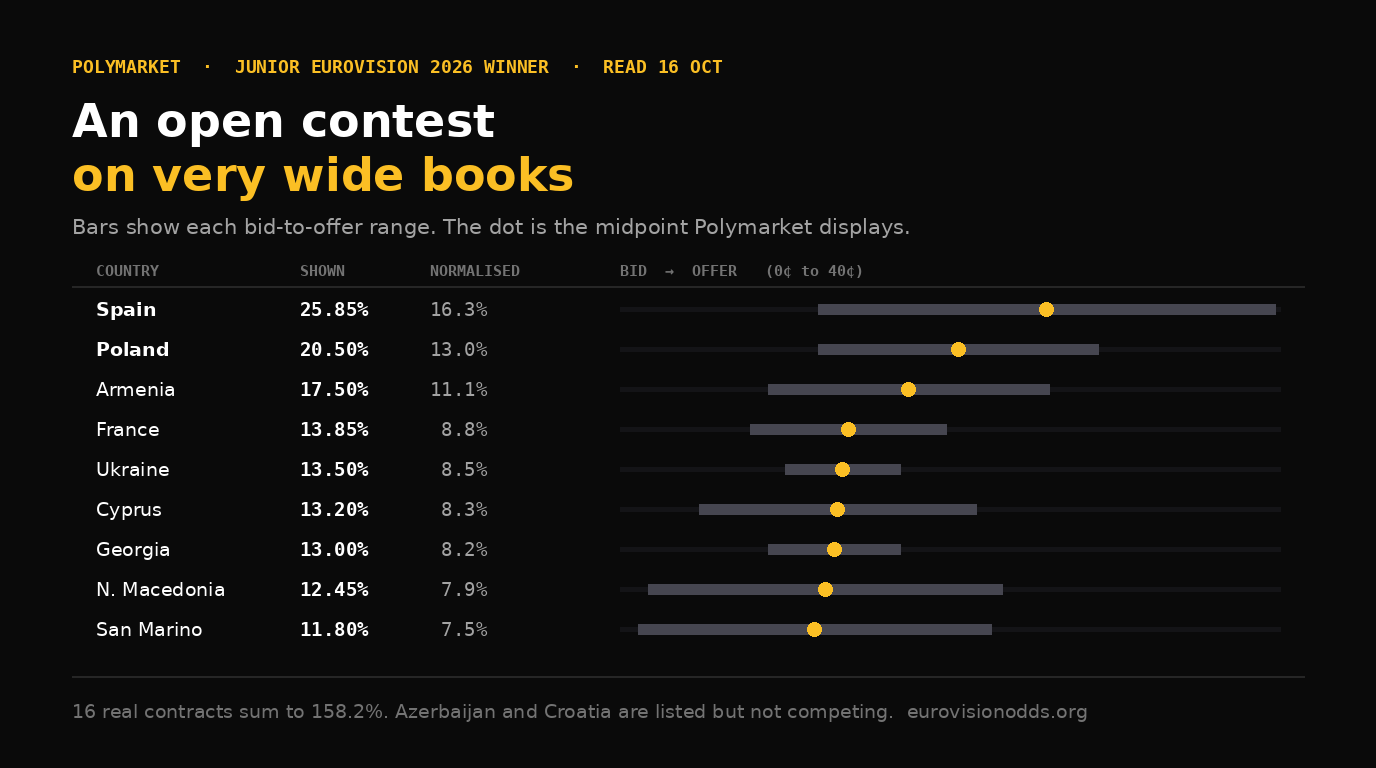
Polymarket’s Junior Eurovision Winner 2026 market has about $11,400 of lifetime volume. Each country is a separate yes/no contract paying $1 if that country wins. The price Polymarket displays is the midpoint between the best bid and the best offer, so the bid, the offer and the last trade are shown alongside it — on a book this thin they tell you more than the headline number.
| Country | Shown | Bid | Offer | Last trade | Volume |
|---|---|---|---|---|---|
| Spain | 25.85% | 12.0¢ | 39.7¢ | 33.9¢ | $315 |
| Poland | 20.50% | 12.0¢ | 29.0¢ | 34.0¢ | $445 |
| Armenia | 17.50% | 9.0¢ | 26.0¢ | 24.0¢ | $589 |
| France | 13.85% | 7.9¢ | 19.8¢ | 19.8¢ | $519 |
| Ukraine | 13.50% | 10.0¢ | 17.0¢ | 16.0¢ | $2,096 |
| Cyprus | 13.20% | 4.8¢ | 21.6¢ | 1.0¢ | $336 |
| Georgia | 13.00% | 9.0¢ | 17.0¢ | 14.0¢ | $507 |
| North Macedonia | 12.45% | 1.7¢ | 23.2¢ | 3.8¢ | $344 |
| San Marino | 11.80% | 1.1¢ | 22.5¢ | 4.8¢ | $387 |
| Albania | 3.60% | 1.3¢ | 5.9¢ | 1.3¢ | $523 |
| Netherlands | 3.40% | 0.9¢ | 5.9¢ | 4.0¢ | $339 |
| Malta (host) | 2.15% | 0.3¢ | 4.0¢ | 0.5¢ | $323 |
| Montenegro | 2.05% | 1.0¢ | 3.1¢ | 1.1¢ | $618 |
| Italy | 2.00% | 0.6¢ | 3.4¢ | 0.4¢ | $329 |
| Ireland | 1.90% | 0.5¢ | 3.3¢ | 6.0¢ | $286 |
| Portugal | 1.45% | 0.3¢ | 2.6¢ | 0.5¢ | $283 |
| Azerbaijan — not competing | 1.75% | 0.7¢ | 2.8¢ | 1.6¢ | $2,552 |
| Croatia — not competing | 1.55% | 0.3¢ | 2.8¢ | 5.0¢ | $595 |
The event page also carries sixteen empty placeholder contracts (“Country A” to “Country O”, plus “Other”) shown at 50% with no orders at all. They are not prices and should be ignored; we leave them out above.
Spain’s lead, and how wide it is
Spain’s 25.85% is the headline, and it is the least solid number on the board. It is the midpoint of a 12¢ bid and a 39.7¢ offer — a spread of almost 28 points. Anyone wanting Spain right now pays nearly 40¢; anyone wanting out gets 12¢. The last trade, 33.9¢, is above the midpoint, which suggests buyers have been paying up, but on $315 of lifetime volume that is a handful of tickets.
Poland is the more interesting contract. Its midpoint is lower, at 20.5%, but its last trade — 34¢ — is the same as Spain’s, and its spread is tighter. On what has actually changed hands, Spain and Poland are level. Poland’s Wiktor Sas sings “Gravity”; TVP has said the performance is directed by Tomasz Motyl with choreography by Tomek Prządka and four dancers chosen by open casting.
Ukraine and France drifting
On 27 August, when we first covered this market, Ukraine led at 22%, ahead of Cyprus at 19.4%, France at 19.2% and Armenia at 19.0%. Since then the field has been reshuffled:
- Ukraine 22% → 13.5%. Still the most-traded genuine contender at $2,096, and the only one of the top nine with a book as tight as 10¢/17¢. If you want a price that reflects real two-sided trading, Ukraine’s is it.
- France 19.2% → 13.85%. The defending champion, which declined to host this year, has drifted further than any other contender.
- Cyprus 19.4% → 13.2% — with a last trade of just 1¢, which says someone sold out at almost nothing while the quotes either side stayed wide.
- Armenia 19.0% → 17.5%, the steadiest of the four.
None of those moves is tied to anything we can point to, and on volumes of a few hundred dollars per contract they would not need to be.
Two contracts for countries that are not there
Azerbaijan and Croatia are not taking part in Junior Eurovision 2026. Polymarket still lists both, at 1.75% and 1.55%, with bids of 0.7¢ and 0.3¢. The market’s own rules say that if it becomes impossible for a listed candidate to win, that contract may resolve No immediately — which both of these already are.
The striking part is the volume. Azerbaijan, at $2,552, is the single most-traded contract on the whole board — more than Ukraine, more than Spain and Poland combined. The data does not say when it traded, and some of it may predate the withdrawal. But someone paid 5¢ for Croatia at some point too, and both contracts still have buyers. If you hold either, the price you can sell at is a fraction of a cent.
It is the same structural problem we have described on the Eurovision 2027 participants board, where confirmed news sits unpriced for days: the contracts are written in advance, and nobody is obliged to tidy them up when the facts move.
The liquidity is not what it looks like
The event page shows about $65,000 of liquidity against roughly $11,400 of lifetime volume, which looks like a deep market. It is not, and the per-contract numbers show why. Every one of the eighteen country books carries between about $3,540 and $3,770 of liquidity — Spain, Poland, Ukraine, Malta, Azerbaijan and Croatia alike. The favourite and a country that is not even in the contest have almost the same amount of money resting in their books.
That pattern is what you see when one market maker seeds every contract with a similar ladder of orders, most of them sitting well away from the midpoint. It provides a quote on every country, which is useful, but it is not conviction. The numbers that reflect what people have actually been willing to pay are the last trades and the volumes, and those are small: no real contender has more than about $2,100 traded, and most have a few hundred dollars.
The practical consequence is that a modest order can still move these prices a long way, and the headline liquidity figure will not protect you from that. Trade the bid and the offer you can see, not the total on the event page.
Normalised
Exactly one country wins, so the sixteen real contracts ought to add up to 100%. Their midpoints add up to 158.2%, mostly because the spreads are so wide. Dividing each by 158.2 gives a fairer comparison:
- Spain about 16%, Poland 13%, Armenia 11%
- France, Ukraine, Cyprus and Georgia all around 8–9%
- North Macedonia and San Marino about 7.5–8%
- Albania, the Netherlands and the rest 2% or less each — including Malta, the host, at about 1.4%
On that reading the market sees an open contest with no real favourite: no country above one in six, and nine countries with at least a one-in-thirteen chance.
How we would read it
Three things, in order of how much they matter.
Trust the last trades and the tight books over the headline. Spain’s lead is real in the sense that buyers have paid more for it than for anyone except Poland. It is not real in the sense of being a confident market view: a 28-point spread means the two sides are a long way apart.
The 50/50 vote means a winner has to land twice. The jury half rewards a polished vocal and arrangement; the online half, where viewers pick three songs each, rewards being memorable on first listen. A song that is strong on only one of those can lead a betting board and still lose, which is one more reason not to treat a single wide-spread price as a verdict.
Do not trade the dead contracts. Buying Azerbaijan or Croatia is buying a country that will not be on stage. Selling them returns a fraction of a cent. Neither is worth the attention.
The contest is a week away and rehearsals are already under way in Malta, which is when real information arrives: first clips from the stage, and how each performance actually looks live. Expect the wide spreads to narrow — and the order to change — as that happens. For the adult contest, see our winner odds coverage; the bookmaker guide covers where fixed-odds prices are offered.
Sources
- Prices, bids, offers, last trades and volumes read from Polymarket via its public API on the morning of 16 October 2026 (UTC). August figures from this site’s 27 August 2026 read.
- Participants, hosts, venue and voting system: Junior Eurovision Song Contest 2026, citing the EBU’s participant pages; song titles cross-checked against Eurovoix.
- Poland’s staging: Eurovoix, 14 October 2026.
Prediction-market prices move continuously. Check the live board before acting on anything here. 18+. Markets carry risk.