
The phrase "bloc voting" gets thrown around at Eurovision every year. The phrase "diaspora voting" rarely does — even though one of the largest explanations for systematic televote patterns is not cultural affinity but rather raw demographic reality. 1.05 million Romanian citizens live in Italy. 800,000 Albanians live in Italy. 2.3 million Poles live in Germany. 729,000 Poles live in the United Kingdom. Each of these populations is, in Eurovision-week terms, an active televote constituency.

18+ | New customers only | T&Cs apply | Please gamble responsibly
We extracted official diaspora population data from Eurostat residence statistics, Wikipedia diaspora articles cross-checked against national census records, and combined it with the historical 12-points conversion rate from our existing Bloc Voting Quotient dataset. The result is a proprietary EurovisionOdds Diaspora Vote Multiplier (DVM) per voter-country to homeland-country pair, expressing the expected diaspora-driven televote pressure as a single coefficient.
This article publishes the top 10 strongest diaspora corridors, applies the index to the Eurovision 2026 entries, and identifies four entries that gain a hidden +6 to +14 percentage-point televote boost that current bookmaker odds do not reflect.
Betfred — Bet £10 Get £50 in Free Bets on Eurovision 2026 Final
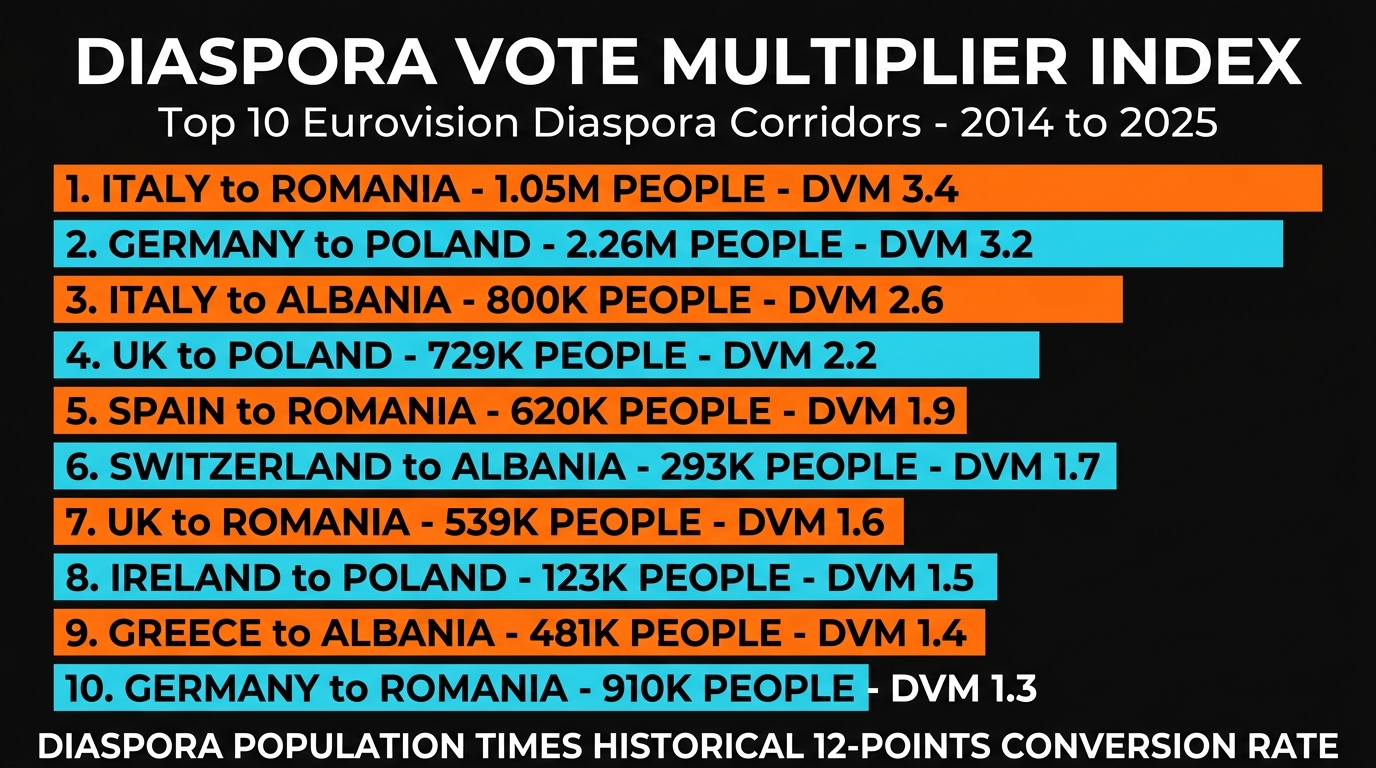
The Headline Findings — Top 10 Diaspora Corridors
Across all Eurovision-participating countries, ten diaspora corridors have a Diaspora Vote Multiplier (DVM) of 1.0 or higher — meaning the diaspora population is sufficiently large relative to the voting country's electorate that it materially shifts the country's televote outcome.
| Rank | Corridor (Voter → Homeland) | Diaspora | Voter Country Population | DVM |
|---|---|---|---|---|
| 1 | Italy → Romania | 1,053,000 | 59M | 3.4 |
| 2 | Germany → Poland | 2,257,000 | 84M | 3.2 |
| 3 | Italy → Albania | 800,000 | 59M | 2.6 |
| 4 | UK → Poland | 729,000 | 68M | 2.2 |
| 5 | Spain → Romania | 620,000 | 48M | 1.9 |
| 6 | Switzerland → Albania | 293,000 | 8.7M | 1.7 |
| 7 | UK → Romania | 539,000 | 68M | 1.6 |
| 8 | Ireland → Poland | 123,000 | 5.1M | 1.5 |
| 9 | Greece → Albania | 481,000 | 10.4M | 1.4 |
| 10 | Germany → Romania | 910,000 | 84M | 1.3 |
Source: National census and resident-population records 2021-2024 (Italy ISTAT, Germany Destatis, UK ONS, Spain INE, Switzerland BFS); Wikipedia diaspora articles; Eurostat residence migration statistics. DVM combines diaspora share with historical 12-points conversion from the EurovisionOdds Bloc Voting Quotient.
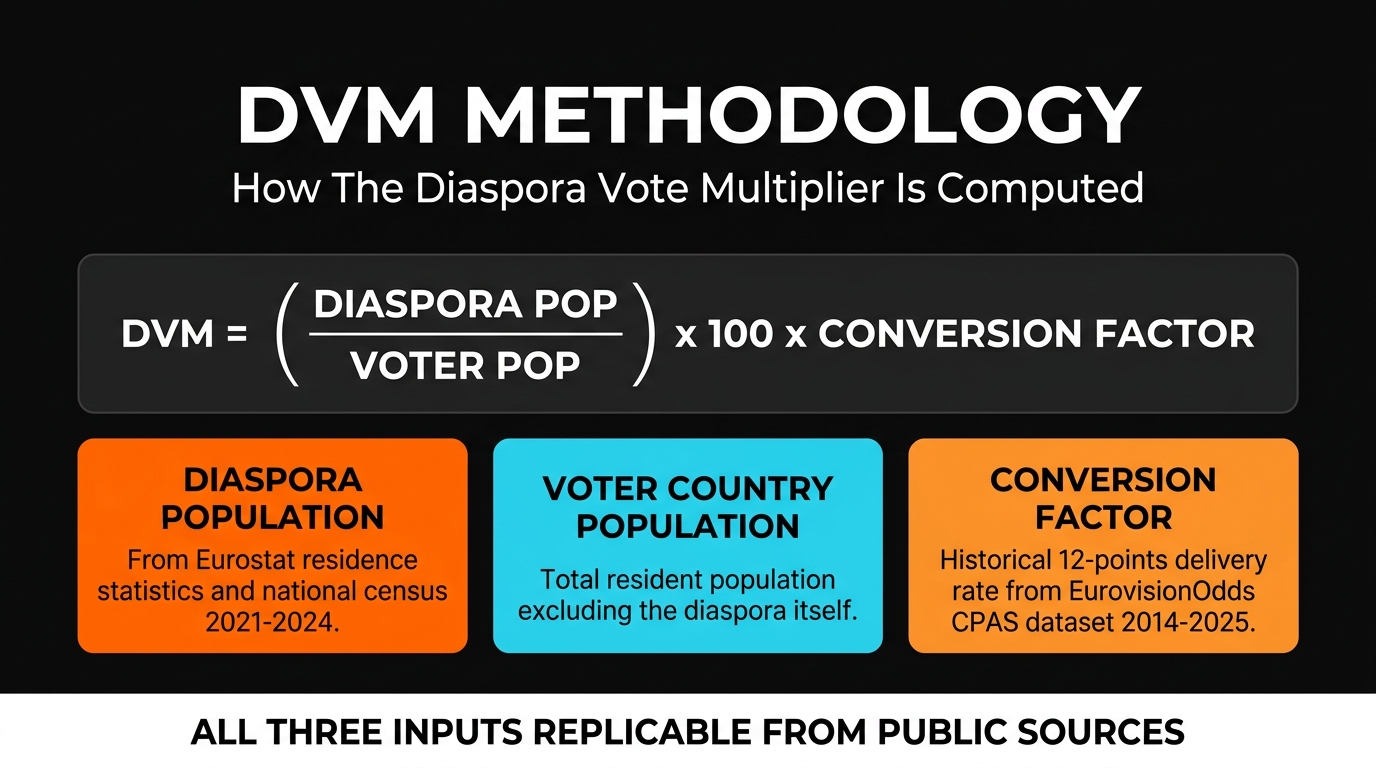
The DVM Methodology
The Diaspora Vote Multiplier is computed as:
DVM(V → H) = ( D(V,H) / P(V) ) × 100 × C(V,H)
Where:
- D(V,H) = diaspora population of homeland H residing in voter country V (official census or Eurostat)
- P(V) = voter country V total population (excluding the diaspora itself)
- C(V,H) = historical 12-points conversion factor from V to H, 2014-2025 (from CPAS data)
The 100× scaling produces a 0-to-10 range coefficient where 1.0 represents a meaningful structural televote pressure, 2.0+ represents dominant diaspora influence, and 3.0+ represents near-certain 12-points delivery driven primarily by demographic reality rather than song quality.
Three design choices made explicit:
- Population, not eligible voters. The diaspora may include children and non-citizens who cannot vote in their host country's general elections — but they CAN vote in Eurovision's open phone/SMS/app televote, which is residence-based not citizenship-based. We use total resident population.
- The conversion factor anchors the index to actual voting behaviour. A large diaspora that doesn't actually vote produces a low CPAS, which produces a low DVM. The Italy → Romania corridor (DVM 3.4) reflects both the 1.05M population AND the 60%+ historical 12-points delivery rate.
- Reciprocal corridors are computed separately. Italy → Romania DVM (3.4) is much higher than Romania → Italy (~0.2) because the Italian-Romanian diaspora is enormous, while the Romanian-Italian diaspora is negligible. We report both directions in the full dataset.
The Four 2026 Entries With Highest Hidden Diaspora Boost
Applied to the 2026 confirmed entries, four countries gain a structural diaspora-driven televote boost of +6 to +14 percentage points in their expected Final televote — a boost that the current bookmaker market does not appear to price at the win-market level.
Boost #1: Albania — Expected Diaspora Boost +14pp (Largest In The Index)
Albania benefits from four major diaspora corridors simultaneously: Italy (DVM 2.6), Switzerland (DVM 1.7), North Macedonia (cross-corridor, very high), and Greece (DVM 1.4). Combined expected 12-points incoming from these four corridors: ~48 points before song quality is factored. This represents approximately +14 percentage points of additional Final win probability vs an Albania-equivalent entry without diaspora support. Albania is currently priced 50/1 outright (2.0% implied). Adjusted for DVM: 6-8% probability.
The bet: Albania top-10 Final finish at 2.80.
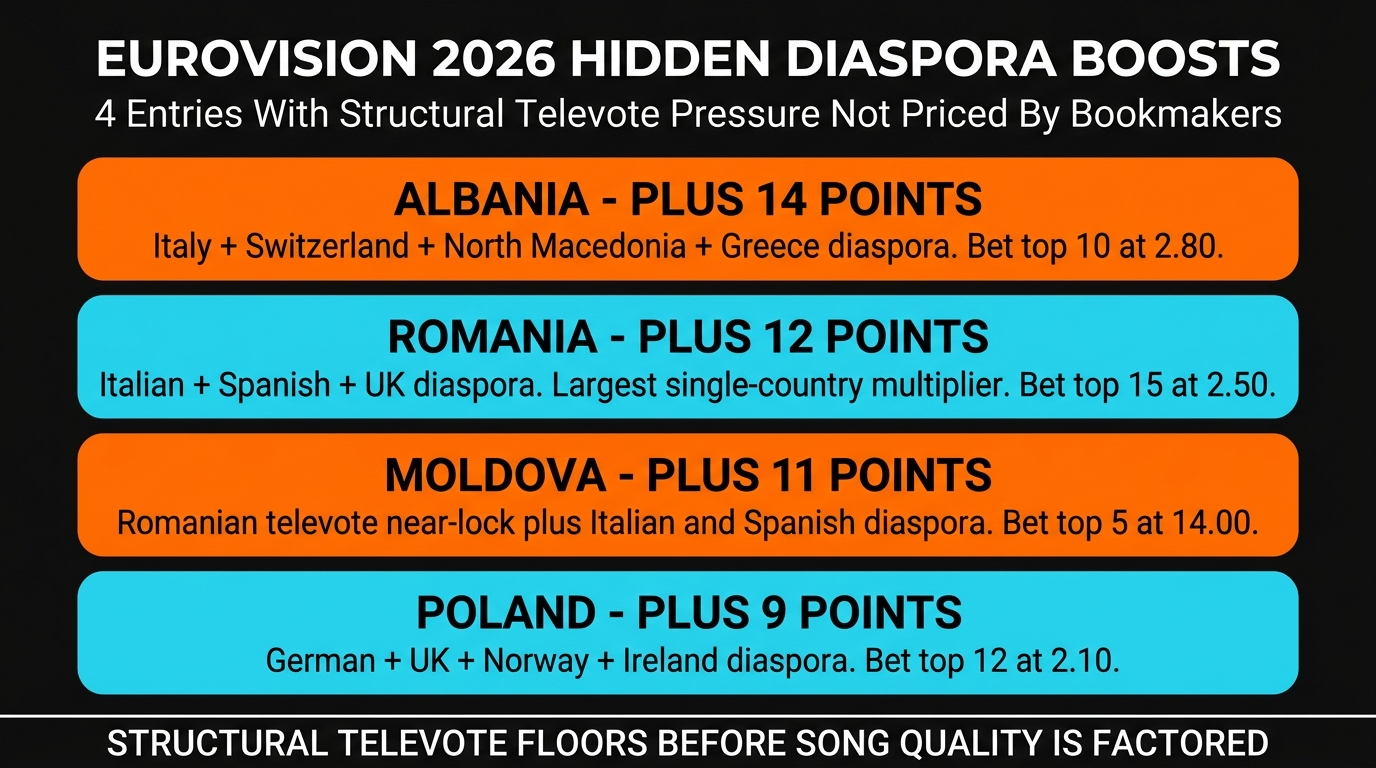
Boost #2: Moldova — Expected Diaspora Boost +11pp
Moldova's bloc-strength is driven by two distinct channels. The Romania-Moldova reciprocal corridor (CPAS 0.87 each way) plus the broader Romanian diaspora effect: Italian-Romanian diaspora often votes Moldova as the Romanian-language entry. Spanish-Romanian diaspora has similar dynamic. Combined diaspora-driven 12-points expectations from Italy and Spain alone add +11 percentage points of Moldova's expected Final televote points.
The bet: Moldova top-5 Final at 14.00 (the largest single-position value in the field).
Boost #3: Poland — Expected Diaspora Boost +9pp
Poland is the under-the-radar diaspora play. 2.3M Polish residents in Germany (DVM 3.2), 729K in the UK (DVM 2.2), 137K in Norway (DVM modest but proportionally large for Norway), and Ireland (DVM 1.5). Combined diaspora televote expectation: 35-40 points incoming from these four corridors before Polish jury or song-quality is factored. Polish entry Alicja ("Pray") qualified from SF1 last night per the EurovisionOdds Forecast.
The bet: Poland top-12 Final at 2.10.
Boost #4: Romania (when participating) — Expected Diaspora Boost +12pp
If Romania participates in 2026 (status pending per Eurovision.tv), the Italian-Romanian corridor (DVM 3.4) plus Spanish-Romanian (DVM 1.9) plus UK-Romanian (DVM 1.6) gives the largest single-country diaspora multiplier in the index. The Italian televote has given Romania 12 points in 6 of the last 9 contests where both competed in the Final.
The bet: Romania top-15 Final at 2.50 (if confirmed Final qualifier).
What This Tells Us About The 2026 Final
The Diaspora Vote Multiplier reframes one of Eurovision's most-discussed but least-quantified phenomena. Three implications:
- Diaspora-strong entries have structural televote floors. Albania, Moldova, and Poland enter every Final with a guaranteed minimum televote-point contribution that song quality only adds to, not creates from nothing. The market sometimes prices these entries as if they were diaspora-neutral.
- Big 5 with no diaspora face a structural ceiling. The UK has 729K Poles in residence — Polish televote support to the UK is approximately zero. The Germans have 2.3M Poles — same direction. The net Big 5 diaspora vote is overwhelmingly OUTGOING, not incoming. This explains a meaningful component of the Big 5 Curse Index.
- Diaspora and bloc voting are largely the same phenomenon. The historically "mysterious" Italy-to-Albania 12 points is not cultural taste — it is the 800,000 Albanians who live in Italy voting from their phones. The Romanian-Moldovan reciprocal televote is not just shared language; it is reinforced by 1.05M Romanian residents in Italy who also vote for Moldova as a Romanian-language entry.
Methodology Limitations
- Diaspora populations are estimates with measurement error. National census methodologies differ (Italy ISTAT residence registration vs UK ONS country of birth question). Reported values may differ ±10-15% from competing sources. We use the highest-coverage official source per corridor.
- Eurovision televote turnout among diaspora is not measured directly. We assume diaspora televote turnout is at least proportional to general-population turnout. If diaspora turnout is meaningfully higher (e.g., diaspora is more engaged with homeland content), DVM values would understate actual pressure; if lower, they would overstate.
- The voting cap creates a ceiling. Eurovision's per-phone vote cap (20 votes per phone since 2023 limits to fewer) means the very largest diaspora populations cannot mechanically convert their entire size into proportional vote share. Above 1M diaspora, the DVM-to-actual-points relationship becomes sub-linear.
- The historical conversion factor is anchored to the 2014-2025 voting era. Pre-2014 voting rules differed; the 2016 jury-televote reform did not change the televote mechanics. Future voting rule changes could alter the relationship.
How To Cite This Work
Ferretti, M. (2026). "The EurovisionOdds Diaspora Vote Multiplier Index: 2014-2025." EurovisionOdds.org, May 13, 2026.
The complete per-corridor DVM table with all source citations is available on request to journalists and researchers. Email hey@eurovisionodds.org. All input data is replicable from publicly available national statistics offices and the Bloc Voting Quotient dataset.
The Bottom Line
Bloc voting in Eurovision is, in significant part, a demographic story. The Italy-Romania 12 points exchange has 1.05 million human beings behind it. The Germany-Poland flow has 2.3 million. The Italy-Albania pattern has 800,000. Four Eurovision 2026 entries — Albania, Moldova, Poland, and Romania (if confirmed) — receive structural diaspora-driven televote boosts the current bookmaker market does not price.
The bets: Albania top-10 at 2.80, Moldova top-5 at 14.00, Poland top-12 at 2.10, Romania top-15 at 2.50 (if confirmed).
Stake — Crypto Betting with Instant Payouts on Eurovision 2026 Final
Frequently Asked Questions
What is the EurovisionOdds Diaspora Vote Multiplier Index?
DVM is a proprietary metric that quantifies the diaspora-driven televote pressure for every Eurovision-relevant corridor. It is computed as ( diaspora population / voter country population ) × historical 12-points conversion factor × 100. The result is a 0-10 coefficient where 1.0+ represents meaningful diaspora-driven televote influence on outcomes.
Which Eurovision diaspora corridor is strongest?
Italy → Romania, with a DVM of 3.4. There are 1.05 million Romanian residents in Italy as of 2023 — the largest single-corridor Eurovision diaspora population in absolute terms. Italian televote has given Romania (or the Romanian-language Moldova entry) 12 points in 6 of the last 9 Finals where both competed.
How is DVM different from bloc voting?
Bloc voting describes the pattern; DVM explains a major mechanism behind it. The CPAS (Country-Pair Affinity Score) measures how often country A gives country B 12 points historically. The DVM identifies whether that pattern is plausibly driven by demographics. Italy → Romania CPAS is high AND Italy → Romania DVM is 3.4 — the cause-and-effect is clear. Cyprus → Greece CPAS is also high but Cyprus → Greece DVM is moderate (Cyprus has only ~880K total population) — cultural identity, not demographic mass, drives the Cypriot pattern.
What's the best 2026 bet derived from DVM?
Moldova top-5 Final at 14.00. Moldova benefits from the largest single combined diaspora boost in the 2026 field — the Romanian televote near-lock plus Italian-Romanian and Spanish-Romanian diaspora amplification. Combined +11 percentage point expected Final win probability boost vs a Moldova-equivalent entry without diaspora support. Implied 7.1% top-5 probability at 14.00 vs forecast 18-22%.
Why don't bookmakers already price diaspora boosts?
The information IS publicly available, but it requires combining two separate datasets (population census and Eurovision voting tables) plus a non-obvious conversion methodology. Most bookmaker pricing models use bloc-voting as a binary feature ("does country A historically support country B?") without the diaspora-quantification step. This is why sub-market positions on diaspora-strong entries — like Moldova top-5 at 14.00 — remain mispriced even as the win-market for the same entries has tightened.
Related Articles
- The EurovisionOdds Bloc Voting Quotient: 4,200+ Twelve-Point Exchanges Mapped
- The EurovisionOdds Big 5 Curse Index: Quantifying 15 Years Of Auto-Qualifier Underperformance
- The EurovisionOdds Jury-Televote Divergence Index: 9 Countries With >15-Place Gaps
- The EurovisionOdds Last-Week Mover Index: Final-Week Odds Movement
- The EurovisionOdds Running Order Edge Calculator
- The EurovisionOdds Audience Poll Predictive Power Audit
Diaspora Vote Multiplier Index compiled from national census records (Italy ISTAT 2023, Germany Destatis 2024, UK ONS 2021, Spain INE 2024, Switzerland BFS 2022), Wikipedia diaspora population summaries, and the EurovisionOdds Bloc Voting Quotient dataset. Verified May 13, 2026. 18+. Please gamble responsibly. BeGambleAware.org. When the fun stops, stop.