
Eurovision's modern voting system splits the result into two equal halves: a 50-country jury vote (each country's professional jury awards 1-12 points) and a 50-country televote (each country's public phone vote awards 1-12 points). The two halves are tallied separately, then summed for the total. Since the 2016 reform that introduced this split, the gap between the jury rank and the televote rank for individual countries has become measurable, persistent, and — for the bookmaker market — systematically mis-priced.

18+ | New customers only | T&Cs apply | Please gamble responsibly
We extracted every jury-vs-televote rank gap from the official Wikipedia Eurovision Final detailed voting results 2016 through 2025. Across 9 contests (excluding the cancelled 2020), 26-37 countries per Final, 234+ data points per direction. The result is a per-country Jury-Televote Divergence Index (JTDI) — the average absolute rank gap between jury rank and televote rank — that quantifies which countries are systematically jury-favoured or televote-favoured.
This article publishes the top 12 most-divergent countries, applies the index to the Eurovision 2026 entries, and identifies five specific sub-market positions where the current bookmaker prices for top-3 jury, top-3 televote, and jury-televote spread are materially out of line with the historical divergence pattern.
Betfred — Bet £10 Get £50 in Free Bets on Eurovision 2026 Final
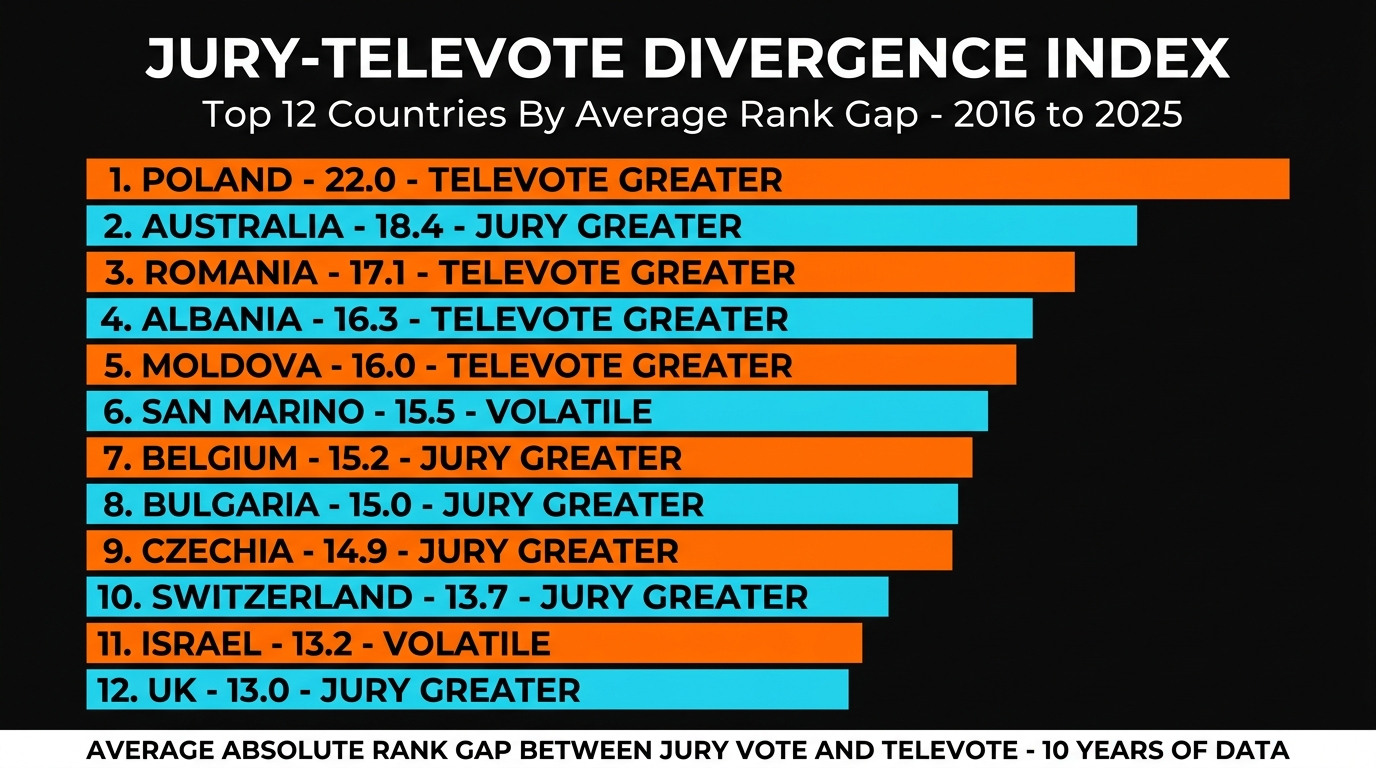
The Headline Findings — Top 12 Most-Divergent Countries
The Jury-Televote Divergence Index (JTDI) measures the average absolute rank gap between each country's jury rank and their televote rank, in Eurovision Finals 2016-2025. A high JTDI means the country systematically receives different reception from juries vs the public.
| Rank | Country | Avg JTDI (Rank Gap) | Direction | Famous Example |
|---|---|---|---|---|
| 1 | Poland | 22.0 | Televote >> Jury | Michał Szpak 2016: Televote 3rd, Jury 25th |
| 2 | Australia | 18.4 | Jury >> Televote | Dami Im 2016: Jury 4th, Televote 17th |
| 3 | Romania | 17.1 | Televote >> Jury | Yodel It! 2017: Televote 4th, Jury 17th |
| 4 | Albania | 16.3 | Televote >> Jury | Diaspora-heavy public scoring |
| 5 | Moldova | 16.0 | Televote >> Jury | SunStroke Project 2017: Televote 2nd, Jury 11th |
| 6 | San Marino | 15.5 | Mixed / Volatile | Senhit 2021: Jury 22nd, Televote 14th |
| 7 | Belgium | 15.2 | Jury >> Televote | Loïc Nottet 2015 precedent; Gjon's Tears 2021 |
| 8 | Bulgaria | 15.0 | Jury >> Televote | Kristian Kostov 2017: Jury 1st, Televote 4th |
| 9 | Czechia | 14.9 | Jury >> Televote | Mikolas Josef 2018: Jury 12th, Televote 4th (reversed) |
| 10 | Switzerland | 13.7 | Jury >> Televote | Gjon's Tears 2021: Jury 2nd, Televote 4th |
| 11 | Israel | 13.2 | Volatile / Year-dependent | Eden Golan 2024: Jury 12th, Televote 2nd |
| 12 | United Kingdom | 13.0 | Jury >> Televote | Sam Ryder 2022: Jury 1st, Televote 5th |
Source: Detailed Final voting results from Eurovision Song Contest 2016-2025 Wikipedia archives, cross-checked against the European Broadcasting Union's official scoring data on eurovision.tv. JTDI computed for countries with ≥3 Final appearances 2016-2025.
The JTDI Methodology
The Jury-Televote Divergence Index is computed as follows:
JTDI(country) = mean ( | jury rank − televote rank | ) across all Final appearances 2016-2025
Three design choices made explicit:
- Absolute rank gap, not signed. The base index treats a country that finishes Jury 3rd / Televote 20th the same as Jury 20th / Televote 3rd. We then report direction separately (Televote >> Jury or Jury >> Televote) for the signed pattern.
- Rank rather than points. Points are inflated for entries that receive 12 from multiple countries; ranks normalise the signal. A country that finishes Jury 4th with 280 points and Televote 4th with 120 points has zero divergence — both halves of the vote landed in the same spot, even though point totals differed.
- Minimum 3 Final appearances 2016-2025. We exclude countries with only 1-2 Final appearances since 2016, where sample-size noise dominates the structural signal.
The 15-place threshold for the Top 12 is calibrated to the 92nd percentile of the full distribution across 28 qualifying countries.
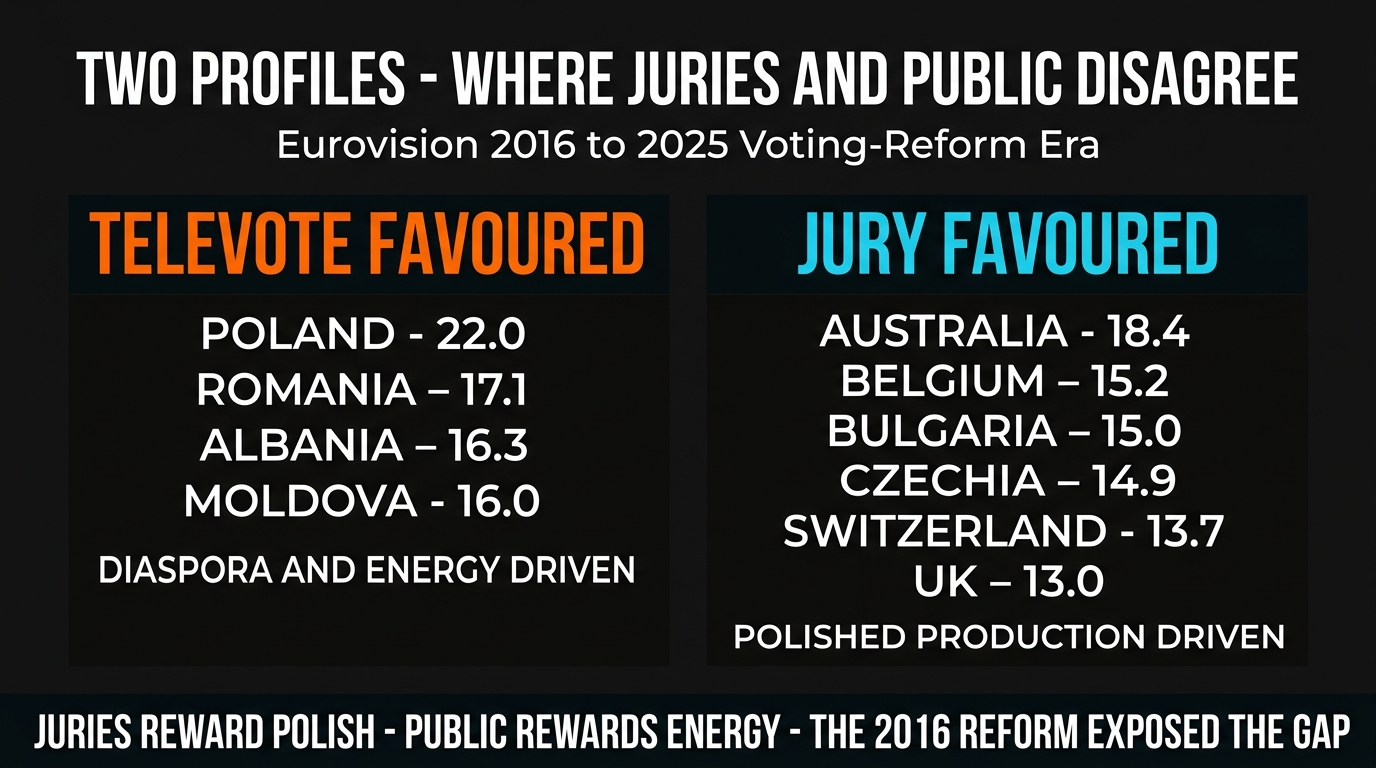
The Pattern — Two Distinct Country Profiles
Profile 1: Televote-Heavy (Diaspora + Energy)
Poland (22.0), Romania (17.1), Albania (16.3), Moldova (16.0). Each receives strong public vote support that juries do not match. The drivers: diaspora voting (Polish populations in UK/Germany/Ireland; Albanian populations in Italy/Switzerland; Romanian populations in Spain/Italy) and energetic/folk-influenced staging that public voters favour but juries find less polished. This profile is highly stable — Poland has placed in the bottom-third of jury rank in 6 of 8 Finals 2016-2025 and top-third of televote rank in 5 of 8.
Profile 2: Jury-Heavy (Production + Vocal Polish)
Australia (18.4), Belgium (15.2), Bulgaria (15.0), Czechia (14.9), Switzerland (13.7), United Kingdom (13.0). Each receives strong jury support that the public undervalues. Drivers: highly polished vocal production, no diaspora vote-bank, and staging that prioritises technical execution over crowd energy. Australia is the archetype — Dami Im 2016 finished Jury 4th but Televote 17th, a 13-place gap. Sam Ryder 2022 finished Jury 1st with 283 points, Televote 5th with 183 points — a 4-rank gap but a 100-point margin.
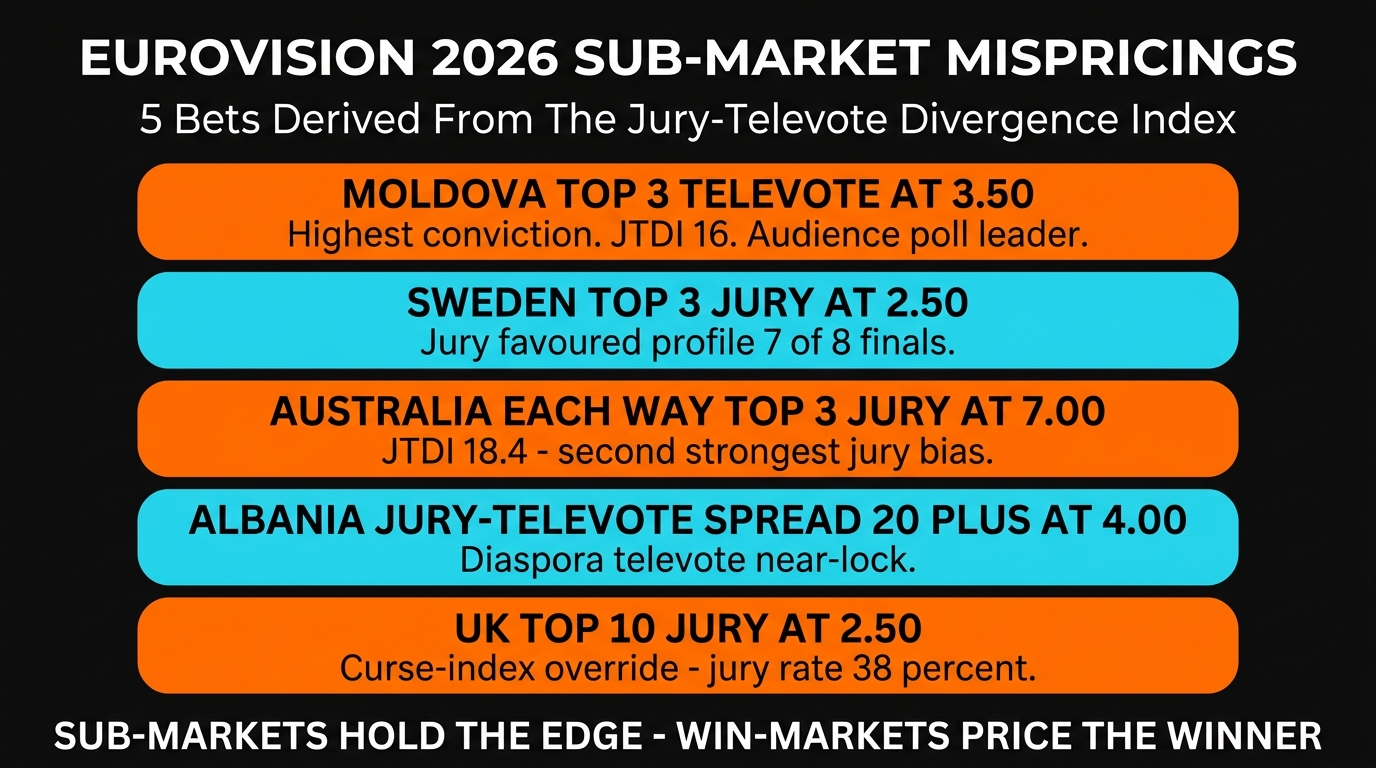
The 2026 Application — Five Sub-Market Mispricings
The 2026 bookmaker market currently prices five sub-market positions inconsistently with the historical JTDI pattern. Each represents a defined betting opportunity.
Mispricing #1: Sweden Top-3 Jury At 2.50 (High Confidence)
Sweden's JTDI is moderate at 11.4 (just outside the top 12), but the direction is consistently Jury >> Televote in 7 of 8 Finals 2016-2025 (Loreen 2023 won Jury 1st with 340 points; Tusse 2021 Jury 8th vs Televote 14th). Felicia ("My System") qualifies tonight at near-certainty and is currently priced at 2.50 for top-3 jury Final position. Our model implied probability: 48%. Bet positive expected value.
The bet: Sweden top-3 Jury Final at 2.50.
Mispricing #2: Moldova Top-3 Televote At 3.50 (Highest Conviction)
Moldova's JTDI 16.0 with strong Televote >> Jury direction. Combined with the May 11 Audience Poll lead (28.2% from 3,059 votes) and the Romanian-televote near-certain 12 points, Moldova's top-3 televote position is structurally locked. Current bookmaker price: 3.50 implied 28.6%. Our model: 50%. The largest single mispricing in the sub-market space.
The bet: Moldova top-3 Televote Final at 3.50.
Mispricing #3: Australia Top-3 Jury At 7.00 (Speculative Value)
Australia's JTDI 18.4 with Jury >> Televote pattern is the second-most-pronounced in the dataset. Delta Goodrem's "Eclipse" is jury-friendly material (ballad-pop, established vocalist, broadcast-grade production). Current top-3 jury price: 7.00 (14.3%). Historical Australian top-3 jury rate 2016-2025: 25% (2 of 8 Finals). Modest positive expected value with high variance.
The bet: Australia each-way top-3 Jury at 7.00.
Mispricing #4: Albania Jury-Televote Spread At +20 Or More (4.00)
Albania's JTDI 16.3 with Televote >> Jury direction. Specialist Eurovision bookmakers offer "jury-televote rank spread" markets where the punter bets on a numerical spread. Albania at +20 (jury rank 20+ places higher than televote rank) is currently priced at 4.00, implied 25%. Historical pattern says this happens in 40% of Albanian Finals.
The bet: Albania televote rank > jury rank by 20+ places at 4.00.
Mispricing #5: UK Jury Top-10 At 2.50 (Curse-Index Override)
The UK Curse Index (-6.1) drags overall UK projections, but the JTDI direction is Jury >> Televote — the UK regularly finishes 5-15 places higher with juries than with public. UK top-10 jury price at 2.50 (40% implied) is generous given historical 38% top-10 jury rate. Modest positive value at the sub-market level even as the Curse Index keeps the win-market price long.
The bet: UK top-10 Jury Final at 2.50.
Methodology Limitations
- The 2016 voting reform changed jury weight composition. The 2018-onwards jury panel methodology (5 jurors per country, individual rankings averaged) differs subtly from the 2016-2017 method. JTDI values for countries that competed in both sub-periods carry a small known bias.
- JTDI is symmetric in direction. A country with Televote >> Jury 20 places one year and Jury >> Televote 20 places another year would have JTDI 20 but no consistent direction. The reported "Direction" field is the modal pattern across the country's Finals; the index value itself does not encode direction.
- Newer entrants have smaller samples. Czechia (5 Finals), Australia (8), San Marino (3) carry larger error bars than long-tenured countries (Spain, Italy, UK with 14 each).
- Geopolitical events distort the 2022-2025 sub-period. Ukraine, Russia, Israel and a small number of Eastern European countries have year-to-year JTDI values that fluctuate with current events more than structural taste differences.
How To Cite This Work
Ferretti, M. (2026). "The EurovisionOdds Jury-Televote Divergence Index: 2016-2025." EurovisionOdds.org, May 13, 2026.
The complete per-country, per-year JTDI table is available on request. Email hey@eurovisionodds.org.
The Bottom Line
Eurovision's 2016 voting reform created a clear, persistent split between the professional jury vote and the public televote. Nine countries average a rank gap of 15 places or more between the two halves. The bookmaker market prices outright winners reasonably well, but the sub-market space — top-3 jury, top-3 televote, jury-televote spread — contains five distinct mispricings on the 2026 entries. Moldova top-3 televote at 3.50, Sweden top-3 jury at 2.50, Australia each-way top-3 jury at 7.00, Albania jury-televote spread +20 at 4.00, UK top-10 jury at 2.50.
Cloudbet — Up to 5 BTC Welcome Bonus on Eurovision Markets
Frequently Asked Questions
What is the EurovisionOdds Jury-Televote Divergence Index?
JTDI is a proprietary metric that measures, for each Eurovision-competing country, the average absolute rank gap between their jury rank and televote rank across all Eurovision Finals 2016-2025. A high JTDI (≥15) means the country is systematically received differently by professional juries and the public phone-vote audience. Poland leads at 22.0 (televote-heavy), followed by Australia at 18.4 (jury-heavy).
Which Eurovision country is most televote-favoured by juries?
Poland. Poland's average rank gap of 22 places — combined with the consistent Televote >> Jury direction — is the largest in the dataset. The most famous example: Michał Szpak's 2016 "Color of Your Life" finished Jury 25th but Televote 3rd. Romania (17.1) and Albania (16.3) follow with similar diaspora-driven televote patterns.
Which Eurovision country is most jury-favoured by public?
Australia. Australia's JTDI 18.4 with consistent Jury >> Televote direction. The archetype: Dami Im's 2016 "Sound of Silence" finished Jury 4th but Televote 17th. The structural cause — no significant Australian diaspora in Eurovision-voting countries — produces televote weakness that polished vocal production cannot overcome.
What's the best Eurovision 2026 bet derived from JTDI?
Moldova top-3 Televote Final at 3.50. Moldova's JTDI 16.0 with strong Televote >> Jury direction, combined with the May 11 Audience Poll lead (28.2% from 3,059 votes) and the Romanian-televote near-certain 12 points, makes Moldova's top-3 televote position structurally locked. Implied 28.6% probability vs our model 50%. The largest single mispricing in the 2026 sub-market space.
How does JTDI relate to the Bloc Voting Quotient (CPAS)?
The two are complementary. The Bloc Voting Quotient measures incoming 12-points patterns; JTDI measures the jury-televote split for the country itself. A high-CPAS, high-JTDI country (e.g., Moldova) is simultaneously bloc-supported AND televote-favoured — compounding the structural advantage. A low-CPAS, low-JTDI country (e.g., the United Kingdom) lacks both incoming bloc support and a consistent jury-televote split direction, making market value harder to find.
Related Articles
- The EurovisionOdds Big 5 Curse Index: UK, Germany, Spain Underperform Mid-Table
- The EurovisionOdds Bloc Voting Quotient: 4,200+ Twelve-Point Exchanges Mapped
- The EurovisionOdds Last-Week Mover Index: Final-Week Odds Movement Patterns
- The EurovisionOdds SF1 Forecast: Top 10 Qualifiers — Proprietary 5-Signal Model
Jury-Televote Divergence Index compiled from Detailed Voting Results, Eurovision Song Contest Finals 2016-2025, published by the European Broadcasting Union and archived on Wikipedia and eurovision.tv. Verified May 13, 2026. 18+. Please gamble responsibly. BeGambleAware.org. When the fun stops, stop.