
Eurovision Asia 2026 — the new EBU-licensed Asia-Pacific spinoff of the European Song Contest — is scheduled to stage its inaugural Grand Final in Bangkok this autumn. Punters who have spent years modelling jury splits, semi-final televote pools and diaspora effects in Vienna will find that very few of those tools transfer cleanly. The new contest is a different shape: a different field size, a different show structure, a different venue scale, and zero precedent to anchor any of it. Treating it like a smaller European Eurovision is the single fastest way to misprice a 2026 ticket.

18+ | New customers only | T&Cs apply | Please gamble responsibly
Here are the ten format differences between Eurovision Asia 2026 and Eurovision Europe 2026 that UK bettors need to factor in before the first market opens. Each is paired with a concrete betting implication.
The high-level comparison
| Format dimension | Eurovision Europe 2026 (Vienna) | Eurovision Asia 2026 (Bangkok) |
|---|---|---|
| Confirmed field size | 35 countries | 10 countries (subject to EBU expansion) |
| Show structure | SF1 + SF2 + Grand Final | Single Grand Final (no semi-finals confirmed) |
| Venue capacity | Wiener Stadthalle, ~16,000 | IdeaLive Bangkok, 4,234 |
| Voting split | 50/50 jury & televote | 50/50 jury & televote |
| Voting alliances | 70 years of mapped diaspora blocs | None mapped — first-contest baseline |
| Language | Mixed — English + native | Expected English + one local language |
| Streaming index | Aussievision weekly Spotify chart | No equivalent reliable index yet |
| Bookmaker market open | ~6 months pre-contest via Oddschecker | Not yet live as of 12 June 2026 |
| Expected Polymarket turnover | $175M (2026 actual) | 10–30% of European range (estimate) |
| Host advantage data | 70 years of precedent | Zero precedent |
The rest of this piece works through those ten dimensions one by one, with the betting implication for each. The full directory of competing nations and entries already announced is mirrored on our Eurovision Asia hub, with country-level pages for the most likely outright candidates including Thailand, South Korea and the Philippines.
1. Field size — 10 countries vs 35
The Vienna 2026 Grand Final fielded 26 finalists out of 35 competing nations. Bangkok 2026 is confirmed at 10 participating countries with no semi-final pruning. The arithmetic implication is immediate: a 10-outcome outright market has a flat prior of 10% per entry, against roughly 2.9% on the European outright. Long-shot value below 5% — the price band where Bulgaria sat on Polymarket throughout Vienna week (see our Polymarket Eurovision 2026 post-mortem) — essentially does not exist on a 10-country book. Every entry will price above 6% by structural floor.
Betting implication: the highest-value trades on European Eurovision typically come from long-shot tickets with mispriced semi-final televote pool dominance. That ladder is structurally unavailable on Eurovision Asia. Expect tight clustering between favourite and outsider — a typical Asian outright spread is likely to run from around 2.50 on the favourite to 12.00 on the longest shot, against Europe's 2.00-to-100.00 range. Stake-per-bet should rise to compensate for the compressed multiplier on outsiders, or — more sensibly — UK punters should treat Asia as a head-to-head and top-3 market, not an outright.
2. Show structure — one Grand Final, no semi-final televote signal
Eurovision Europe runs SF1 + SF2 + Grand Final across a Tuesday-Thursday-Saturday cadence. Eurovision Asia 2026 is confirmed as a single Grand Final only, with no semi-finals scheduled in the EBU's published format documentation. That removes the single most useful signal in modern Eurovision modelling: semi-final televote-pool dominance.
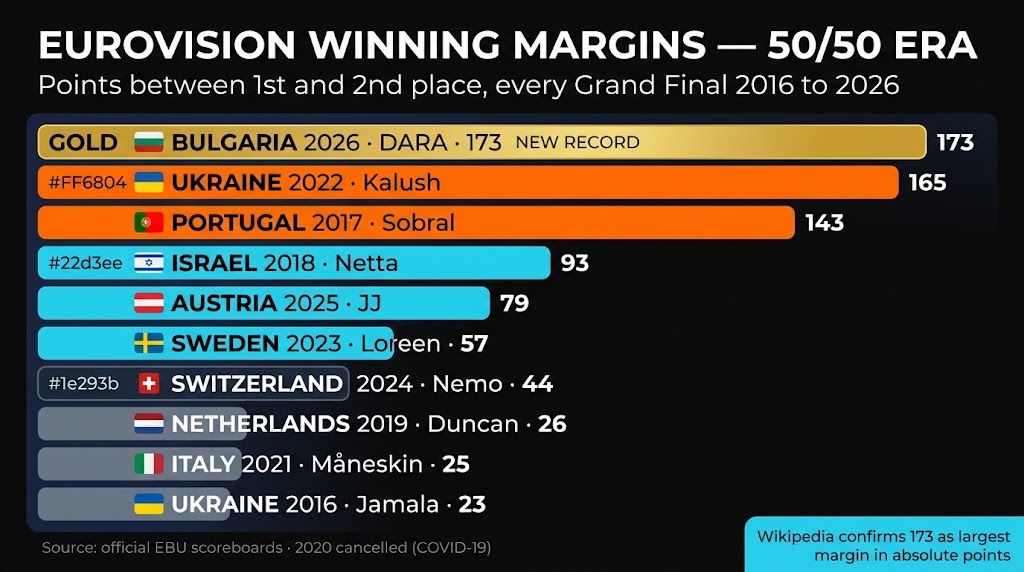
Three of the four largest winning margins in the European 50/50 era — Ukraine 2022, Portugal 2017 and Bulgaria 2026 — were preceded by 4+RoW or better in a single semi-final televote pool. Polymarket and Betfred missed Bulgaria at less than 5% because they didn't reprice on that semi-final evidence, but at least the evidence existed. Bangkok will produce no such pre-show televote signal.
Betting implication: the post-SF repricing trade — the cleanest edge on European Eurovision — does not exist on Eurovision Asia. Live in-show betting becomes the only remaining sharp edge. Books that quote a rolling live outright through the running order, with prices updating after each performance, will be the highest-EV venue for Bangkok if any UK book offers them. Pre-show prices should be treated as final and not as a setup for a late move.
3. Venue scale — 4,234 seats vs 16,000
IdeaLive Bangkok has a confirmed capacity of 4,234 seats. Wiener Stadthalle seated approximately 16,000 in Eurovision configuration in May. The acoustic and visual energy of a 4,000-seat televote arena is fundamentally different from a 16,000-seat one. Crowd reaction shots and applause sustain — both of which feed jury impressions during the live show — will be more compressed.
Betting implication: in European Eurovision, big-room anthems with a clear key change or audience-participation chorus historically benefit from venue energy on the jury vote. Bangkok's smaller room will dampen that effect. Stripped-back vocal performances and intimate ballads — the format that won Portugal 2017 and Austria 2025 — should carry less of a venue penalty in Bangkok than they do in 16,000-seat European venues. Adjust priors on intimate entries upward.
4. Voting split — same 50/50 jury and televote, different population
The EBU has confirmed Eurovision Asia 2026 will use the same 50/50 jury-and-televote split as the European contest, with each participating country submitting a 12-to-1 jury allocation and a 12-to-1 televote allocation. The mechanism is identical. What differs is who is voting.
European Eurovision juries have 70 years of voting-pattern history — including documented anti-bloc corrections, professional-music-industry weighting, and recurring biases towards specific entry types. Asian juries have none. The first contest creates the baseline.
Betting implication: jury splits on Bangkok 2026 are essentially un-modellable. Punters who price European outrights using a separate jury-projection and televote-projection should collapse the model to a single combined-score projection for Bangkok, and widen the uncertainty interval substantially.
5. Voting alliances — zero diaspora blocs mapped
European Eurovision modelling leans heavily on documented diaspora effects: the Turkish vote bloc across Germany and the Netherlands, the Balkan reciprocal televote, the Nordic exchange, the Greek-Cypriot 12-point exchange. Bulgaria's 9-televote-12s in SF2 2026 came partly from a Balkan + South-Eastern Europe pool that has been mapped for 20 years.
Eurovision Asia 2026 has no such map. Korean-Australian diaspora voting in Australia? Vietnamese-American diaspora visible on the global televote? Japanese fan-base reach into Indonesia? All open questions. The first contest will create the baseline that future modelling builds on.
Betting implication: do not bet pre-show on Eurovision Asia using diaspora reasoning carried over from Europe. Anyone telling you a country wins because of a diaspora pool is guessing. The single 2026 contest will produce the first usable data, which then becomes the prior for 2027.
6. Language — English + one local language vs Europe's mixed multilingual norm
Public guidance from the Asia-Pacific Broadcasting Union confirms entries will perform in English plus one local language. Eurovision Europe historically allowed any language, with native-language entries rising sharply from 2010 onward — Italy 2021, Ukraine 2022, Portugal 2017 and Bulgaria 2026 all included native-language content and won.
Betting implication: the English-plus-local-language constraint will compress one of the format axes that European punters use to identify outliers. There will be no equivalent of Stefania's monolingual Ukrainian hook driving a televote landslide. Expect a smaller jury-televote gap on Bangkok entries than Vienna typically produces — and therefore a smaller range of plausible winning margins.
7. Streaming pre-contest — no Aussievision equivalent
European Eurovision punters use Aussievision's weekly Spotify chart as a public pre-contest momentum index. The chart correctly identified Italy as a top-five threat for 2026 ahead of the May contest, and flagged Bulgaria's Bangaranga rise from outside the top 20 in late March to ninth by the second week of May — momentum that fed directly into the eventual Grand Final win documented in our Spotify dominance breakdown.
No equivalent index exists for Eurovision Asia 2026. Spotify market penetration varies wildly across the ten participating countries — strong in South Korea and the Philippines, weaker in Thailand and Vietnam. YouTube Music and local platforms (Melon, JioSaavn, Joox) carry more weight in different countries. There is currently no single aggregator publishing a weekly cross-country pre-contest chart.
Betting implication: the streaming-momentum trade — buying an entry whose Spotify trajectory is rising sharply in the four weeks pre-contest — is unavailable on Asia. UK punters should not extend the Spotify model across this format gap.
8. Bookmaker market timing — Asian outright not yet live
European Eurovision outright markets typically open via Oddschecker around six months pre-contest. Betfred's Eurovision 2026 outright was live by mid-November 2025. As of today, 12 June 2026 — roughly five months before the expected Bangkok date — no major UK bookmaker has published a public outright for Eurovision Asia 2026. Polymarket has not yet listed an Asia market either.
Two practical reasons: (a) the EBU has not yet confirmed full participant list and running order, which books need before posting outright prices; (b) UK retail demand for the contest is unproven, so books are unlikely to be first movers. Expect the first outright prices in September or October 2026.
Betting implication: UK punters wanting to bet Eurovision Asia 2026 ahead of the contest should monitor Oddschecker daily from mid-September onward. The first book to post will set a tentative anchor that the others copy within 48 hours — historically the cleanest pre-contest value sits in that first 48-hour window before books cross-reference each other's lines.
9. Polymarket turnover expectation — 10-to-30% of European range
Polymarket cleared over $175M of Eurovision 2026 turnover across its outright market and its derivative books — the largest non-sports event ever priced on a prediction market, per NYT reporting around the Vienna Grand Final, also documented in our prediction-market post-mortem. That figure reflects a 70-year-old contest with a deeply entrenched UK and continental European fan base, ECB-friendly transaction infrastructure, and a viral pre-contest streaming cycle.
Eurovision Asia 2026's first edition will trade considerably less. Reasonable expectation: 10-to-30% of the European range, or roughly $20M to $50M total turnover, including all derivative books. The contest will need a multi-year viewership cycle to converge on the European volume profile.
Betting implication: thinner order-book depth means wider spreads, especially on long-shot YES contracts. Limit orders will fill substantially better than market orders. Anyone planning to size into Polymarket Asia at scale should expect to walk through several percentage points of slippage on long-shot tickets — and should not size to a number that would have to clear in one fill.
10. Host advantage — zero precedent
European Eurovision has 70 years of host-advantage data. The host nation has won 9 times out of 69 editions, with several documented top-five finishes immediately after winning the previous year's contest. Punters know roughly how to price the host effect.
Thailand hosts Eurovision Asia 2026 as the inaugural host. There is no host-advantage prior to apply. Whether IdeaLive Bangkok's home crowd will lift Thailand's televote by 30 points or 80 points or zero is unknown — and will not be known until the scoreboard goes public on Grand Final night.
Betting implication: do not let UK books charge you a host-advantage premium on Thailand without evidence. If Thailand opens at significantly shorter odds than its pre-contest streaming and music-industry profile would justify, the book is pricing in a Vienna-style host effect that is not yet validated for Bangkok. The cleaner trade for UK punters confident in Thailand's profile is a top-3 or top-5 ticket, not the outright.
Bringing it together — a checklist before placing a Bangkok ticket
| Check | Why it matters |
|---|---|
| Have you stripped out diaspora-bloc reasoning? | Asia has no mapped bloc data. Carry-over from Europe is noise. |
| Are you treating jury and televote as one combined number? | Asian juries have no track record — split projections add false precision. |
| Have you adjusted intimate-entry priors upward for the 4,234-seat room? | Smaller venues historically reward subtler vocals. |
| Are you trading head-to-heads and top-3 instead of pure outright? | 10-outcome outright pricing compresses long-shot value. |
| Have you accepted no semi-final televote signal exists? | The cleanest European edge is unavailable in Bangkok. |
| Are you watching Oddschecker daily from mid-September? | First-mover books publish the anchor price others copy within 48 hours. |
The single highest-leverage statement that can be made about Eurovision Asia 2026 betting is the negative one: nothing carries over from Europe automatically. The voting split is the same. The 12-to-1 mechanism is the same. The 50/50 jury-televote balance is the same. Everything else — field size, show structure, venue scale, alliance mapping, language constraints, streaming visibility, market timing, prediction-market depth, host effects — is new. The first contest is the prior. Every ticket placed before October will be a prior-creation bet, not an outright bet against a stable model.
For UK punters, the disciplined posture is: stake small, prefer top-3 and top-5 markets over outrights, wait for the first Oddschecker line in September, and treat the inaugural Bangkok scoreboard as the database that 2027 modelling will use.
Betfred — Bet £10 Get £50 in Free Bets on Eurovision Asia 2026 and Eurovision 2027
Related
- Eurovision Asia 2026 — participating nations, dates and contest hub
- Thailand at Eurovision Asia 2026 — host-country profile
- South Korea at Eurovision Asia 2026 — entry and odds
- Philippines at Eurovision Asia 2026 — entry and odds
- Polymarket's $4.79M Eurovision 2026 miss — the prediction-market post-mortem
- DARA's Spotify dominance in 11 countries — the signal bookmakers and Polymarket missed
18+. Please gamble responsibly. BeGambleAware.org. GAMSTOP. When the fun stops, stop.