View this post on Instagram (@nyendra.official)
Bhutan is one of eleven countries confirmed for the inaugural Eurovision Song Contest Asia, which lands at the One Bangkok Forum in Bangkok on 14 November 2026. The Bhutanese broadcaster is the Bhutan Broadcasting Service (BBS), the country's sole public-service broadcaster, and its national selection format is called Druk Dra — Dzongkha for "Voice of Bhutan," subtitled Road to Eurovision Asia. With a population of roughly 770,000, Bhutan is the smallest country in the contest by a wide margin, and the only one whose entire broadcasting industry sits inside a single public organisation.
The Druk Dra selection — and why it was pulled in 2025
BBS originally produced Druk Dra as a five-episode televised competition in August 2025, hosted by Kelzang Dolkar and Wangchuk Dem from BBS Studio in Thimphu. The format ran ten contestants through three qualification rounds (covers, jury-scored out of 100), a semi-final weighted 80% jury and 20% online vote, and a planned final at 70% jury and 30% online vote. Three professional jurors — Pema Samdrup, Choeying Gyatsho and Uygen Dorji — anchored the panel.
The ten contestants were Baeyul 301, Sangay Lhaden, Nyendra, Pelden Wangchuk, Tashi Choden, Tshering Namgay, Tandih Phub, Kinga Rinchen, Drukbi Tshompapo and Karma Drubchu. Five reached the final stage — Sangay Lhaden, Nyendra, Baeyul 301, Tshering Namgay and Pelden Wangchuk — before the project was paused.
On 28 August 2025, Eurovision Director Martin Green publicly stated that "no plans have been confirmed or announced to date" for any Asian Eurovision contest. The Druk Dra final was postponed and previously aired episodes were quietly removed from BBS's online platforms. BBS then internally selected jury member Pema Samdrup, with the song The Song of Joy, to represent Bhutan at the ABU TV Song Festival 2025 — a face-saving placeholder while the EBU sorted out its public messaging. On 31 March 2026, the EBU confirmed Eurovision Song Contest Asia for 14 November 2026 and clarified that the 2025 removal had been a miscommunication with BBS rather than a cancellation.
Per Eurovoix's 15 May 2026 report, Bhutan is now scheduled to be the first of the eleven participating countries to select its representative, with the relaunched Druk Dra running in early August 2026. Voxovation — the EBU's production partner on the contest itself — will be producing the national selections, which marks a meaningful upgrade in technical quality from the 2025 BBS Studio package. BBS has not yet published the relaunch format, jury composition or contestant list as of 12 June 2026.
Bhutanese music in 2026 — small industry, distinct sound
The Bhutanese music industry is small by any comparison, but it is not thin on talent. Two genres dominate domestic radio and streaming: traditional zhungdra and boedra — long, modal vocal forms tied to the lineage music of the dzongs — and rigsar, the modern pop genre that emerged in the 1990s by fusing Bhutanese melodic conventions with synth-pop arrangements borrowed from Bollywood and Nepali film music. Rigsar is the format most likely to dominate any Druk Dra shortlist, because it already sits at the same three-minute, hook-led, single-vocalist scale that Eurovision rewards.
The names worth knowing going into the August selection: Kelden Lhamo Gurung, a Bhutanese vocalist with cover work and original releases circulating on SoundCloud and Deezer; the rest of the standing BBS-orbit jury and presenter pool from 2025 (Pema Samdrup, Choeying Gyatsho, Uygen Dorji); and the five 2025 Druk Dra finalists — Sangay Lhaden, Nyendra, Baeyul 301, Tshering Namgay and Pelden Wangchuk — none of whom were eliminated on merit and all of whom would be plausible re-entries in the 2026 relaunch. The Music of Bhutan Research Centre tracks an older lineage of master artists working in the traditional forms, but those acts are unlikely candidates for a three-minute, six-performer-cap Eurovision stage.
The constraint that matters most for a Bhutanese entry is language. Druk Dra performances in 2025 mixed Dzongkha and English — the same balance Bhutanese radio uses every day — and there is no Eurovision rule against an entirely Dzongkha song. The harder commercial question is whether a Dzongkha-only entry can attract televotes from the contest's largest audiences in Thailand, the Philippines, Korea and Vietnam, none of which have any historical exposure to the language. A bilingual hook, with a Dzongkha verse and English chorus, is the safest bet and the one closest to the standing rigsar radio convention.
What Eurovision Asia means for a country of 770,000
Bhutan's entire population is smaller than the city of Bangkok's third-largest district. BBS operates one main TV channel and two FM radio networks; the country has fewer than 100,000 broadband subscribers, no commercial pop radio sector in the Western sense, and a national music budget that would be a rounding error inside HYBE or GMA. Eurovision Asia is by far the largest international broadcast Bhutan will participate in this decade — bigger than its sporadic ABU TV Song Festival appearances and an order of magnitude beyond its sporting reach.
The strategic upside for BBS is therefore disproportionate. A single competent televised performance, even a non-qualifying one if a heat structure emerges in future editions, lands the Bhutanese music industry in front of a Pan-Asian audience for the first time. The downside is real but contained: a poor result for Bhutan reads as a small-country novelty rather than a national embarrassment, because no one in the contest's audience is expecting Bhutan to challenge South Korea on production budget. The narrative cover that smallness provides is the same cover that San Marino, Andorra and Monaco have leaned on at Eurovision proper for decades.
Candidate profile and the betting outlook
The most likely candidate archetype, given the 2025 finalist pool and the structural shape of Bhutanese music: a solo rigsar-trained vocalist in the 20–35 age bracket, performing a bilingual ballad with one or two backing vocalists on stage, vocal-led rather than choreography-led, sub-3:00, single hook, Bhutanese cultural flagging in the staging (kira, gho, dzong-inspired backdrops) without dressing the act as a tourist-board reel.
For betting markets, Bhutan will be the longest of the long-shots when prices open. None of Polymarket, Smarkets or any UK fixed-odds book has yet posted a Eurovision Asia market at the time of writing, but when they do — most likely between the August selection reveals and early October — Bhutan should trade in the 1–3% implied-probability band, behind South Korea, Thailand, the Philippines and probably Vietnam. The underdog narrative is exactly what gives the price its liquidity: every prediction market needs a tail of long-shot positions to absorb sentiment betting, and Bhutan is the natural home for "narrative" tickets — the equivalent of betting San Marino at Eurovision proper, where the implied probability is wrong but the price is fun.
The two events that could move Bhutan's price meaningfully: the early-August Druk Dra reveal (a known mid-tier rigsar name compresses the price; an unknown debutant keeps it wide), and any major draw or production reveal in the four weeks before the final. For how prediction markets have actually performed on Eurovision so far — and the structural mispricing risks that hit Eurovision 2026 in Vienna — see our piece on why Polymarket priced Finland at 44% and Bulgaria still won.
Update — 4 August 2026: Rhythm of Bhutan final set for 11 August
BBS has confirmed the national final — now branded Rhythm of Bhutan rather than a relaunched Druk Dra — for 11 August 2026, making Bhutan the first of the eleven countries to pick its Bangkok entry. Five acts compete: The Sangay Lhaden Band, Baeyul 301, Karma Drupchu, Thukten Nyendra and Pelden Wangchuk. As predicted below, the field is drawn largely from the paused Druk Dra 2025 finalist pool — Sangay Lhaden, Baeyul 301 and Pelden Wangchuk all return. Whoever wins gets a three-month runway to Bangkok, the longest preparation window of any competing act.
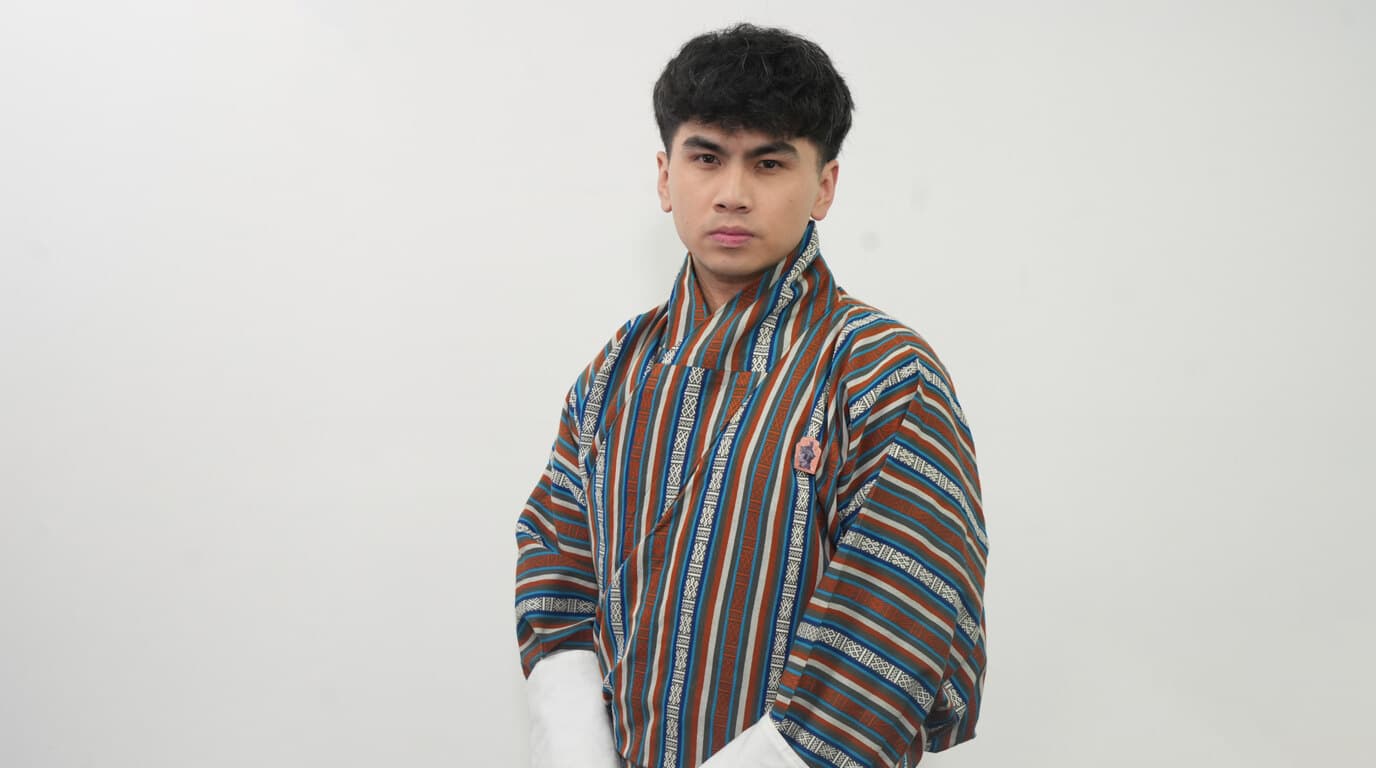
Top photo: Nyendra, Rhythm of Bhutan champion. Photo: Eurovision Song Contest Asia (eurovisionasia.com).