
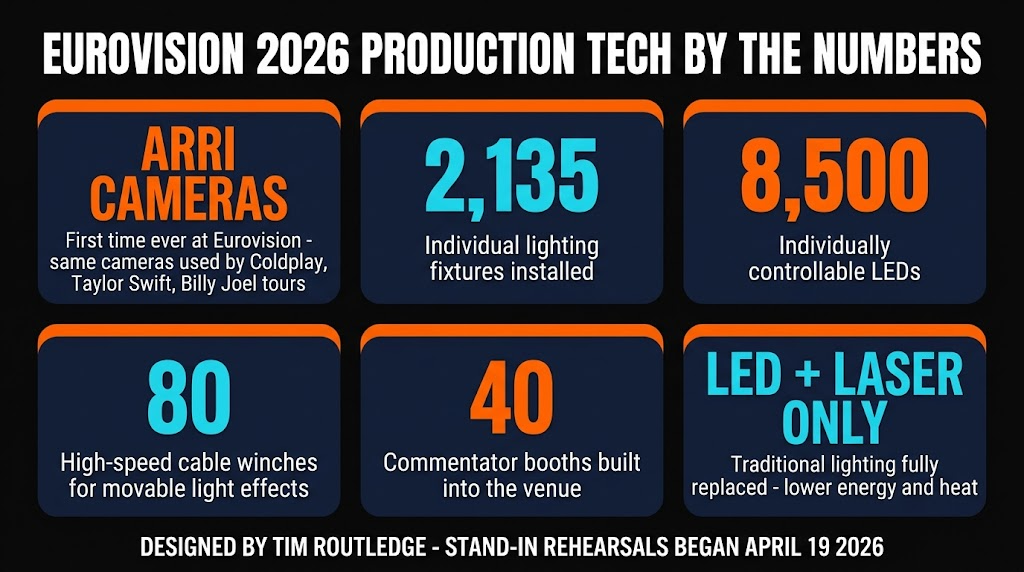
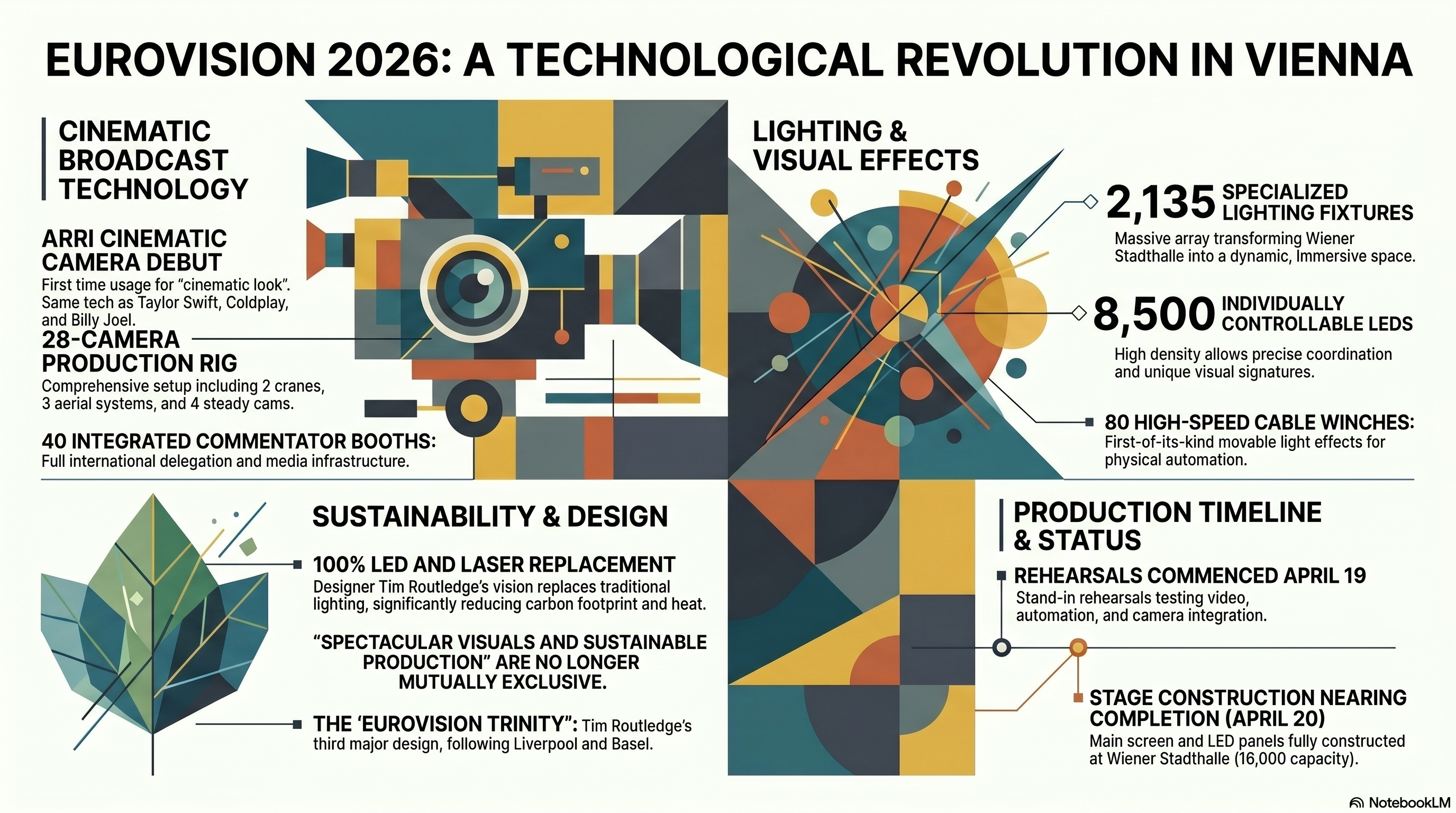
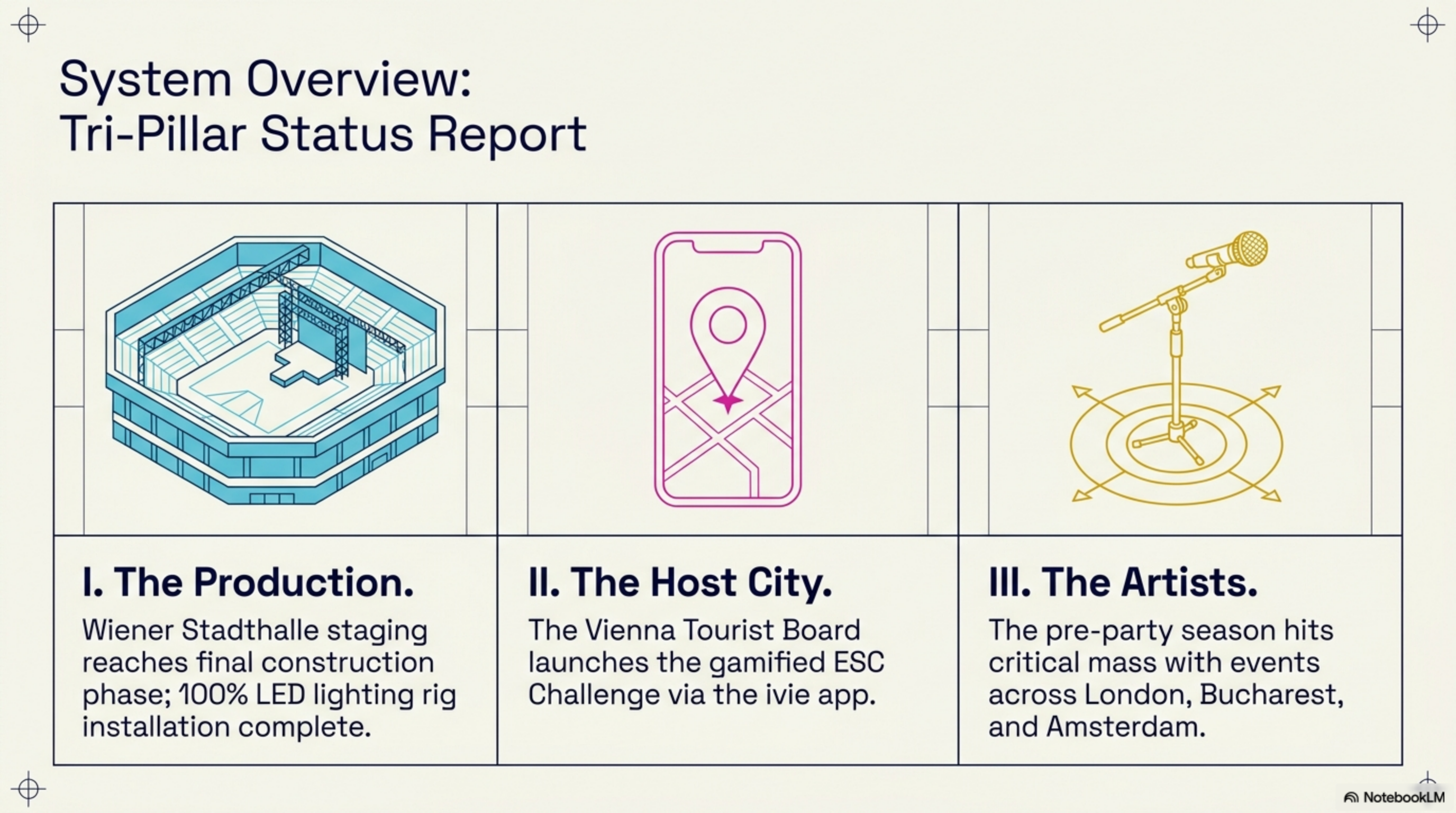
Stage construction at the Wiener Stadthalle is almost complete, and ORF has now confirmed the full technical scope of what may be the most ambitious Eurovision production in the contest's 70-year history. The headline: Eurovision 2026 will be the first Eurovision ever shot on cinematic Arri cameras — the same film-grade camera systems used to capture Coldplay, Taylor Swift and Billy Joel tours.

18+ | New customers only | T&Cs apply | Please gamble responsibly
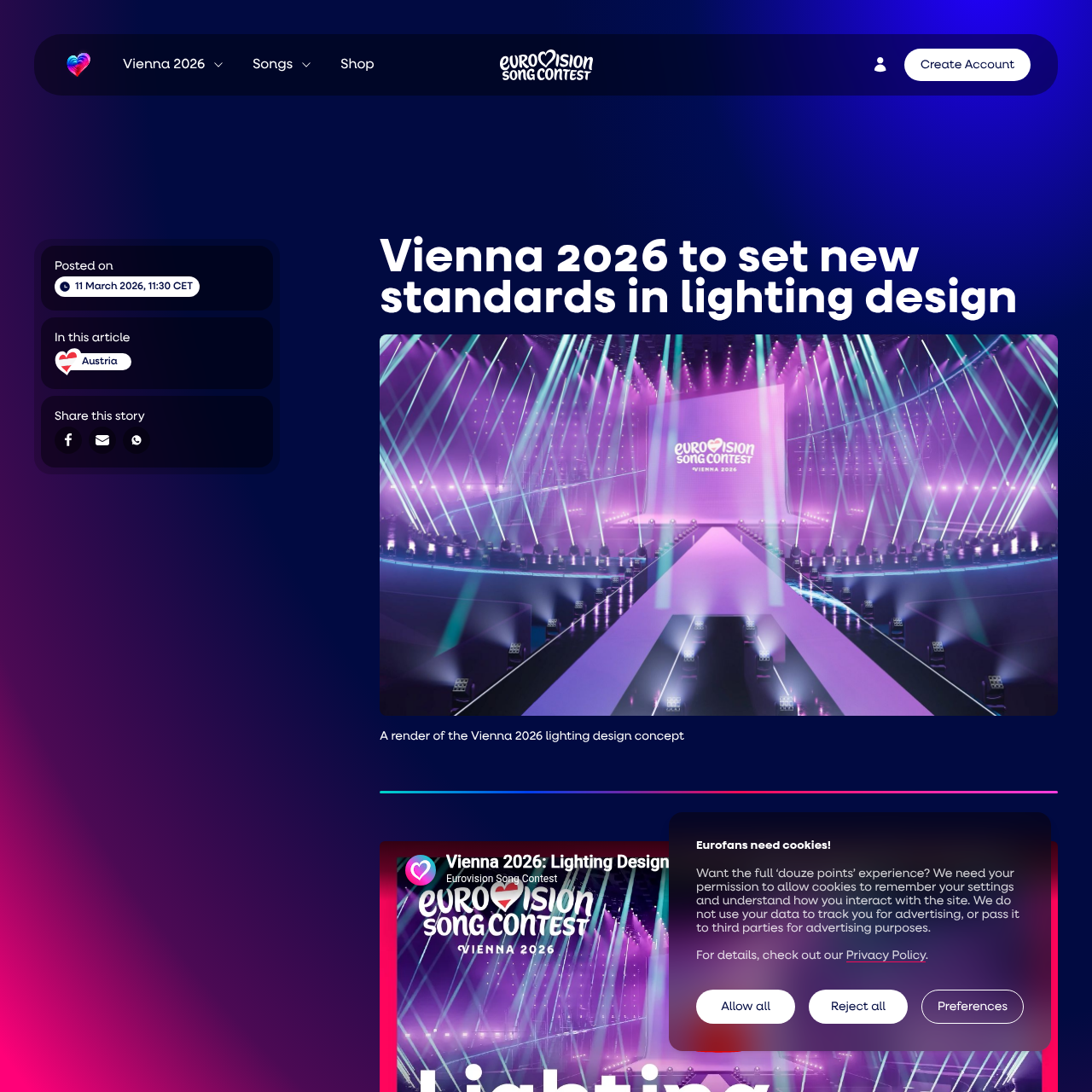
Combined with 2,135 lighting fixtures, 8,500 individually controllable LEDs and 80 high-speed cable winches for movable light effects, this is a radical technical leap for the Eurovision broadcast. Here is the full breakdown of what's being built into the Vienna stage.
Stage Build Timeline
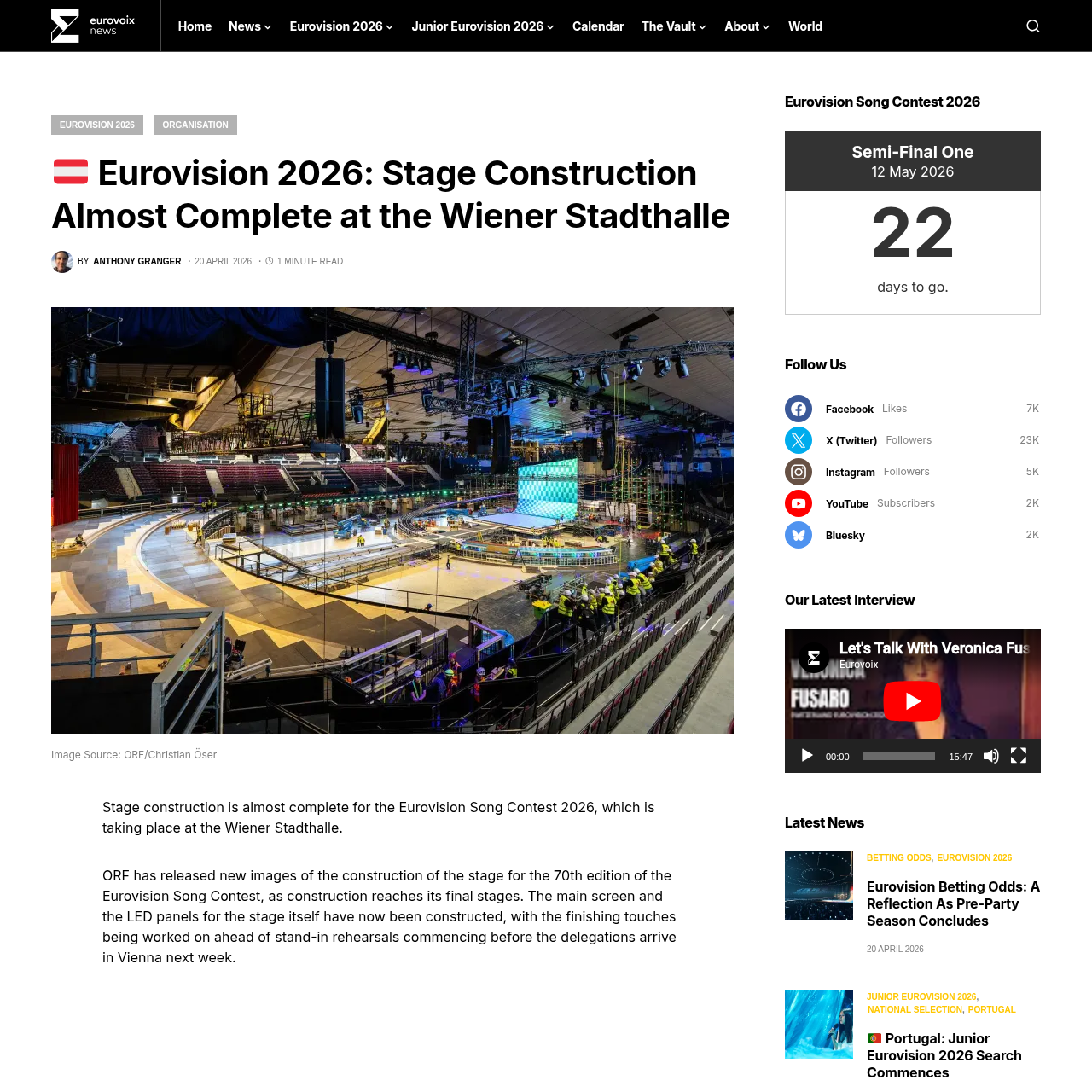
ORF took over the Wiener Stadthalle on March 30, 2026. Since then, crews have worked around the clock on a six-week build schedule:
- Late March – Mid April 2026 — Structural build: stage, lighting rigs, LED installation
- Mid – Late April — Technical installation: sound, cameras, broadcast infrastructure
- April 19, 2026 — Stand-in rehearsals began (before delegations arrive)
- April 24, 2026 — Rehearsals for the wider shows begin
- Early May — Delegation rehearsals on stage
- May 12, 14, 16 — Live shows
As of April 20, the main screen and LED panels are constructed and finishing touches are being worked on. Hundreds of crew members are on site at the Stadthalle overseeing setup, programming, and integration across video, automation, and camera technology.
First-Ever Cinematic Arri Cameras at Eurovision
This is the technical headline that matters most. For the first time in Eurovision Song Contest history, Arri cameras will be used to capture the live broadcast — replacing the traditional broadcast camera rigs used at every previous Eurovision.
Arri cameras are the film and high-end live-music industry standard. Recent deployments include:
- Coldplay — Music of the Spheres world tour
- Taylor Swift — Eras tour (including the record-breaking concert film)
- Billy Joel — Madison Square Garden residency
These cameras deliver a cinematic look — deeper colour reproduction, wider dynamic range, shallower depth of field, and the particular "film look" audiences associate with premium music documentaries and concert films rather than standard TV broadcasts.
The decision matters enormously for how the 35 competing entries will appear on screen. Staging that might have looked flat on conventional broadcast cameras will suddenly have the visual richness of a cinematic music video. Finland's 'Liekinheitin' with its dramatic violin staging, France's 'Regarde!', and Denmark's 'Før vi går hjem' are all expected to benefit particularly well from the upgrade.
Tim Routledge's Lighting Design: The Technical Specs
Lighting is handled by Tim Routledge, one of the most respected live-event lighting designers in the world. Here's what he's installed at the Wiener Stadthalle:
2,135 Lighting Fixtures
Over 2,100 LED and laser units are distributed throughout the venue — across the main stage, the Green Room walkway, the audience area, and the press positions. This is one of the largest single-event lighting deployments ever assembled for a television production.
8,500 Individually Controllable LEDs
Each LED can be programmed independently for colour, intensity, and timing. Combined with the cinematic cameras, this enables the kind of pixel-level visual choreography previously only seen in stadium rock tours.
80 High-Speed Cable Winches
A world-first for Eurovision. 80 high-speed cable winches create movable light effects — lighting fixtures that can physically move during a performance, swooping down from the rig, sweeping across the stage, and repositioning in real-time synchronised with the music. This is new technology that hasn't been deployed in Eurovision before and adds an entirely new dimension to staging.
LED + Laser Only (No Traditional Lighting)
For the first time in Eurovision history, the production is entirely LED and laser based — traditional tungsten and halogen lighting has been fully replaced. The benefits:
- Significantly lower energy consumption
- Dramatically reduced heat generation in the venue (better for performers, audience and equipment)
- Lower material usage and more sustainable overall footprint
- Faster cue-to-cue changes (LEDs transition instantly, tungsten lights need warm-up time)
40 Commentator Booths
The Wiener Stadthalle has been fitted with 40 commentator booths — one for each major participating broadcaster that sends its own commentary team. These are self-contained sound-treated booths with monitor feeds, comms lines, and direct audio paths to their home broadcast.
This is a meaningful upgrade. Commentary quality directly affects the viewing experience in each market — UK viewers hearing Graham Norton, German viewers hearing their team, Australian viewers hearing SBS's voices. Dedicated booths with professional acoustic treatment mean each team can work at broadcast-grade quality regardless of how loud the arena is.
The Stand-In Rehearsals Are Happening Now
As of April 19, stand-in rehearsals are underway. These are technical rehearsals using stand-in performers (not the actual delegations) to test lighting cues, camera angles, sound balance, and stage mechanics.
Stand-in rehearsals are a critical phase because they surface technical problems before the delegations arrive. A moving light cue that doesn't land, an LED panel that flickers, a camera blocking a pyrotechnic effect — all of these are discovered and fixed in the stand-in period, so delegations step into a fully functional production.
What This Production Tech Means for the Betting Market
Better production generally rewards entries that leverage visual spectacle. Expect the following effects in the Betfred markets once rehearsal clips emerge:
- Visual-first entries gain value — Finland (fire/violin spectacle), Greece (Akylas's 'Ferto' staging), San Marino (Senhit + Boy George) all feature strong visual concepts that will read better under cinematic cameras
- Ballads may be revalued — Cinematic close-ups give intimate emotional performances extra weight. France's 'Regarde!' and Denmark's 'Før vi går hjem' are candidates to benefit
- Low-budget national selection staging will feel more exposed — Entries that looked "good enough" under conventional TV cameras may look dated on cinema-grade rigs
The biggest odds movements of the pre-contest period traditionally happen during the rehearsal window. With cinematic cameras and the new lighting system, expect these movements to be sharper than usual.
How This Compares to Previous Eurovisions
| Contest | Stage Designer | Lighting Innovation | Camera System |
|---|---|---|---|
| Vienna 2015 | Florian Wieder | Rotating LED cubes | Standard broadcast |
| Stockholm 2016 | Frida Arvidsson | Multi-level LED floor | Standard broadcast |
| Lisbon 2018 | Florian Wieder | Circular LED arrangement | Standard broadcast |
| Tel Aviv 2019 | Florian Wieder | Geometric LED patterns | Standard broadcast |
| Turin 2022 | Florian Wieder | Vertical LED columns | Standard broadcast |
| Liverpool 2023 | Julio Himede | United By Music LED art | Standard broadcast |
| Malmö 2024 | Florian Wieder | Sustainable LED integration | Standard broadcast |
| Basel 2025 | Florian Wieder | Cubic LED matrix | Standard broadcast |
| Vienna 2026 | Florian Wieder | Curved leaf + 80 motorised winches | Cinematic Arri cameras |
Vienna 2026 is the clearest technical leap since the modern LED era began around 2011.
When to Watch the First Rehearsal Clips
The EBU traditionally releases first rehearsal clips as delegations step onto the stage — typically 30-60 seconds per entry, showing the first pass of the full staging. For Eurovision 2026:
- April 24 — Wider rehearsals begin, not delegation-specific
- Late April onward — Delegations arrive and begin staged rehearsals
- Rehearsal clips — released progressively throughout early May on eurovision.com and the official YouTube channel
Keep an eye on these clips — they'll be the first public view of how the cinematic cameras, 8,500 LEDs, and motorised lighting all work together on the competing entries.
Place Your Bets Before Rehearsal Clips Move the Market
Current Eurovision 2026 odds at Betfred:
- Finland — 6/4 favourite
- France — Joint second
- Denmark — Joint second
- Greece — Top 5, surging
- Sweden — Around 4th
Once rehearsal clips begin dropping, the entries that translate best to the new cinematic look will shorten significantly. The window between now and late April is the last pre-rehearsal market period — ideal for locking in value odds on entries you believe will benefit from the upgraded production.
18+. Please gamble responsibly. BeGambleAware.org
Related Articles
- Eurovision 2026 Stage Design Revealed: Florian Wieder's Viennese Secession Concept
- ORF Takes Over Wiener Stadthalle: Eurovision 2026 Stage Build Begins
- Eurovision 2026 Security: Airport-Level Checks & Drone Defense
- Eurovision 2026 Odds Update (April 9): Finland Narrows, Denmark Surges
- Eurovision 2026 Schedule & Start Times by Time Zone
Frequently Asked Questions
Is Eurovision 2026 really the first contest shot on Arri cameras?
Yes — ORF has confirmed this is the first Eurovision Song Contest to use Arri cinematic cameras for the main broadcast. Every previous Eurovision has used standard television broadcast cameras. The Arri system is the same grade used for Coldplay's Music of the Spheres tour, Taylor Swift's Eras tour, and Billy Joel's Madison Square Garden residency.
How many LEDs are on the Eurovision 2026 stage?
8,500 individually controllable LEDs, mounted across 2,135 total lighting fixtures. Each LED can be programmed independently for colour, intensity, and timing.
What are the 80 cable winches for?
They create movable lighting effects — lights that physically swoop, sweep, and reposition during performances, synchronised with the music. This is a world-first for Eurovision. The winches are high-speed and allow precise programmed choreography of lighting instruments in mid-air.
Who designed the lighting for Eurovision 2026?
Tim Routledge, a leading international lighting designer known for major live music productions. He's overseeing the complete LED and laser design for the 70th Eurovision Song Contest.
When do rehearsals begin?
Stand-in technical rehearsals began on April 19, 2026. Wider production rehearsals start April 24. Delegation rehearsals (with the actual competing artists) begin in early May ahead of the live shows on May 12, 14, and 16.