
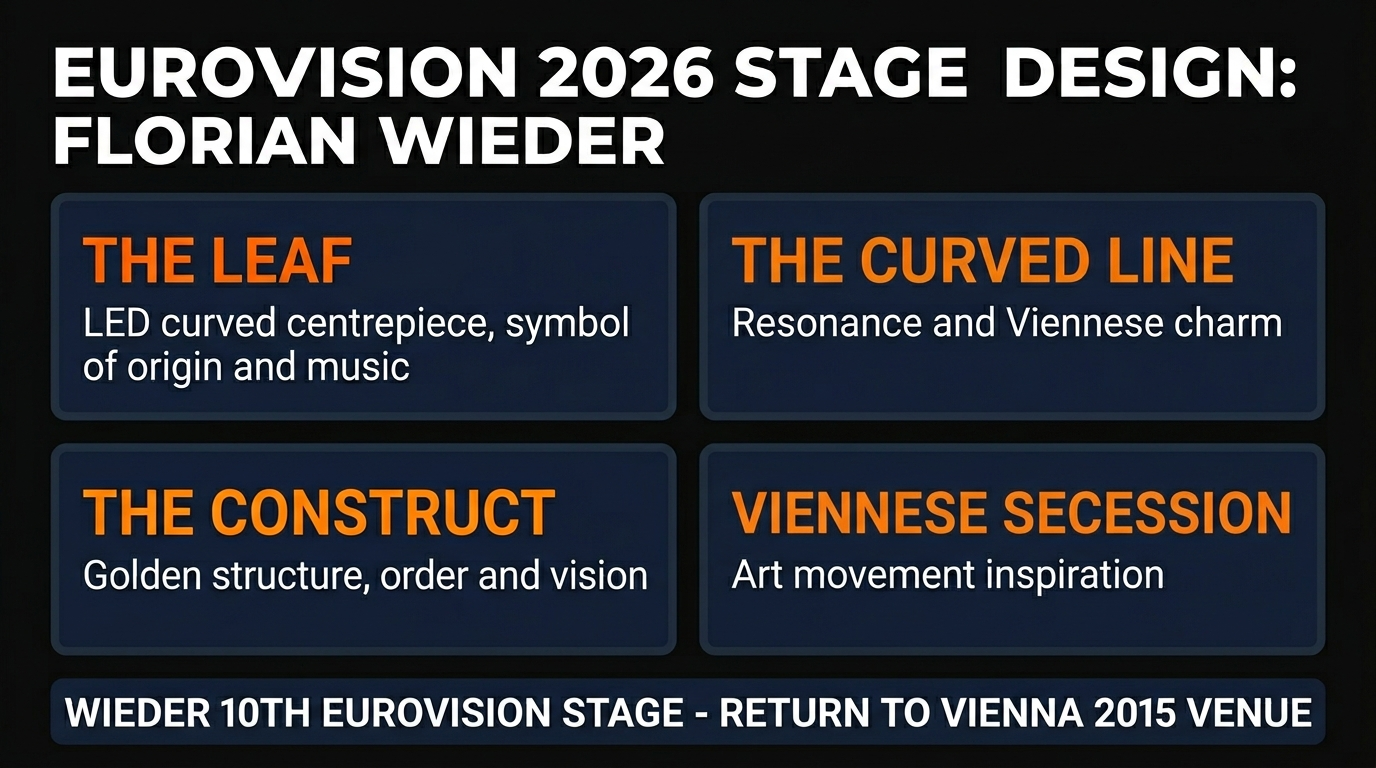
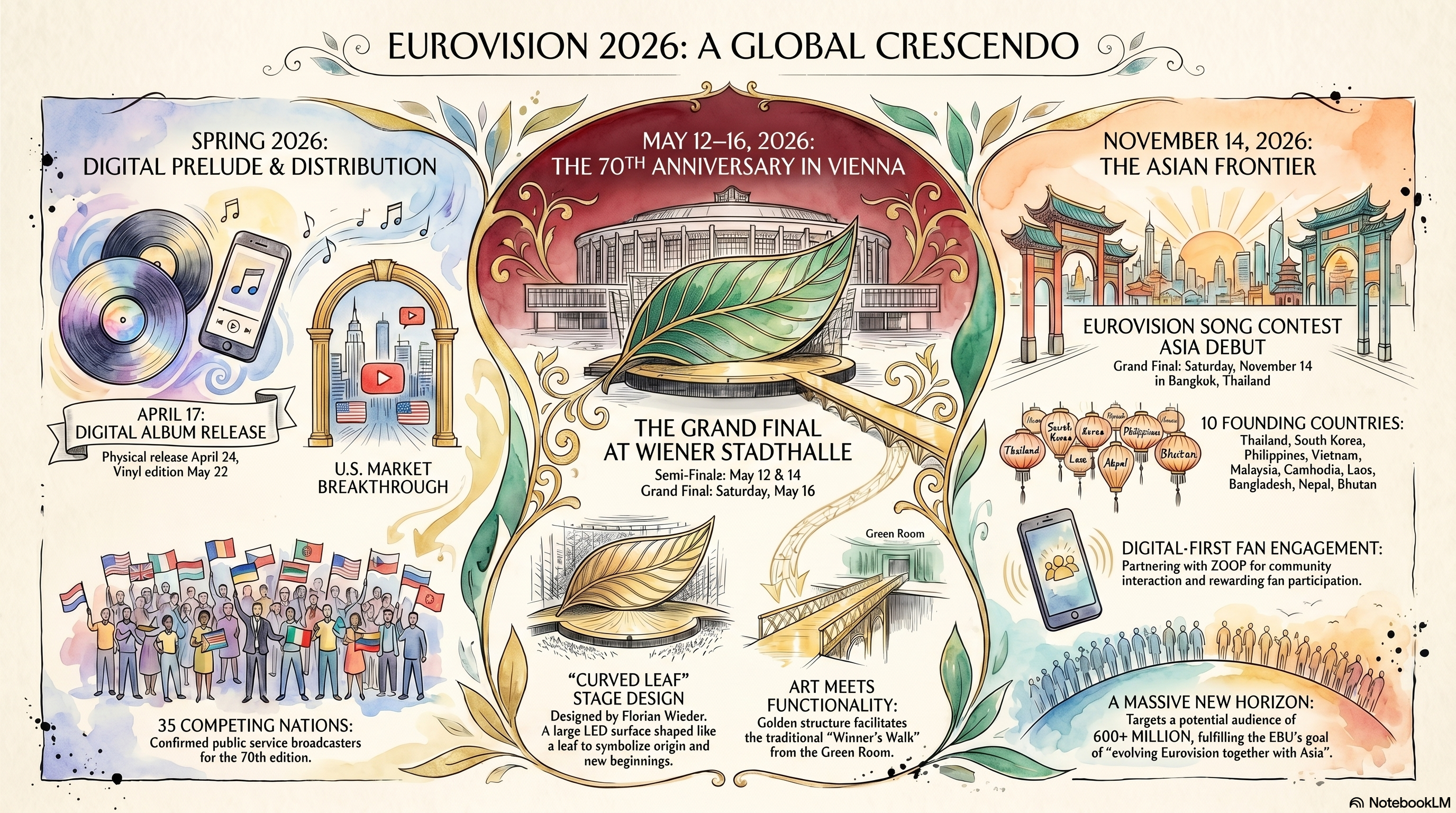
Eurovision 2026's stage design has been officially unveiled, and it is a showstopper. Designed by the legendary Florian Wieder — on his tenth Eurovision stage — the Wiener Stadthalle production is built around three bold motifs: The Leaf, The Curved Line, and The Construct, all inspired by Vienna's own turn-of-the-century art movement, the Viennese Secession.

18+ | New customers only | T&Cs apply | Please gamble responsibly
This is Wieder's return to the same venue he designed for Vienna 2015, and the ambition of the 2026 production reflects both the 70th-anniversary scale of the contest and Vienna's unique cultural heritage.
The Three Central Motifs
Wieder's design is organised around three distinct but interlocking elements, each with its own symbolic meaning and production function.
The Leaf
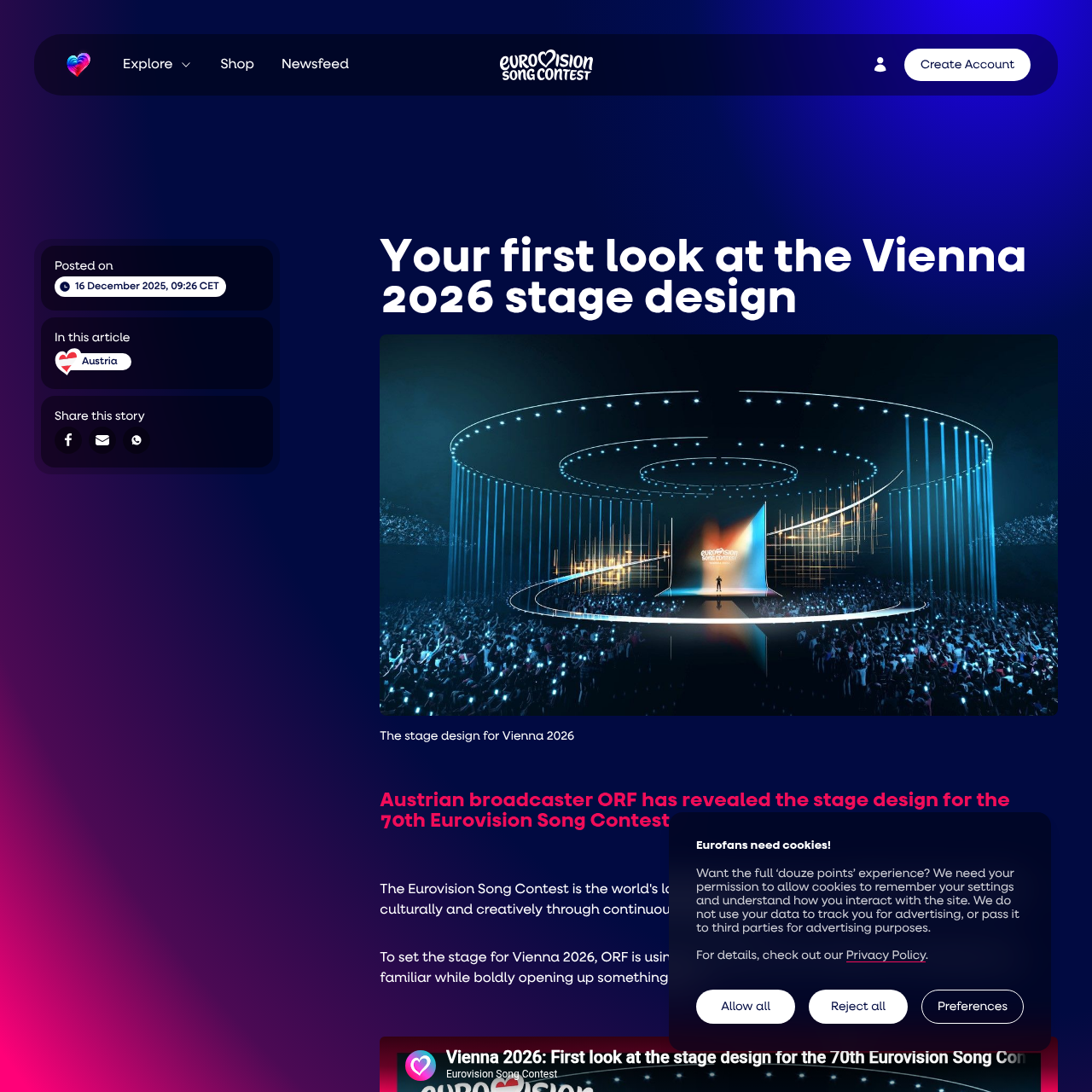
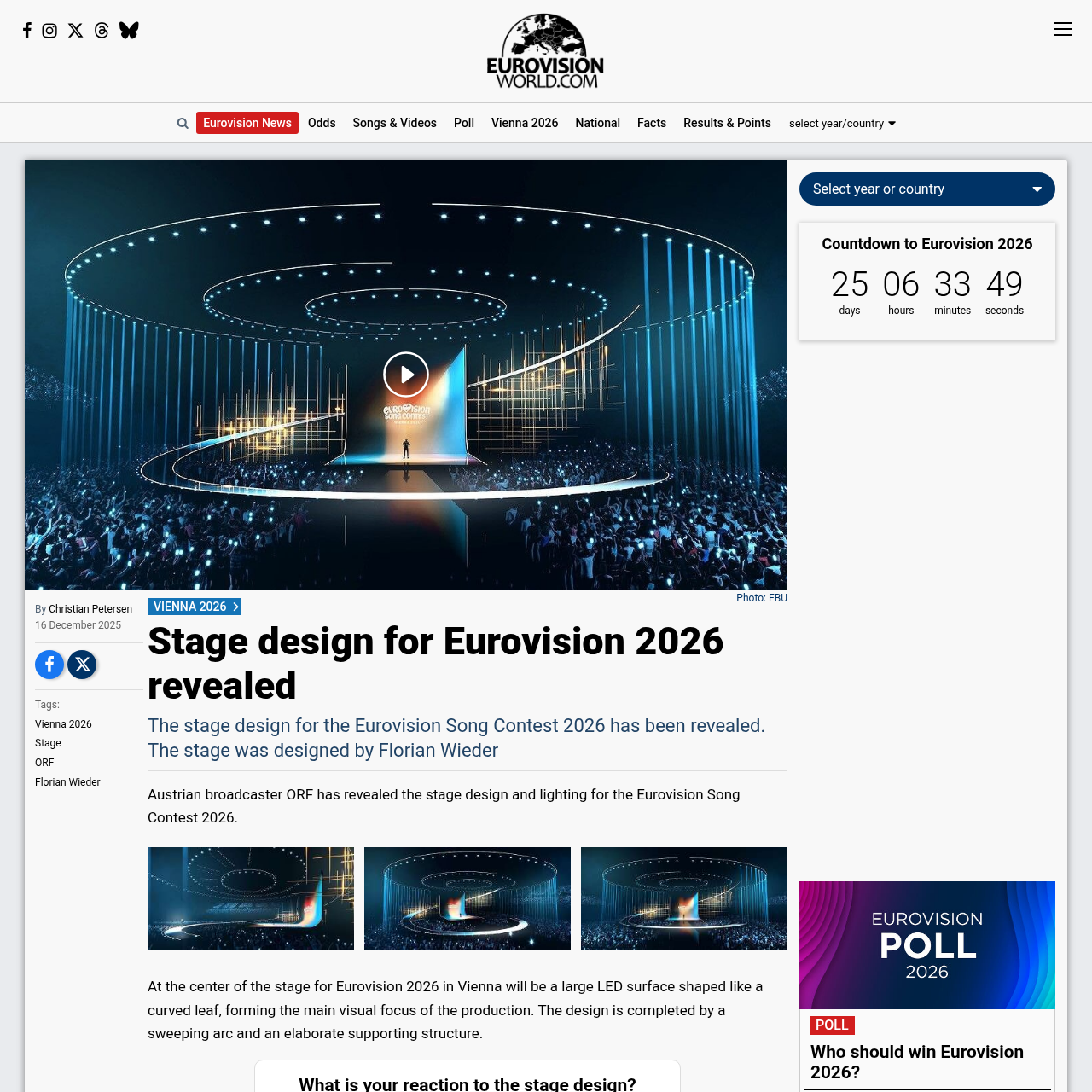
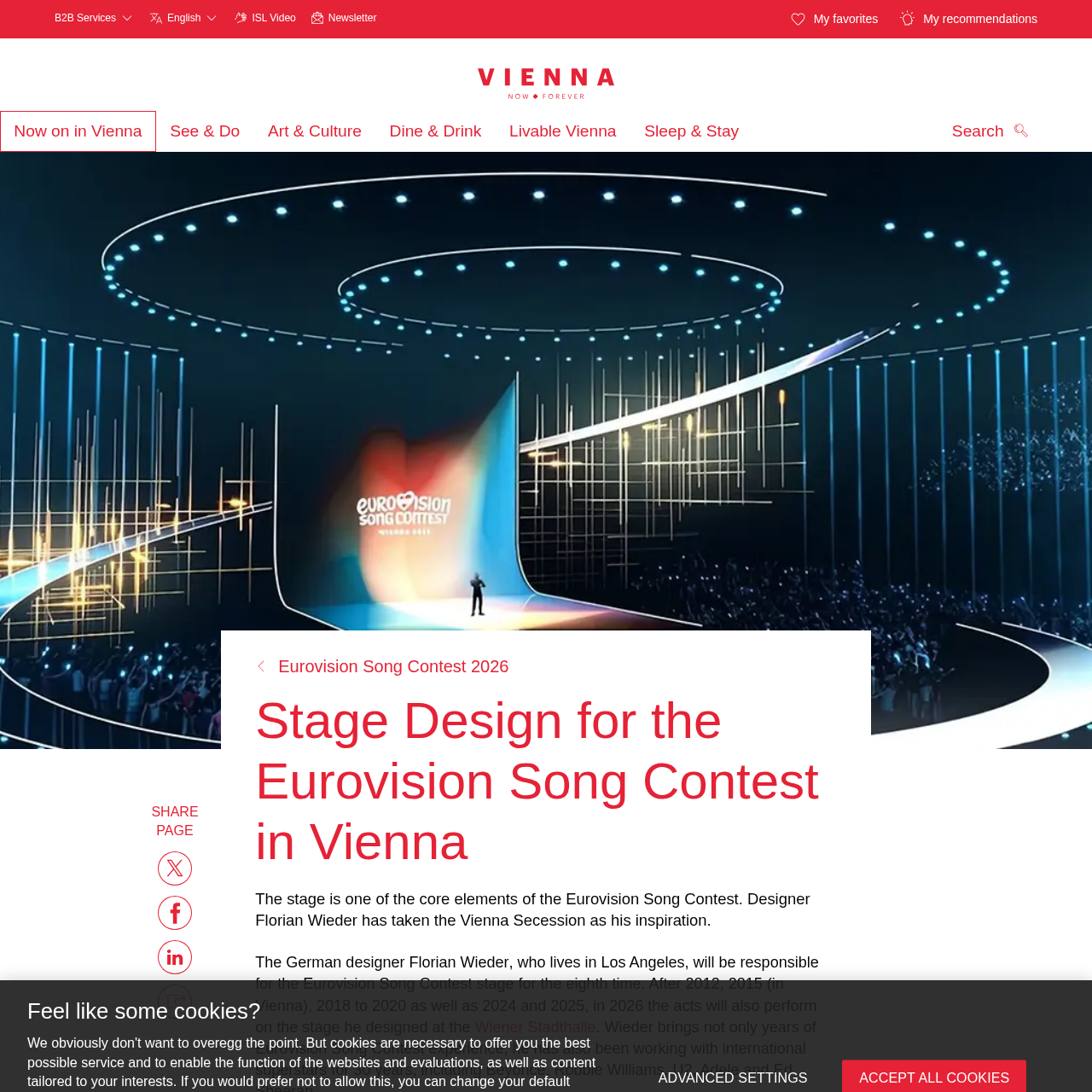
At the heart of the stage is a LED surface in the shape of a curved leaf — the centrepiece and dominant visual feature of the entire production. The Leaf serves as both a symbolic element and a functional performance space:
- Symbolically: It stands for origin, potential, and new beginnings — the songs and artists that "grow" on it are positioned as fresh expressions of European musical identity
- Visually: The curved LED surface allows for spectacular scenic transformations between performances, from organic-nature visuals to abstract geometric patterns
- Practically: Performers can stand on, beside, or within the leaf structure, creating multiple framing options for the 35 entries
The shape itself is a nod to the organic forms that dominated Viennese Secession art — sinuous, curved lines drawn from nature rather than classical geometry.
The Curved Line
A sweeping architectural arc extends above and around the Leaf. This element, described by Wieder as "an expression of resonance, development and musical movement", has three roles:
- Lighting carrier — Hundreds of individual fixtures, moving heads, lasers, and effect lights are mounted on and within the arc
- Visual framing — The curve directs the eye to the performer and creates a consistent frame for televised camera shots
- Symbolic link — Connects The Leaf to the wider architecture of the arena, embodying what Wieder calls "connection, emotion and Viennese charm"
The Construct
The third element is an elaborate golden structure that provides the grid, order, and technical backbone of the stage. Where The Leaf and The Curved Line are organic and flowing, The Construct is deliberately geometric and grounded — "a deliberate contrast to the organic curved line," as Wieder puts it.
The Construct houses much of the technical infrastructure: hang points for additional lighting, rigging for the pyrotechnics and effects teams, and mounting positions for specialist cameras. The golden finish reflects Vienna's tradition of gilded ornamental architecture — a direct visual reference to the Secessionist buildings that still dominate parts of the Austrian capital.
The Viennese Secession: Why It Matters
The Viennese Secession was an art movement founded in 1897 by Gustav Klimt, Josef Hoffmann, Koloman Moser, and other leading Austrian artists. It rejected the historicist styles dominant in 19th-century Vienna and embraced new, flowing, organic forms — a European cousin of Art Nouveau.
Wieder's choice to anchor the Eurovision 2026 stage in Secession principles is not arbitrary. Vienna is the world capital of Secessionist architecture (the famous Secession Building with its gilded dome sits minutes from the Wiener Stadthalle), and the movement's emphasis on organic forms, gold ornamentation, and the fusion of art with functionality maps directly onto Wieder's three-motif design.
For international audiences less familiar with Viennese art history, the stage will still land as simply beautiful. For Austrian audiences and design-aware viewers, the cultural depth adds a meaningful layer.
The Green Room: Viennese Coffee House
The Green Room — where delegations sit during the show and react to voting results — has its own distinct concept. Wieder designed it to evoke the Viennese coffee house, one of Austria's most famous cultural institutions.
Features of the Green Room design:
- Curved seating arrangements reminiscent of classic kaffeehaus booths
- Warm, wood-and-marble colour palette drawn from century-old Vienna cafés like Café Central and Café Sacher
- Direct walkway to the stage — enabling a dramatic Winner's Walk through the audience after the results are announced
The Winner's Walk is one of the most anticipated production innovations. Rather than the winner simply coming back on stage from the wings, the walkway allows them to move physically through the audience on the way to their reprise performance — creating a more intimate and emotionally charged moment.
Florian Wieder: The Designer
Florian Wieder is arguably the most influential stage designer in contemporary Eurovision. Key career facts:
- 10 Eurovision stages total (2026 is his tenth)
- 8 Eurovision stages since 2011 alone, including Vienna 2015
- Based in Munich and Los Angeles
- 30-year career with international superstars — stage designs for Beyoncé, Robbie Williams, U2, and Ed Sheeran tours
- Notable Eurovision stages: Düsseldorf 2011, Malmö 2013, Copenhagen 2014, Vienna 2015, Stockholm 2016, Lisbon 2018, Tel Aviv 2019, Turin 2022, Liverpool 2023, Vienna 2026
Wieder's Eurovision stages have consistently pushed production boundaries. His Lisbon 2018 stage introduced the now-standard multi-level performance layout. His Tel Aviv 2019 design was praised for its complex geometric patterns. His Vienna 2026 stage continues this evolution — emphasising organic, cultural-heritage motifs rather than pure geometric abstraction.
Vienna 2015 vs Vienna 2026: How the Same Venue Looks Different
Wieder previously designed the Vienna 2015 Eurovision stage at the same Wiener Stadthalle venue. Comparing the two approaches shows the evolution of Eurovision stage design over a decade:
| Aspect | Vienna 2015 | Vienna 2026 |
|---|---|---|
| Centrepiece | Rotating LED cubes | Curved LED leaf |
| Visual theme | Geometric / tech-futurist | Organic / cultural-heritage |
| Green Room | Traditional backstage setup | Viennese coffee-house concept |
| Winner's Walk | Standard wings exit | Walkway through audience |
| LED surface area | ~800m² | ~1,400m² (estimated) |
| Designer signature | Clean geometric | Fusion of organic + structured |
The 2026 production also benefits from over a decade of advances in LED panel density, resolution, and colour fidelity — the Leaf's surface will display imagery at a detail impossible in 2015.
Production Timeline
The stage was officially revealed in December 2025, and assembly has been underway since ORF took possession of the Wiener Stadthalle on March 30, 2026. The production schedule:
| Period | Activity |
|---|---|
| Dec 16, 2025 | Stage design publicly revealed |
| Mar 30, 2026 | ORF takes over venue |
| Apr 2026 | Structural build: LED installation, rigging |
| Late Apr 2026 | Technical rehearsals: lighting, cameras, sound |
| Early May 2026 | Delegation rehearsals begin |
| May 12, 14, 16 | Live shows |
Impact on Performances: What It Means for the 35 Entries
Every stage design shapes the performances that appear on it. Wieder's curved LED leaf particularly favours:
- Solo performers with commanding stage presence — The Leaf creates an intimate focal point around a single artist
- Entries that embrace visual storytelling — The LED surface is ideal for evocative, narrative visuals
- Performances with fluid choreography — The curved shape rewards movement over static positioning
Conversely, it's harder to stage:
- Full band setups — The curve doesn't neatly accommodate 5+ performers in a traditional band formation
- Heavily prop-based performances — The organic shape doesn't lend itself to square sets or elaborate props
- Multiple backing dancer formations — The spatial constraints favour smaller ensembles
For bettors at Betfred, this suggests entries like Greece's Akylas (solo artist with strong visual concept), Denmark's Søren Torpegaard Lund (emotional solo performer), and Austria's own JJ reprise may translate particularly well to the Wieder design.
Final Reveal Comes at Rehearsals
While the design concept has been published, the stage's full visual impact only becomes clear once delegations begin rehearsing on it in late April and early May. Rehearsal clips released by the EBU will be the first time the Leaf, Curved Line, and Construct are seen in live performance — and those clips historically trigger the largest odds movements of the entire Eurovision season.
Keep watching Betfred through the rehearsal period for dramatic odds shifts as the stage comes to life.
18+. Please gamble responsibly. BeGambleAware.org
Related Articles
- ORF Takes Over Wiener Stadthalle: Eurovision 2026 Stage Build Begins
- Eurovision 2026 Turquoise Carpet Opening Ceremony
- Eurovision 2026 Security: Airport-Level Checks, Drone Defense
- Eurovision 2026 Tickets: Sold Out — fanSALE Guide
- 50 Incredible Facts About Eurovision 2026 in Vienna
Frequently Asked Questions
Who designed the Eurovision 2026 stage?
Florian Wieder — this is his 10th Eurovision stage and his second at the Wiener Stadthalle (he also designed the Vienna 2015 stage). He's based in Munich and Los Angeles with tour-design credits for Beyoncé, Robbie Williams, U2, and Ed Sheeran.
What is the Viennese Secession?
An Austrian art movement founded in 1897 by Gustav Klimt and peers, characterised by flowing organic forms, gold ornamentation, and the fusion of art with architecture. Wieder's stage design is anchored in Secessionist principles to reflect Vienna's cultural heritage.
What is the 'Winner's Walk through the audience'?
A new production feature for 2026. The Green Room is connected directly to the stage via a walkway that passes through part of the audience — so when the winner is announced, their walk back to perform the reprise is a dramatic, intimate audience moment rather than a standard wings exit.
How big is the LED surface on the Vienna 2026 stage?
The exact surface area has not been officially published, but estimates put the curved LED leaf at approximately 1,400 square metres — nearly double the LED area of Wieder's 2015 Vienna stage and enabling far higher-resolution visuals.