
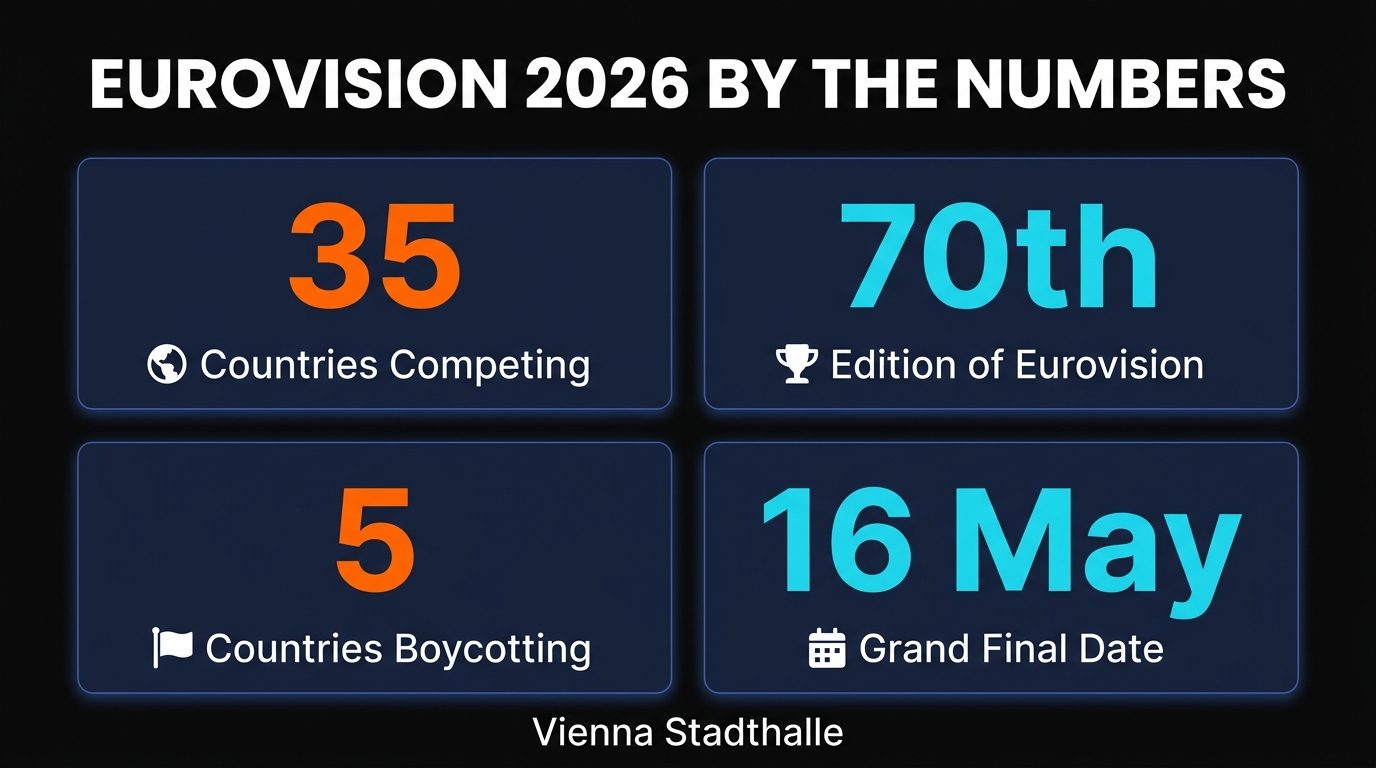
It is officially happening. ORF, the Austrian host broadcaster for Eurovision 2026, has taken possession of the Wiener Stadthalle and the transformation of Vienna's largest indoor arena into the Eurovision stage has begun.

18+ | New customers only | T&Cs apply | Please gamble responsibly
The Ceremonial Handover
The official move-in was marked on March 30, 2026 with a ceremonial handover led by Michael Krön, Executive Producer of Eurovision 2026, and Thomas Waldner, Managing Director of the Wiener Stadthalle. The moment symbolises the point at which the Stadthalle ceases to be a regular concert venue and becomes the property of Eurovision for approximately six weeks.
During this period, the venue will undergo a complete transformation. Every aspect of the arena — from the stage and lighting rigs to the seating configuration, broadcast infrastructure, Green Room, press centre, and backstage areas — will be rebuilt from scratch to meet Eurovision's exacting production standards.
The Scale of the Build
Building a Eurovision stage is one of the largest temporary construction projects in the entertainment industry. The production involves:
- Stage construction — A custom-designed stage built to accommodate the contest's varied performance styles, from solo ballads to full dance productions with large casts
- LED screens and projection — Massive LED walls and projection systems that create the visual backdrops for each performance
- Lighting — Hundreds of individual lighting fixtures, moving heads, lasers, and effect lights controlled by a dedicated lighting team
- Sound — A broadcast-quality sound system designed for both the in-arena audience and the television mix, which must meet EBU broadcast standards
- Camera positions — Multiple camera positions throughout the arena, including crane cameras, steadicam operators, and specialist camera rigs
- Green Room — A fully equipped area where delegations watch the show and await results, visible to cameras throughout the broadcast
- Press centre — Workspace for the thousands of accredited journalists covering the contest
- Broadcast compound — An external area housing the outside broadcast trucks, satellite uplinks, and technical infrastructure that distributes the signal to broadcasters worldwide
The Wiener Stadthalle: A Eurovision Venue with History
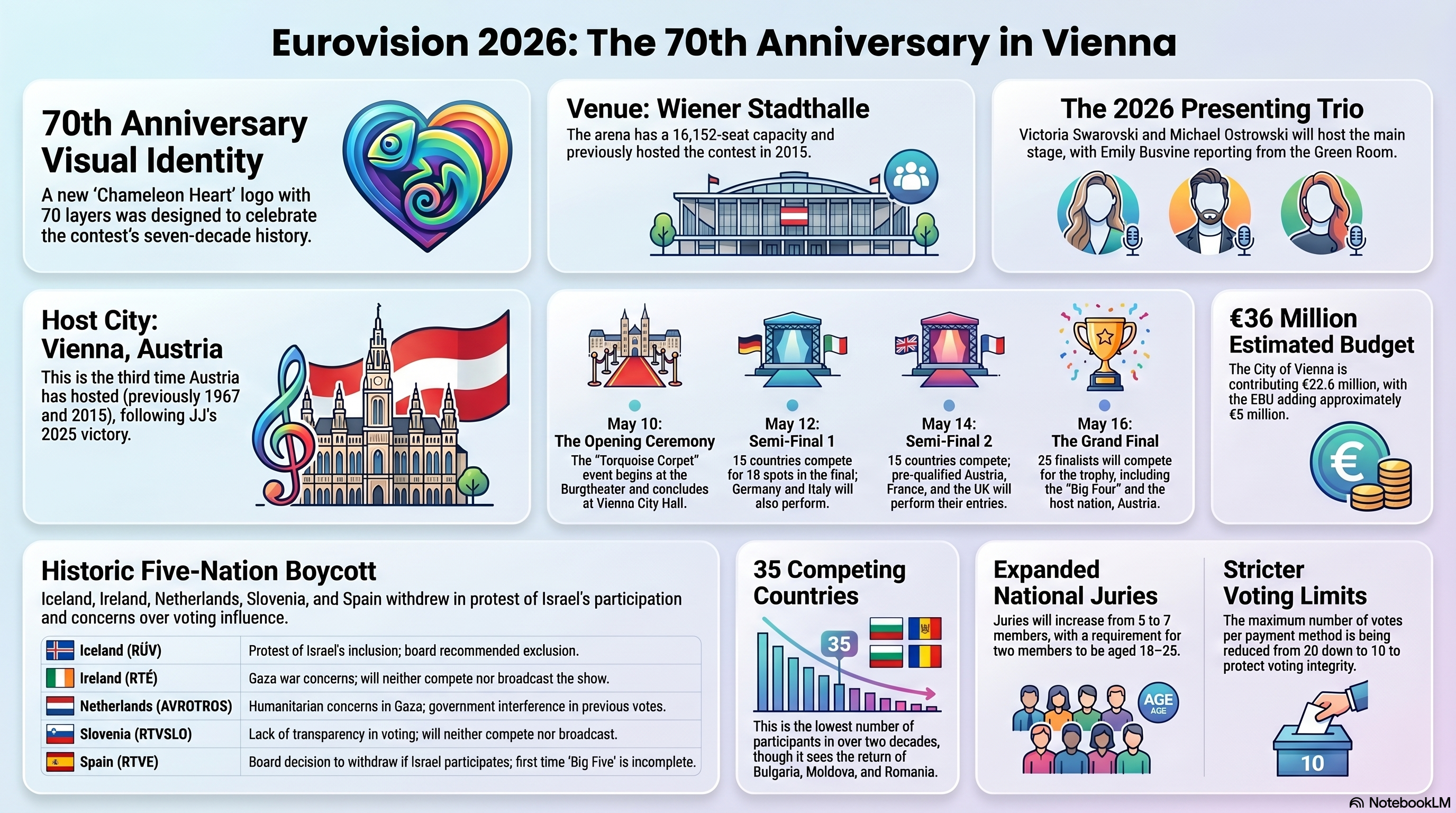
The Wiener Stadthalle is no stranger to Eurovision. The venue last hosted the contest in 2015, when Austria staged Eurovision following Conchita Wurst's historic victory in Copenhagen in 2014. That year, Sweden's Mans Zelmerlow won with 'Heroes', and Italy's Il Volo finished third with 'Grande Amore' — Il Volo will return to the same stage as an interval act in 2026.
The Stadthalle's Halle D, the venue's largest space, has a capacity of approximately 16,000 for concert configurations. For Eurovision, the capacity is adjusted to accommodate the stage, broadcast infrastructure, and Green Room, typically resulting in an audience capacity of around 10,000-12,000.
The venue's central location in Vienna's 15th district makes it accessible by public transport, with the Stadthalle U-Bahn station directly adjacent. This accessibility is crucial for an event that will see thousands of fans travelling to and from the venue across multiple show days.
Timeline: What Happens Next
The six-week build period follows a carefully planned schedule:
| Period | Activity |
|---|---|
| Late March - Mid April | Structural build: stage, lighting rigs, LED installation |
| Mid - Late April | Technical installation: sound, cameras, broadcast infrastructure |
| Late April | Technical rehearsals: testing all systems without performers |
| Early May | Delegation rehearsals begin: each country gets allocated rehearsal slots |
| May 10 | Opening Ceremony at Rathausplatz |
| May 11 | Semi-Final 1 dress rehearsal and jury show |
| May 12 | Semi-Final 1 live show |
| May 13 | Semi-Final 2 dress rehearsal and jury show |
| May 14 | Semi-Final 2 live show |
| May 15 | Grand Final dress rehearsal and jury show |
| May 16 | Grand Final live show |
Rehearsals: When the Odds Really Move
For bettors, the most important phase of the build is the rehearsal period beginning in late April and early May. This is when delegations arrive in Vienna and begin rehearsing their performances on the actual stage for the first time.
Rehearsal footage and reports from accredited press in the arena traditionally cause the biggest odds movements of the pre-contest period. A song that looked average on a national selection stage can be transformed by spectacular Eurovision staging, while a favourite can stumble if the staging does not translate to the larger venue.
The first rehearsal clips — short snippets released by the EBU — will be the next major catalyst for odds movement. Historically, these clips have caused dramatic repricing in the betting markets.
Keep a close eye on Betfred during the rehearsal period for the best odds on all Eurovision 2026 markets. The market will be at its most volatile — and for informed bettors, that means opportunity.
18+. Please gamble responsibly. BeGambleAware.org

Related Articles
- Turquoise Carpet Opening Ceremony
- Eurovision 2026 Security Measures
- Eurovision 2026 Tickets Guide
- Eurovision 2026 Hosts Profiles
Frequently Asked Questions
When did ORF take over the Wiener Stadthalle?
March 30, 2026 — marked by a ceremonial handover between Executive Producer Michael Krön and Stadthalle Managing Director Thomas Waldner.
How long is the Eurovision stage build?
Approximately six weeks, from late March through the Grand Final on May 16.
Has Vienna hosted Eurovision before?
Yes — most recently in 2015, following Conchita Wurst's 2014 victory. The same venue, Halle D at Wiener Stadthalle, is being used again for 2026.