Eurovision's hosting rule is simple in theory: win the contest, host it next year. In practice, the rule has been bent often enough that the all-time hosting table looks very different from the all-time winners' table. The United Kingdom — with 5 wins — has hosted 9 times. Luxembourg — with 5 wins — has hosted just 4. The discrepancy is the EBU's emergency-host clause, and no broadcaster has been called on more often than the BBC.
The UK's 9-hosting record is built on backup duty. The BBC has hosted four contests it actually won (1968, 1977, 1982, 1998) and five contests it didn't (1960, 1963, 1972, 1974, 2023). Three of those backup hostings came in a single 14-year window — 1960, 1963 and 1972-1974 — when the contest's economics were precarious and host countries routinely declined the bill. The Netherlands, France, Monaco and Luxembourg all passed the contest to London or Edinburgh in that era. Liverpool 2023, on behalf of Ukraine, was the first BBC backup hosting in 49 years.
Ireland's 1990s purple patch is the densest hosting cluster in Eurovision history. RTÉ staged the contest in Dublin in 1988, Millstreet in 1993, Dublin again in 1994, 1995 and 1997 — five hostings in nine years, four of them in five years. Ireland is the only country ever to host three consecutive contests (1993, 1994, 1995). The streak followed the country's unmatched three-in-a-row winning run from 1992 to 1994, and after Eimear Quinn's win in 1996 there were rumours — never proven — that RTÉ was deliberately fielding weak entries to avoid the cost of hosting yet again. Whatever the truth, Ireland hasn't placed in the top five since Marc Roberts's runner-up finish in 1997.
Sweden's hosting record matches Ireland's, but the pattern is opposite. Sweden's 7 stagings are spread evenly across half a century — 1975, 1985, 1992, 2000, 2013, 2016 and 2024 — at roughly one per decade in line with their consistent winning record. Stockholm has hosted three times, Malmö three times, and Gothenburg once. Sweden is the only country to have hosted in three different cities more than once each.
The Netherlands sits on 5 hostings, but the 2020/2021 story is its own footnote. Rotterdam was awarded the 2020 contest after Duncan Laurence's 2019 win, the COVID-19 pandemic cancelled it, and the city re-hosted in 2021 — making the 2020 selection the only host city in Eurovision history to never actually stage a contest. Hilversum 1958, Amsterdam 1970, The Hague 1976 and The Hague 1980 round out the Dutch tally. The 1980 staging was itself a backup — Israel's IBA declined after hosting 1979, the BBC and Spain's TVE both reportedly turned the EBU down, and NOS eventually stepped in.
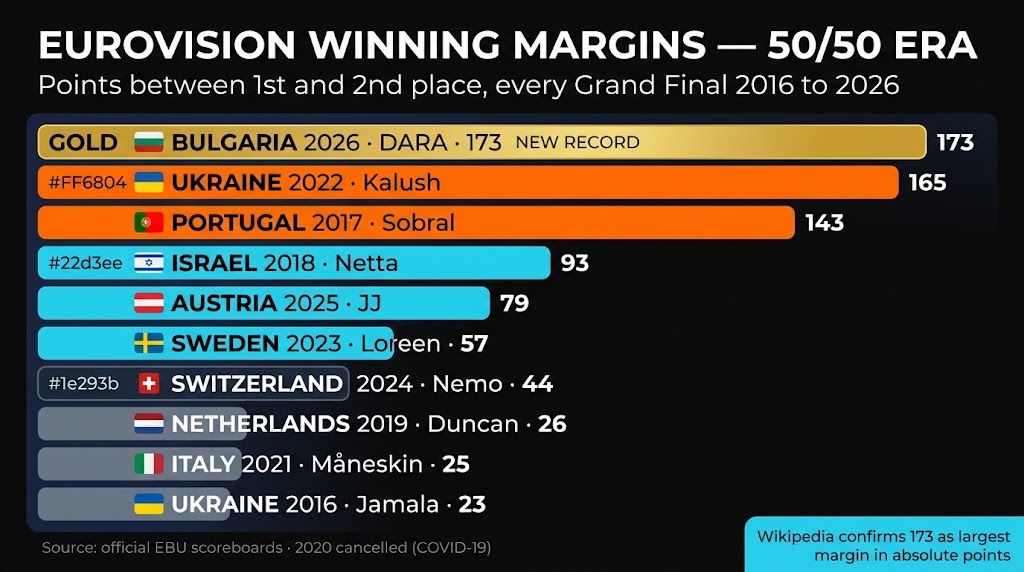
Vienna 2026 hands the baton to Sofia 2027 — Bulgaria's first ever hosting. DARA's record-breaking 173-point margin victory at the Wiener Stadthalle in May 2026 makes Bulgaria the 27th country to host the Eurovision Song Contest, ending a 14-year wait since the country's 2007 debut. Sofia joins a club that, after 70 contests, still includes only one host city from the former Eastern Bloc capitals of Belgrade, Moscow, Kyiv and Baku. The 2027 contest will also be the first Eurovision held in a Slavic-language country since Kyiv 2017.