Sixty-nine Eurovision Grand Finals have been held since 1956 (the 2020 contest was cancelled), and across that span, twenty-eight countries have won and another nine have reached the podium without taking the trophy. But the distribution of finishing positions tells a richer story than the medal table alone. Some countries are reliable top-10 fixtures. Some swing wildly. Some have never made the top 10 at all.
The consistent top-10 club is smaller than you'd think. Sweden leads with 45 Grand Final top-10 finishes — that's roughly two out of every three contests they've entered. Italy is the most striking modern example: since returning to Eurovision in 2011 after a 14-year absence, Italy has finished in the top 10 in 13 of 15 contests, with one win (Måneskin 2021) and four other top-3 placings. The only misses were 2014 (21st) and 2016 (16th). Ukraine's pattern is similar — 3 wins (Ruslana 2004, Jamala 2016, Kalush Orchestra 2022) and a 100% qualification rate from the semi-finals across 21 entries.
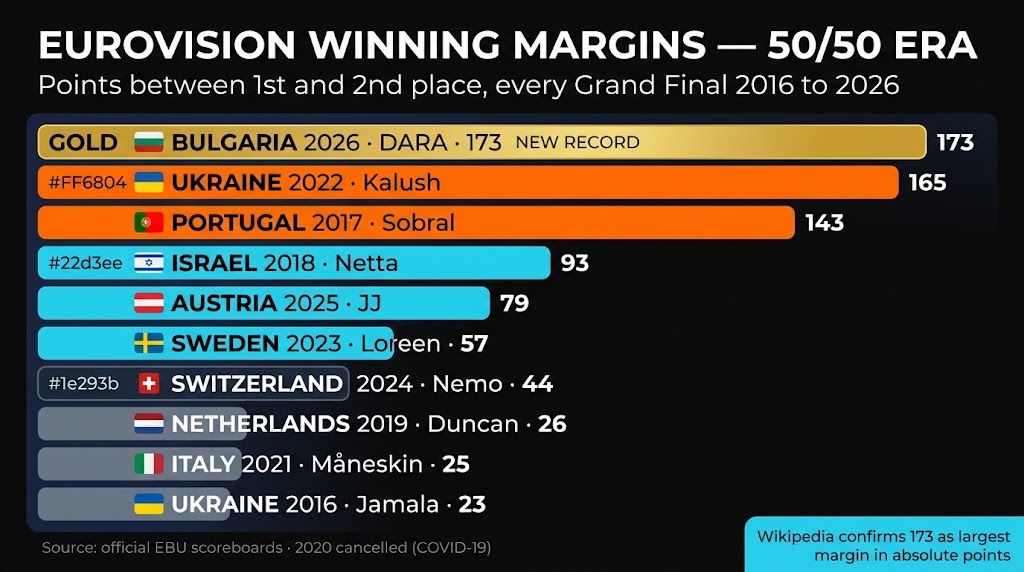
Israel and Ireland are the boom-bust archetypes. Israel has won four times (Izhar Cohen 1978, Milk and Honey 1979, Dana International 1998, Netta 2018) and has now silvered three years running (Eden Golan was 5th in 2024; Yuval Raphael 2nd in 2025; Noam Bettan 2nd in 2026 behind Bulgaria's record win). Yet Israel has also finished 23rd or 24th seven times since 2000, and failed to qualify from the semi-finals in five separate years (2007, 2011, 2012, 2013, 2014, 2022). The range from 1st to 24th is the widest of any country with multiple wins. Ireland's profile is even sharper — seven wins (a record they share with Sweden), but since 2004 the country has failed to qualify from the semi-finals seven times. The Celtic Tiger of Eurovision turned bottom-feeder almost overnight.
Finland and Norway are the wooden spoon kings. Each has been bottom of the Grand Final scoreboard eleven times — a shared record. Finland's win came in 2006 with Lordi's Hard Rock Hallelujah, the only metal song ever to win Eurovision. Norway has three wins (Bobbysocks 1985, Secret Garden 1995, Alexander Rybak's record-breaking 2009) but bookends that with eleven lasts, most recently Alessandra in 2024.
The never-podium countries are a real club. Andorra entered six times between 2004 and 2009 and never once reached the Grand Final — every entry stopped at the semi-final stage. North Macedonia (as F.Y.R. Macedonia until 2019) has 21 entries with a best of 7th place in 2019 and no podium. Montenegro has reached the final just twice in 14 attempts. San Marino's only Grand Final qualification in 16 attempts since 2008 was Serhat's 19th place in 2019. Australia, despite its near-instant success on debut — Guy Sebastian 5th in 2015, Dami Im 2nd in 2016 — has never won, although a 4th place for Go-Jo in Vienna 2026 was the country's third top-5 in eleven appearances.
Vienna 2026's top 10 in historical context. Bulgaria's win (DARA, Bangaranga, 498 points) was the country's first after 14 attempts and only its second podium ever, joining Kristian Kostov's 2017 silver. Israel's silver (Noam Bettan) extends a three-year run of top-five finishes. Romania's bronze (Stefan Banica Jr.) is the country's fourth podium and first since 2010. Australia's 4th was the program's joint-best non-medal result (matching Kate Miller-Heidke's 9th place era benchmarks). Italy's 5th continues its astonishing modern streak. Notably absent from this top 10: Sweden (20th with Felicia's My System), the United Kingdom (25th — their fifth last-place finish since 2003), and France (15th). The 2026 Grand Final saw seven of the ten top finishers ranking outside their country's all-time top-3 historical positions — a sign that the contest's modern voting era continues to redistribute success.