The Eurovision Song Contest has grown six-fold in seventy years, from 7 founding countries in Lugano 1956 to a record 43 in Belgrade 2008, Düsseldorf 2011 and Lisbon 2018. Across all 69 editions actually staged (the 2020 Rotterdam contest was cancelled due to COVID-19), 52 different countries have competed at least once — from Iceland in the north-west to Azerbaijan in the east, plus Morocco, Israel and Australia from beyond Europe's geographic borders.
The 7-to-43 growth arc. The first contest at Teatro Kursaal, Lugano, in May 1956 fielded seven founding broadcasters — Belgium, France, Germany, Italy, Luxembourg, the Netherlands and Switzerland — with each country sending two songs. By 1965 the field had stabilised between 16 and 18, where it remained for most of the 1970s. The 1980s saw Cyprus (1981) and Iceland (1986) push the total above 20 for the first time, and by the late 1980s a field of 22 was standard. The collapse of the Soviet bloc in 1991-92 changed everything: between 1993 and 1994 alone, ten new broadcasters from former Yugoslav and Warsaw Pact countries entered the competition.
The 1993 and 1996 pre-qualification controversies. With too many countries wanting in and only one Saturday night available, the EBU twice resorted to pre-qualification. In 1993, seven new Eastern European broadcasters competed in a Kvalifikacija za Millstreet show — only three (Bosnia and Herzegovina, Croatia, Slovenia) made it to the main contest. In 1996, the EBU went further: every country except host Norway submitted an audiotape to national juries, and the seven lowest-ranked entries were eliminated before a single televised note was sung. The most famous casualty was Germany, a Big Four financial contributor, which failed to qualify — directly leading to the permanent automatic-qualification rule that still protects France, Germany, Italy, Spain and the UK today.
The 2004 semi-final structural change. By 2003 the contest had reached 26 countries — the cap for a single Saturday show — and the EBU was rejecting more debutants than it accepted. Istanbul 2004 introduced a Wednesday semi-final, immediately allowing the field to leap from 26 to 36. By 2008 two semi-finals were needed, and the record field of 43 became achievable. Belgrade 2008, Düsseldorf 2011 and Lisbon 2018 are the three contests that hit the 43-country ceiling.
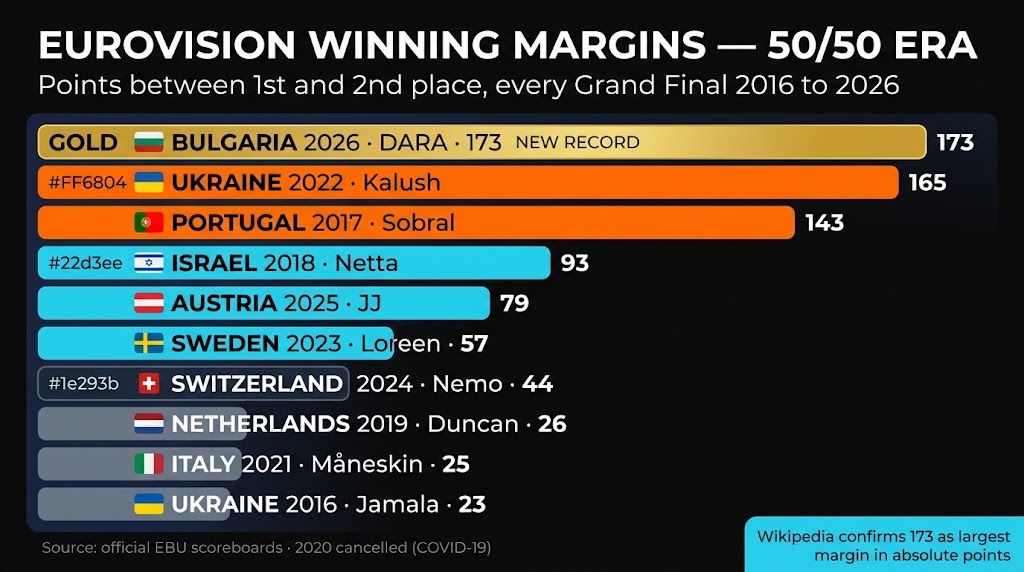
Russia's 2022 ban. Following Russia's invasion of Ukraine in February 2022, the EBU expelled Russian broadcasters VGTRK and Channel One from the union, ending a participation streak that ran from 1994. Turin 2022 fielded 40 countries — and Ukraine won, with Kalush Orchestra's Stefania.
Vienna 2026's 35-country boycott-affected field. The 2026 contest at Wiener Stadthalle is the smallest in five years. Five broadcasters — RTVE (Spain), RTÉ (Ireland), AVROTROS (Netherlands), RÚV (Iceland) and RTVSLO (Slovenia) — withdrew in protest at Israel's continued participation. Bulgaria, Moldova and Romania returned after multi-year absences, but the net effect was a drop from 37 to 35. The boycotting countries include three previous winners (Spain, Ireland, Netherlands) and Iceland, the country with the most final appearances without a win — a significant absence by any measure.