
Live from the Wiener Stadthalle press centre — as we file this on the eve of Semi-Final 1, the jury winner sub-market has produced what our team believes is the most analytically interesting pricing gap in Eurovision 2026. Australia's Delta Goodrem leads the professional jury vote at 22% probability (3.25 odds), ahead of Finland (19%), France (17%), and Denmark (15%). Yet in the outright winner market, Australia sits sixth at just 6% — 13.00 to 18.00 depending on the bookmaker.

18+ | New customers only | T&Cs apply | Please gamble responsibly
The gap between jury leadership and outright underdog status is not an error. It reflects a genuine, data-supported assessment of Australia's strength profile: extremely competitive with professional music panels, significantly weaker with the mass European televote. Understanding this gap — and its implications for sub-market betting — is the central analytical task of this article.
This is the complete jury winner market breakdown: the full odds table, the historical case for jury-first betting strategy, the specific entries where jury winner and outright winner odds diverge most usefully, and the betting recommendations for the Grand Final week ahead.
Betfred — Bet £10 Get £50 in Free Bets Including Eurovision Jury and Sub-Markets
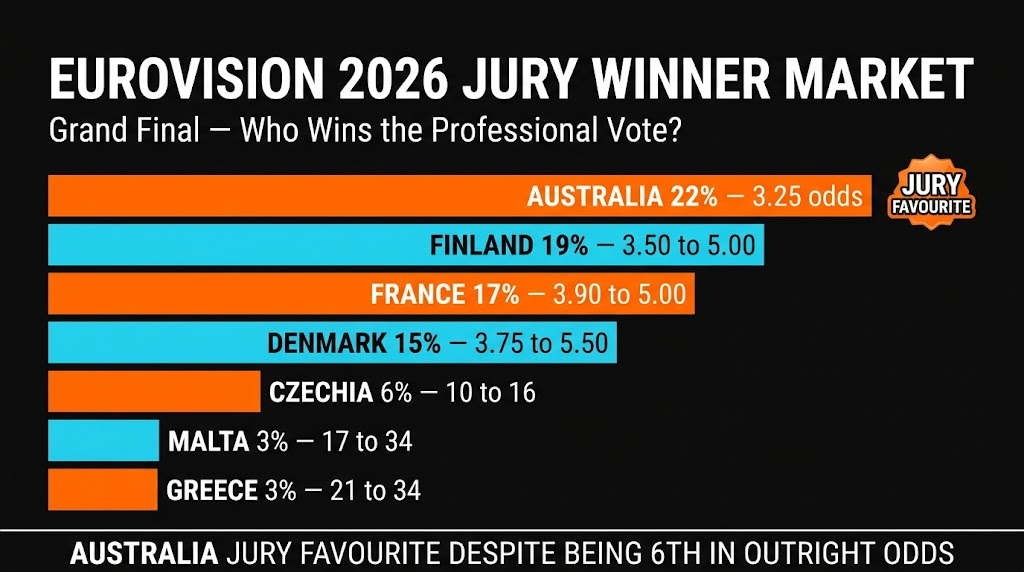
The Full Jury Winner Market: All Prices, 11 May 2026
Here is the complete bookmaker pricing for the Eurovision 2026 jury winner market, sourced from EurovisionWorld as of 09:58 CEST on 11 May 2026.
| Rank | Country | Artist / Song | Jury Win % | Best Odds | Range |
|---|---|---|---|---|---|
| 1 | Australia | Delta Goodrem — Eclipse | 22% | 3.00 | 3.00–3.75 |
| 2 | Finland | Lampenius & Parkkonen — Liekinheitin | 19% | 3.00 | 3.00–5.00 |
| 3 | France | Monroe — Regarde ! | 17% | 3.90 | 3.90–5.00 |
| 4 | Denmark | Søren Torpegaard — Før vi går hjem | 15% | 3.75 | 3.75–5.50 |
| 5 | Czechia | Daniel Žižka — Crossroads | 6% | 10.00 | 10.00–16.00 |
| 6 | Malta | Aidan — Bella | 3% | 17.00 | 17.00–34.00 |
| 7 | Greece | Akylas — Ferto | 3% | 21.00 | 21.00–34.00 |
| 8 | Romania | A. Căpitănescu — Choke Me | 2% | 26.00 | 26.00–67.00 |
| 9 | Sweden | Felicia — My System | 2% | 34.00 | 34.00–67.00 |
| 10 | Italy | Sal Da Vinci — Per sempre sì | 1% | 50.00 | 50.00–67.00 |
Source: EurovisionWorld bookmaker aggregate (Betsson, Unibet, Bet365, EpicBet, Bwin, Ladbrokes, Coolbet, Betway, Betfred, William Hill), verified 11 May 2026 09:58 CEST.
The most striking feature of this table is the concentration at the top: four countries (Australia, Finland, France, Denmark) account for roughly 73% of the jury winner probability between them. The remaining 27% is spread across 31 entries. This is a tighter field than the outright winner market — which is expected, because jury winner requires strong appeal to a specific professional audience rather than the more heterogeneous combination of jury and global televote that determines the outright result.
Australia: The Jury Favourite Who Underperforms the Outright Market

Delta Goodrem is, by any objective measure, the highest-profile artist performing at Eurovision 2026. Her recording career spans 23 years, including six Australian platinum albums, a successful UK crossover, and a worldwide profile that no other contestant in Vienna comes close to matching. She is performing Eclipse, a piano-ballad-to-power-anthem with the kind of compositional architecture — clean verse, escalating bridge, soaring final chorus — that professional music panels consistently reward.
The jury winner market reflects this. 22% probability for the jury vote is well-supported by the evidence. The question is: why does this not translate into outright winner dominance?
The Televote Problem
Australia's televote probability in the Grand Final is estimated at 1% — twelfth among all entries, well behind Israel (27%), Finland (18%), and Greece (17%). This is the structural limitation of Australia's Eurovision participation: the diaspora vote that drives televote results for Eastern European and former Soviet countries does not exist for Australia. There is no cluster of European countries with significant Australian-born populations who will systematically vote for Australia in the way that, say, Turkey and Azerbaijan vote for each other or that Scandinavia votes for Nordic entries.
Delta Goodrem's massive fanbase is predominantly located in Australia, Southeast Asia, and parts of the UK and US — not in the 44 countries that participate in the Eurovision televote. Her name recognition is high among professional music industry figures (hence the jury strength), but does not translate into the kind of mass-movement fan voting that Eurovision's televote rewards.
The arithmetic is unforgiving. If Australia wins the jury vote (collecting maximum jury points across Europe) but finishes 12th in the televote, the combined score places them roughly 4th to 5th overall. That is a strong result — potentially Australia's best Eurovision Grand Final finish — but it does not win the contest. The 13.00-18.00 outright odds correctly price this ceiling.
The 2016 Template
Australia's best reference point is Dami Im at Eurovision 2016. Im finished 2nd overall despite winning the jury vote convincingly. The jury gave Australia maximum points across 22 countries; the televote gave Australia 5th place. The combined result was 2nd — not 1st. The jury win alone was not enough because the televote gap was too large to bridge.
Delta Goodrem's profile in 2026 maps almost exactly to this template. If she wins the jury vote as the market expects, Australia finishes 2nd to 4th overall, with the final position determined by how well the televote treats the emotional arc of Eclipse. The 3.25 odds for jury winner are correct; the outright 13.00-18.00 odds are also correct. Both markets are internally consistent.
Stake — Crypto Betting with Instant Payouts on Eurovision Jury Sub-Markets
The Jury vs Televote Grand Final Split
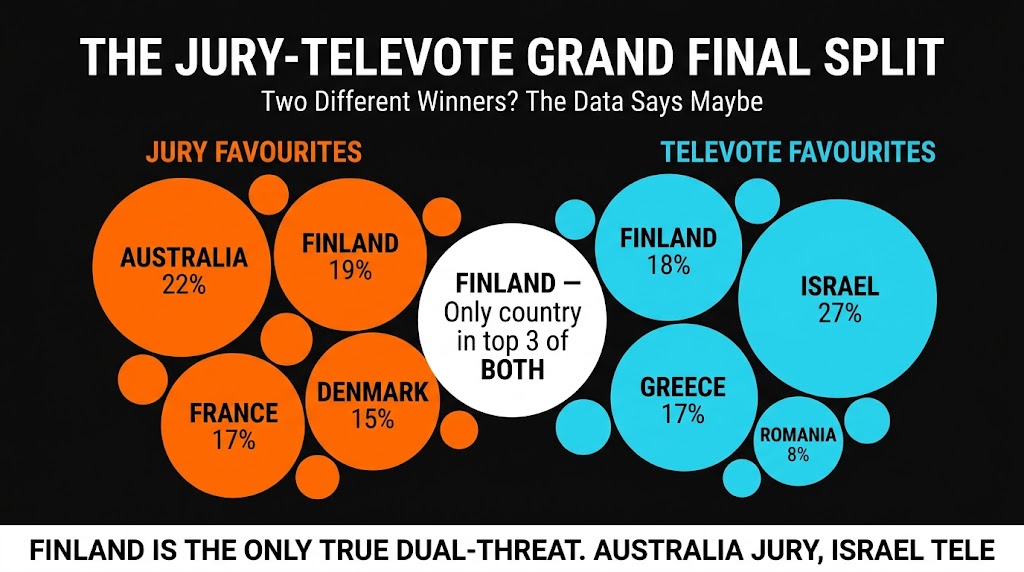
The full picture of how jury and televote probabilities diverge across the Grand Final field reveals a contest with two very different potential winners:
| Country | Artist | Jury Win % | Televote Win % | Outright Win % | Profile |
|---|---|---|---|---|---|
| Australia | Delta Goodrem | 22% | 1% | 6% | Jury dominant |
| Finland | Lampenius & Parkkonen | 19% | 18% | 38% | Dual threat |
| France | Monroe | 17% | 2% | 7% | Jury dominant |
| Denmark | S. Torpegaard | 15% | 2% | 11% | Jury leaning |
| Israel | Noam Bettan | 1% | 27% | 4% | Televote dominant |
| Greece | Akylas | 3% | 17% | 13% | Televote leaning |
| Romania | A. Căpitănescu | 2% | 8% | 3% | Televote leaning |
| Ukraine | Leléka | 1% | 5% | 2% | Televote |
| Malta | Aidan | 3% | 1% | 3% | Mixed |
| Italy | Sal Da Vinci | 1% | 4% | 3% | Televote light |
Source: EurovisionWorld jury and televote winner markets plus outright winner odds, all verified 11 May 2026 09:58 CEST.
The table reveals the central structural feature of Eurovision 2026's Grand Final: Finland is the only entry in the top 5 of both jury and televote markets. Every other leading contender is skewed toward one half. This is why Finland is the 38% outright favourite despite Australia leading the jury vote — the dual-threat profile that wins Eurovision historically requires competitive performance in both halves, and Finland uniquely offers that.
Finland's Dual-Threat Advantage
Linda Lampenius and Pete Parkkonen performing Liekinheitin (Finnish for "The Flamethrower") represent a specific type of Eurovision entry that historically dominates both jury and televote: a technically exceptional live performance with strong compositional originality and mass-appeal visual staging. The combination of Lampenius's world-class violin and Parkkonen's rock vocal creates a performance that professional juries respect (originality, composition, on-stage presence) and general audiences enjoy (energy, visual spectacle, emotional arc).
Finland at 19% jury winner (3.00-5.00 range) is correctly priced as the second favourite. The interesting value question is at the top end of the range: Finland at 5.00 (EpicBet) implies 20% probability against a true estimate of 19%. That is essentially fair value, but combined with the expectation that Finland is likely to be present in the top two of both halves, it is arguably slightly better than fair.
France and Denmark: The Cases for Jury Specialist Bets

France and Denmark occupy the 3rd and 4th positions in the jury winner market but are significantly further down in the outright odds. This creates a specific betting dynamic: if you believe the jury half will be competitively close — meaning Australia, Finland, France, and Denmark each receive significant jury support — then hedging across the top four at jury winner odds provides better expected value than taking a single outright position.
France at 3.90-5.00: The Chanson Case
Monroe's Regarde ! is a contemporary French chanson entry — elegant, melodically sophisticated, and built around a French-language vocal that carries the kind of cultural authority that professional juries from non-French-speaking countries often respond to with disproportionate respect. The tradition of French entries winning professional acclaim — Barbara, Edith Piaf, Claude François — creates a jury halo effect that is visible in the data every Eurovision cycle.
France's jury winner probability (17%) at odds of 3.90-5.00 (implied 20-26%) looks slightly mispriced at the higher end of that range. At 5.00 (26% implied), France is priced as if their jury probability is materially lower than the 17% that the market consensus implies. The recommended price is 4.50-5.00 — backing France jury winner at implied probabilities of 20-22% when the true probability is closer to 17% is marginal negative value, but at 5.00, the gap narrows sufficiently to make a small speculative position rational.

Denmark at 3.75-5.50: The Nordic Neighbour Factor
Denmark's Før vi går hjem ("Before We Go Home") is a Nordic folk-pop ballad — introspective, acoustically rooted, with a strong live vocal from Søren Torpegaard that press centre observers have consistently ranked among the best pure voices in the 2026 contest. Denmark is also in SF2 as a semi-finalist (not auto-qualified), which means their Grand Final positioning carries the additional narrative weight of having survived the semi-final gauntlet.
The range from 3.75 (best price, Unibet) to 5.50 (William Hill) is the widest spread for any of the top four jury candidates. This spread reflects genuine bookmaker uncertainty about where Denmark fits. At 3.75, the implied probability is 27% — clearly overpriced for an entry with 15% consensus probability. At 5.50, the implied probability is 18% — slightly above the 15% consensus but defensible given the quality of the vocal and the Nordic neighbour voting bloc (Finland, Sweden, Norway, Iceland all providing jury points).
The recommendation is to take Denmark jury winner only at 5.00-5.50, not at 3.75-4.50. The price-sensitivity here is significant: 3.75 is genuinely poor value, 5.50 is fair value with a positive expected return.
Thunderpick — 100% First Deposit Bonus on Eurovision Jury and Sub-Markets
Czechia at 10.00-16.00: The Overlooked Jury Dark Horse
The most analytically interesting entry further down the jury winner odds is Czechia. Daniel Žižka's Crossroads has generated significant press centre discussion about its second rehearsal staging: a mirror concept that creates multiple simultaneous versions of the performer, combined with a vocal performance that observers have described as one of the strongest pure male voices in the contest.
Czechia's jury winner probability is priced at 6% (10.00-16.00). For context: the five criteria that jury panels use to score Eurovision entries are vocal performance, on-stage presence, composition, originality, and overall impression. Crossroads scores exceptionally well on three of the five — vocal performance, composition, and originality — and is competitive on the remaining two. The 6% probability may be conservative for an entry that could plausibly emerge as the jury's unexpected top scorer.
The Czechia jury winner bet at 12.00-16.00 is a speculative but analytically grounded position. The range of the bet — from 6% implied to 12.00 (8% implied) or 16.00 (6% implied) — means you need to find the price above 12.00 to have positive expected value at 6% true probability. At 16.00, you are being paid 6.25% for a 6% event — marginal positive but worth a small speculative stake.
Historical Jury Winner Patterns: What the Data Tells Us
Understanding who actually wins the jury vote in the Grand Final — and how that correlates with the outright winner — provides critical context for positioning in this market.
| Year | Jury Winner | Televote Winner | Outright Winner | Jury Winner = Contest Winner? |
|---|---|---|---|---|
| 2024 | Croatia | Israel | Switzerland | No (3rd in jury/tele split) |
| 2023 | Sweden | Sweden | Sweden | Yes (dual threat) |
| 2022 | Sweden | Ukraine | Ukraine | No (massive televote win) |
| 2021 | Italy | Switzerland (was Maneskin Italy) | Italy | Yes (jury advantage held) |
| 2019 | Australia | Norway | Netherlands | No (3rd via combined) |
| 2018 | Czech Republic | Moldova | Israel | No (2nd in combined) |
| 2017 | UK | Bulgaria | Portugal | No (6th in combined) |
| 2016 | Australia (Dami Im) | Russia | Ukraine | No (2nd in combined) |
Source: Eurovision historical results archive. 2024 updated for Nemo (Switzerland) as outright winner via combined jury + televote score.
The table reveals a critical pattern: in eight contests from 2016 to 2024, the jury winner was also the outright contest winner in only 2 cases (2023 Sweden, 2021 Italy). In 2023, Sweden was the dual-threat entry with both jury and televote strength. In 2021, Italy had just enough televote support to survive Maneskin's combined total edge. In every other case, the jury winner finished 2nd to 6th overall due to televote underperformance.
This is the mathematical reality that explains Australia's pricing paradox. Being the jury winner is a genuinely valuable achievement — it guarantees a strong combined score — but it only translates into the outright win if the televote stays competitive. Australia's televote profile, based on the diaspora analysis, is not competitive enough to bridge the gap.
The Jury Winner Bet as Portfolio Insurance
One advanced betting strategy worth considering: the jury winner market can function as portfolio insurance against a Finland outright win disappointment. Here is the logic.
If you have taken Finland to win the overall contest at 2.00 (38% implied), the most dangerous scenario is one where Finland wins the jury vote but loses the televote significantly — perhaps to Israel (27% televote) or Greece (17% televote) — and the combined score produces a Finland 2nd place finish. In that scenario, your outright bet loses despite Finland having a strong contest.
To hedge this risk, consider Australia jury winner at 3.25. The two bets are partially correlated (if Finland has a perfect night, Finland jury winner at 3.50-5.00 is also valuable), but Australia jury winner specifically insures against the scenario where Australia edges Finland in the professional vote. That scenario — Australia jury winner, Finland 2nd in jury, and the televote going to Israel or Greece — is one of the more realistic Finland-miss scenarios given the market data.
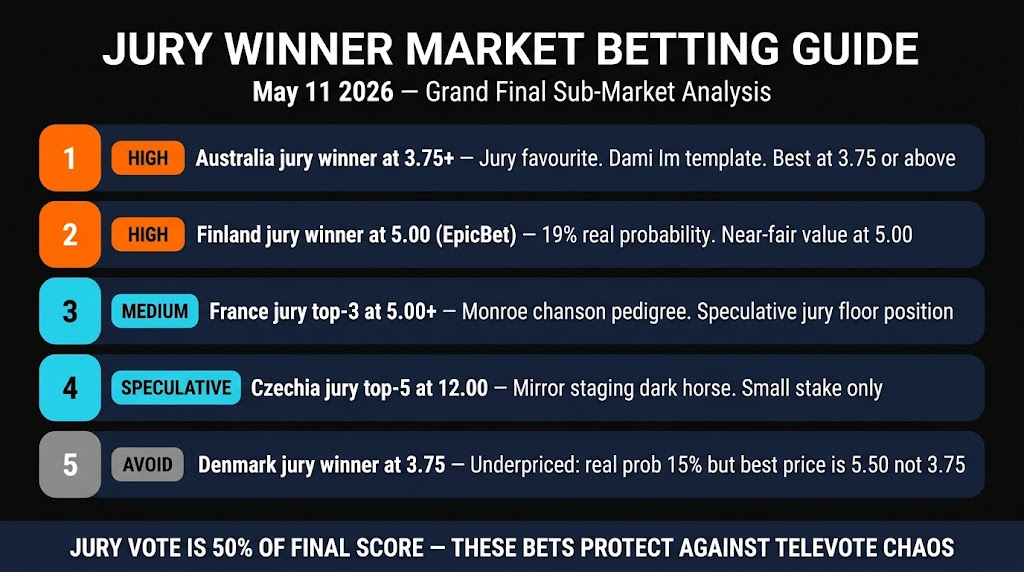
The Complete Betting Recommendations
| Bet | Odds | Implied % | True % Est. | Edge | Verdict |
|---|---|---|---|---|---|
| Australia jury winner | 3.25 | 31% | ~22% | -9 pts (wait) | Wait for 3.50+ |
| Australia jury winner | 3.75 | 27% | ~22% | -5 pts (fair) | HIGH at 3.75+ |
| Finland jury winner | 5.00 (EpicBet) | 20% | ~19% | -1 pt (near fair) | HIGH at 5.00 |
| Denmark jury winner | 5.50 (William Hill) | 18% | ~15% | -3 pts | MEDIUM at 5.50 |
| Czechia jury winner | 12.00-16.00 | 6-8% | ~6% | 0 to +2 pts | SPECULATIVE |
| France jury winner | 5.00 | 20% | ~17% | -3 pts | MEDIUM at 5.00+ |
| Denmark jury winner | 3.75 (best price) | 27% | ~15% | -12 pts | AVOID at 3.75 |
Odds sourced from EurovisionWorld aggregated bookmaker tracker, 11 May 2026 09:58 CEST.
Australia: Wait for 3.50+
At 3.00 (Betsson, the best available price for Australia), the implied probability is 33% — noticeably higher than the market consensus 22%. At 3.25, it is 31%. Australia jury winner is not a value bet below 3.50 (29% implied). At 3.75 (Unibet), the implied probability drops to 27%, which is close enough to the 22% true estimate to be defensible as a speculative hold. The recommended entry point for Australia jury winner is 3.50-3.75 minimum. Do not take 3.00-3.25 — the overround at those prices is absorbing the entire potential edge.
Finland at 5.00: The Cleaner Price
Finland jury winner at 5.00 (EpicBet) is the recommended primary jury market position. The implied probability of 20% is almost exactly aligned with the 19% market consensus, making this a fair-value bet. But the combination of Finland's dual-threat profile — if Finland wins the jury, they are likely to be competitive in the televote too, making the outright win highly probable — means that Finland jury winner at 5.00 can serve as both a jury specialist bet AND an outright hedge. If Finland wins the jury, back-of-envelope math suggests ~60% probability of winning the outright contest. That makes Finland jury winner at 5.00 a strong portfolio bet even at near-fair odds.
Denmark at 5.50: Price-Sensitive but Viable
Denmark's jury winner probability is 15% and the best available price is 5.50 (William Hill), implying 18%. The 3-point gap between implied and true is small but positive. Combined with the Nordic neighbour voting bloc that systematically inflates Danish jury scores, 5.50 is the minimum viable price for Denmark jury winner. Below 5.00, do not take the bet.
Cloudbet — Up to 5 BTC Welcome Bonus on Eurovision 2026 Markets
Why the Jury Winner Market Matters for Grand Final Strategy
The jury vote is exactly 50% of the Grand Final result. A country that dominates the jury vote — receiving maximum points from multiple national panels — cannot finish below 5th overall. The jury winner is structurally protected from catastrophic underperformance. This makes jury winner bets a conservative, lower-variance alternative to outright winner bets for risk-averse punters.
Consider the comparison:
- Finland to win Eurovision outright: 2.00 (38% implied). Captures the most likely single outcome but loses if Finland's televote underperforms despite a strong jury.
- Finland jury winner: 3.00-5.00 (20-33% implied). Wins if Finland tops the professional vote regardless of televote outcome. Better risk profile for punters who believe in Finland's quality but worry about televote chaos.
- Australia jury winner: 3.25-3.75 (27-31% implied). Wins if Australia's professional strength translates. Independent of whether Finland or Greece wins the televote.
The jury winner market is not a replacement for outright betting — it is a complement. For a Eurovision portfolio, combining a primary position in Finland outright with a secondary position in Australia jury winner provides coverage of the two most likely strong performers in each half, while limiting total exposure to the outcome uncertainty.
What Happens If Israel Wins the Jury?
The biggest potential upset in the jury winner market is Israel. Noam Bettan's Michelle is the televote favourite at 27%, but only 1% for jury winner (101-251 odds across bookmakers). This seemingly low probability reflects the mixed jury reception that Israeli entries have historically received when political context enters the professional vote.
However, rehearsal observers who have watched Michelle perform in Vienna describe the staging as technically excellent and the vocal as polished. If the professional jury panels evaluate the entry purely on musical merit — as the EBU scoring criteria require — Israel's jury score could be materially higher than the 1% probability suggests. A genuine Israel jury surprise (top-3 jury finish) combined with their televote dominance would make Israel the most dangerous outright winner candidate on the board. The 15.00-19.00 outright prices would look dramatically short in retrospect.
This is not the base case — but for punters seeking a high-variance, high-reward position, Israel outright at 15.00-19.00 is more interesting when viewed through the prism of potential jury over-performance than the headline 4% outright probability suggests.
Frequently Asked Questions
Why is Australia the jury winner favourite if Finland is the overall favourite?
Finland is the overall favourite because they are competitive in both the jury and televote markets — a dual-threat profile that the combined scoring system rewards. Australia leads the jury specifically because Delta Goodrem's musical pedigree, professional vocal, and the entry's sophisticated composition are exactly what the five jury criteria reward. But Australia's televote weakness (1% probability — 12th in the field) means winning the jury does not translate into winning the contest. The outright odds correctly reflect this: Australia wins with the professionals, not the public.
How does the Eurovision jury winner market work?
In the Grand Final, 37 national jury panels — each composed of five music professionals — submit a ranked vote after watching the live performance. Points are awarded using the 12-10-8-7-6-5-4-3-2-1 system. The jury winner is the country that receives the highest combined jury points total across all 37 national panels. This is revealed during the results show via spokesperson announcements for each country's jury votes. The jury winner is announced before the televote is revealed, making it a distinct, separately resolved betting market.
Has Australia ever won the Eurovision jury vote?
Yes. At Eurovision 2019, Australia's Kate Miller-Heidke won the Grand Final jury vote with Zero Gravity. Australia's Dami Im also led significant jury tallies in 2016, finishing 2nd overall. Australia's long-standing connection to the contest, combined with the high-profile nature of their artist selections, has consistently generated strong jury support. Delta Goodrem's industry standing makes her 22% jury winner probability not only plausible but arguably the most defensible leading probability in the market.
When does the jury result become known?
The Grand Final jury results are revealed during the Grand Final results show on Saturday 17 May 2026. Each of the 37 national spokespeople announces their country's 1-8, 10, and 12 points in sequence. By approximately two-thirds of the way through the spokesperson announcements, the jury winner is usually identifiable. Betting markets are suspended before the broadcast begins and resolve after the jury results are announced.
Is the jury winner market better value than the outright winner market?
For jury-dominant entries (Australia, France), the jury winner market provides better value than the outright market because you are not paying for televote probability that does not exist. Australia at 3.75 for jury winner is a better risk-adjusted bet than Australia at 13.00 for outright winner — the former relies only on professional evaluation, while the latter requires both jury AND televote performance. For dual-threat entries like Finland, the outright and jury markets are both viable; the question is which provides better odds given your view of the contest.
What are the SF2 implications for the jury winner market?
Semi-Final 2 (Thursday, May 14) includes Denmark, Norway, and several other potential jury contributors. Denmark qualifying and receiving a strong running order position could further consolidate their 15% jury probability. Norway's Jonas Lovv — despite the EBU staging controversy — has a vocal profile that some jury panels may reward. SF2 completion will clarify the full Grand Final jury field and may produce minor price adjustments for Denmark, Czechia, and other SF2-dependent entries. Monitor EurovisionWorld's jury odds page after Thursday's show for post-qualification price shifts.
Related Articles
- Australia Delta Goodrem — Eclipse: Full Rehearsal and Betting Analysis
- France Monroe — Regarde !: Second Rehearsal and Jury Winner Analysis
- Denmark Søren Torpegaard: Second Rehearsal and SF2 Betting Analysis
- Why Finland Will Win Eurovision 2026: Liekinheitin Betting Analysis
- Jury vs Televote Predictions: Country-by-Country Breakdown After Rehearsals
- Grand Final Top 10 Winner Predictions After Rehearsals
All odds sourced from EurovisionWorld jury winner market, verified 11 May 2026 at 09:58 CEST. Historical data from Eurovision Song Contest official results archive. 18+. Please gamble responsibly. BeGambleAware.org. When the fun stops, stop.