
Five countries are sitting out Eurovision 2026, marking the largest boycott since 1970. With Spain, Ireland, Iceland, the Netherlands, and Slovenia all absent, the competition shrinks to just 35 entries — the smallest field since 2003. For bettors, this is not just a political headline. It fundamentally changes the odds, the voting dynamics, and where the value lies.

18+ | New customers only | T&Cs apply | Please gamble responsibly
Whether you are a seasoned Eurovision punter or placing your first wager this year, understanding the ripple effects of this boycott is essential to making smart bets in Basel.
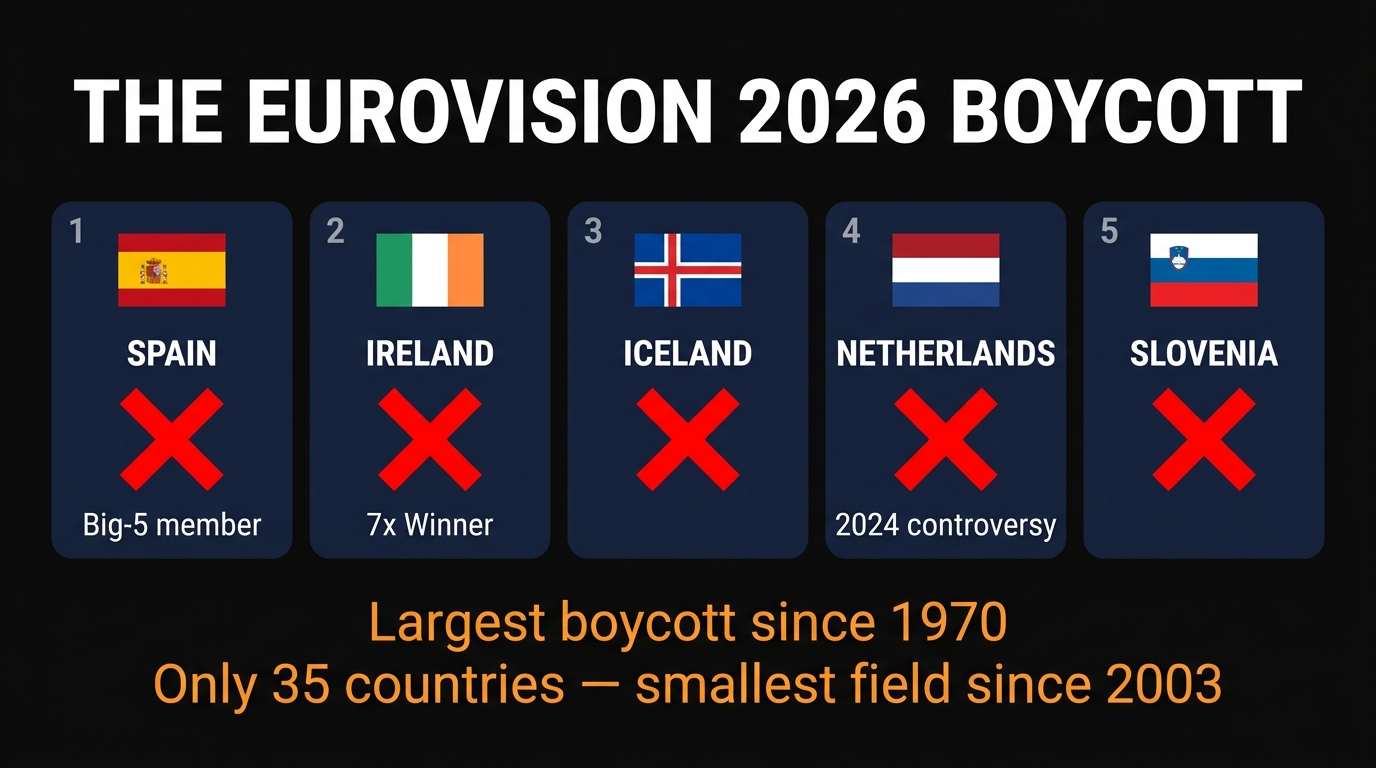
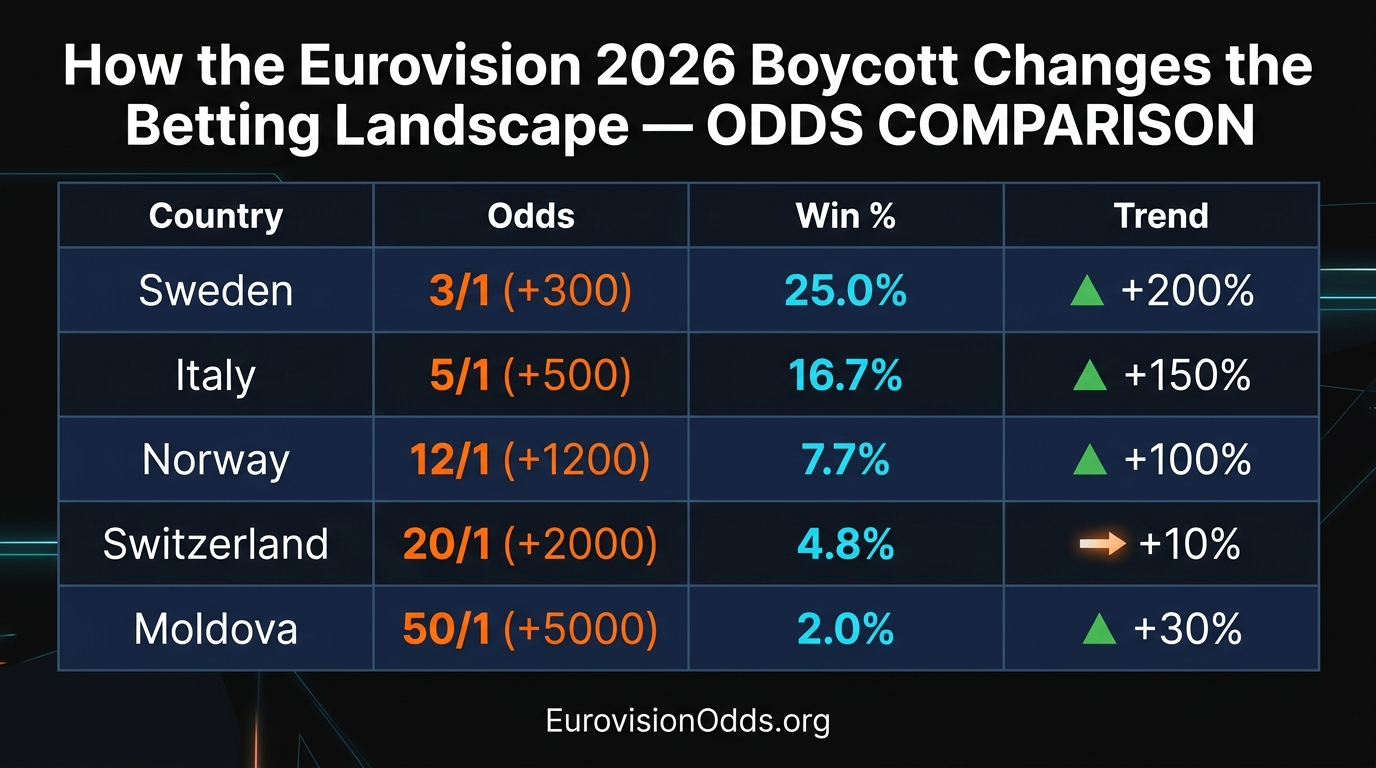
The Five Countries Boycotting Eurovision 2026
Let us start with who is missing and why it matters from a betting perspective.
Spain is the biggest absence by far. As one of the traditional "Big Five" automatic finalists — alongside France, Germany, Italy, and the United Kingdom — Spain had a guaranteed spot in the Grand Final every year. That privilege now passes to nobody. The Big Five becomes the Big Four, and the Grand Final loses one guaranteed competitor.
Spain has been a consistent televote magnet in recent years, particularly among Southern European and Latin American diaspora voters. Removing Spain from the equation means those televote points get redistributed elsewhere, and that shift matters enormously for anyone studying the odds.
Ireland brings seven Eurovision victories to its name — more than almost any other country. While Ireland has not won since 1996, their entries regularly attract nostalgic goodwill and solid televote support. Their absence removes a competitor that bookmakers always have to account for.
The Netherlands delivered strong performances in both 2024 and 2025, and Dutch entries have consistently punched above their weight in the modern era. Losing the Netherlands removes a genuine contender from the upper half of the odds board.
Iceland has become a fan favorite in recent years, and their entries often perform well in televoting. They bring a distinctive Nordic-alternative edge that attracts a loyal voting base.
Slovenia rounds out the boycott. While not traditionally a frontrunner, Slovenia's departure further thins the field and reduces the overall competitive density.
Why Fewer Countries Means Stronger Favorites
This is the single most important principle for betting on Eurovision 2026: fewer competitors means the favorites become even stronger.
In a standard year with 40 or more countries, the points are spread widely. Dark horses can emerge because the vote is fragmented. With only 35 countries — the smallest field in over two decades — there are simply fewer entries to split the jury and televote points.
The math is straightforward. Each voting country distributes the same number of points (1 through 8, then 10 and 12 for the top entries). With fewer acts in the Grand Final, the top-ranked songs collect a larger share of total available points. Frontrunners like Finland, France, and Denmark all benefit from this dynamic.
If you are looking at the current odds on Betfred, you will notice that the top five favorites are priced more tightly than in a typical year. That is the bookmakers accounting for reduced competition. The question for bettors is whether the market has fully priced this in or whether there is still value to be found.
The Big Four: What Happens Without Spain
Spain's departure from the Big Five creates an unusual structural change. France, Germany, Italy, and the United Kingdom still qualify automatically for the Grand Final, but they now face one fewer guaranteed rival on the big night.
This matters most for France. Louane's strong showing in 2025 already established France as a serious competitor heading into 2026, and with Spain absent, France inherits much of the Southern European televote that would have split between them. French entries tend to perform well with both juries and televoters, and losing their most direct regional competitor is a clear advantage.
Italy similarly benefits. The Italian entry often competes with Spain for Mediterranean and Southern European votes. Without that competition, Italy's ceiling rises.
For Germany and the United Kingdom, the impact is more marginal. These countries compete in different voting corridors, but they still benefit from the reduced total field.
Televote Patterns Are Disrupted
Eurovision voting has long been shaped by regional blocs — Scandinavian countries vote for each other, Balkan nations support their neighbors, and the former Soviet states tend to cluster. The boycott disrupts several of these patterns.
With Ireland and Iceland both absent, the Nordic-Celtic voting axis is weakened. Countries like Norway, Sweden, Finland, and Denmark lose two friendly voters but also lose two competitors for the overall Nordic televote pool. On balance, this is a net positive for Scandinavian entries. They face less internal competition while the televote points from their region concentrate on fewer acts.
The absence of the Netherlands disrupts the Western European corridor. Dutch televoters historically supported Belgian, German, and Scandinavian entries. Those countries lose a friendly voting source, but again, they also lose a competitor.
For bettors, the key takeaway is this: regional voting blocs still exist, but they are redistributed. The smart play is to identify which remaining countries inherit the voting goodwill of the boycotting nations.
The Jury Vote Becomes Even More Important
Here is a subtle but critical point that most casual bettors miss. Several of the boycotting countries — particularly Ireland and the Netherlands — were historically strong televote performers. Their absence tilts the overall balance slightly toward jury-friendly entries.
When televote-heavy countries leave the field, the relative weight of the jury vote increases. Not because the scoring system changes, but because the televote becomes less competitive. Entries that rely on jury scores to compensate for weaker televotes suddenly find themselves in a better position.
This means polished, technically sophisticated entries have a structural edge in 2026. Acts with strong vocal performances, clever staging, and mainstream pop appeal — the kind that juries reward — should be weighted more heavily in your betting portfolio.
Look for entries that score consistently well in both jury and televote rather than acts that rely entirely on televote hype. The boycott makes jury performance a more reliable predictor of final placement.
The Israel Factor
No analysis of Eurovision 2026 betting would be complete without addressing Israel's continued participation, which is at the center of the boycott controversy. Israel's inclusion has driven the five-country walkout, and it creates a unique dynamic in the voting.
Historically, controversial entries attract strong reactions in both directions. Israel could receive significant protest votes — or significant sympathy votes. The televote for Israel is genuinely unpredictable this year, which makes it a high-variance bet.
From a pure odds perspective, Israel represents a classic boom or bust wager. If you believe the controversy will galvanize support (as it did in 2024 when Yuval Raphael qualified despite protests), then Israel at longer odds could represent value. If you believe the political backlash will suppress televotes from liberal Western European countries, then fading Israel is the play.
What is certain is that Israel's presence will affect voting for every other country. Some televoters will cast their votes specifically to counter Israel, which could create unexpected surges for neighboring entries on the scoreboard.
Smaller Countries Get a Boost
With only 35 countries competing, the semifinal rounds become less brutal. Countries that typically struggle to qualify for the Grand Final — think San Marino, Malta, Montenegro, or North Macedonia — face a slightly easier path.
This does not mean they will win, but it does mean they are more likely to reach the final. For bettors who enjoy longer-odds plays, the boycott year creates marginally better value on smaller entries reaching the Grand Final at attractive prices.
Keep an eye on semifinal qualification markets, which are often overlooked. The reduced field means borderline qualifiers in a normal year become more comfortable qualifiers in 2026.
Betting Strategy for Eurovision 2026
Putting it all together, here is how to approach your Eurovision 2026 betting in light of the boycott.
Back jury-friendly favorites. Finland, France, and Denmark all benefit from the reduced competition and the tilt toward jury voting. These are the foundation of any sensible Eurovision betting portfolio this year.
Look for value in the Scandinavian/Nordic entries. With fewer competitors from their region and a consolidated televote base, Nordic entries are structurally advantaged. If any Scandinavian country is trading at odds longer than their true probability, that is where the value lies.
Consider each-way bets on mid-table entries. The reduced field means a top-five or top-ten finish is easier to achieve. Markets like top-five finish or podium placing offer better risk-reward ratios than outright winner bets, especially in a disrupted year.
Be cautious with high-variance plays. Israel and any other politically charged entry could swing wildly in the televote. These are lottery tickets, not investments. Size your bets accordingly.
Use the boycott narrative. Bookmakers adjust odds based on historical data, but a five-country boycott has no modern precedent. The models are working with incomplete information, which means the market is more likely to be mispriced than in a standard year. That is where sharp bettors find edges.
Head over to Betfred to check the latest Eurovision 2026 odds and take advantage of their new customer offer before the competition begins.
Final Thoughts
The Eurovision 2026 boycott is the most significant disruption to the contest in over fifty years. For casual viewers, it is a political story. For bettors, it is an opportunity. Fewer countries, disrupted voting blocs, and a structural tilt toward jury-friendly entries create a landscape where informed punters can find genuine value.
The key is to think beyond the headlines. Do not just note which countries are missing — think about where their votes go, which competitors benefit, and how the reduced field changes the math. That is how you turn a boycott into a betting edge.
Get Your Free Eurovision Bet Here
New customers only. Register with BETFRED50. Deposit £10+ via Debit Card and place first bet £10+ at Evens (2.0)+ within 7 days to get 3 x £10 in Free Bets & 2 x £10 - 7-day expiry. Eligibility & payment exclusions apply. Full T&Cs apply. 18+ only. Please gamble responsibly. BeGambleAware.org