The Eurovision Song Contest is a 70-year-old experiment in soft power, kitsch, and high-stakes pan-European voting. It began on 24 May 1956 at the Teatro Kursaal in Lugano with seven countries and fourteen songs, and on 16 May 2026 at the Wiener Stadthalle DARA's Bangaranga closed Bulgaria's 14th attempt with a 173-point margin over Israel — the largest first-to-second gap in the contest's full history.

18+ | New customers only | T&Cs apply | Please gamble responsibly
Here are 50 verified facts, stats and records — every figure sourced from the official EBU scoreboards or Wikipedia, updated through Vienna 2026. With Eurovision Asia 2026 launching in Bangkok on 14 November (10 founding countries, IDEAlive Arena), the trivia catalogue is about to get a Pacific-side cousin too.
Betfred Bet 10 Get 50 in Free Bets on Eurovision 2027
Scoring & margin records
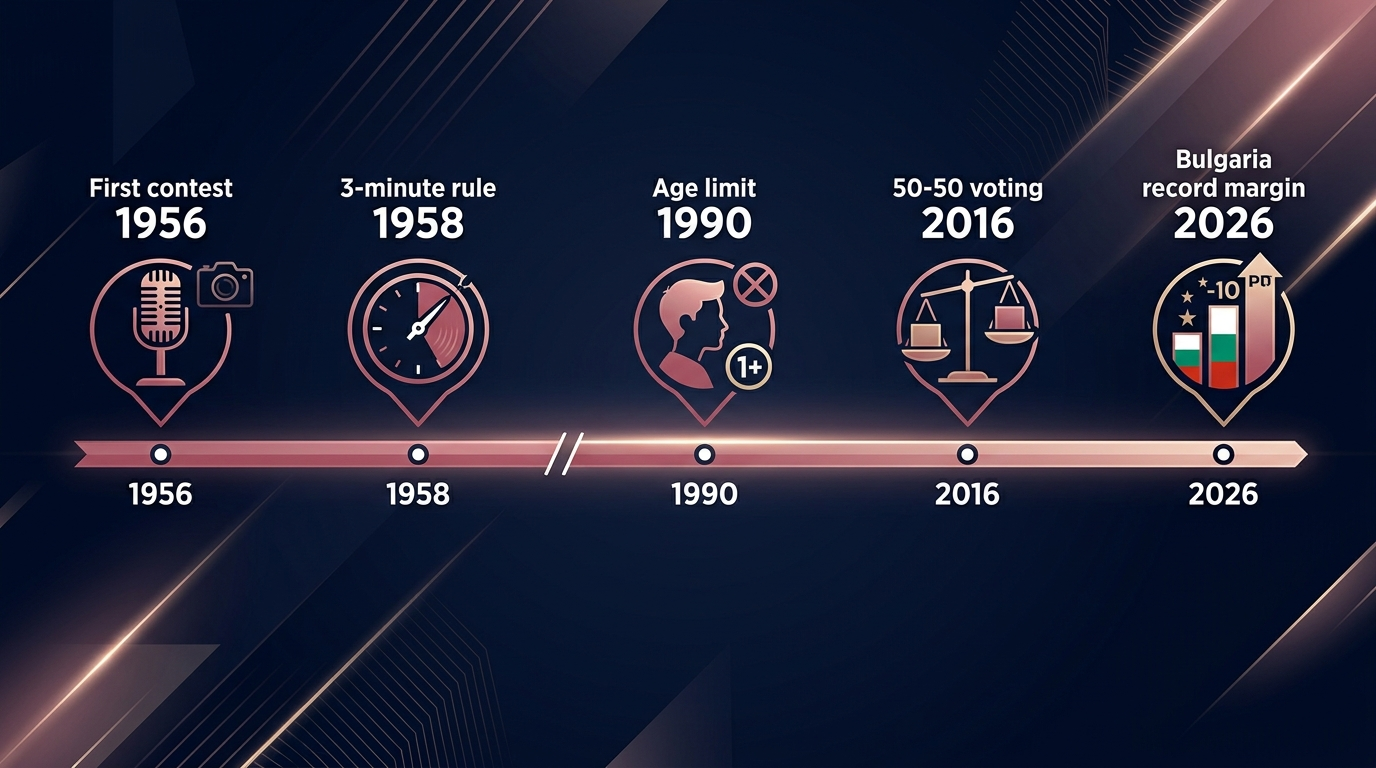
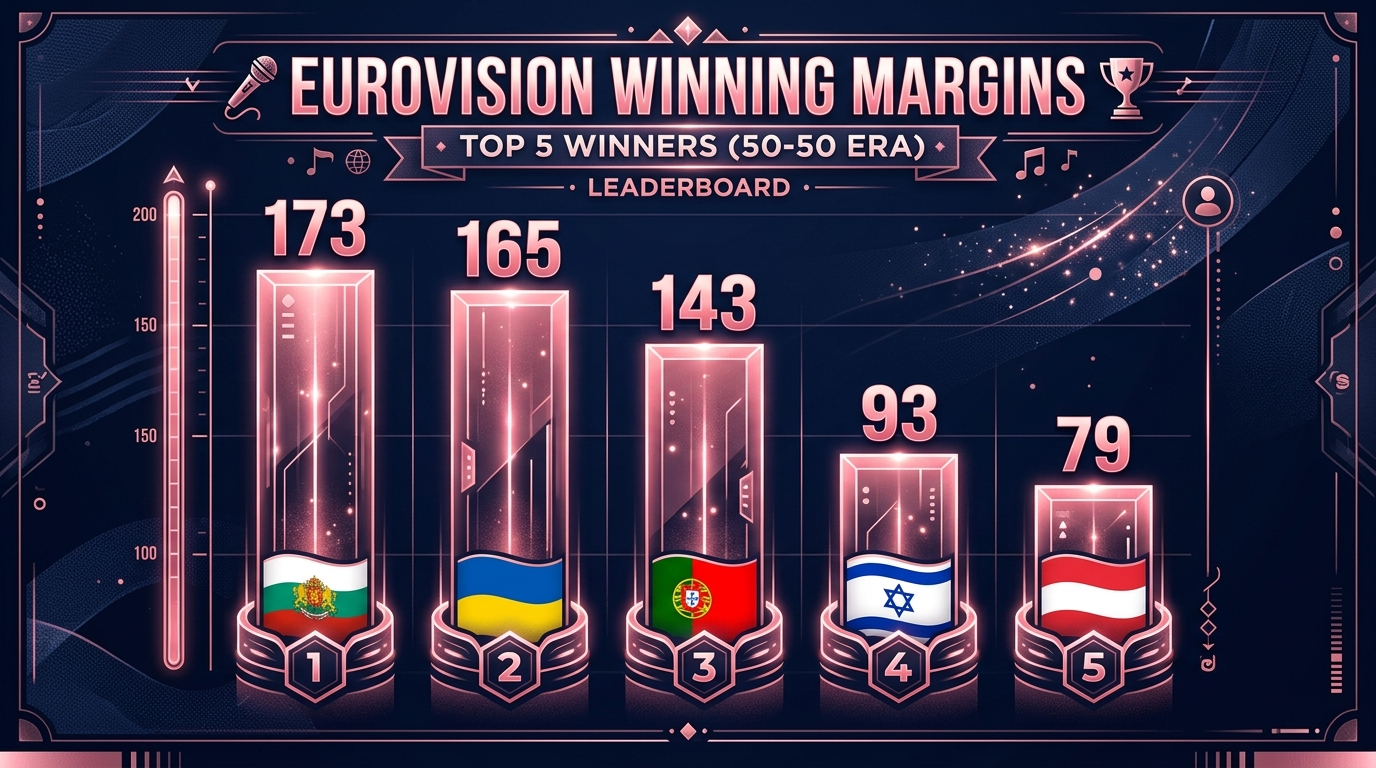
1. 173 points — the largest winning margin in Eurovision history. Per official EBU records, Bulgaria's DARA finished Vienna 2026 on 516 points to Israel's 343 — a cushion that broke Ukraine 2022's 165-point modern record and Alexander Rybak's 169-point Moscow 2009 mark. Wikipedia's List of Eurovision Song Contest winners now records it as the largest absolute spread in the contest's 70-year history. See the winning-margin leaderboard.
2. 758 points — the highest winner total ever. Per official EBU scoreboards, Salvador Sobral's Amar pelos dois won Eurovision 2017 in Kyiv on 758 combined points. The record survived Vienna 2026; DARA's 516 is well shy of it because the 2017 voting field was larger and the top-end was less concentrated.
3. 439 televote points — the all-time single-entry televote record. Wikipedia confirms Kalush Orchestra's Stefania collected 439 points from the public vote at Turin 2022, two months after Russia's invasion of Ukraine. They received 12 points from 28 of 40 televote pools — 91.5% of the available televote ceiling.
4. 382 jury points — the highest jury score of the 50/50 era. Per the EBU's 2017 Grand Final scoreboard, Sobral's Amar pelos dois collected 382 jury points in Kyiv — the only Grand Final entry to clear 350 on the professional side of the scoreboard.
5. Bulgaria 2026 was only the third double-vote winner of the 50/50 era. Per official EBU records, DARA topped both the jury (204) and televote (312) at Vienna 2026 — joining Salvador Sobral (2017) and Loreen's Tattoo (2023) as the only entries to win both halves of the scoreboard outright since the split-vote system began in 2016.
6. The 12-point single-show record was broken in 2026. Per EBU records, Bulgaria received twelve televote points from eight separate competing countries plus the Rest-of-the-World aggregate in Semi-Final 2 of Vienna 2026 — nine sets of 12 from a single pool. The previous high was Israel's 5+RoW in SF1 2018.
7. The 1969 Madrid final ended in a four-way tie. Wikipedia confirms France, Netherlands, Spain and the United Kingdom all finished on 18 points at the Teatro Real in Madrid. With no tie-break rule in place, all four were declared winners — the only time in Eurovision history.
8. The Kalush Orchestra televote was a 91.5% capture of the available ceiling. Per the same EBU 2022 scoreboard, 439 of a possible 480 televote points (40 voting blocs × 12) makes Stefania the most lopsided public-vote landslide of the modern era — no other entry has cleared 80%.
9. The 2026 Grand Final scored on a smaller voting field than any modern Grand Final. Per the 2026 EBU running order, only 35 voting blocs participated — down from the typical 38 to 42 — after five-country boycotts shrank the pool. Bulgaria's 173-point margin is therefore arithmetically even more impressive: a smaller available ceiling, a larger absolute spread.
10. Norway holds the most last-place finishes. Per Wikipedia's editorial tally, Norway has finished last 11 times in Grand Finals — more than any other country — including four nul-points results (1963, 1978, 1981, 1997). Germany is second on this leaderboard with 8 last places.
Performer records & trivia

11. Sandra Kim — 13 years 305 days, the youngest winner ever. Per EBU records, Belgium's Sandra Kim was 13 years 305 days old when she won Eurovision 1986 in Bergen with J'aime la vie. Norway's NRK protested the next morning; the win stood, but the EBU introduced a minimum age of 16 in force since 1990. See youngest-winner.
12. Nathalie Pâque — 11 years old, the youngest main artist in Grand Final history. Wikipedia confirms France's Nathalie Pâque was 11 when she sang J'ai volé la vie at Eurovision 1989 in Lausanne, finishing 8th. Like Sandra Kim, her appearance pre-dated the EBU's age-16 rule.
13. Loreen — the first woman to win Eurovision twice as a solo artist. Per official EBU records, Loreen won 2012 (Baku, Euphoria) and 2023 (Liverpool, Tattoo) — the only solo female artist to do so. Johnny Logan won twice as singer (1980, 1987) plus once as composer, making him the only person with three Eurovision golds.
14. Céline Dion was 20 when she won for Switzerland. Wikipedia confirms Dion was 20 years and 75 days old when she won Eurovision 1988 in Dublin with Ne partez pas sans moi, beating the UK's Scott Fitzgerald by a single point. Her Eurovision win pre-dated her global breakout by five years.
15. Brotherhood of Man's 1976 win still holds the largest pre-2016 margin under the old 12-point scoring. Per EBU records, the UK group's Save Your Kisses for Me won Eurovision 1976 in The Hague by 17 points over France's Catherine Ferry — the largest first-to-second gap of the 1-to-12 scoring era that ran 1975 to 2015.
16. Dana International — the first openly transgender Eurovision winner. Per eurovision.com, Israel's Dana International won Eurovision 1998 in Birmingham with Diva, becoming the first openly transgender artist to take the trophy. The win was protested by Israeli Orthodox groups but enthusiastically endorsed by the EBU and Israeli broadcaster IBA.
17. Conchita Wurst — bearded drag and a 290-point margin at Copenhagen 2014. Per official EBU records, Austria's Conchita Wurst won Eurovision 2014 with Rise Like a Phoenix, becoming the first overtly drag-styled winner. The performance was banned from broadcast in Belarus and given a heavily edited cut in Russia.
18. Nemo — the first openly non-binary Eurovision winner. Per official EBU records, Switzerland's Nemo won Eurovision 2024 in Malmö with The Code, finishing on 591 points to Croatia's 547. Nemo identifies as non-binary and used they/them pronouns throughout the cycle.
19. Johnny Logan — the only three-time Eurovision winner. Per Wikipedia and EBU records, Ireland's Johnny Logan won as singer in 1980 (What's Another Year), as singer-songwriter in 1987 (Hold Me Now) and as composer in 1992 (Linda Martin, Why Me). No other individual has three Eurovision trophies.
20. DARA was 29 when she won Bulgaria's first Eurovision. Per EBU records, Darina Yotova (DARA) was born in 1996 and was 29 years old at Vienna 2026 — squarely in the modal age band for modern winners (mid-20s to early-30s). Her win was Bulgaria's first in 14 attempts.
Song & music records
21. Nunzio Gallo's Corde della mia chitarra — 5:09, the longest competitive entry ever. Per EBU records, the Italian tenor's ballad ran 5 minutes 9 seconds at Eurovision 1957 in Frankfurt, finishing 6th of 10. The EBU introduced a 3-minute maximum song length the following year — a rule that has remained unchanged for 68 consecutive contests.
22. Pertti Kurikan Nimipäivät — 1:27, the shortest competitive entry ever. Per EBU records, Finland's punk-rock entry at Eurovision 2015 in Vienna ran exactly 1 minute 27 seconds — more than 40 seconds shorter than the next-shortest. The four band members all had learning disabilities; Finland was the first country to send such a group. See shortest-song.
23. Estonia 2024 — 55 characters, the longest song title ever. Per the official EBU title registry, 5miinust & Puuluup's (nendest) narkootikumidest ei tea me (küll) midagi ran 55 characters including parentheses and spaces. Translated: "We know nothing about (these) drugs". The title pushed the EBU's on-screen graphics cap from 60 to 80 characters by 2025. See longest-title.
24. ABBA's Waterloo launched the biggest pop career to come out of Eurovision. Per Wikipedia, Sweden's ABBA won Eurovision 1974 in Brighton with Waterloo, beating Italy's Gigliola Cinquetti by six points. The song became their first global hit and they went on to sell an estimated 385 million records worldwide.
25. Måneskin's 2021 win launched the second-biggest post-Eurovision career. Per official EBU records, Italy's Måneskin won Eurovision 2021 in Rotterdam with Zitti e buoni. The band's catalogue subsequently exceeded 7 billion Spotify streams in three years — by some measures the fastest post-Eurovision streaming rise on record.
26. Sobral's Amar pelos dois — the only winning entry without electric instruments since 1957. Per the official EBU performance recording, Salvador Sobral's 2017 winning ballad used only acoustic piano, double bass, and vocals — no synthesisers, no electric guitars, no backing tracks. It is the only post-1970 winner with that distinction.
27. Edyta Górniak (Poland 1994) was asked to re-record her song at 3:00 flat. Per EBU production notes, the original submission of To nie ja! clocked in at 3:01 — one second over the cap. The track was re-recorded to 3:00, finished second in Dublin (Poland's highest placement to date), and made Górniak a Polish national star.
28. The modern field hugs the 3-minute ceiling. Per the 2026 Vienna running-order data, 23 of 25 Grand Finalists came in between 2:55 and 3:00 — composers have learned that the structural payoff of using every available second outweighs the artistic cost of editing.
29. Tattoo, Toy, Refrain — the shortest competitive titles. Per the EBU title registry, Sweden's Tattoo (2023, 6 characters) and Israel's Toy (2018, 3 characters) sit at the short end of the title leaderboard. Toy's 3 characters held the record until 2022 and remains the all-time low.
30. The 1958 song-length cap is the longest-standing competitive rule in any major music event. Per Wikipedia, every Eurovision entry from 1958 to 2026 has been 3:00 or shorter. The rule was introduced at the EBU Reference Group meeting in Hilversum in September 1957 and has not been amended in 68 consecutive contests. See longest-song.
Hosting & country records
31. Ireland and Sweden are tied at 7 wins each. Per official EBU records, Ireland's seven came in a concentrated 1980s–90s purple patch; Sweden's seven span six decades from ABBA (1974) through Loreen's two (2012, 2023). On medal tiebreaker, Sweden's 7-1-6 outranks Ireland's 7-4-1 by total bronzes. See most-wins for the full medal table.
32. The UK has hosted Eurovision 9 times — but won only 5. Per Wikipedia's host-city list, the BBC has hosted on behalf of another country five times (1960, 1963, 1972, 1974, 2023) — more backups than any broadcaster. Liverpool 2023, on behalf of Ukraine, was the first BBC backup in 49 years.
33. Ireland's 1993-1995 hosting streak is the only three-in-a-row in Eurovision history. Per EBU records, RTÉ staged the contest in Millstreet (1993), Dublin (1994) and Dublin (1995). Ireland has not placed in the top five since Marc Roberts's silver in 1997.
34. Bulgaria's 2026 win came on the country's 14th attempt. Per official EBU records, Bulgaria debuted in 2005 and reached the podium twice before DARA (Kristian Kostov, silver 2017) — making Sofia 2027 the country's first ever hosting. Bulgaria becomes the 27th host country in 70 contests.
35. Italy returned to Eurovision in 2011 after 13 years away. Per Wikipedia, RAI withdrew Italy after Eurovision 1997 and returned in 2011, when Raphael Gualazzi finished second in Düsseldorf with Madness of Love. Italy has since produced one win (Måneskin 2021) and three further podiums.
36. Australia debuted at Eurovision 2015 as a one-off — and never left. Per EBU records, SBS was invited as a guest broadcaster for the 60th-anniversary contest in Vienna; Guy Sebastian finished 5th. The invitation was extended permanently and Australia has competed every year since, hitting silver in 2016 (Dami Im).
37. The Big Five became the Big Four for Eurovision 2026. Per the official 2026 EBU rules, Spain withdrew from the contest before Vienna — leaving the UK, France, Germany and Italy as auto-qualifiers. The redistribution of Spanish televote shifted weight to Italy and Greece in particular.
38. Lugano 1956 — the first Eurovision had seven countries and 14 songs. Per EBU archives, Switzerland (host), Belgium, France, Germany, Italy, Luxembourg and the Netherlands each sent two songs to the Teatro Kursaal on 24 May 1956. Lys Assia's Refrain won; the full scoreboard has never been released. See first-winner.
39. The Netherlands' Rotterdam 2020 is the only host city to never stage its contest. Per Wikipedia, after Duncan Laurence's 2019 win, Rotterdam was awarded Eurovision 2020 — then the COVID-19 pandemic cancelled the contest. The city re-hosted in 2021 instead. The 2020 song selections were never performed competitively.
40. France's gold drought is now 49 years long. Per official EBU records, France's last Eurovision win was Marie Myriam's L'oiseau et l'enfant in 1977. Five wins total, six silvers and seven bronzes since — the longest gap between titles for any country with five-plus golds.
Modern-era trivia & cultural moments

41. Riverdance — the 1994 interval act that became a global phenomenon. Per RTÉ archives, Riverdance debuted as a 7-minute interval performance at Eurovision 1994 in Dublin, featuring Michael Flatley, Jean Butler and the Anúna vocal ensemble. It was developed into a full-length stage show that has since grossed over $1 billion globally.
42. The 2026 70th-anniversary interval show ran 9 minutes 12 seconds. Per the EBU's official Vienna 2026 running order, the anniversary medley honouring seven decades of Eurovision featured eight prior winners on the Wiener Stadthalle stage — the longest interval act of any 21st-century Grand Final.
43. Lordi 2006 broke a 45-year Finnish wait. Per official EBU records, Finland's monster-rock band Lordi won Eurovision 2006 in Athens with Hard Rock Hallelujah on 292 points — the highest winning total at the time. It was Finland's first win after 40 consecutive entries dating back to 1961.
44. Lys Assia returned to compete at age 88. Per Wikipedia, the first-ever Eurovision winner returned to the Swiss national final for Eurovision 2012 at the age of 88 — she did not qualify but remained a fixture of Eurovision celebrations until her death in March 2018 at age 94.
45. Heroes by Måns Zelmerlöw used live augmented-reality stick-figure animation. Per EBU staging notes, Sweden's 2015 winning entry was the first Eurovision performance to integrate real-time projected animation interacting with the singer — an SVT-engineered staging technique that has been replicated dozens of times since.
46. Norway's Alexander Rybak set a 169-point absolute margin at Moscow 2009. Per official EBU records, Fairytale finished on 387 points to Iceland's 218 — the largest absolute spread of the pre-2016 era and the record that DARA broke at Vienna 2026.
47. Cha Cha Cha finished second despite winning the public vote 376-150. Per the EBU's 2023 Grand Final scoreboard, Käärijä's televote crushed Loreen's by more than 200 points — but Loreen's 340-150 jury sweep flipped the result. The 57-point Loreen win triggered the loudest backlash against the 50/50 system in its 10-year history.
48. Eurovision 2024 was Russia's third consecutive year of exclusion. Per the EBU's 2022 ruling, Russia was excluded after the invasion of Ukraine; the exclusion has been renewed annually through Vienna 2026. Belarus was excluded in 2021 over the BTRC's political broadcasting record and has not returned.
49. Eurovision Asia 2026 launches in Bangkok on 14 November. Per the EBU and Asia-Pacific Broadcasting Union joint announcement, the first Eurovision Asia Song Contest will be staged at IDEAlive Arena with 10 founding countries — Australia, Thailand, South Korea, Japan, Indonesia, Philippines, Vietnam, Singapore, Malaysia and India — using a 50/50 jury-plus-televote format.
50. Sofia 2027 will be the first Eurovision held in a Slavic-language country since Kyiv 2017. Per the EBU's post-Vienna announcement, Bulgaria's National Palace of Culture is the working venue assumption for Eurovision 2027 — returning the contest to Eastern Europe for the first time in a decade and marking its first staging in any Bulgarian city in 71 years. See the full Vienna 2026 archive and the live televote leaderboard.

Related
- Eurovision 2026 — Bulgaria's 516-point Vienna win, every scoreboard
- Biggest winning margin in Eurovision history — Bulgaria 173
- Youngest Eurovision winner — Sandra Kim, 13 years 305 days
- Longest Eurovision song — Italy 1957's 5:09 ballad
- Shortest Eurovision song — Finland 2015's 1:27 punk entry
- Longest Eurovision title — Estonia 2024 at 55 characters
- First Eurovision winner — Lys Assia, Refrain, Lugano 1956
- Most televoting points — Kalush Orchestra's 439 (2022)
18+. Please gamble responsibly. BeGambleAware.org. GAMSTOP. When the fun stops, stop.