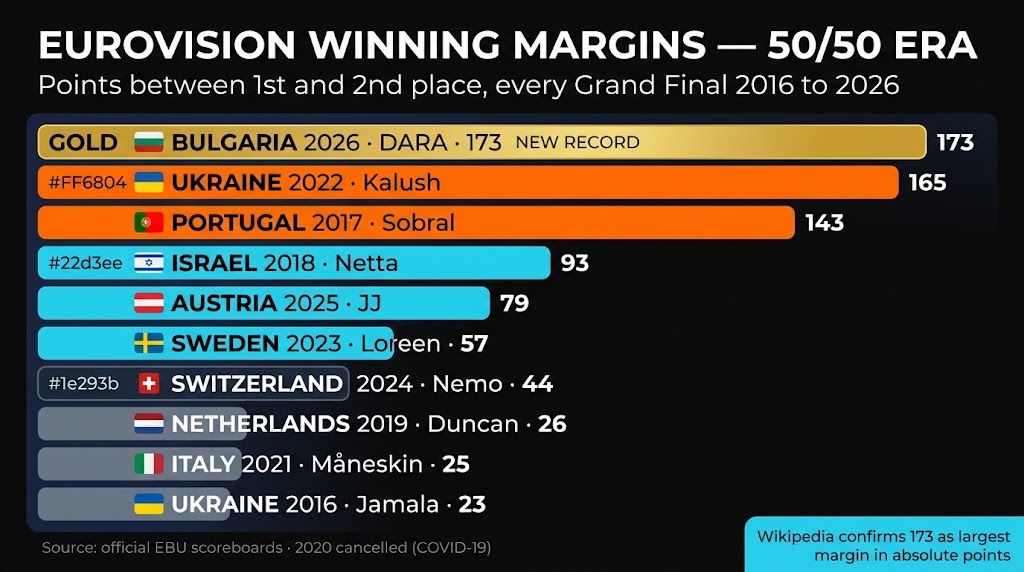
Sandra Kim was 13 years and 305 days old when she won the Eurovision Song Contest for Belgium at the Bergen Grieghallen on 3 May 1986. Singing J'aime la vie — a bright, mid-tempo French-language pop song — she collected 176 points to finish 23 clear of Switzerland's Daniela Simons in second place. To this day it remains Belgium's only Eurovision victory.
The rule that followed. Sandra Kim's age caused immediate controversy in 1986. Norway's broadcaster NRK lodged a formal protest the morning after, arguing she had been miscategorised; her age had been listed as 15 in the official EBU programme. After internal review the EBU confirmed the win stood, but introduced a minimum-age rule for participating singers: 16 years on the date of the Grand Final. That rule has applied without exception since Eurovision 1990 (one earlier minor exception in 1989). It is the reason no contestant younger than 16 has appeared in any Grand Final for the past 36 years.
The 2026 perspective. DARA — Darina Yotova, born 1996 — was 29 when she won Eurovision 2026 for Bulgaria in Vienna with Bangaranga. Her age sits in the modal cluster for modern Eurovision winners (mid-20s to early-30s) and is broadly comparable to Måneskin's Damiano David at 22, Duncan Laurence at 25, and Conchita Wurst at 25.
The youngest Grand Final non-winning artist. France's Nathalie Pâque was 11 years old when she represented France in 1989 with J'ai volé la vie (finishing 8th) — making her the youngest main artist ever to perform at a Eurovision Grand Final. Like Sandra Kim, Pâque's appearance pre-dated the modern age-limit rule. See the related /stats/youngest-main-artist page for the full youngest-artist data.
Career arc. Sandra Kim is now in her early 50s and remains a working singer in the French-language pop scene, having released albums steadily through the 1990s and 2000s. She made a guest appearance during the 2024 Eurovision interval show in Malmö. Her 1986 win is still considered, by most fan polls, among the top-20 Eurovision winners of all time.